
When engineers design a tank level monitoring system, the first question is usually about the sensor.
Should the project use radar, ultrasonic, hydrostatic, float, or another technology?
But there is another decision that can affect the entire system:
How should the measurement data travel?
In some projects, a wired connection to a PLC is the obvious answer.
In others, wireless tank level monitoring can dramatically simplify deployment.
Neither method is universally better.
The right choice depends on the distance, infrastructure, number of tanks, communication requirements, power availability, and operational goals.
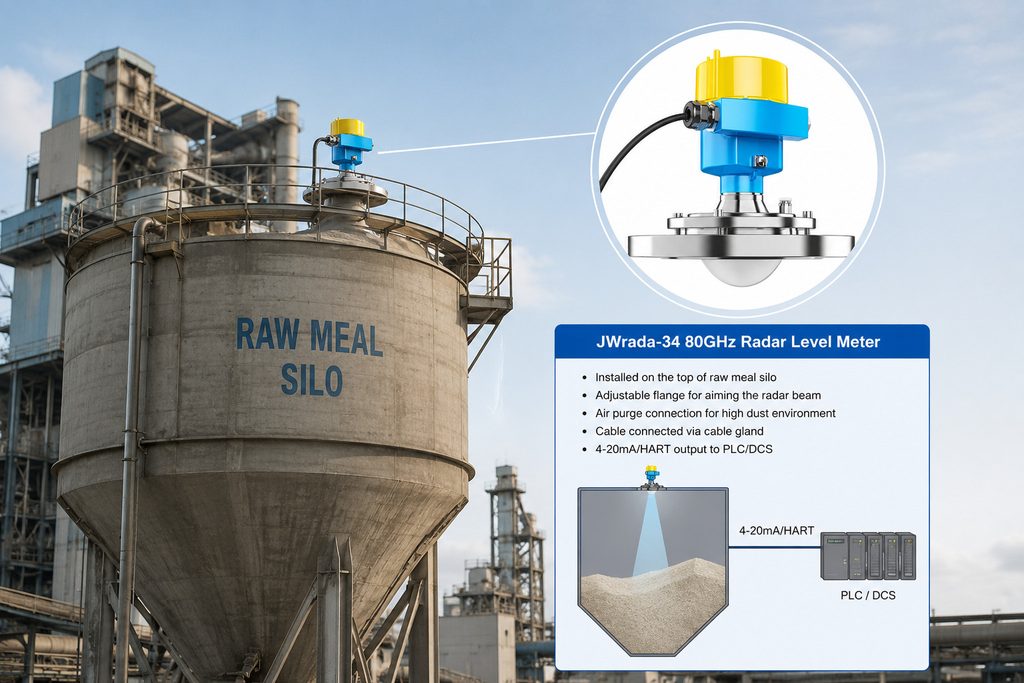
What Is Wired Tank Level Monitoring?
A wired system uses a physical communication path between the field instrument and another device.
A radar level transmitter may send data using:
- 4–20 mA
- HART
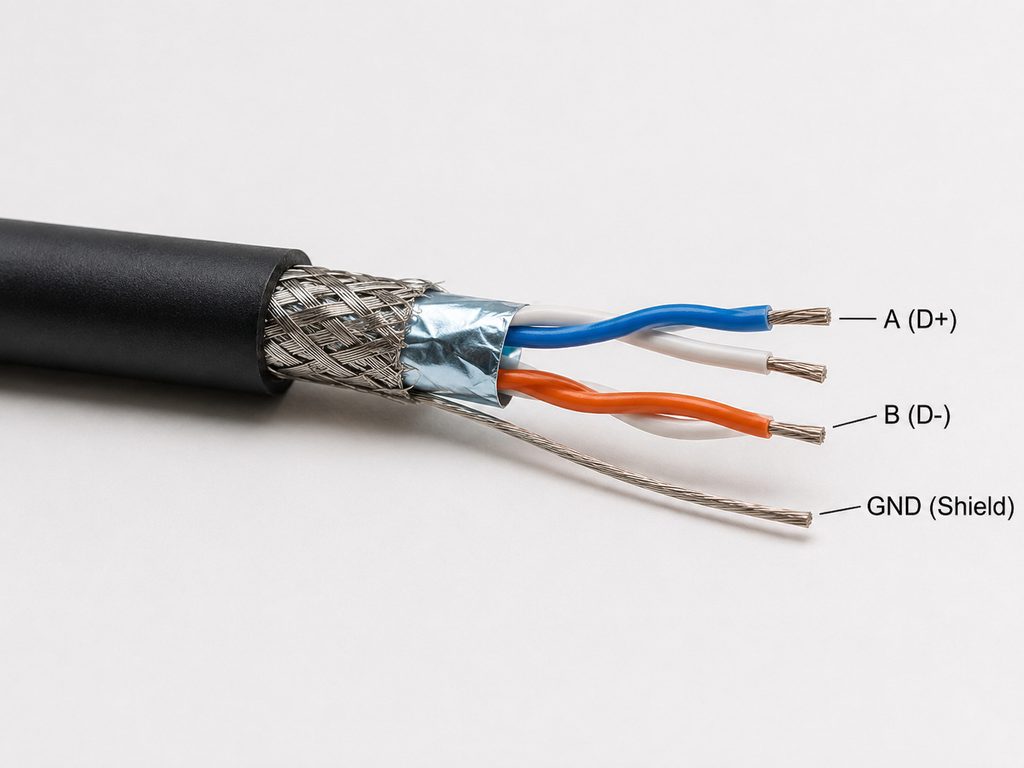
- RS485
- Modbus
- Ethernet through additional equipment
The signal may go to a PLC, DCS, local display, or industrial gateway.
Wired systems are common inside factories because electrical and automation infrastructure is already available.
What Is Wireless Tank Level Monitoring?
A wireless system transfers measurement data without a continuous physical data cable back to the monitoring center.
Communication may use:
- 4G
- NB-IoT
- LTE-M
- Wi-Fi
- LoRa or other wireless networks
The sensor may communicate directly, or several field instruments may connect to a wireless gateway.
The information can then be displayed on a cloud platform, web dashboard, or mobile application.
Installation: Where Wireless Has a Clear Advantage
Imagine a tank located several kilometers from the main control building.
A wired design may require:
- Cable
- Trenching
- Conduit
- Junction boxes
- Surge protection
- Network equipment
- Installation labor
- Ongoing cable maintenance
For a remote site, the communication infrastructure may cost more than the measuring instrument.
If reliable cellular coverage is already available, a wireless solution can simplify the communication path.
This is one reason wireless tank monitoring is becoming common in water management, agriculture, distributed storage, and remote utility installations.
Inside a compact factory, however, existing cable trays and control infrastructure may make wiring straightforward.
Reliability: Wired Does Not Automatically Mean Better
Wired communication has an important advantage: it does not depend on a public wireless network.
For critical real-time process control inside a plant, this can be valuable.
However, wired systems also have failure points.
Long field cables may be affected by:
- Physical damage
- Moisture
- Lightning
- Grounding issues
- Electromagnetic interference
- Connector problems
Wireless systems eliminate some of these cable-related risks but introduce different considerations, such as network coverage and communication availability.
The correct comparison is therefore not “reliable versus unreliable.”
It is which failure modes are easier to manage in the specific application.
Scalability
Suppose a company starts with three tanks.
A wired system may be simple.
Now imagine that the company expands to fifty tanks across fifteen locations.
Extending a common wired network across those sites may be impractical.
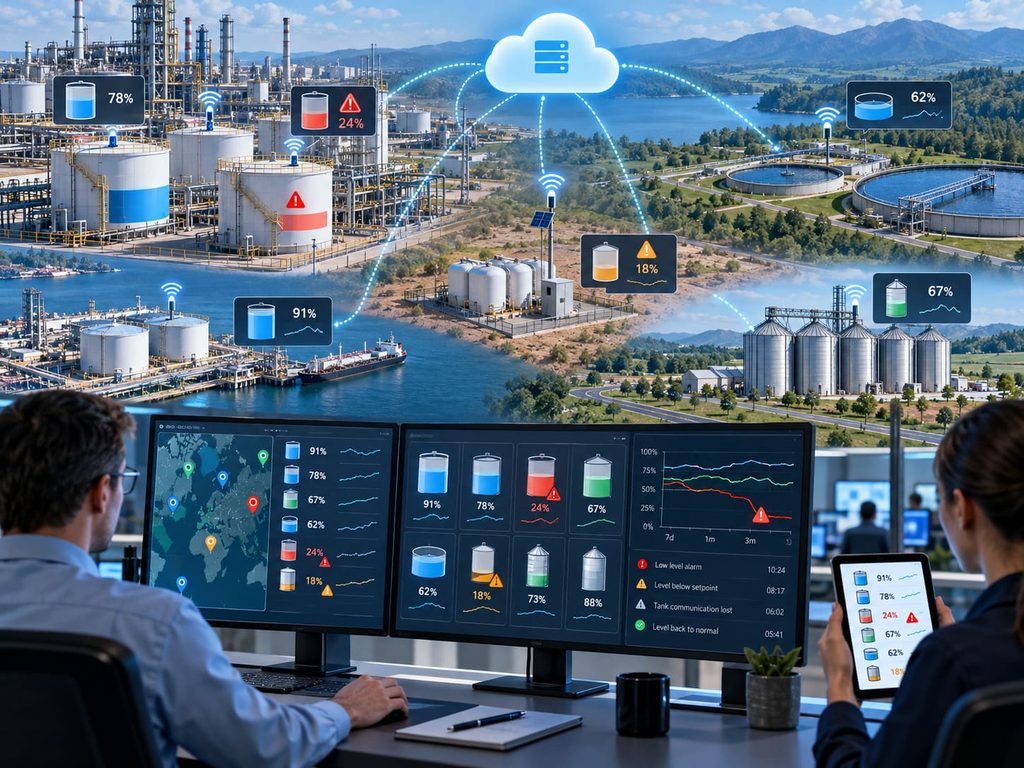
Wireless systems are often easier to scale geographically because each new site can connect independently to the remote platform.
A cloud-based architecture also makes it easier to add users and organize devices by location.
Monitoring Across Several Facilities
This is one of the strongest arguments for wireless communication.
Traditional plant automation works extremely well within one site.
But when the business wants to combine information from multiple independent facilities, additional infrastructure is needed.
A wireless cloud architecture creates a common destination for the data.
Tank A may be in one city.
Tank B may be at a customer facility.
Tank C may be at a pumping station.
If each device can communicate securely with the remote platform, all three can appear on the same dashboard.
Power Is Different from Communication
A common misunderstanding is that “wireless” means “no wires at all.”
The sensor and communication electronics still require power.
Some installations use mains electricity.
Others use batteries or solar power.
When the site has no mains supply, energy consumption becomes an important design variable.
The measurement interval, upload frequency, network technology, local climate, battery capacity, and solar panel size all affect the solution.
Wireless data can reduce communication cabling, but it does not remove the need for a properly engineered power system.
Real-Time Control vs Remote Monitoring
Another important distinction is the purpose of the data.
If a level signal is used for a fast process-control loop inside a plant, a conventional PLC-based wired architecture may be preferable.
If the goal is inventory visibility, remote alarm notification, historical trending, or periodic monitoring, wireless communication may be very effective.
A hybrid solution is also common.
For example:
Radar sensor → PLC for local control
and at the same time:
PLC or gateway → Cloud platform for remote monitoring
This allows critical local automation to remain independent while management data is available remotely.
Cost Should Be Evaluated at System Level
Comparing only the price of a wireless modem and a cable does not provide a useful economic comparison.
Consider the complete project.
A wired system may involve:
- Cable material
- Cable tray
- Trenching
- Engineering
- Installation
- Network switches
- Junction boxes
- Maintenance
A wireless system may involve:
- Cellular hardware
- SIM or data service
- Cloud service
- Antenna
- Gateway
- Network management
The lower-cost choice depends heavily on the site.
For one tank next to a PLC cabinet, wiring may be inexpensive.
For ten tanks spread across a large area, wireless communication may reduce infrastructure work significantly.
Cybersecurity and Access
Both architectures require appropriate security.
A wired system connected to an industrial network must be protected as part of the plant’s OT environment.
A cloud-connected wireless system needs secure authentication, account management, network protection, and controlled remote access.
Remote access should be designed intentionally.
Not every user should necessarily have the same permissions.
Monitoring access and control authority should also be separated where appropriate.
Maintenance
Wired systems require physical infrastructure maintenance.
Wireless systems require communication management.
The maintenance team may need to check:
- Network signal
- Device connectivity
- SIM status
- Antenna condition
- Battery condition
- Gateway status
- Cloud communication
The advantage is that many wireless problems can be identified remotely if the platform provides clear device-status information.
Where Wired Monitoring Makes Sense
Wired communication is often a strong choice when:
- The sensor is inside an existing industrial plant
- PLC or DCS infrastructure already exists
- Cable routing is simple
- The signal is used for local control
- Network independence is important
- Very frequent deterministic communication is required
Where Wireless Monitoring Makes Sense
Wireless monitoring is particularly attractive when:
- Tanks are geographically distributed
- Cable installation is difficult
- Sites are remote
- New monitoring points are added frequently
- Web or mobile access is required
- Centralized multi-site visibility is important
- Existing sensors need to be connected through a gateway
A Hybrid Architecture Is Often the Best Answer
Industrial systems rarely need to be completely wired or completely wireless.
A factory may use wired Modbus between several radar level transmitters and an Air Link gateway.
The gateway can then use a wireless network to send the aggregated data to Air Cloud.
This provides local industrial communication together with remote cloud visibility.
Another plant may use wired PLC control but send selected process values to a cloud dashboard.
The important principle is to assign each communication method to the job it performs well.
How to Decide
Ask five questions:
1. Where are the tanks?
One plant or many remote sites?
2. What infrastructure already exists?
PLC, Ethernet, power, cable tray, cellular coverage?
3. What will the data be used for?
Local control, remote monitoring, inventory, alarm management?
4. How often must data update?
Seconds, minutes, hours?
5. How large might the system become?
Three tanks today may become thirty tanks later.
Conclusion
The choice between wired and wireless tank level monitoring is not a competition between old and new technology.
Both can be excellent when applied correctly.
Wired communication remains highly effective for local automation and process control.
Wireless communication becomes especially valuable when distance, distributed assets, installation cost, or centralized cloud visibility are important.
The most effective architecture is often the one that combines them.
A reliable level sensor performs the measurement.
Industrial communication connects nearby devices.
Wireless networking bridges remote locations.
A cloud platform brings the information together.
The result is a monitoring system designed around the real operating environment rather than around a single communication technology.