1. Why Are Radar Level Meters Increasingly Dependent on RS-485?
In modern industrial sites, level measurement is no longer simply about “displaying a value.” Chemical storage tanks, wastewater treatment pools, reservoirs and sluices, bridge water level monitoring, food fermentation tanks, and condensate tanks in the energy industry all require field level data to be transmitted continuously, accurately, and reliably to PLC, DCS, SCADA, or intelligent monitoring platforms. In other words, a radar level meter must not only “measure accurately,” but also “transmit reliably, connect smoothly, and support centralized management.”
This is where RS-485 demonstrates its value. RS-485 is a widely used serial communication electrical interface in industrial automation. It is suitable for long-distance, multi-node, and interference-resistant data transmission. Unlike ordinary point-to-point signals, RS-485 allows multiple instruments to be connected to the same monitoring system through a bus structure. It is especially suitable for industrial sites with many distributed measuring points, strong electromagnetic interference, and long wiring distances.
2. What Is RS-485? Remember This First
Simply put, RS-485 is not a “software protocol,” but an “electrical interface standard.” It specifies how devices transmit data reliably through differential signals, rather than defining how the data content should be interpreted.
It can be compared to the relationship between a highway and vehicles. RS-485 is like the road rules and lane design, while protocols such as Modbus RTU are like the cargo labels and transport documents on the vehicles. With RS-485, data can be transmitted stably in industrial environments. With Modbus, a PLC or host computer can understand whether a specific register represents level, temperature, status, or alarm information.
Analog Devices describes RS-485 as a physical-layer bus design widely used in industrial and instrumentation applications. Its typical features include long-distance links, bidirectional communication over a single twisted pair, differential transmission for improved noise immunity, and the ability to connect multiple drivers and receivers on the same bus. The Modbus Organization also provides Modbus protocol specifications and Modbus serial line implementation guides for Modbus use in serial communication applications.
Therefore, when you see “RS485/Modbus” in radar level meter selection, it can be understood as follows: the instrument transmits signals through the RS-485 hardware interface and exchanges data with a PLC, RTU, data collector, or host computer through the Modbus protocol.
3. Why Is RS-485 Suitable for Industrial Sites?
Industrial sites are very different from office networks. A site may contain frequency converters, motors, pumps, agitators, solenoid valves, high-voltage equipment, high humidity, high temperature, dust, corrosion, thunderstorms, and long-distance cable laying. Once the communication system becomes unstable, the result may be data fluctuation at best, or incorrect interlocking, alarms, or control decisions at worst.
RS-485 is commonly used in level meters, flow meters, pressure transmitters, energy meters, PLC remote modules, and other devices mainly because of the following advantages.
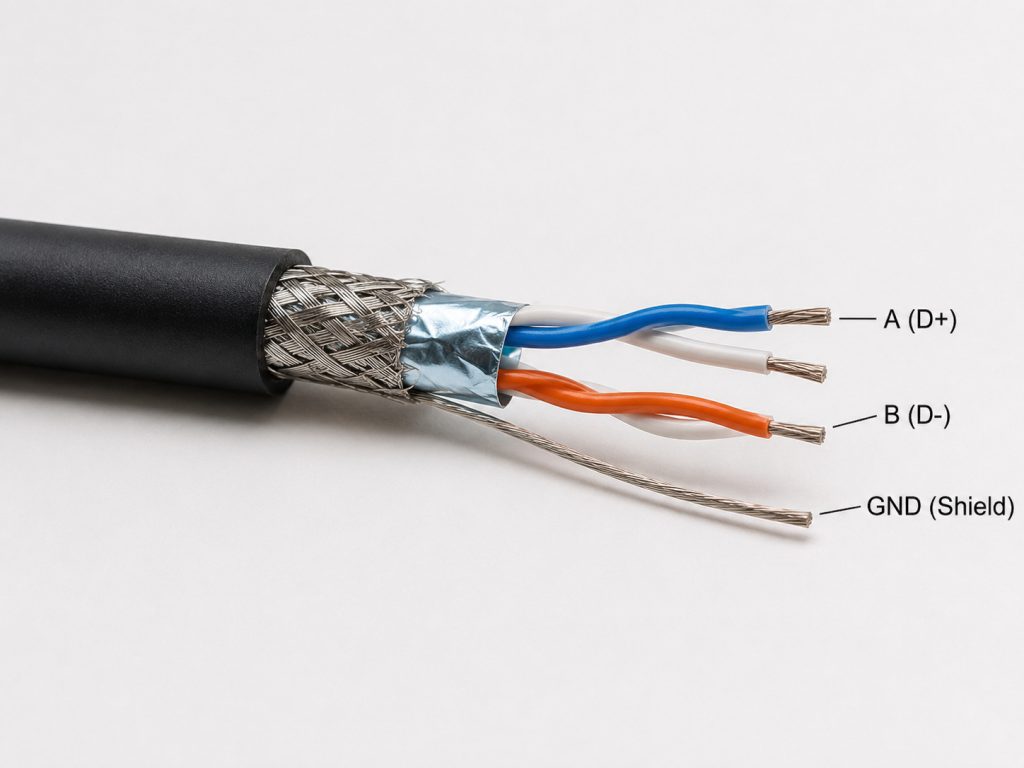
First, RS-485 uses differential transmission. It determines the signal state based on the voltage difference between two wires, A and B, rather than relying solely on the voltage of one wire relative to ground. The benefit of differential signaling is that when electromagnetic interference is coupled equally onto both wires, the receiver focuses on the difference between the two wires, thereby canceling part of the common-mode interference. Analog Devices notes that differential or balanced lines are an important reason why RS-485 can support long-distance communication, improve noise immunity, and reduce electromagnetic radiation.
Second, RS-485 is suitable for long-distance transmission. Industrial level measurement points are often widely distributed. For example, in water management projects, pumping stations, sluices, open channels, and wastewater pools may be far apart; in chemical tank farms, the distance between the storage tank area and the control room may be dozens or even hundreds of meters. Under reasonable baud rates, standardized wiring, and correct termination matching, RS-485 can meet the needs of long-distance data transmission. Analog Devices documentation mentions that RS-485 can support long-distance links, and under low-speed conditions, it can be used for communication distances of around 1,200 meters.
Third, RS-485 supports multi-node bus communication. A traditional 4–20mA signal usually requires one instrument to correspond to one analog input channel. In contrast, an RS-485 bus allows multiple devices to be connected to one communication line, with different instruments identified by device addresses. For projects with many level measuring points, this can reduce cable usage, lower wiring complexity, and make centralized data acquisition and management easier.
Fourth, RS-485 works maturely with Modbus RTU. Modbus RTU is widely used in industrial automation, and PLCs, RTUs, data collectors, configuration software, and edge gateways generally support it. For radar level meters, RS485/Modbus output allows the system not only to read level values, but also to read echo status, fault status, range parameters, alarm information, and other data according to the register table provided by the manufacturer. This enables more refined operation and maintenance management.
4. What Is the Difference Between RS-485 and Modbus?
Many users confuse RS-485 with Modbus, and some even refer to it simply as the “485 protocol.” In engineering conversation, this is usually understandable, but technically it is not precise.
RS-485 answers the question of “how signals are transmitted.” It belongs to the physical layer and focuses on voltage, current, differential signals, drive capability, receiving thresholds, bus topology, terminal matching, and related electrical characteristics.
Modbus answers the question of “how data is read.” It defines how the master initiates requests, how the slave responds, how device addresses are set, how function codes read and write registers, and how CRC checks determine whether a message is valid.
In radar level meter applications, the common structure is as follows: the radar level meter acts as a Modbus slave, while the PLC, RTU, gateway, or host computer acts as the master. The master polls the address of a specific radar level meter and reads the level value, distance value, status word, or alarm information from the corresponding registers. After receiving a correct request, the instrument returns data. The master then uses the data for display, recording, alarms, interlocking, or remote upload.
This is also why devices that both claim to support RS-485 may not communicate directly if their protocol, baud rate, parity bit, data bits, stop bits, or register addresses are inconsistent. RS-485 only means the “road” is available; Modbus parameters and register mapping determine whether the devices can actually “understand each other.”
5. Why Do Radar Level Meters Need Digital Communication?
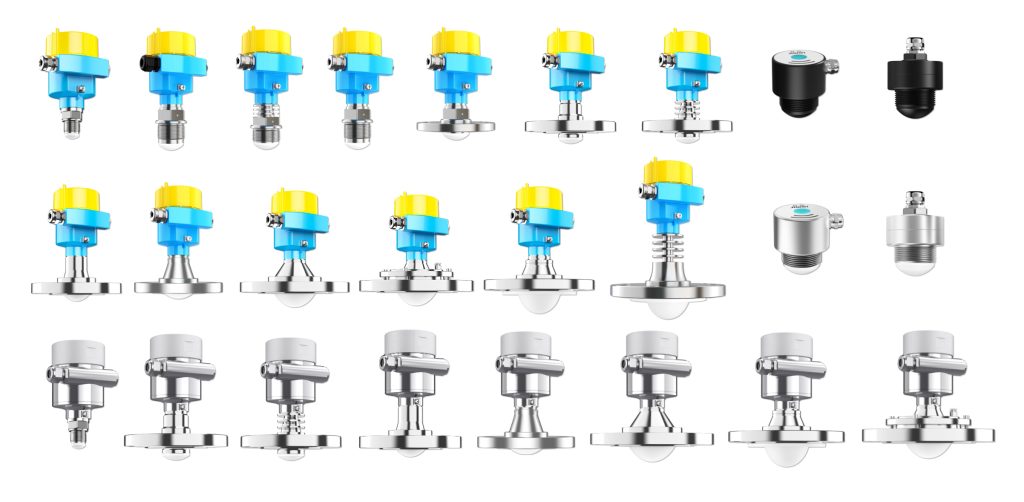
The core task of a radar level meter is to measure the distance from the antenna to the material surface using radar waves, and then convert that distance into the level height. The JWrada series 80GHz radar level meters use FMCW frequency-modulated continuous wave technology. They transmit high-frequency electromagnetic waves and receive echoes reflected from the material surface. Through mixing, FFT, and other signal processing methods, they calculate the distance between the radar level meter antenna and the material surface, thereby determining the level height.
If the only requirement is to send a level value to the control room, a 4–20mA analog signal can already meet many traditional application needs. However, as intelligent, digital, and remote operation and maintenance become increasingly common, users want more than just a “level percentage.” They also want more status information, such as:
Whether the current echo is stable and whether false echoes exist;
Whether conditions such as empty tank, full tank, over-range, or signal loss have occurred;
Whether the current range, blind zone, medium parameters, damping time, and other settings are correct;
Whether the device requires maintenance or has communication faults or power supply abnormalities;
Whether multiple measuring points can be collected, stored, and analyzed in a unified manner.
Such information is difficult to fully express using only analog transmission. RS485/Modbus can transmit more digital information through registers, allowing radar level meters to evolve from single-function measuring instruments into field nodes that can be connected to industrial IoT and intelligent monitoring systems.
6. Typical Applications of RS-485 in Radar Level Meters
1. Hydrology, Water Management, and Urban Flood Monitoring
In rivers, lakes, open channels, reservoirs, sluices, pumping stations, and wastewater treatment plants, water level points are often distributed across wide areas. Many measuring points are outdoors, under bridges, at well openings, or in remote locations. An RS-485 bus can connect radar water level meters to an RTU or data acquisition gateway, and the data can then be transmitted to a monitoring platform through 4G, Ethernet, optical fiber, or a private network.
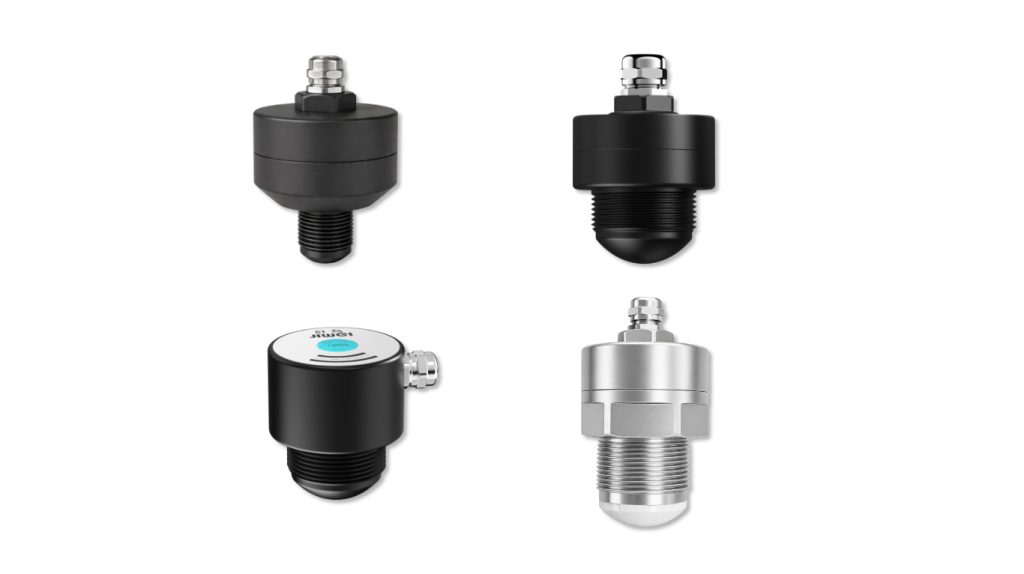
The JWrada®-20 radar level meter is especially suitable for water level measurement in hydrology and water management, simple liquid level measurement conditions, and short-range material level measurement. Its applications include water level monitoring in rivers, lakes, and open channels; liquid level monitoring in wastewater treatment plants and wastewater treatment systems; water level monitoring in reservoirs, sluices, and pumping stations; and urban flood monitoring and drainage system early warning.
2. Centralized Monitoring of Storage Tank Levels
Chemical, food, pharmaceutical, and energy industries often use multiple storage tanks, mixing tanks, fermentation tanks, lubricating oil tanks, or condensate tanks. If every radar level meter is connected to a PLC through a separate analog signal, the number of channels increases, wiring costs rise, and later expansion becomes less flexible. With RS485/Modbus, multiple instruments can be connected through a bus structure, and the master station can poll data according to address. This makes it suitable for centralized monitoring and data archiving.
According to Jiwei’s official JWrada®-31 radar level meter page, this product uses 80GHz FMCW technology, has a maximum measuring range of 10 meters, and is suitable for continuous non-contact liquid measurement in complex vessels in industries such as pharmaceuticals, food, energy, and water management. It also provides output options such as RS485/Modbus.
3. Petrochemical and Complex Industrial Level Measurement
Petrochemical, mining, and coal chemical applications often involve high temperature, high pressure, steam, dust, agitation, electromagnetic interference, and explosion-proof requirements. The radar level meter is responsible for stable measurement, while RS-485 is responsible for reliably transmitting data to the control system. Jiwei’s JWrada®-32 page states that this product uses 80GHz millimeter-wave radar technology, has a maximum range of 60 meters, provides strong anti-interference capability, can handle complex environments with agitation, steam, dust, and electromagnetic interference, and includes explosion-proof and dust explosion-proof certification information.
In these scenarios, the advantage of RS485/Modbus lies in its ability to centrally read the level, material level, and diagnostic status of multiple instruments. It also helps connect data to DCS, SCADA, or safety monitoring systems, supporting production scheduling, inventory management, overflow warning, and equipment maintenance.
4. Bridges, Seawater, and Smart Infrastructure Monitoring
In cross-sea bridges, ports, coastal monitoring, and tide level monitoring, instruments must withstand salt spray, high humidity, strong wind, vibration, and complex electromagnetic environments. A Jiwei case study shows that JWrada® MINI radar level meters were deployed in batches for a seawater monitoring project on the Hong Kong-Zhuhai-Macao Bridge. Multiple radar level meters were installed to monitor changes in the water level beneath the bridge in real time around the clock. The related content also mentions that the devices can be connected to PLC, SCADA, DCS, and smart transportation management platforms for remote data collection and centralized management.
Such projects usually require long-term unattended operation. RS-485 communication, together with gateways or data acquisition terminals, can send water level data to a platform, forming historical curves, alarm records, and trend analyses. This provides data support for disaster prevention, traffic operation, and maintenance decision-making.
7. RS-485 Wiring and Usage Tips for Radar Level Meters
Although RS-485 is mature and reliable, improper field installation can still cause unstable communication, data loss, intermittent disconnection, read timeout, and other problems. Therefore, the following points should be considered in radar level meter applications.
First, shielded twisted-pair cable should be used whenever possible. Twisted pairs help reduce external interference, while shielding improves electromagnetic interference resistance. In areas with frequency converters, motors, and dense power cables, communication cables should be routed separately from power cables as much as possible to avoid long-distance parallel runs.
Second, the preferred bus topology is daisy-chain wiring. RS-485 is better suited to a linear bus structure and is not recommended for random star-shaped branches. Excessively long branch lines can cause signal reflection and unstable communication. When multiple radar level meters are networked on site, they should be connected in bus order, and branch lengths should be controlled.
Third, pay attention to terminal resistors. For long-distance or relatively high-speed communication, matching termination is usually required at both ends of the bus to reduce signal reflection. Analog Devices documentation notes that reliable RS-485/RS-422 communication requires correct termination to minimize transmission line reflections.
Fourth, device addresses must not be duplicated. On a Modbus bus, each radar level meter should have a unique address. If two devices use the same address, conflicts may occur when the master polls the bus, causing abnormal or failed data returns.
Fifth, communication parameters must be consistent. Baud rate, data bits, stop bits, and parity must match the settings of the PLC or data collector. Common parameters such as 9600 bps, 8N1, or even parity should be configured according to the manufacturer’s manual and project requirements.
Sixth, pay attention to power supply and communication isolation. In scenarios with strong interference, long distances, or large ground potential differences across regions, isolated RS-485 modules, repeaters, surge protectors, or signal isolators may be considered. Analog Devices application notes on isolated RS-485 repeaters indicate that long-distance RS-485 systems may be affected by signal attenuation and ground potential differences, while isolation and repeaters can help improve fieldbus reliability.
8. How to Choose Between RS-485 and 4–20mA/HART?
In radar level meter selection, 4–20mA/HART and RS485/Modbus are not necessarily mutually exclusive. They are suitable for different project requirements.
If the project only needs to connect the level value of a single instrument to a PLC analog input module, and the number of measuring points is small, 4–20mA is simple, intuitive, and highly compatible. HART can also superimpose digital communication on the analog signal for parameter setting and diagnostics.
If the project has many measuring points, long distances, a need to centrally read data from multiple instruments, or a desire to obtain more digital status information, RS485/Modbus has greater advantages. It is suitable for water management, hydrology, tank farms, environmental monitoring, smart parks, remote unattended stations, and similar applications.
If the project needs analog signals for interlocking control while also requiring a digital bus for platform integration, an output method that supports both 4–20mA and RS485/Modbus can be selected. Jiwei’s JWrada®-31 and JWrada®-32 official parameters both list six-wire 4–20mA + RS485/Modbus options. This type of configuration is suitable for projects that need to support both traditional control systems and digital operation and maintenance platforms.
9. The Value of RS-485 in Jiwei Radar Level Meters
According to Jiwei Automation’s official website, Shenzhen Jiwei Automations Ltd. focuses on the R&D, production, and sales of level measurement instruments. Its products include radar level meters, radar level transmitters, magnetic level gauges, ultrasonic level meters, float level meters, and various level switches. These products are used in industries such as chemical, power, environmental protection, food, pharmaceutical, and building materials.
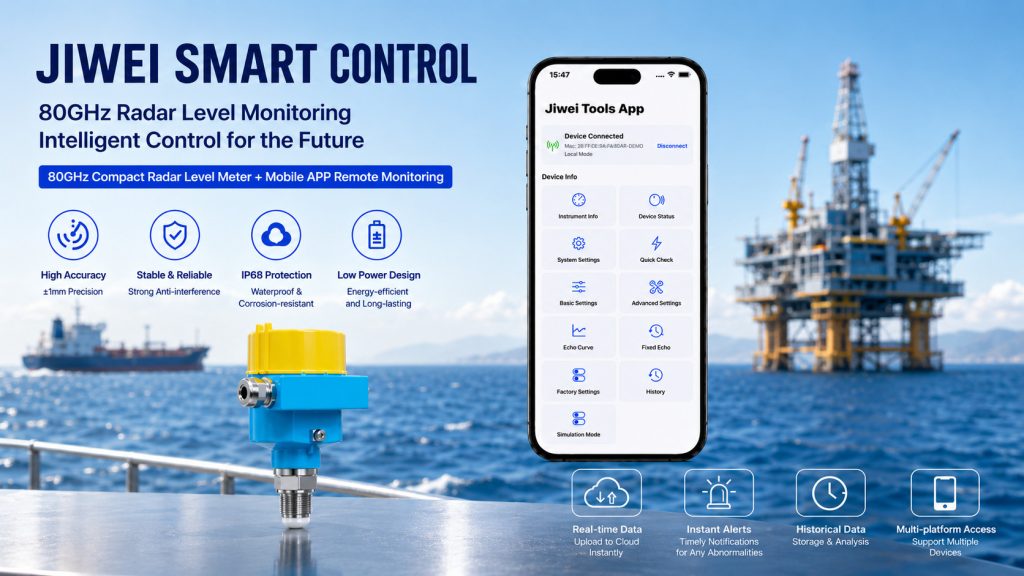
Based on the product information on the official website, the core features of Jiwei’s JWrada® series radar level meters can be summarized as 80GHz high-frequency radar, FMCW frequency-modulated continuous wave technology, non-contact measurement, intelligent echo processing, Bluetooth wireless debugging, remote monitoring capability, and multiple communication output options for different working conditions. For users, the significance of RS485/Modbus is not merely “one more communication interface,” but the ability to connect radar level meters more easily to automation systems and digital platforms.
For example, in hydrology and water management projects, RS-485 can connect multiple water level points to an RTU for remote water level monitoring. In tank farms, RS-485 helps multiple level meters connect centrally to PLC or SCADA systems, reducing wiring and channel costs. In smart bridge or seawater monitoring projects, RS-485 can serve as part of the field data acquisition link to upload radar water level data to the monitoring center. In chemical and energy industries, RS485/Modbus can also work with alarm, trend, diagnostic, and other functions to support more refined process management.
10. Frequently Asked Questions
1. Is RS-485 the same as Modbus?
No. RS-485 is an electrical interface, while Modbus is a communication protocol. In industrial sites, the two are often used together, which is why common descriptions include RS485/Modbus or RS-485 Modbus RTU.
2. If a radar level meter already has 4–20mA output, is RS-485 still necessary?
It depends on the project requirements. 4–20mA is convenient for single-point level control. RS-485 is more advantageous for multi-point centralized acquisition, remote monitoring, diagnostic data reading, and reduced wiring costs.
3. How many radar level meters can be connected to one RS-485 bus?
The actual number depends on transceiver load, cable length, baud rate, power supply, termination matching, and site interference. In engineering practice, the instrument manual, PLC or data collector capability, and a reasonable design margin should all be considered. Analog Devices documentation mentions the unit load concept in the RS-485 specification. Under standard unit load conditions, 32 unit loads can be supported, while low-load receivers can support more nodes.
4. What are the common causes of unstable RS-485 communication?
Common causes include reversed A/B wiring, address conflicts, inconsistent baud rate or parity settings, improper termination resistor configuration, overly long branch lines, improper shielding and grounding, strong electrical interference, excessive cable length, and unstable device power supply.
5. What systems can a radar level meter connect to through RS-485?
Common systems include PLC, RTU, DCS, SCADA, data collectors, edge gateways, environmental monitoring platforms, water management platforms, and smart transportation platforms. In Jiwei’s Hong Kong-Zhuhai-Macao Bridge seawater monitoring case, the devices are also described as being connectable to PLC, SCADA, DCS, and smart transportation management platforms for remote data collection and centralized management.
Conclusion: RS-485 Helps Radar Level Meters Evolve from Measuring Instruments into Data Nodes
The value of RS-485 does not lie in conceptual complexity, but in its reliability, maturity, cost-effectiveness, and suitability for industrial sites. For radar level meters, RS485/Modbus can transmit not only level data, but also help users achieve multi-point networking, remote acquisition, centralized monitoring, status diagnosis, and intelligent operation and maintenance.
As industries such as water management, environmental protection, chemicals, energy, and smart transportation continue to demand more digital monitoring, radar level meters are evolving from single-purpose measuring devices into key nodes in industrial data acquisition systems. Choosing radar level meters with stable measurement performance and mature communication interfaces not only improves field measurement reliability, but also lays the foundation for future automation, informatization, and intelligent management.
For liquid level measurement projects requiring non-contact measurement, high accuracy, low maintenance, and easy system integration, Jiwei’s JWrada® series radar level meters with RS485/Modbus support are a solution worth serious consideration.