1. Application Background: The Challenge of Monitoring R134a Storage Tanks
R134a refrigerant is used in a variety of refrigeration, air-conditioning, and industrial cooling systems. Although newer refrigerants are increasingly adopted in some markets, many existing industrial facilities continue to operate R134a equipment and require reliable monitoring solutions.
One important application is R134a refrigerant tank level measurement.
In refrigeration equipment manufacturing plants, maintenance facilities, and centralized refrigerant supply systems, liquid R134a may be stored in pressure-rated vessels before being transferred to downstream equipment.
Accurate level information helps operators monitor inventory, plan replenishment, supervise refrigerant transfer, and identify abnormal operating conditions.
However, R134a behaves differently from water and many conventional industrial liquids.
Its volatility, pressure-dependent liquid-vapor equilibrium, and relatively low dielectric properties can create challenges for level measurement instruments.
A radar level transmitter that works reliably in a water tank may not automatically deliver the same performance in an R134a storage vessel.
This engineering application case examines the measurement challenges associated with R134a storage and explains how an 80GHz radar level transmitter can be evaluated as a continuous monitoring solution.
2. Typical Industrial Application
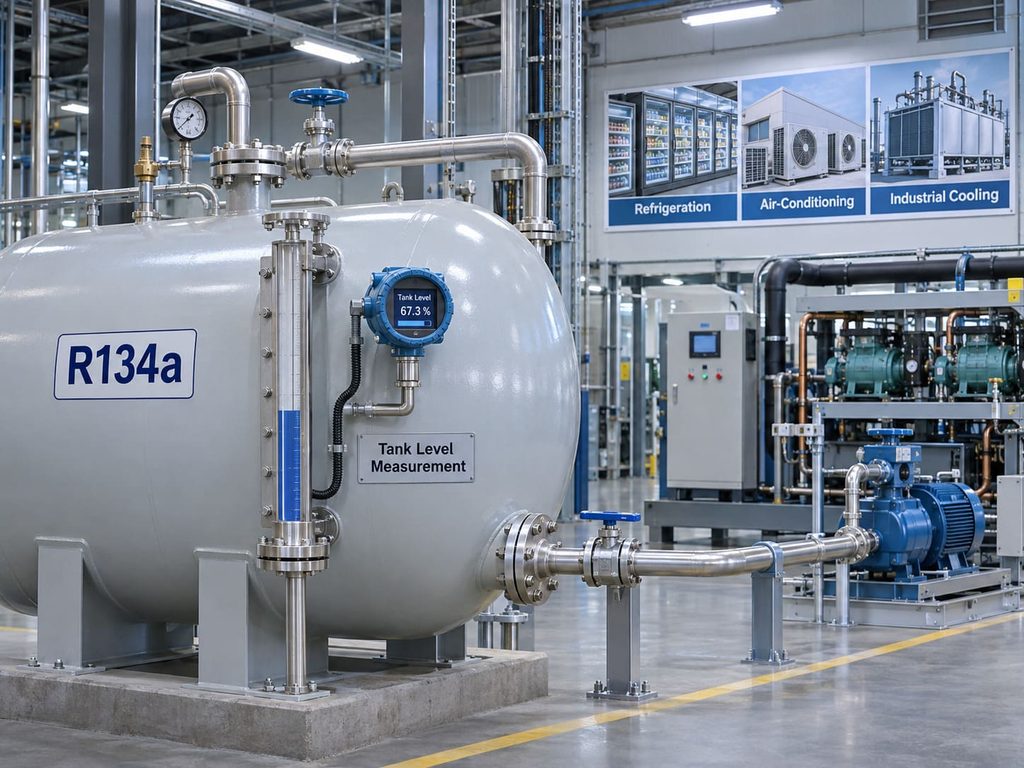
Consider a refrigeration equipment manufacturer operating a centralized R134a storage system.
The facility uses a horizontal pressure vessel to store liquid refrigerant before transferring it to production filling stations.
During normal operation, the storage vessel contains both liquid R134a and refrigerant vapor.
The liquid level decreases as refrigerant is withdrawn and increases during replenishment.
The facility needs continuous liquid-level information to support production scheduling and inventory supervision.
The main measurement requirements include:
- Continuous monitoring of liquid R134a
- Stable readings under changing operating conditions
- Compatibility with pressurized refrigerant
- Remote monitoring through the plant control system
- Reliable low-level and high-level indication
- Minimal maintenance intervention
- Safe installation on an existing pressure vessel
The exact operating temperature, pressure, vessel dimensions, and process connections must be established before selecting the level transmitter.
3. Measurement Challenge One: Low Dielectric Constant
One of the most significant technical challenges in R134a level measurement is the relatively weak electromagnetic reflection that may occur at the liquid surface.
Radar level transmitters emit electromagnetic waves toward the measured medium.
When these waves reach the boundary between the vapor space and the liquid, part of the energy is reflected toward the antenna.
The instrument analyzes the returned signal to calculate the distance to the liquid surface.
The strength of the reflection depends partly on the dielectric properties of the two media.
Water generally produces a strong radar reflection because of its high dielectric constant.
R134a has different dielectric behavior, and its properties vary with temperature, pressure, and frequency.
Under some operating conditions, the liquid-surface reflection may be comparatively weak.
This can create several problems.
First, the instrument may have difficulty distinguishing the liquid surface from other reflections.
Second, radar energy may penetrate the liquid and reflect from the metal tank bottom.
Third, the transmitter may temporarily track an incorrect echo, causing an unstable or inaccurate level indication.
These problems are particularly important when the liquid level is low.
Why Does the Tank Bottom Matter?
In a metal storage vessel, the bottom surface can generate a strong radar reflection.
When the refrigerant produces a weak surface echo, the bottom reflection may compete with the actual liquid-level signal.
If the transmitter selects the wrong echo, the displayed level may suddenly decrease or remain near the empty-tank value even when liquid is present.
Therefore, radar echo recognition is a critical part of R134a measurement.
4. Measurement Challenge Two: Temperature and Pressure Changes
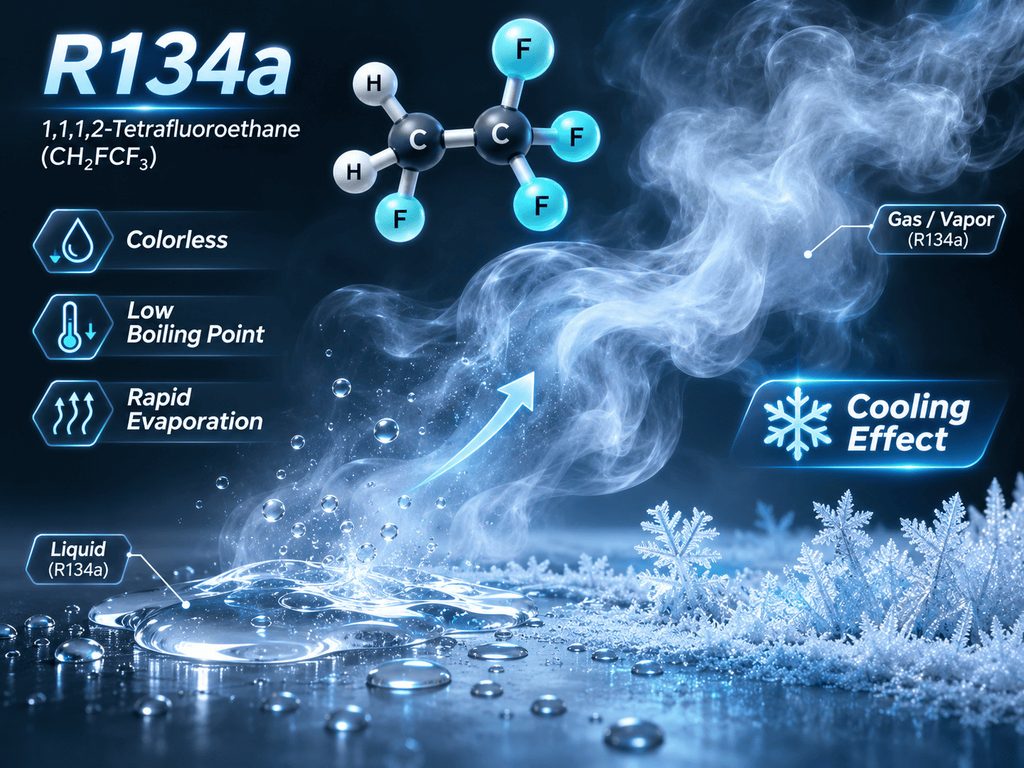
R134a is a volatile refrigerant that is commonly stored as a pressurized liquid.
Its saturation pressure and liquid density depend strongly on temperature.
When the storage vessel temperature changes, the internal pressure may also change.
These variations influence the behavior of the refrigerant and can affect some measurement technologies.
For example, differential pressure level transmitters calculate liquid level from hydrostatic pressure.
The calculation depends on liquid density.
If the density changes significantly without appropriate compensation, the calculated level may contain errors.
Radar level transmitters use a different principle.
They measure the distance between the antenna and the liquid surface.
This makes the basic level measurement less dependent on liquid density.
However, radar is not completely unaffected by process conditions.
The instrument must still be suitable for the operating pressure and temperature, and the effects of vapor conditions, condensation, and installation geometry must be evaluated.
5. Measurement Challenge Three: Pressurized Vessel Installation
R134a storage tanks are closed pressure vessels.
Installing a level instrument requires careful attention to mechanical compatibility.
The transmitter process connection becomes part of the pressure boundary.
Therefore, the selected instrument must be rated for the maximum expected pressure and relevant design conditions.
The process seal, antenna materials, gasket, and flange or threaded connection must be compatible with the refrigerant.
This is especially important because refrigerant leakage can lead to inventory loss, environmental emissions, and operational problems.
Engineers should confirm:
- Maximum allowable process pressure
- Minimum and maximum process temperature
- Process connection dimensions
- Wetted material compatibility
- Sealing arrangement
- Applicable pressure equipment requirements
A transmitter should not be selected solely because its nominal measuring range exceeds the tank height.
6. Proposed Solution: JIWEI 80GHz Radar Level Measurement
For suitable R134a applications, a high-frequency radar level transmitter can be considered.
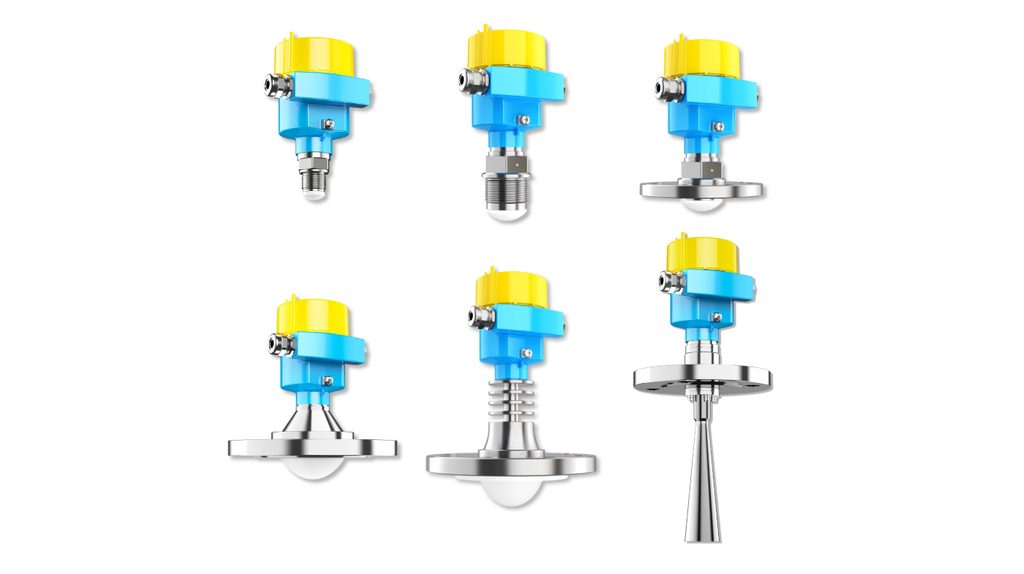
The JIWEI JWrada-35 radar level meter is an example of an industrial 80GHz radar instrument designed for demanding liquid-level measurement environments.
Its high-frequency measurement principle and narrow beam characteristics can be advantageous in vessels with limited installation space.
The non-contact measurement principle also avoids placing a moving mechanical float inside the refrigerant.
Potential advantages include:
Continuous Non-Contact Measurement
The transmitter measures the liquid surface without requiring a mechanical sensing element to move through the refrigerant.
Reduced Dependence on Liquid Density
Radar measures distance rather than calculating liquid level from hydrostatic pressure.
Narrow Beam Characteristics
A narrow radar beam can help reduce unwanted reflections from nearby structures.
Industrial Communication
Depending on the instrument configuration, level information can be transmitted to a PLC, DCS, or monitoring system.
Echo Analysis
Radar echo information can help engineers distinguish the liquid-surface reflection from interference signals.
However, these advantages do not eliminate the need for application testing.
The actual R134a dielectric properties and radar echo strength must be evaluated before confirming suitability.
7. Installation Design
Correct installation is essential for stable measurement.
For a horizontal R134a storage tank, the radar transmitter may be installed vertically through a suitable top connection.
The selected mounting position should provide a clear view of the liquid surface.
Installing the transmitter directly above an inlet pipe should be avoided when possible.
Liquid entering the vessel can disturb the surface and create temporary measurement fluctuations.
Internal piping, support structures, and other metal components should also be considered.
The nozzle diameter and length must be compatible with the selected antenna.
Long or narrow metal nozzles can create unwanted reflections.
For existing tanks, any modification to the pressure boundary must be reviewed according to applicable engineering and safety requirements.
8. Commissioning and Echo Verification
After installation, the instrument must be configured according to the actual vessel geometry.
The empty reference distance and full-level reference point should be established.
The transmitter should then be checked under different liquid-level conditions.
Particular attention should be given to low-level measurement.
At low liquid levels, the tank-bottom echo may become more significant.
Engineers should inspect the radar echo profile and confirm that the transmitter tracks the actual liquid surface.
If fixed false echoes are present, suitable interference suppression settings may be applied.
However, false-echo suppression should not remove genuine liquid-level signals.
The measurement should also be compared with an independent reference method.
Verification should cover filling, withdrawal, and stable storage conditions whenever practical.
9. From Level Measurement to Refrigerant Inventory
A radar transmitter measures liquid height, not refrigerant mass.
This distinction is important for industrial R134a storage.
For a horizontal cylindrical tank, liquid volume does not increase linearly with liquid height.
A suitable tank calibration table or geometric conversion must therefore be used.
Once liquid volume is determined, the liquid mass can be estimated using appropriate density information.
For applications requiring accurate total inventory, vapor mass may also need to be considered.
This means that a reliable refrigerant inventory system may combine:
- Radar liquid-level measurement
- Tank geometry information
- Temperature measurement
- Pressure measurement
- Refrigerant property data
Together, these parameters can support more useful inventory monitoring than level indication alone.
10. Expected Application Benefits
When properly selected and commissioned, radar level measurement can support several operational improvements.
Inventory visibility: Operators can monitor refrigerant storage levels continuously.
Production planning: Low-level trends can help schedule replenishment.
Reduced density sensitivity: The basic level measurement is less dependent on liquid density than hydrostatic methods.
Maintenance convenience: Non-contact measurement avoids moving sensing mechanisms inside the liquid.
Digital monitoring: Level information can be integrated into the facility’s automation system.
Actual performance must be verified under the site’s operating conditions.
11. Frequently Asked Questions
Can an 80GHz radar level transmitter measure R134a?
It may be suitable for certain R134a applications. The actual dielectric properties, tank geometry, and transmitter performance must be evaluated.
Does R134a pressure affect radar measurement?
The transmitter must be mechanically rated for the process pressure. Vapor conditions and other process effects should also be considered.
Can radar measure refrigerant weight directly?
No. Radar measures liquid level. Converting level into mass requires additional tank geometry and density information.
Why does a radar transmitter sometimes detect the tank bottom?
Weak liquid-surface reflections may allow radar energy to reach the metal tank bottom, producing a competing echo.
Conclusion
R134a tank level measurement requires careful consideration of low dielectric properties, pressure conditions, tank geometry, and radar echo behavior.
An 80GHz radar level transmitter may provide an effective continuous monitoring solution when the application is properly evaluated.
The most important steps are selecting a mechanically compatible instrument, confirming the liquid-surface echo, choosing the correct installation position, and validating performance during commissioning.
Looking for an R134a refrigerant level measurement solution?
JIWEI provides industrial radar level measurement instruments and technical selection support.
Contact our engineering team with your refrigerant type, tank dimensions, operating pressure, temperature range, and measurement requirements.
Website: https://www.jiweilevel.com/
Email: info@jiweilevel.com