When an existing VEGASWING X needs to be replaced, the most important question is not whether another level switch looks identical.
The real question is whether the replacement can perform the same point-level detection function under the actual process conditions.
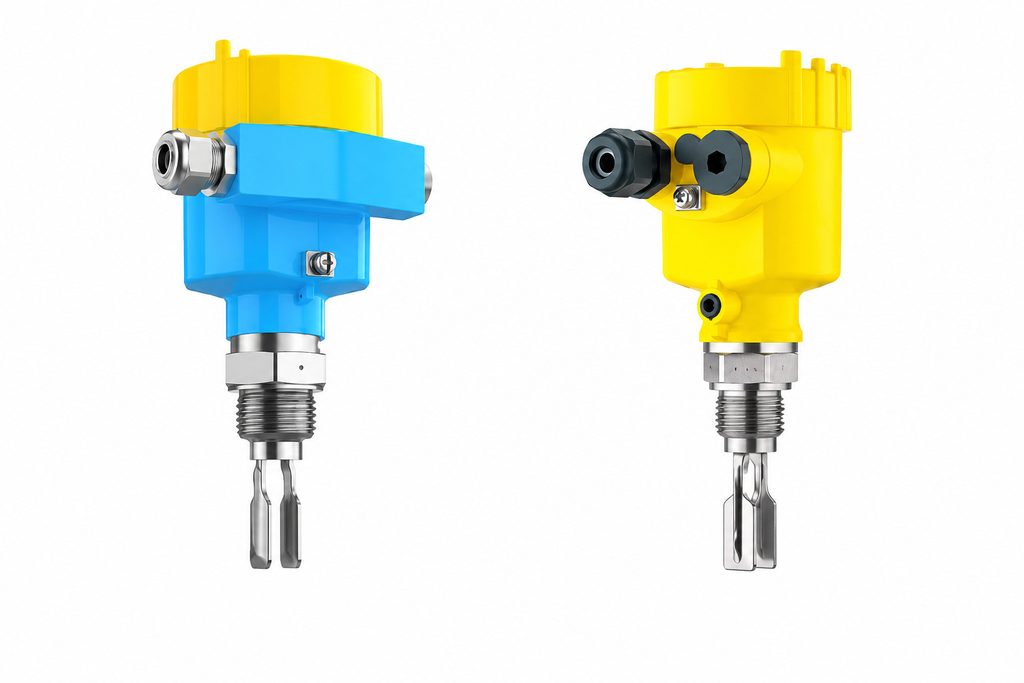
For many conventional liquid applications, the Jiwei Ring-11 tuning fork level switch is a practical alternative to VEGASWING X.
Both instruments use the vibrating tuning fork principle to detect the presence or absence of liquid. Both can be applied to high-level alarms, low-level detection, overfill protection, pump protection, dry-run protection, and liquid detection in pipelines.
Ring-11 also provides a compact 40 mm tuning fork, liquid detection down to approximately 0.5 g/cm³, viscosity capability up to approximately 10,000 mPa·s, and multiple electrical output options.
This makes Ring-11 particularly suitable for VEGASWING X replacement projects where the requirement is conventional and reliable point-level switching rather than advanced HART-based measurement functions.
However, a successful replacement should always be based on the process conditions, electrical interface, installation geometry, and safety requirements—not simply the product name.
Why Can Ring-11 Be Used as a VEGASWING X Replacement?
The strongest reason is that the two products are based on the same fundamental measurement principle.
A tuning fork level switch contains a vibrating sensing element driven at its resonant frequency. When liquid covers the fork, the vibration characteristics change. The electronics detect this change and convert it into a switching signal.
This simple principle is widely used for applications such as:
- High-level alarm
- High-high overfill protection
- Low-level alarm
- Pump dry-run protection
- Pump control
- Liquid presence detection
- Pipeline liquid detection
Therefore, when VEGASWING X is being used primarily as a point-level switch, Ring-11 can perform the same fundamental measurement task in many applications.
The next step is to confirm whether the actual operating conditions fall within the Ring-11 specification.
1. Compact 40 mm Fork for Tanks, Vessels and Pipelines
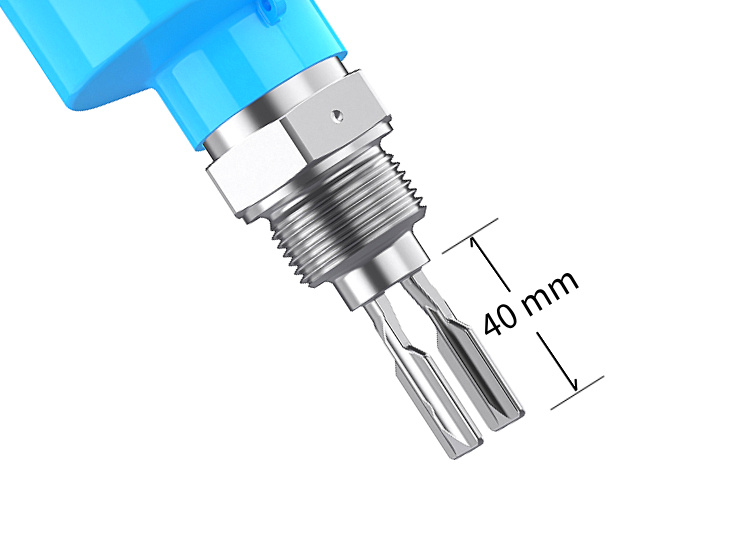
One practical advantage of Ring-11 is its compact 40 mm tuning fork.
A short sensing element is particularly useful when installation space is limited, including small tanks, process vessels, pipelines, skids, narrow chambers, and short process connections.
It can also be advantageous when replacing an existing tuning fork switch mounted through a side nozzle.
However, fork length alone does not determine mechanical compatibility.
Before replacing VEGASWING X with Ring-11, engineers should check the process connection, nozzle length, insertion position, available clearance, and actual switching elevation.
The active sensing area should extend into the process rather than remain recessed inside a long nozzle where liquid or deposits can become trapped.
2. Suitable for a Wide Range of Industrial Liquids
Liquid density is one of the most important parameters when selecting a tuning fork level switch.
Ring-11 can detect liquids with densities down to approximately 0.5 g/cm³. This allows it to cover a broad range of water-based liquids, chemicals, solvents, oils, process liquids, and other industrial fluids.
Its specified viscosity capability extends to approximately 10,000 mPa·s, making it suitable for many relatively viscous liquids as well.
Typical applications can include:
- Water and wastewater
- Oils and fuels
- Chemical liquids
- Solvents
- Syrups and viscous products
- Detergents
- Acids and alkaline liquids
- Industrial process fluids
- Liquefied gases within the applicable density range
For a VEGASWING X replacement, however, the actual minimum density should always be checked.
If the existing application requires reliable detection below approximately 0.5 g/cm³, Ring-11 should not be treated as an automatic replacement without additional engineering review.
3. Multiple Outputs Make Control-System Integration Easier
Mechanical compatibility is only half of a successful replacement.
The new level switch must also communicate correctly with the existing PLC, DCS, safety barrier, relay, or alarm circuit.
Ring-11 is available with several commonly used output configurations:
- Relay
- Two-wire
- NAMUR
- NPN/PNP transistor
This gives engineers flexibility when replacing conventional VEGASWING X switching applications.
For example, a storage tank high-level alarm may require a relay output, while a hazardous-area installation may use NAMUR or a two-wire circuit through an appropriate barrier.
The important point is to identify the existing electrical design before ordering the replacement.
Check the power supply, output type, input card, fail-safe mode, alarm current, high/low operating mode, barrier requirements, and fault behavior.
A replacement is successful only when its normal, alarm, and fault states are correctly understood by the control system.
4. Ring-11 Can Cover the Core VEGASWING X Applications
For many plants, VEGASWING X is not being used for complex measurement. It is being used to answer a simple but critical question:
Is liquid present at this point or not?
That is exactly where Ring-11 becomes a strong replacement candidate.
High-Level and Overfill Protection
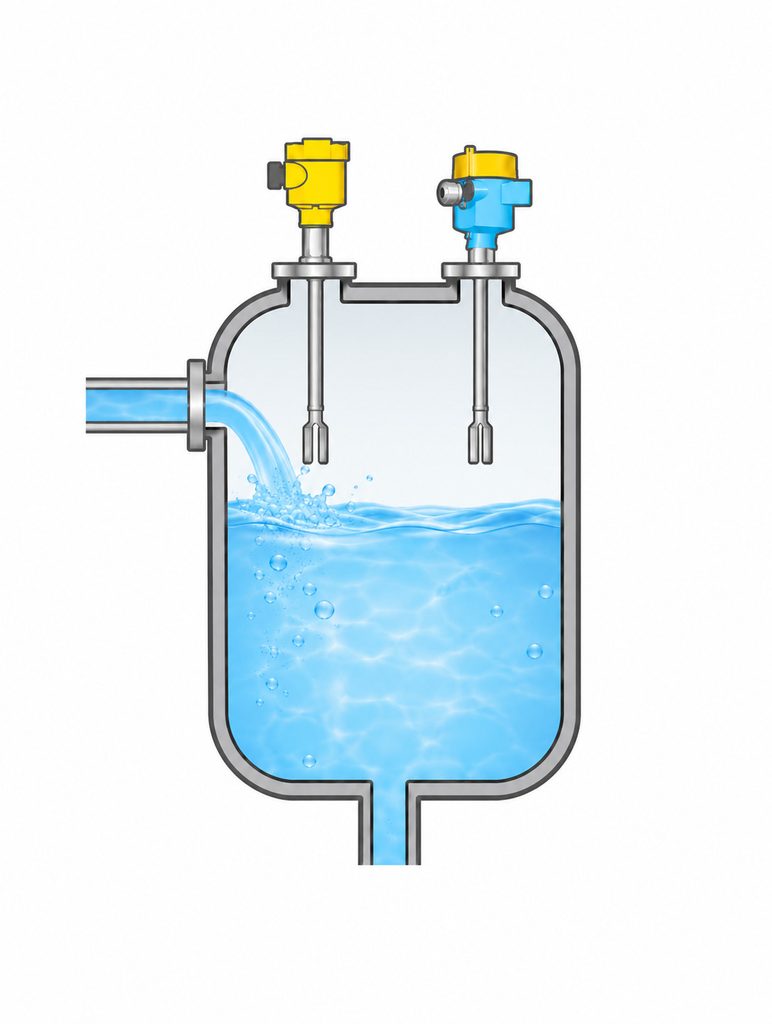
Installed near the upper part of a vessel, Ring-11 can provide a high-level or high-high signal when liquid reaches the required alarm elevation.
The signal can then be used by the control system to activate an alarm, stop a filling pump, or close an inlet valve according to the plant’s control philosophy.
Low-Level and Dry-Run Protection
Installed at a lower elevation, Ring-11 can detect when the liquid level falls below the required point.
This makes it suitable for pump dry-run protection, low-level alarms, and pump start/stop interlocks.
Pipeline Liquid Detection
The 40 mm compact fork makes Ring-11 particularly attractive for pipelines and other installations where available space is limited.
For pipeline applications, engineers should still confirm flow velocity, pipe diameter, fork orientation, pressure, viscosity, and installation clearance.
Difficult Liquid Conditions
Foam, bubbles, viscosity, turbulence, and product buildup can make some level-detection technologies difficult to apply.
The vibrating tuning fork principle provides a simple point-level detection method without requiring a mechanical float mechanism.
Correct installation remains important, particularly with sticky or highly viscous products.
5. Options for Corrosive and Demanding Applications
A VEGASWING X replacement must be selected according to the actual process medium, not only according to pressure and temperature.
Ring-11 is available with different wetted-material and corrosion-resistant configurations.
This allows the switch to be considered for applications involving aggressive chemicals, acids, alkaline liquids, wastewater, and other industrial fluids.
Before replacement, check the complete wetted path, including:
- Tuning fork material
- Process connection
- Coating
- Flange
- Process seal or gasket
- Extension components, if used
Material compatibility should always be evaluated against the actual chemical composition, concentration, temperature, and pressure.
6. Hazardous-Area and Safety Applications Can Also Be Covered
Many VEGASWING installations are located in chemical plants, tank farms, oil and gas facilities, and other areas where explosion protection or functional safety may be required.
Ring-11 is available in hazardous-area configurations and SIL-related configurations.
This means it can be considered for many safety-related point-level applications when the selected version and complete loop design satisfy the project requirements.
However, certification should never be assumed simply because both instruments are tuning fork switches.
For a replacement project, confirm the exact hazardous-area classification, explosion-protection method, safety barrier, cable gland, enclosure requirement, SIL requirement, and project-specific approvals.
VEGASWING X vs. Ring-11: Replacement Comparison
| Requirement | VEGASWING X | Ring-11 | Replacement Consideration |
|---|---|---|---|
| Measurement principle | Vibrating tuning fork | Vibrating tuning fork | Same basic detection principle |
| High-level detection | Yes | Yes | Good replacement application |
| Low-level detection | Yes | Yes | Good replacement application |
| Overfill protection | Yes | Yes, subject to configuration | Verify safety requirements |
| Pump/dry-run protection | Yes | Yes | Good replacement application |
| Pipeline detection | Yes | Yes | 40 mm Ring-11 fork is useful in compact installations |
| Minimum liquid density | Model/configuration dependent | Approx. 0.5 g/cm³ | Review if liquid density is below 0.5 g/cm³ |
| Viscosity | Wide range | Up to approx. 10,000 mPa·s | Suitable for many conventional applications |
| Relay output | Available | Available | Match voltage and contact requirements |
| Two-wire output | Available | Available | Verify current levels and input system |
| NAMUR | Available | Available | Verify barrier and hazardous-area design |
| NPN/PNP | Available | Available | Verify PLC input |
| Hazardous-area versions | Available | Available | Match exact certification |
| SIL-related configurations | Available | Available | Verify complete safety-loop requirements |
| HART-based additional functions | Available on selected VEGASWING X versions | Not the standard Ring-11 function | Not a direct functional replacement |
| Process pressure | Depends on VEGASWING X version | Up to 64 bar for Ring-11 configurations | Review applications above 64 bar |
The important conclusion from this comparison is that Ring-11 does not need to duplicate every VEGASWING X feature to be a suitable replacement.
It needs to match the features actually required by the application.
For conventional point-level switching, the overlap is substantial.
When Is Ring-11 a Good VEGASWING X Replacement Candidate?
Ring-11 is particularly worth considering when the existing VEGASWING X is being used for conventional high- or low-level detection and the process falls within the Ring-11 operating range.
A typical replacement candidate would have:
- Liquid density of approximately 0.5 g/cm³ or higher
- Viscosity within the Ring-11 specified range
- Process pressure within the selected Ring-11 rating
- Process temperature within the selected configuration
- Compatible wetted materials
- Relay, two-wire, NAMUR, or NPN/PNP output requirements
- Conventional high-level, low-level, overfill, dry-run, or pump-protection duty
- Compatible hazardous-area and safety requirements
In these applications, Ring-11 can provide a straightforward and practical alternative to VEGASWING X.
When Does a VEGASWING X Replacement Need Additional Review?
Ring-11 should not be presented as a universal one-for-one replacement for every VEGASWING X configuration.
Additional engineering review is particularly important when:
- Process pressure exceeds 64 bar
- Liquid density is below approximately 0.5 g/cm³
- Extreme process temperature is involved
- The existing instrument uses HART-based functions
- Density monitoring is required
- Interface detection is required
- Process-temperature measurement through the level switch is required
- A specific process connection or special material is required
- Project-specific approvals must be maintained
- The existing VEGASWING X performs functions beyond conventional point-level switching
In these situations, compare the exact existing VEGASWING X model and configuration against the proposed Ring-11 version before making the replacement.
7 Checks Before Replacing VEGASWING X with Ring-11
A reliable replacement starts with the application data.
Before selecting Ring-11, confirm:
- Medium: exact liquid and chemical concentration.
- Process properties: minimum density and maximum viscosity.
- Temperature and pressure: normal, minimum, maximum, and design conditions.
- Mechanical installation: process connection, nozzle length, insertion position, and required switching height.
- Wetted materials: fork, process connection, coating, flange, and seal compatibility.
- Electrical interface: supply voltage, output type, PLC/DCS input, fail-safe mode, and barrier requirements.
- Safety and environment: hazardous-area classification, SIL requirement, ingress protection, cable entry, and required certifications.
It is also worth reviewing the existing installation itself.
A replacement sensor should not inherit old installation problems such as a fork recessed inside a long nozzle, direct exposure to a filling stream, incorrect orientation in a pipeline, excessive external vibration, or moisture entering through the cable gland.
Replacing the instrument is a good opportunity to correct these issues.
Can Ring-11 Directly Replace VEGASWING X?
For many standard liquid point-level applications, Ring-11 can be a suitable replacement for VEGASWING X after the application parameters are matched.
The two products share the same fundamental vibrating tuning fork principle and cover many of the same core applications.
Ring-11’s compact 40 mm fork, approximately 0.5 g/cm³ minimum detectable density, viscosity capability up to approximately 10,000 mPa·s, multiple electrical outputs, corrosion-resistant options, and hazardous-area configurations make it particularly suitable for conventional industrial point-level detection.
The key is not to ask whether Ring-11 can replace every VEGASWING X ever produced.
A better question is:
Can Ring-11 replace the VEGASWING X in this specific application?
For a large number of conventional high-level, low-level, overfill, pump-protection, dry-run, and pipeline liquid-detection applications, the answer can be yes.
Conclusion
VEGASWING X is a versatile tuning fork level switch, but many installations use only its core point-level switching function.
In those applications, Jiwei Ring-11 provides a practical alternative.
It uses the same basic vibration principle, offers a compact 40 mm fork, supports liquids down to approximately 0.5 g/cm³, handles viscosities up to approximately 10,000 mPa·s, and provides relay, two-wire, NAMUR, and NPN/PNP output options.
That combination makes Ring-11 well suited to many VEGASWING X replacement projects in tanks, vessels, pipelines, pump-protection systems, chemical processes, and general industrial liquid applications.
The correct approach is simple:
Match the process conditions, mechanical installation, electrical interface, materials, and safety requirements first. Then select the Ring-11 configuration that matches the application.
For replacement selection, provide the existing VEGASWING X model, process medium, density, viscosity, temperature, pressure, process connection, output type, and hazardous-area requirements. These parameters make it possible to determine whether Ring-11 is the appropriate replacement and select the correct configuration.