Large integrated refining and petrochemical complexes typically contain numerous silos and storage vessels for powders, granules, and other bulk solids. Level switches installed on these silos are commonly used for high-level alarms, overflow prevention, low-level detection, equipment protection, and material handling interlocks.
Compared with ordinary storage applications, refinery and petrochemical silos often involve multiple challenging conditions at the same time, including heavy dust, abrasive particles, material buildup, impact from falling solids, hazardous areas, and elevated process temperatures.
These conditions place much higher demands on the reliability, mechanical durability, and long-term stability of a vibrating rod level switch.
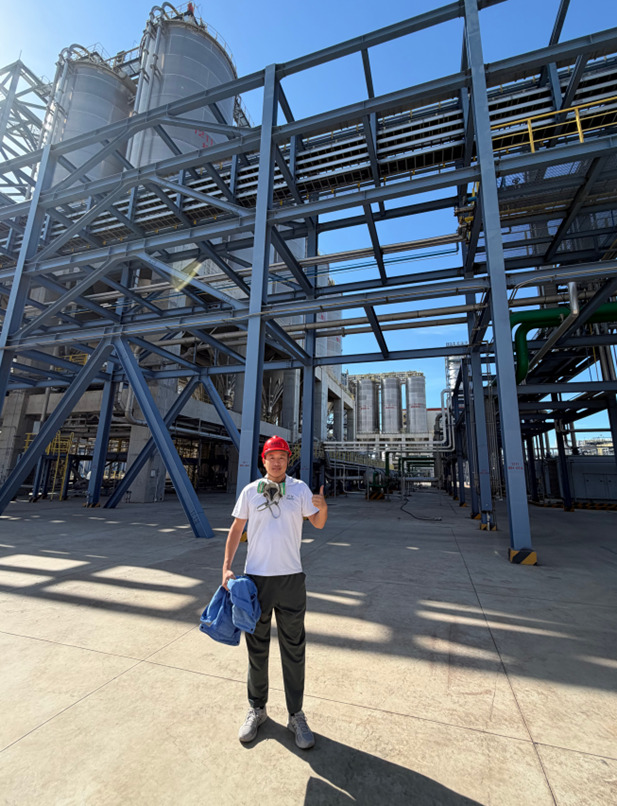
Recently, the Jiwei Automation technical team visited a large integrated refinery and petrochemical project in East China. During the visit, our engineers exchanged technical insights with the site’s instrumentation specialists on topics including vibrating rod level switch selection, probe abrasion caused by granular materials, false alarms caused by buildup, explosion protection, and the use of domestically manufactured instrumentation in large industrial projects.
According to the site team, more than one thousand vibrating level switches are operating across the project, with several finished-product silos using multiple point level switches on a single vessel.
At this scale, selecting a level switch is no longer simply a question of whether the instrument can detect the material.
Engineers must also consider whether the device can remain reliable under dust, impact, abrasion, buildup, and temperature fluctuations, while minimizing maintenance requirements, spare-parts inventory, and total lifecycle costs.
This article examines the typical challenges of point level detection in refinery silos and explains how the Tube-11 vibrating rod level switch can be selected and applied in demanding environments involving high dust, abrasive materials, low bulk density, high temperatures, and hazardous areas.
Why Is Level Switch Reliability So Important in Large Refinery Projects?
Refinery and petrochemical plants are typically designed for continuous, long-term operation.
Although a vibrating rod level switch is a relatively small field instrument, its output may be connected directly to critical process logic such as material feeding, conveyor start/stop control, high-level alarms, low-level protection, and silo overflow prevention.
A false alarm, failure to switch, or persistent instrument fault may result in:
- continued filling after a silo reaches its maximum level;
- material overflow or spillage;
- unnecessary shutdown of conveying equipment;
- insufficient material supply to downstream equipment;
- disruption of continuous production;
- additional troubleshooting and maintenance work;
- higher spare-parts and lifecycle costs.
For a plant using only a few level switches, occasional maintenance may have a limited operational impact.
In a large refinery with hundreds or even thousands of point level measurement devices, however, even a relatively small difference in failure rate can translate into a significant amount of maintenance work.
For this reason, refinery projects typically focus on several key requirements when selecting a solid level switch:
long-term stability, resistance to material buildup, mechanical durability, abrasion resistance, reliable hazardous-area protection, and low maintenance requirements.
These factors are particularly important when evaluating vibrating rod level switches for large-scale industrial applications.
Typical Level Detection Challenges in Refinery Silos
1. Particle Impact and Abrasion Can Damage the Probe
Granular materials continuously fall, slide, and move inside many refinery and petrochemical silos.
When particles have high velocity, significant hardness, or a large falling distance, a level switch installed directly in the material flow may be exposed to continuous impact and abrasion.
Mechanical wear can therefore become a major factor affecting probe life in applications involving:
- petrochemical pellets;
- plastic granules;
- mineral materials;
- coal and coke;
- catalysts;
- abrasive powders;
- other hard bulk solids.
In general, the farther a probe extends into the silo, the greater its potential exposure to moving material.
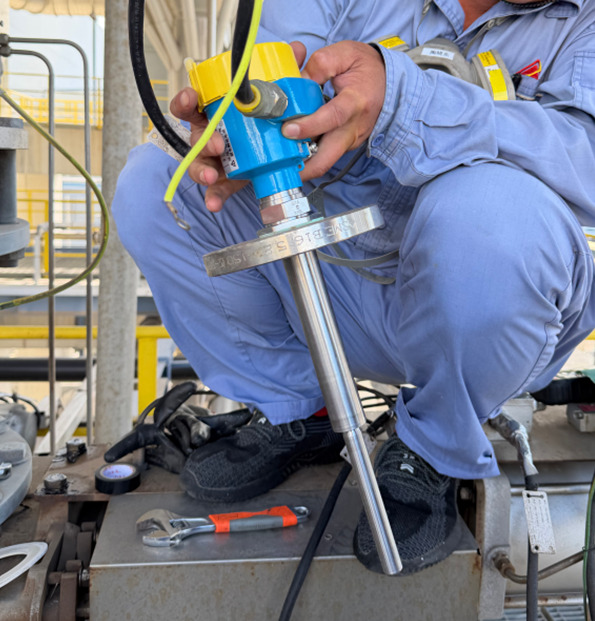
The Tube-11 uses a compact vibrating probe approximately 125 mm in length and 16 mm in diameter, helping reduce the amount of probe surface exposed to the material flow while maintaining reliable point level detection.
A short probe alone, however, cannot eliminate abrasion in extremely severe applications.
Installation design remains equally important.
For abrasive or high-impact solids, it is recommended to:
- avoid mounting the probe directly below the material inlet;
- keep the sensing element away from the main falling material stream;
- select a side-mounting position based on the direction of material flow;
- consider angled installation when appropriate;
- use a properly designed protective shield where severe impact cannot otherwise be avoided.
The service life of a vibrating rod level switch in abrasive solids therefore depends on both the mechanical design of the instrument and the installation conditions inside the silo.
2. Heavy Dust and Material Buildup May Cause False Level Alarms
Dust is another major concern in powder handling applications.
Fine powders, humid solids, and slightly sticky materials may gradually accumulate on a level switch probe during long-term operation.
Depending on the measurement principle, excessive coating or buildup can eventually lead to unreliable switching or false alarms.
A vibrating rod level switch operates by monitoring the mechanical vibration of its sensing probe.
When the probe is free in air, it vibrates at its normal operating condition. When bulk material covers the sensing element, the vibration characteristics change. The electronics detect this change and switch the output accordingly.
Because the measurement principle does not depend on optical visibility, material color, or a clear line of sight, airborne dust itself generally has little direct influence on the measurement.
The Tube-11 vibrating rod level switch uses a dual-tube vibrating probe designed for point level detection in powders, granules, and other bulk solids, including many applications where dust or material buildup is present.
However, material characteristics must still be considered carefully.
If a product is extremely adhesive or forms hard deposits between the sensing elements, the application should be evaluated before final instrument selection.
In practical terms:
A dusty environment does not automatically cause false alarms, but severe buildup, caking, or hardened deposits should always be considered during level switch selection.
3. Low Bulk Density Requires Higher Detection Sensitivity
Bulk density is another important factor when selecting a vibrating rod level switch.
Different powders and granular materials can have dramatically different bulk densities.
Conventional pellets and granules may have relatively high bulk density, while materials such as:
- lightweight powders;
- plastic powders;
- additives;
- expanded materials;
- certain catalysts;
- low-density chemical products
may exert much less damping force on the vibrating probe.
When a low-density material covers the sensing element, the resulting change in vibration can be relatively small. The level switch must therefore provide sufficient sensitivity to detect the material reliably.
The Tube-11 is designed for bulk solids with densities as low as approximately 0.02 g/cm³, allowing it to handle a wide range of lightweight powders and granular products.
For accurate selection, engineers should use the actual bulk density of the material rather than relying only on the material name.
The same material can have different bulk densities depending on:
- particle size;
- moisture content;
- compaction;
- aeration;
- storage conditions.
For applications close to the minimum detection limit, providing actual material data—or conducting a sample test where necessary—can help confirm suitability before installation.
4. Refinery Silos May Require Dust or Gas Explosion Protection
Refineries, petrochemical plants, coal chemical facilities, and other process industries may contain explosive gases, vapors, or combustible dust.
A level switch installed in these areas must therefore satisfy not only the measurement requirements but also the applicable hazardous-area requirements.
Combustible dust can create an explosion risk when it reaches a hazardous concentration in the presence of a suitable ignition source.
Before selecting an explosion-proof level switch, engineers should confirm:
- whether the hazardous atmosphere involves gas or combustible dust;
- the hazardous-area classification;
- the required explosion-protection marking;
- applicable certification requirements;
- enclosure protection requirements;
- process connection and electrical connection specifications.
The Tube-11 is available with configurations for hazardous industrial environments and provides IP66/IP67 enclosure protection for demanding dusty or outdoor installations.
The specific explosion-protection certification and marking should always be verified against the exact model configuration and the requirements specified in the project documentation.
5. High-Temperature Silos Require the Correct Instrument Configuration
Not every refinery silo operates at the same temperature.
Some bulk-solid storage vessels operate close to ambient temperature, while others receive material directly from drying, reaction, heating, or high-temperature conveying processes.
Excessive process temperature can affect the probe material, sealing structure, electronics, and overall service life of the instrument.
A standard-temperature level switch should therefore not be used in a high-temperature process without verifying its temperature rating.
Depending on the application, Tube-11 configurations are available for temperature classes of approximately 150°C, 250°C, and up to 400°C.
When selecting a high-temperature vibrating rod level switch, engineers should consider more than the maximum process temperature.
Important factors include:
- normal operating temperature;
- maximum continuous process temperature;
- short-term peak temperature;
- ambient temperature around the electronics;
- thermal radiation from nearby equipment;
- heat dissipation and insulation conditions.
This prevents situations in which the sensing element is technically within its process temperature limit while the electronics are still exposed to excessive heat.
How Does the Tube-11 Handle Harsh Refinery Silo Conditions?
A reliable level detection solution for refinery silos cannot be defined by a single specification.
It must address a combination of mechanical, process, environmental, and safety challenges.
The following table summarizes how the Tube-11 addresses several common refinery silo conditions.
| Refinery Silo Condition | Tube-11 Feature or Specification | Application Benefit |
|---|---|---|
| Particle impact and abrasion | Approx. 125 mm short probe, Ø16 mm compact design | Reduces probe exposure to the main material flow |
| Heavy dust | Vibrating point level detection | Does not depend on optical visibility or material color |
| Material buildup | Dual-tube vibrating probe | Improves adaptability in challenging powder applications |
| Low-density solids | Detection down to approx. 0.02 g/cm³ | Suitable for many lightweight powders and granules |
| Hazardous areas | Explosion-protected configurations available | Suitable for refinery, petrochemical, and chemical applications |
| Dusty or outdoor locations | IP66/IP67 enclosure protection | Provides strong resistance to dust and water ingress |
| High process temperature | 150°C, 250°C, and 400°C configurations | Covers a wide range of high-temperature silo applications |
| Large numbers of measuring points | Fast switching and diagnostic design | Helps simplify maintenance and troubleshooting |
It is important to recognize that stable level detection rarely depends on one technical parameter alone.
For example:
Abrasion resistance depends not only on probe construction but also on the mounting position.
Resistance to buildup depends on both the sensing principle and the physical characteristics of the material.
High-temperature capability requires consideration of both process and ambient temperature.
Explosion protection must be selected according to the actual hazardous-area classification.
For this reason, correct application engineering is often more important than simply comparing product datasheets.
How to Select a Vibrating Rod Level Switch for Refinery Silos
Before choosing a vibrating rod level switch for a refinery, petrochemical, or chemical silo, several process parameters should be confirmed.
1. Identify the Material Type
First determine whether the material is:
- powder;
- granules;
- pellets;
- coarse solids;
- lightweight powder;
- adhesive or cohesive material;
- highly abrasive bulk solid.
The physical condition of the material directly affects sensitivity requirements, installation position, and mechanical design.
2. Confirm the Bulk Density
Bulk density is one of the most important parameters when selecting a vibrating rod level switch.
This is particularly relevant for:
- plastic powders;
- catalysts;
- chemical additives;
- lightweight fillers;
- low-density process materials.
The actual bulk density should be used whenever possible rather than estimating suitability from the material name alone.
If the material density is close to the instrument’s lower detection limit, detailed application data should be provided during the selection stage.
A sample test may also be useful for particularly challenging materials.
3. Check the Particle Size
Particle size influences both mechanical impact and the way material surrounds the sensing probe.
Large granules or coarse solids may increase impact forces and may also create a risk of material becoming trapped around certain probe structures.
Applications involving large particles, lumps, or severe mechanical impact should therefore be evaluated carefully for probe strength and mounting position.
4. Confirm the Process Temperature
The following temperature information should be provided during instrument selection:
- normal operating temperature;
- maximum continuous temperature;
- short-term peak temperature.
For elevated-temperature applications, the appropriate high-temperature configuration must be selected.
5. Confirm the Process Pressure
Many bulk-solid silos operate at atmospheric or slightly positive pressure.
However, some sealed vessels may operate under higher process pressure.
The pressure rating of the process connection and instrument must therefore be verified before installation.
6. Identify Hazardous-Area Requirements
For installation in hazardous locations, confirm:
- gas or dust hazardous atmosphere;
- zone or area classification;
- required explosion-protection marking;
- applicable regional certification;
- project-specific instrumentation requirements.
Selecting an instrument simply because it is described as “explosion-proof” is not sufficient. The exact certification and protection concept must match the site’s requirements.
7. Determine the Correct Mounting Position
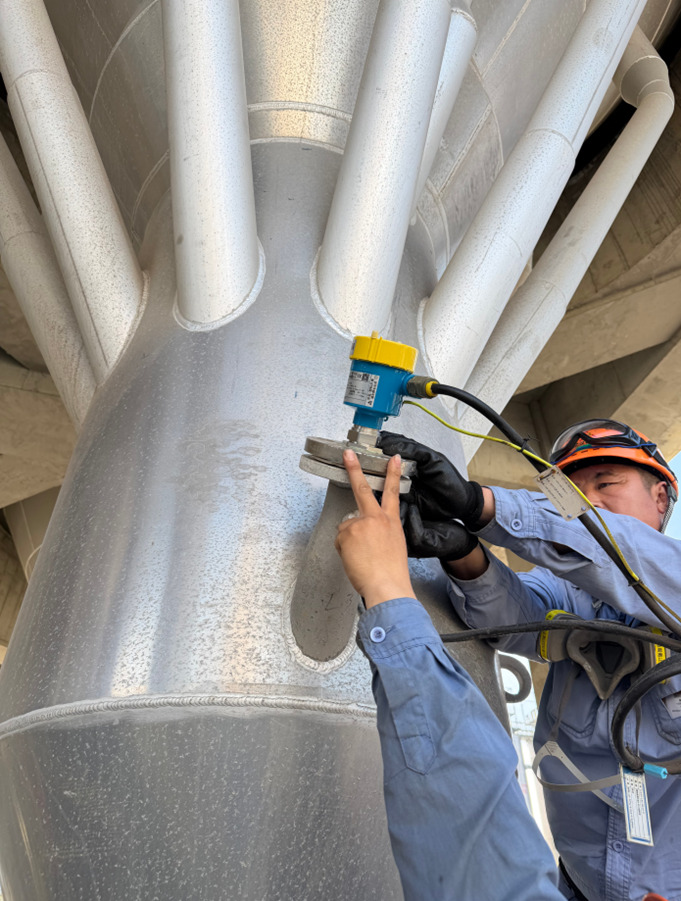
Vibrating rod level switches can typically be installed from the side or top of a silo, depending on the application.
Side mounting is common for high-level detection, while top mounting may be appropriate for certain vessel structures or extended sensing applications.
Where possible, avoid positions exposed to:
- direct impact from falling material;
- high-velocity material flow;
- excessive mechanical vibration;
- bridging zones;
- stagnant or dead material zones.
Correct mounting can significantly improve both measurement reliability and probe service life.
Installation Tips for Vibrating Rod Level Switches in Abrasive Silos
Selecting a durable level switch is only part of the solution in a high-abrasion application.
Installation has a direct impact on probe life.
Avoid Installing Directly Below the Material Inlet
A probe positioned directly beneath the filling point may be continuously exposed to high-velocity falling particles.
This can significantly accelerate mechanical wear.
Whenever possible, position the level switch away from the main material stream.
Consider the Direction of Material Flow
If the level switch cannot be installed completely outside the falling-material zone, select a location where particle velocity and impact are lower.
The internal flow pattern of the silo should be considered when determining the mounting point.
Add Mechanical Protection When Necessary
For severe impact conditions, a protective shield or deflector may be installed where appropriate.
However, any protective structure must be designed carefully.
An incorrectly designed shield may cause material accumulation around the sensing point and create a new source of measurement error.
Avoid Dead Zones Inside the Silo
Bulk solids do not always move uniformly inside a vessel.
Material may remain on one side of a silo even after the main level has fallen.
If the level switch is installed in such a stagnant zone, the probe may remain covered and continue indicating “material present” even though the actual operating level has dropped.
Mounting location should therefore be selected with the actual material flow pattern in mind.
Why Do Large-Scale Projects Focus on Lifecycle Maintenance?
For a single instrument, purchase price may initially appear to be the most important consideration.
In an integrated refinery using hundreds or thousands of level switches, however, total lifecycle cost becomes much more significant.
The reason is straightforward:
As the number of measuring points increases, even small reliability or maintenance issues are multiplied across the plant.
If each level switch requires frequent adjustment, cleaning, troubleshooting, or replacement, the accumulated labor cost can become substantial.
Large industrial users therefore tend to consider:
- long-term instrument stability;
- frequency of calibration or adjustment;
- ease of fault diagnosis;
- standardization of instrument models;
- spare-parts management;
- technical support availability;
- ability to adapt to changing process conditions.
Vibrating point level switches typically require little routine calibration during normal operation.
For applications involving a large number of measuring points, this can help reduce routine maintenance requirements.
At the same time, locally manufactured instrumentation can offer additional advantages in areas such as delivery time, spare-parts availability, technical communication, and application support.
Vibrating Rod Level Switches: From Product Substitution to Real-World Application Validation
In recent years, domestically manufactured process instruments have been increasingly applied in petrochemical, chemical, power generation, mining, new energy, and other industrial sectors.
For large refinery projects, however, instrument substitution is not simply about finding a product with similar specifications.
The critical question is whether the instrument can operate reliably over the long term under actual plant conditions.
This is especially important for field instruments such as level switches.
A device that performs well under laboratory conditions may behave differently when exposed to:
- continuous heavy dust;
- abrasive particles;
- repeated mechanical impact;
- material buildup;
- extreme temperatures;
- hazardous atmospheres.
As a result, the evaluation of industrial instrumentation is gradually shifting from:
“Can the specifications match those of an imported product?”
to:
“Can the instrument operate reliably under real process conditions?”
This shift requires manufacturers to understand more than the instrument itself.
They also need to understand:
- what material is being measured;
- why failures occur in the application;
- why the probe experiences abrasion;
- how material buildup affects switching;
- how different mounting positions change probe exposure;
- which maintenance issues matter most to plant operators.
For a vibrating rod level switch, real value is not demonstrated by a single specification in a datasheet.
It is demonstrated by the instrument’s ability to adapt to actual industrial conditions.
The technical discussions conducted during this refinery project visit also indicate that users are placing increasing emphasis on long-term operating performance, application suitability, engineering support, and lifecycle reliability when evaluating alternative instrumentation.
Frequently Asked Questions About Vibrating Rod Level Switches for Refinery Silos
Is a Vibrating Rod Level Switch Suitable for High-Dust Environments?
Yes.
A vibrating rod level switch detects the change in mechanical vibration that occurs when bulk material covers the sensing probe.
Its operation does not depend on visible light or a clear optical path, so airborne dust generally does not directly interfere with the measurement principle.
However, extremely adhesive materials, severe caking, or hardened deposits around the probe should still be evaluated during instrument selection.
Can a Vibrating Rod Level Switch Measure Continuous Level?
No.
A vibrating rod level switch is a point level detection device, meaning it determines whether material is present at a specific position.
Typical applications include:
- high-level alarm;
- low-level alarm;
- silo overflow prevention;
- dry-run or empty-silo protection;
- conveyor and feeding interlocks.
If continuous measurement of the actual material level is required, a continuous level measurement technology such as a radar level transmitter may be more appropriate.
What Is the Minimum Bulk Density the Tube-11 Can Detect?
The Tube-11 can be used for bulk solids with densities as low as approximately 0.02 g/cm³, depending on the application conditions.
For lightweight materials close to the detection limit, actual bulk density and process conditions should be provided before final model selection.
Can Granular Material Wear Out a Vibrating Rod Probe?
Yes.
Any probe exposed continuously to high-velocity solid particles may experience mechanical wear.
The severity of abrasion depends on factors such as:
- material hardness;
- particle size;
- falling velocity;
- drop height;
- probe material;
- probe insertion length;
- mounting position.
In abrasive applications, both the instrument design and installation method should therefore be optimized.
Can a Vibrating Rod Level Switch Be Used in High-Temperature Silos?
Yes, provided the correct high-temperature version is selected.
The Tube-11 is available in configurations designed for process temperatures of approximately 150°C, 250°C, and up to 400°C, depending on the model and application.
Both process temperature and ambient temperature should be considered during selection.
Can a Vibrating Rod Level Switch Be Installed in a Dust Hazardous Area?
Yes, when an appropriately certified configuration is selected.
However, engineers should not simply confirm whether the instrument is described as “explosion-proof.”
The exact explosion-protection marking, hazardous-area classification, and certification requirements must match the project specifications.
Providing the manufacturer’s instrumentation team with the project’s hazardous-area requirements or instrument datasheet before ordering is recommended.
Does a Vibrating Rod Level Switch Require Frequent Calibration?
Normally, no.
A vibrating rod level switch is a mechanical vibration-based point level device and generally does not require the same type of frequent field calibration associated with some analog measurement instruments.
Routine inspection should still follow the plant’s maintenance procedures.
For applications involving severe abrasion, heavy buildup, or corrosive materials, the probe condition should be checked periodically.
Conclusion: In Harsh Silo Applications, Reliability Matters More Than a Single Specification
Selecting a vibrating rod level switch for a refinery silo should not be based on sensitivity or purchase price alone.
Engineers should consider the complete application, including:
- bulk density;
- particle size;
- material abrasion;
- probe buildup;
- hazardous-area classification;
- process temperature;
- process pressure;
- installation position;
- long-term maintenance requirements.
This is particularly important in large refinery and petrochemical projects involving hundreds or thousands of level detection points, where long-term instrument stability can have a direct impact on maintenance workload and total lifecycle cost.
With its compact dual-tube vibrating probe, low-density detection capability, high-temperature configurations, hazardous-area options, and industrial enclosure protection, the Tube-11 vibrating rod level switch is designed for high- and low-level detection of powders, granules, and other bulk solids in refinery, petrochemical, chemical, coal chemical, and other demanding industrial applications.
For applications involving severe abrasion, heavy dust, low-density materials, high temperatures, or other challenging process conditions, users are encouraged to provide detailed information on the material properties, process temperature, hazardous-area requirements, and installation conditions before final model selection.
Learn more about the Tube-11 Vibrating Rod Level Switch, including technical specifications, model selection, dimensions, and installation guidelines.