Introduction
Water circulates continuously through a modern paper machine.
A large part of this water is not immediately discharged. Instead, it is recovered, collected, treated where necessary, and reused in the production process.
One of the most important streams in this circulation system is white water.
Despite its name, white water is not simply clean water.
It can contain fine fibers, fillers, suspended solids, chemicals, and entrained air. Depending on the paper grade and process conditions, the liquid surface can also contain a substantial foam layer.
These characteristics make white water level measurement more challenging than ordinary water tank measurement.
Reliable level monitoring supports pump control, paper machine stability, water reuse, and process balance.
What Is White Water in a Paper Mill?
During sheet formation, water drains from the pulp suspension through the forming fabric.
The recovered water contains fine fibers and mineral particles, giving it a cloudy or white appearance.
This process water is commonly called white water.
Rather than discarding it, paper mills reuse it in several parts of the process.
White water may be collected in:
- White water chests
- Seal pits
- Save-all systems
- Filtrate tanks
- Recovered-water tanks
- Broke preparation systems
Maintaining stable inventory in these vessels is important to both production and water efficiency.
Why Does White Water Level Matter?
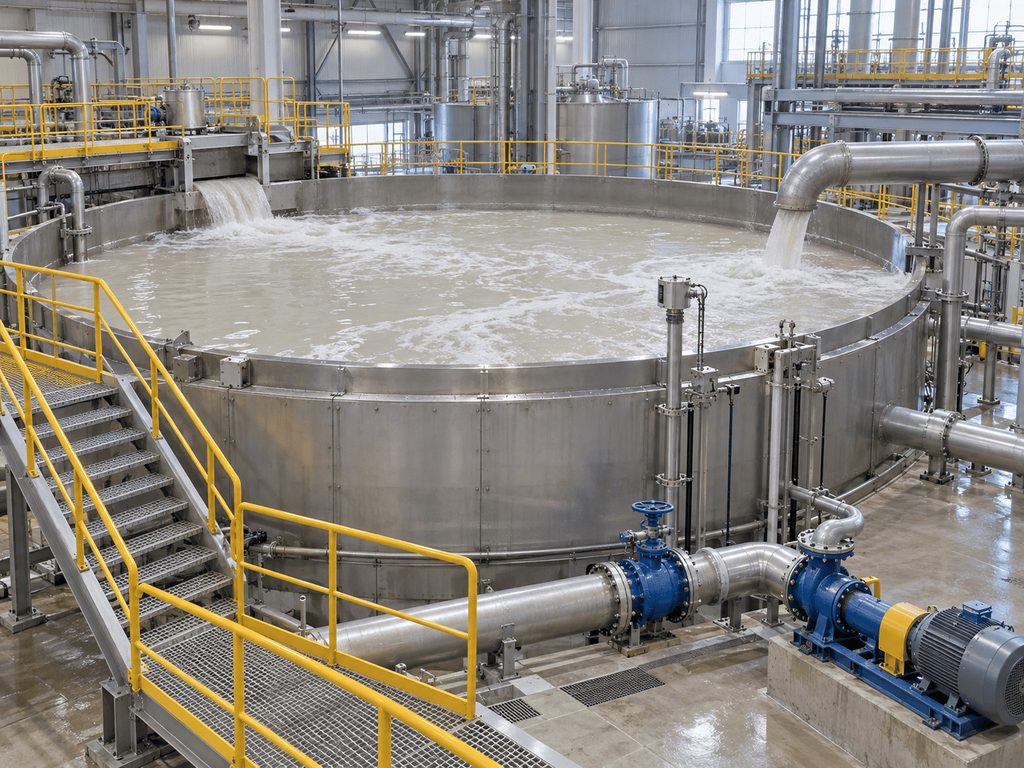
A white water system performs a balancing function.
Flow into and out of the system changes as paper machine conditions vary.
If the level becomes too low, pumps can lose suction and process water may become unavailable where needed.
If the level becomes too high, the system may overflow.
Unstable level control can also cause unnecessary valve movement and pump cycling.
Continuous level measurement provides the control system with the information needed to balance inflow and outflow.
What Makes White Water Difficult to Measure?
Fine Fibers and Suspended Solids
White water contains fiber fines and fillers.
Although it flows like a liquid, it is not equivalent to clean water.
Contact sensors can gradually become contaminated.
Foam
Foam is one of the most significant challenges.
Air entrained during paper machine operation combines with surfactants, chemicals, and fiber particles.
A foam layer can form on the liquid surface.
Its thickness may change with machine speed, furnish composition, chemical dosage, and process conditions.
Turbulence
Incoming and outgoing flows create moving surfaces.
Pumps and circulation systems can also generate waves.
Variable Process Conditions
Paper machines frequently change grade or operating speed.
The composition of white water can therefore change.
A reliable level sensor should remain stable during normal process variation.
Why Non-Contact Radar Is Attractive
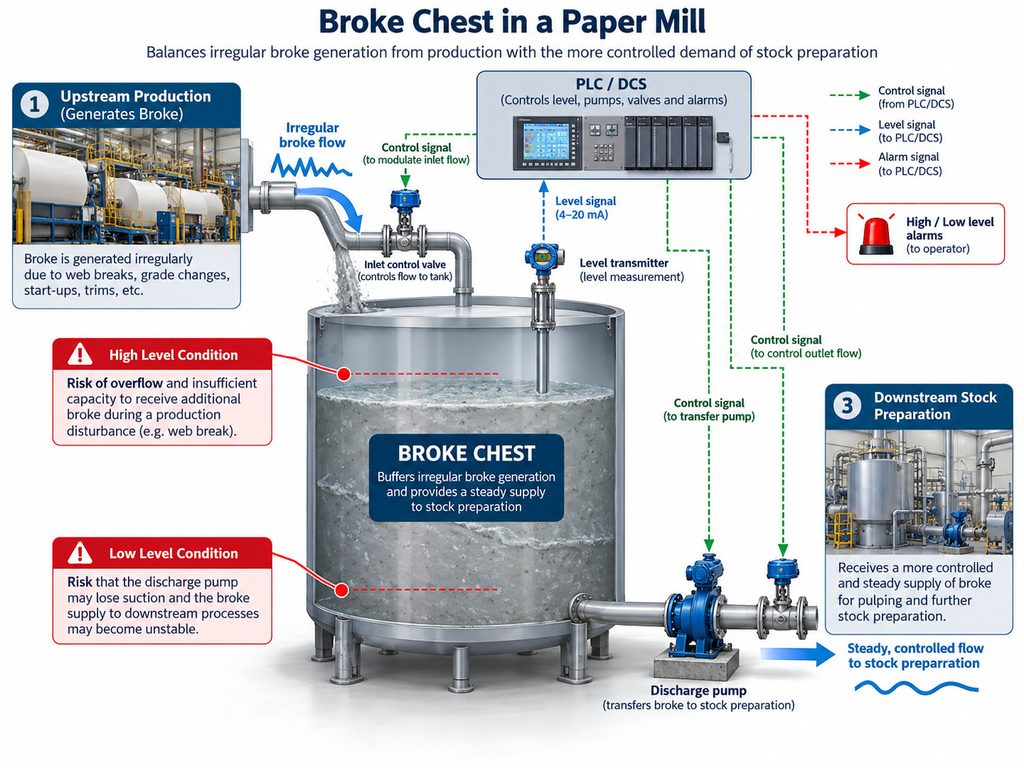
A radar level meter transmits electromagnetic waves from the top of the tank toward the process surface.
The reflected signal is used to determine the distance.
Because the sensor does not need to remain submerged, several common maintenance issues can be reduced.
Reduced Fiber Buildup
The antenna is normally located above the process.
Fine fibers therefore have less opportunity to wrap around or accumulate on a submerged measuring element.
Less Influence from Vapor
Radar does not rely on sound propagation through the atmosphere above the liquid.
This can provide an advantage where humidity, vapor, or temperature changes are present.
Continuous Measurement
Radar provides a real-time level value rather than only a high or low alarm.
The output can be integrated into the plant PLC or DCS.
What About Foam?
Foam should always be discussed honestly when evaluating radar.
Different types of foam produce different measurement behavior.
A thin, wet foam layer may still allow a useful reflection from the liquid surface.
Dense wet foam may produce its own reflection.
Very thick dry foam can weaken the signal.
For this reason, an engineer should determine whether the process objective is to measure:
- The actual liquid surface
- The top of the foam
- An operational average that provides stable control
Understanding the control objective can be just as important as selecting the sensor.
Why High-Frequency Radar Helps
White water tanks often contain:
- Pipes
- Overflow structures
- Agitators
- Support beams
- Inlet chutes
- Cleaning equipment
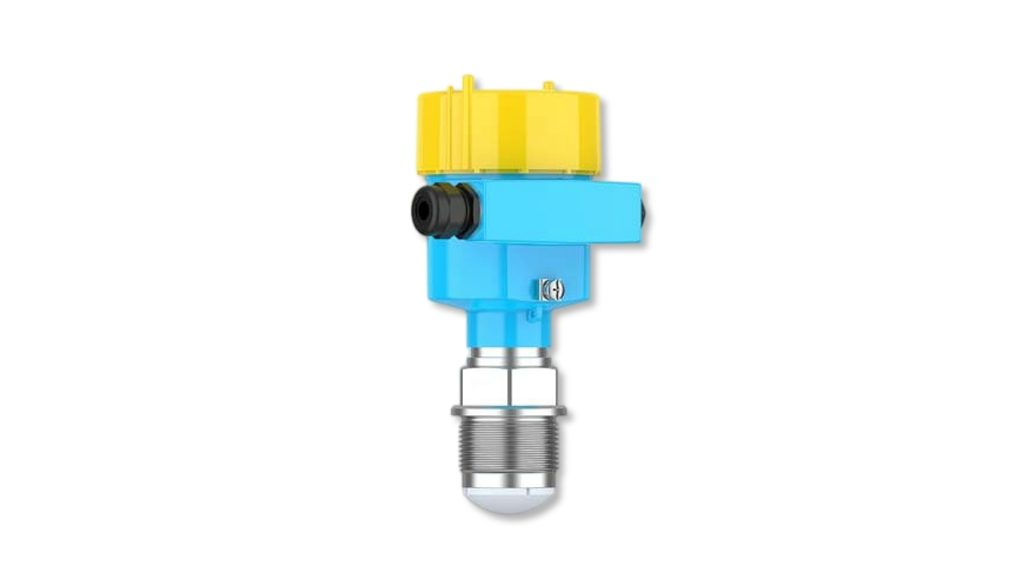
An 80 GHz radar instrument can use a narrow measurement beam.
This makes it easier to locate a relatively unobstructed measuring path.
A narrow beam also reduces the area of the surface being observed.
This can help avoid strong reflections from nearby tank structures.
Recommended Installation Practices
Keep Away from the Inlet
Incoming white water can generate foam and turbulence.
Mounting directly above the filling stream should be avoided where possible.
Avoid Tank Walls
Although modern radar can operate relatively close to a wall, a clear central measurement path is preferred when available.
Avoid Agitators and Structures
Check the complete radar beam path from antenna to minimum operating level.
Consider Maximum Foam Height
The maximum expected process level should include any operating restrictions created by foam.
Keep the Antenna Clean
Although the measurement is non-contact, condensation and splashing can still contaminate the antenna.
The mounting position should minimize direct splashing.
Radar vs. Hydrostatic Measurement
Hydrostatic sensors measure pressure generated by the liquid column.
They can provide simple and effective measurement in some water applications.
However, a pressure sensor is in direct contact with the process.
Deposits, fibers, and changing liquid density may create additional maintenance or accuracy considerations.
Radar avoids direct immersion.
For tanks with significant solids or fibers, this can simplify long-term operation.
Radar vs. Ultrasonic Level Measurement
Ultrasonic level meters are widely used for water applications.
For a relatively clean open tank without heavy vapor or foam, ultrasonic technology may be economical and effective.
White water, however, can be more complicated.
Foam, humidity, condensation, and temperature variation may influence acoustic measurement.
Radar can therefore provide a more robust solution in demanding applications.
The final decision should still consider the actual process and project budget.
Point Level Protection
Continuous level measurement provides the normal operating signal.
An additional high-level switch may be used to provide independent overflow protection.
Low-level detection can also protect pumps.
This combination allows one instrument to perform process control while another provides an independent alarm.
Information Needed for Selection
Before selecting a white water level meter, confirm:
- Tank height
- Tank diameter
- Normal level range
- Maximum foam thickness
- Number and position of inlet pipes
- Agitation
- Internal structures
- Temperature
- Pressure
- Existing process connection
- Required output
- Required accuracy
Photos and drawings can help identify the best installation position.
How Radar Supports Paper Mill Water Management
Water reuse is increasingly important in paper manufacturing.
Accurate tank level information helps plants understand available process-water inventory.
It also allows control systems to coordinate pumps and valves.
While the level instrument itself does not reduce water consumption automatically, reliable measurement is an important foundation for an effective water management strategy.
Stable level data can support:
- Better circulation control
- Reduced overflow
- Improved pump operation
- More consistent process water supply
Jiwei Solutions for White Water Applications
Jiwei offers non-contact radar level measurement technologies for paper industry tanks and process vessels.
For white water systems, the sensor configuration should be selected according to tank dimensions, foam conditions, internal structures, measurement range, and process environment.
High-frequency radar is particularly useful where installation space is limited or where multiple internal obstacles are present.
A proper application review helps determine whether radar, ultrasonic, or another measurement technology provides the best balance between performance and cost.
Conclusion
White water is a valuable process stream in modern paper mills, but measuring its level can be more difficult than measuring clean water.
Fibers, suspended solids, foam, turbulence, and changing process conditions can all influence instrument performance.
Non-contact radar level measurement reduces direct contact with the process and can provide stable continuous measurement for automated tank control.
High-frequency radar adds the advantage of a narrow beam, helping avoid internal structures and unwanted reflections.
The best results come from combining suitable instrument selection with careful installation.
Before choosing a sensor, engineers should evaluate not only tank height but also foam, inlet position, agitation, process temperature, and internal structures.
FAQ
Is white water the same as clean water?
No. Paper mill white water commonly contains fiber fines, fillers, chemicals, and suspended solids.
Can radar measure white water with foam?
Radar can work in many foamy applications, but foam characteristics should be evaluated during selection and commissioning.
Is ultrasonic suitable for white water tanks?
It may be suitable for mild applications. Radar is often preferred where heavy foam, vapor, condensation, or complex tank structures are present.
Does the radar touch the white water?
Normally no. Radar is a non-contact measurement technology installed above the process surface.