1. Why Has Beam Angle Become a Core Indicator in Radar Level Meter Upgrades?
In industrial level measurement, radar level meters have become an increasingly important solution for continuous measurement in storage tanks, reactors, water basins, silos, and process vessels. For high-performance radar level meters, users usually care most about measurement accuracy, stability, anti-interference capability, installation adaptability, and long-term operating reliability. Behind these performance indicators, there is one parameter that is often overlooked but extremely important: the beam angle.
The beam angle can be understood as the main energy coverage range formed when the radar antenna emits electromagnetic waves downward. The larger the beam angle, the wider the radar wave spreads outward. The smaller the beam angle, the more concentrated and directional the radar wave becomes, making it easier to focus energy on the real liquid surface or material surface. Under ordinary working conditions, a relatively large beam angle may still complete the measurement. However, in complex storage tanks, narrow-opening vessels, stirred reactors, high-foam liquid surfaces, steam environments, dusty environments, low-reflection media, and tanks with many internal structures, the beam angle directly affects whether the radar level meter can stably identify the true echo.
The reason high-performance radar level meters pursue a smaller beam angle is not simply to achieve an impressive technical parameter. The real purpose is to allow the radar wave to “see more accurately, focus more precisely, avoid interference more effectively, and capture the real level more reliably.” This is also an important reason why 80GHz high-frequency radar level meters are receiving increasing attention in modern industrial sites.

2. A Small Beam Angle Concentrates Radar Energy and Makes Real Echoes Clearer
The basic operating process of a radar level meter is that the antenna emits electromagnetic waves toward the measured medium. After reaching the liquid surface or material surface, the electromagnetic waves are reflected back. The instrument then calculates the distance between the antenna and the medium surface based on the echo signal, and finally converts it into the level height. Although this process appears simple, echo signals in real industrial environments are often far from clean.
Inside a vessel, there may be interference from tank wall reflections, mounting nozzle reflections, reinforcing rib reflections, coil reflections, agitator reflections, inlet impact, surface foam, steam, mist, dust, and material fluctuations. To obtain stable data, the radar level meter must identify the effective signal from the real liquid or material surface among complicated echoes.
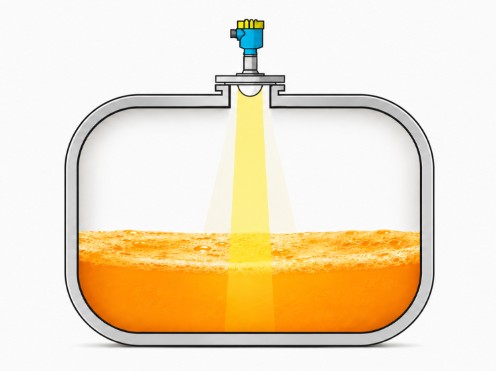
The first advantage of a small beam angle lies in energy concentration. The narrower the beam, the more the electromagnetic wave behaves like a focused light beam, allowing more energy to be projected onto the target measurement area instead of scattering toward the tank wall or other obstacles. As a result, the echo from the real liquid surface becomes more prominent, stray echoes are reduced, the signal-to-noise ratio becomes higher, and the instrument can more easily determine which echo represents the real level.
For high-performance radar level meters, a clear echo is the foundation of high-accuracy measurement. Without stable, clear, and identifiable echoes, even advanced algorithms will face major challenges. Therefore, a smaller beam angle is not merely an added selling point. It is one of the fundamental conditions for high-performance measurement.
3. A Small Beam Angle Reduces False Echoes and Improves Measurement Stability
Industrial storage tanks are not always ideal empty cylindrical structures. Many vessels contain agitators, coils, baffles, ladders, support beams, reinforcing ribs, inlet pipes, outlet pipes, and other internal structures. If the radar wave covers too wide an area, it can easily hit these internal components and generate multiple false echoes. Once the instrument mistakenly recognizes a false echo as the liquid surface echo, level jumps, data fluctuations, false alarms, or even loss of measurement may occur.
A small beam angle can significantly reduce this risk. Because the radar wave is more directional, the beam can be aimed at a relatively clean measurement path during installation, avoiding tank walls, obstacles, and internal structures. In this way, the echo sources received by the radar level meter become more focused, the number of false echoes decreases, and the real liquid surface signal becomes easier to identify.
The intelligent echo learning, adaptive processing, false echo recognition, multi-layer echo separation, and dynamic target tracking mentioned in Jiwei’s JWrada series radar level meter information are designed to further improve measurement reliability under complex working conditions. A small beam angle and intelligent echo algorithms do not replace each other. Instead, they complement each other. The small beam angle first reduces interference at the physical level, while intelligent algorithms identify, filter, and optimize echoes at the signal level. Only when the two work together can a high-performance radar level meter maintain stable long-term output in complex industrial sites.
4. A Small Beam Angle Is More Suitable for Narrow Tank Openings and Limited Installation Space
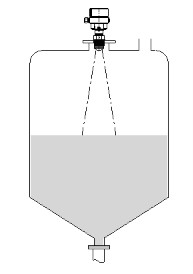
In many industrial sites, installation conditions are far from ideal. The top of a storage tank may have only a small opening, and the installation position may be limited by pipelines, platforms, insulation layers, or maintenance space. Narrow-opening storage tanks, small vessels, irregular vessels, and deep well-type structures require radar waves to travel downward through limited space as much as possible, without excessive reflection from the opening edge or vessel wall.
If the beam angle is relatively large, the radar wave quickly spreads after entering the vessel. It may easily hit the inner wall of the mounting nozzle, flange edge, or vessel side wall, generating strong interference echoes. A small beam angle allows the radar wave to pass through a narrower opening and reach the liquid surface in a more concentrated direction, reducing interference from the mounting nozzle, tank wall, and opening edge.
Therefore, high-performance radar level meters pursue a smaller beam angle largely to improve installation flexibility. For engineering sites, it is not enough for an instrument to simply “be able to measure.” It must also be easy to install, easy to commission, and stable over the long term. A small beam angle gives engineers more adjustment space when facing complex installation environments and makes radar level meters easier to adapt to vessels of different sizes, structures, and process conditions.
5. A Small Beam Angle Helps Improve High-Precision Level Control
As industrial production moves toward automation, refinement, and intelligence, level measurement is no longer just about showing “how much material is left.” In many processes, level data directly affects batching, reaction control, storage and transportation, safety interlocking, inventory management, discharge control, and energy efficiency. The more accurate the level measurement, the more refined the production control and the more reliable the management decisions.
The contribution of a small beam angle to accuracy mainly comes from three aspects. First, after energy is concentrated, the target echo becomes stronger and distance judgment becomes more stable. Second, after stray echoes are reduced, the instrument is less likely to be affected by tank walls and internal structures, resulting in smaller measurement fluctuations. Third, when a small beam angle is combined with high-frequency radar technology, higher spatial resolution can be achieved, making it easier to distinguish the real liquid surface from nearby interference signals.
This is also an important reason why 80GHz radar level meters attract attention. High-frequency radar has a shorter wavelength and stronger focusing capability. Under the same installation conditions, it is easier to form a narrow beam and improve measurement quality under complex working conditions. For applications requiring millimeter-level accuracy, continuous monitoring, and stable control, the value brought by a small beam angle is especially significant.
6. A Small Beam Angle Enhances Anti-Interference Capability Under Complex Working Conditions
Many users choose high-performance radar level meters not because their sites are simple, but because their sites are complex. For example, chemical reactors may involve agitation, steam, and foam. Wastewater treatment sites may involve mist, foam, and liquid surface fluctuation. Powder silos may involve heavy dust, feeding impact, and conical material surfaces. Energy and environmental protection applications may involve high temperature, pressure changes, and fluctuations in medium composition.
In these scenarios, radar level meters must have strong anti-interference capability to operate stably. A small beam angle can reduce the chance that radar waves come into contact with interfering objects, thereby lowering the probability of interference generation at the source. The more concentrated the beam, the more the instrument can focus on the target measurement area instead of being distracted by the surrounding environment.
Of course, a small beam angle does not mean all interference will automatically disappear. Foam, steam, dust, liquid surface fluctuation, and dielectric constant changes can still affect echo quality. Therefore, high-performance radar level meters usually need to combine high-frequency measurement technology, stable antenna structure, intelligent signal processing, and adaptive algorithms. A small beam angle solves the problem of “avoiding unnecessary contact with interfering objects,” while intelligent algorithms solve the problem of “correctly judging complex signals after they appear.” Together, they form true anti-interference capability under complex working conditions.
7. A Small Beam Angle Helps Identify Low-Reflection Media and Weak Echo Signals
In liquid level and material level measurement, different media have different reflection capabilities for radar waves. Media with a higher dielectric constant usually generate stronger echoes, while low-dielectric media, powders, small-particle materials, foam-covered liquid surfaces, or uneven material surfaces may produce weaker echoes. In weak-echo scenarios, radar level meters require higher energy utilization efficiency and stronger signal identification capability.
A small beam angle can project the transmitted energy more intensively onto the measured medium surface, allowing limited energy to be used more efficiently. The real target receives more concentrated energy, and the returned effective echo becomes easier for the instrument to capture. This is especially important for high silos, long-distance measurement, or weak-reflection media measurement.
This is why high-performance radar level meters emphasize a small beam angle, high signal-to-noise ratio, and strong echo quality. A small beam angle is not an isolated parameter. It works together with measurement distance, medium reflection capability, antenna structure, signal processing capability, and installation method to determine the final measurement performance.
8. A Small Beam Angle Helps Reduce Commissioning Difficulty and Maintenance Costs
Many users pay attention to the purchase cost of radar level meters, but in real projects, the full life cycle cost should be considered more carefully. After installation, if the instrument frequently experiences fluctuations, false alarms, signal loss, or repeated manual commissioning, maintenance workload increases, production continuity is affected, and safety risks may even arise.
One important engineering value of a small beam angle is that it reduces on-site commissioning and later maintenance pressure. Because the beam is more concentrated, there are fewer interference sources and the echo curve is clearer. Engineers can more easily find a stable measurement position during installation and commissioning, and they can more easily determine whether on-site problems are caused by installation, medium characteristics, or parameter settings. For high-altitude storage tanks, hazardous areas, closed vessels, or remote stations, reducing on-site maintenance frequency is itself a very important value.
Jiwei’s JWrada series radar level meters emphasize wireless commissioning, remote monitoring, software upgrades, and intelligent echo processing. When these functions are combined with a small beam angle, operation and maintenance efficiency can be further improved. The more stable the front-end measurement signal is, the more efficient the back-end commissioning, diagnosis, and management become. For enterprises, stable data means less downtime, fewer inspections, fewer misjudgments, and lower maintenance costs.
9. A Small Beam Angle Is Not Always Better; It Must Match the Working Conditions
Although high-performance radar level meters pursue a smaller beam angle, in actual selection, it is not enough to simply assume that “the smaller, the better.” The beam angle must match the measurement range, vessel size, installation height, medium type, internal structure, working condition complexity, and measurement target.
For example, in narrow vessels, storage tanks with complex internal structures, high-precision level control, and long-distance weak-echo applications, the advantages of a small beam angle are obvious. However, in some open, simple, strongly reflective, and moderate-accuracy applications, users should also consider measurement range, temperature and pressure conditions, process connection, material, protection rating, and cost-effectiveness. The key to high-performance selection is not blindly pursuing a single parameter, but choosing the right radar level meter according to actual site requirements.
Therefore, when discussing beam angle, one should not only look at the angle value itself, but also evaluate the overall capability behind it: whether high-frequency measurement technology is used, whether the antenna design is stable, whether intelligent echo processing is available, whether it suits the site installation conditions, and whether it can maintain stable data during long-term operation. A truly high-performance radar level meter is the result of comprehensive hardware, algorithm, structure, and engineering adaptability.
10. Why Does Jiwei’s High-Performance Radar Level Meter Emphasize a Small Beam Angle?
Based on information from Jiwei’s official website, Jiwei’s high-performance radar level meters emphasize a small beam angle not to highlight a single parameter alone, but to build an overall technical route around stable measurement under complex working conditions. The 80GHz high-frequency radar technology provides stronger focusing capability, the FMCW measurement method improves distance measurement accuracy, intelligent echo processing algorithms identify and filter complex echoes, and false echo recognition, multi-layer echo separation, and dynamic target tracking further enhance site adaptability.
Within this technical combination, the small beam angle plays a fundamental role. It enables radar waves to point more directly toward the real liquid or material surface, reduces the influence of tank walls, obstacles, and stray reflections, improves effective echo quality, gives algorithms a clearer data foundation, enhances installation adaptability, and allows radar level meters to enter more challenging application scenarios such as narrow-opening, irregular, and complex vessels. It also reduces commissioning and maintenance pressure, helping the equipment maintain reliable output during long-term operation.
In other words, a small beam angle is not pursued simply to make the parameter look better. It is pursued so that radar level meters can operate more stably, accurately, and reliably in real industrial sites.
11. The Essential Value of a Small Beam Angle for High-Performance Radar Level Meters
From the user’s perspective, choosing a high-performance radar level meter is ultimately not about a single technical term, but about continuous, stable, and trustworthy level data. The more accurate the level data, the more refined the production control. The more stable the measurement, the fewer the false alarms. The easier the maintenance, the lower the operating cost. The stronger the adaptability, the smoother the project implementation.
A small beam angle is an important path to achieving these values. It makes the radar beam more concentrated, the real echo clearer, false echoes fewer, complex vessels easier to install, weak-echo media easier to identify, and high-precision control more reliable. Especially in 80GHz high-frequency radar level meters, a small beam angle works together with high-frequency measurement, intelligent algorithms, non-contact structure, and digital operation and maintenance capabilities to form the core competitiveness of modern industrial level measurement.
Conclusion: A Small Beam Angle Is Key to Precise Measurement in High-Performance Radar Level Meters
High-performance radar level meters pursue a smaller beam angle because industrial sites have increasingly higher requirements for level measurement. When facing complex vessels, internal obstacles, steam, foam, dust interference, low-reflection media, and high-precision control demands, the traditional concept of wide-range coverage can no longer fully meet the needs of refined production. A smaller beam angle means better directionality, higher energy concentration, fewer stray echoes, and stronger site adaptability.
For Jiwei’s JWrada series radar level meters, the combination of a small beam angle, 80GHz high-frequency technology, FMCW measurement, intelligent echo processing, and remote operation and maintenance capability not only improves measurement accuracy, but also enhances reliability and long-term operating value under complex working conditions. As industrial automation and intelligent manufacturing continue to develop, a small beam angle will remain an important technical direction for high-performance radar level meters and a key reference for users when judging whether a radar level meter is suitable for complex industrial sites.