In fertilizer production, chemical raw material storage, and ammonium bicarbonate packaging and conveying systems, a storage silo may appear to be a relatively simple piece of equipment. However, the reliability of level detection can directly affect feeding, discharging, conveyor interlocking, and the continuity of the entire production process.
This is particularly important for ammonium bicarbonate, a solid material that can be affected by storage temperature, humidity, and environmental conditions. If the wrong level switch is selected, problems such as material buildup, caking, blocked sensing elements, false alarms, and even high-level detection failure may occur.

For these applications, a rotary paddle level switch provides a practical solution. Thanks to its simple mechanical structure, direct detection principle, minimal commissioning requirements, and suitability for powders and granular solids, it can be effectively used for high- and low-level detection in ammonium bicarbonate silos.
This application case explains how a rotary paddle level switch can help solve common problems associated with ammonium bicarbonate storage, including caking, material impact, and unstable level signals. It also covers key considerations for product selection, installation, and long-term operation.
Why Does an Ammonium Bicarbonate Silo Need Reliable Level Detection?
Ammonium bicarbonate is widely used as a nitrogen fertilizer and as a chemical raw material in various industrial processes. It is generally stored and handled in the form of white crystals, granules, or powder.
Compared with materials such as plastic pellets, minerals, or other relatively stable bulk solids, ammonium bicarbonate is more sensitive to storage conditions.
One important characteristic is its relatively poor thermal stability. As temperature rises, ammonium bicarbonate decomposes more rapidly and may release ammonia, carbon dioxide, and water. For this reason, storage conditions generally need to avoid excessive heat and should provide appropriate ventilation.
Humidity is another important factor.
During long-term storage or under humid environmental conditions, ammonium bicarbonate may absorb moisture and gradually form agglomerates or cakes. A material that originally flows relatively freely can therefore become uneven, sticky, or partially compacted.
Inside a storage silo, these changes may result in:
- Material buildup on the silo wall
- Localized accumulation
- Uneven discharge
- Bridging or partial blockage
- Irregular material surfaces
- Residual material around the level detection point
For an automated production line, these characteristics place higher demands on the level detection system.
The level switch must accurately determine whether the ammonium bicarbonate has reached a specified point while avoiding false signals caused by wall buildup, localized caking, or irregular material distribution.
If the high-level switch fails, continuous feeding may eventually cause overfilling or material spillage.
If the low-level switch produces an incorrect signal, screw conveyors, packaging machines, dosing systems, or downstream equipment may operate without sufficient material.
For this reason, a seemingly simple level switch plays an important role in process control and equipment interlocking.
Application Background: Caking Caused Unstable Level Detection
A fertilizer production facility used several storage silos for finished ammonium bicarbonate.
After production, the material was conveyed into the silos for temporary storage before being transferred to packaging equipment or downstream processing systems.
Over time, the original level detection system began to show several operational problems.
One issue was the formation of an irregular material surface inside the silo.
Because the feeding position was relatively fixed, ammonium bicarbonate entering the silo created a natural angle of repose. The material surface around the high-level detection point was therefore not completely horizontal.
If a level detector was installed too close to the inlet, it could also be continuously exposed to falling material.
Another problem appeared during periods of higher humidity or extended storage.
Some ammonium bicarbonate gradually formed agglomerates. Material accumulated around certain sensing locations, affecting the stability of the level indication.
At the same time, the plant wanted to keep the control system as simple as possible.
The operators did not require continuous measurement showing the exact remaining quantity of ammonium bicarbonate inside the silo. Instead, they mainly needed two reliable signals:
- A high-level signal to stop feeding
- A low-level signal to initiate replenishment or equipment interlocking
After evaluating the operating conditions, rotary paddle level switches were selected for high- and low-level detection.
Why Is a Rotary Paddle Level Switch Suitable for Ammonium Bicarbonate?
The working principle of a rotary paddle level switch is straightforward.
A small motor inside the instrument drives the sensing paddle at a low rotational speed.
When no material surrounds the paddle, it rotates normally.
As ammonium bicarbonate rises and covers the paddle, resistance from the material prevents the paddle from rotating. The internal mechanism detects this change and activates a microswitch, generating an electrical output signal.
When the material level falls and the paddle becomes exposed again, the resistance disappears. The mechanism automatically resets and the paddle resumes rotation.
This detection method offers an important advantage.
The switch does not need to calculate material level based on dielectric constant, conductivity, or complex signal processing. Instead, it simply determines whether material is physically present at the sensing point by detecting mechanical resistance.
This makes a rotary paddle level switch for ammonium bicarbonate particularly suitable for applications involving granules, crystals, and powders.
For example, the Spin-11 series rotary paddle level switch is designed for solid powders and granular materials with a minimum material density of approximately 0.3 g/cm³.
Typical ammonium bicarbonate bulk density is significantly higher than this minimum requirement, making the material well suited to the rotary paddle detection principle.
For this reason, material density is generally not a limiting factor in a typical ammonium bicarbonate silo application.
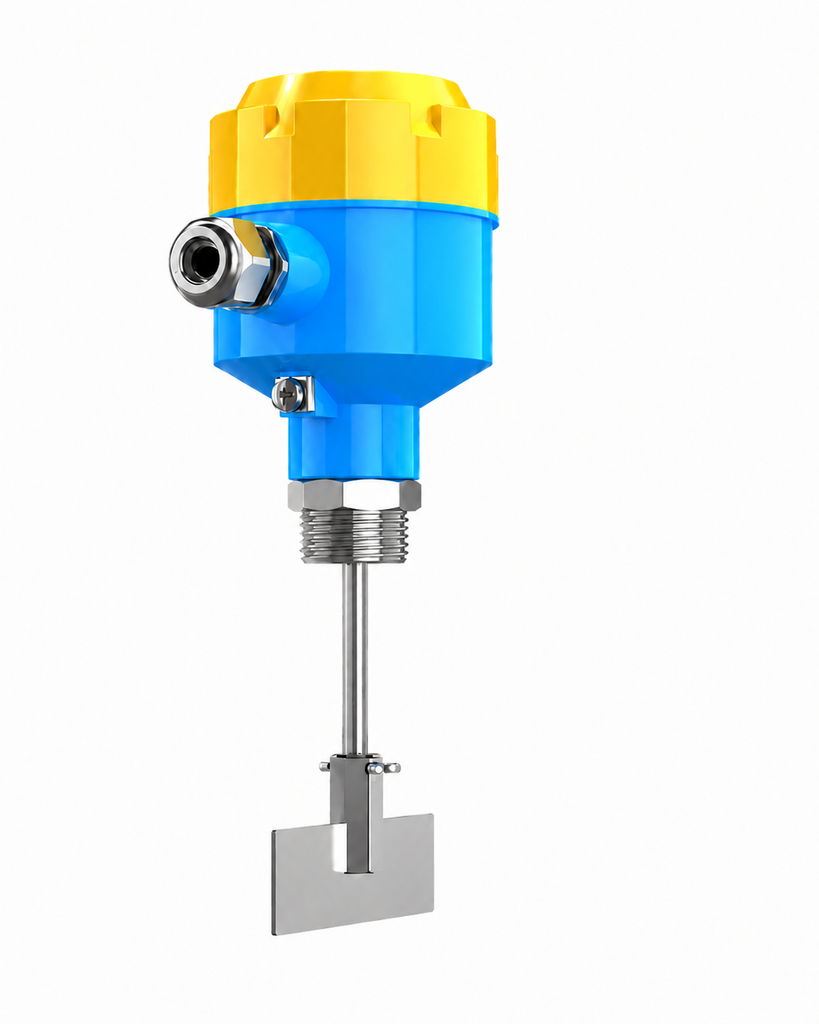
How to Select a Rotary Paddle Level Switch for Ammonium Bicarbonate
Although ammonium bicarbonate is a granular or powdery solid, selecting a level switch should involve more than simply confirming that the instrument can detect powder.
Several operating conditions should be evaluated, including:
- Material temperature
- Bulk density
- Caking tendency
- Mechanical impact
- Mounting location
- Process connection
- Wetted material compatibility
- Required insertion length
For normal ammonium bicarbonate storage conditions, a standard rotary paddle level switch can meet the requirements of many applications.
The low-speed rotating paddle and mechanical resistance detection principle make it particularly suitable for high-level alarm and low-level control.
Material Compatibility
For the process connection and parts exposed to the product, stainless steel materials such as 304 or 316L can be selected depending on process requirements.
Using corrosion-resistant metal components helps improve long-term reliability in chemical and fertilizer production environments.
Temperature Considerations
A standard rotary paddle level switch may have a process temperature range of approximately -20°C to 70°C.
However, there is an important distinction when applying the instrument to ammonium bicarbonate.
The fact that the instrument can tolerate temperatures up to 70°C does not mean that ammonium bicarbonate should be stored at such temperatures.
Because ammonium bicarbonate has limited thermal stability and decomposes more rapidly as temperature increases, the process temperature should primarily be controlled according to the material’s safe storage requirements.
Instrument temperature limits and material storage limits should therefore be considered separately.
This is a critical point when selecting a level switch for ammonium bicarbonate storage.
Installation Location Has a Major Impact on Reliability
Correct product selection is only part of the solution.
For an ammonium bicarbonate silo, installation position can have a major influence on long-term measurement reliability.
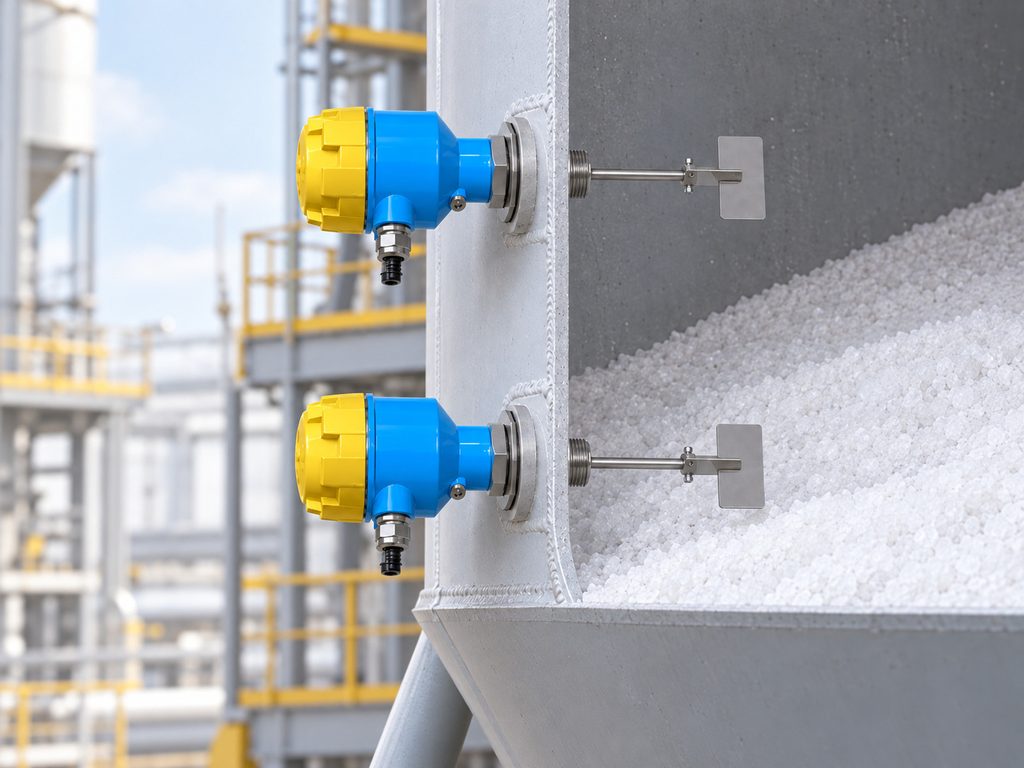
In this application, the high-level rotary paddle switch was mounted on the side wall of the silo and positioned away from the direct material inlet.
This arrangement helps protect the sensing paddle and shaft from continuous impact.
When ammonium bicarbonate falls from a conveyor or feeder into a storage vessel, the material can exert considerable mechanical force on components installed directly below the inlet.
Even if the sensing principle is suitable for the application, long-term impact may increase wear on the shaft and transmission mechanism.
For side-mounted rotary paddle switches, a slightly downward mounting angle can help reduce the direct force of falling material on the sensing assembly.
If the installation point must be located close to the material inlet, a protective baffle can also be installed above the sensing area.
The baffle redirects falling material and reduces direct impact on the paddle and shaft.
Avoid Dead Zones and Persistent Material Buildup
Caking is another important installation consideration.
Because ammonium bicarbonate can form agglomerates under unfavorable storage conditions, the sensing point should not be located in an area where residual material frequently accumulates.
For example, a corner or internal dead zone may retain compacted material even after most of the silo has been discharged.
If this residual material continues to surround the paddle, the level switch may continue indicating “material present” even though the main material level has already dropped below the detection point.
This can cause a false high-level or false material-present signal.
Before installing a rotary paddle switch, it is therefore important to understand:
- Feeding direction
- Material flow pattern
- Angle of repose
- Silo geometry
- Common buildup areas
- Discharge behavior
Understanding actual material movement inside the silo is often just as important as selecting the correct instrument.
High- and Low-Level Interlocking for Simple Silo Control
In an ammonium bicarbonate application, rotary paddle level switches are commonly used for point-level detection rather than continuous level measurement.
One switch can be installed at the high-level position and another at the low-level position.
High-Level Detection
As ammonium bicarbonate enters the silo, the material level gradually rises.
When the product reaches the high-level sensing paddle, material resistance stops the paddle from rotating.
The internal switching mechanism changes state and generates a high-level signal.
This signal can be sent to a PLC, DCS, relay control system, or alarm circuit.
The control system can then:
- Stop the feeding conveyor
- Close a feeding valve
- Stop a screw feeder
- Activate a high-level alarm
- Prevent silo overfilling
Low-Level Detection
As material is discharged into a packaging line or downstream process, the level gradually decreases.
Once the ammonium bicarbonate falls below the low-level sensing paddle, the paddle is released and resumes rotation.
The switch returns to its normal state and sends a low-level signal.
This signal can be used to:
- Start material replenishment
- Activate a low-level warning
- Stop downstream equipment
- Prevent dry running
- Trigger an automatic feeding sequence
This control strategy does not require complex software or continuous level calculations.
For applications where the only requirement is reliable “material present” or “material absent” detection, rotary paddle switches provide a simple and practical solution.
Dust Protection and Mechanical Reliability Should Not Be Ignored
Ammonium bicarbonate may not generate dust as fine as materials such as carbon black, but dust can still be produced during filling, discharging, conveying, and packaging.
The surrounding fertilizer or chemical production environment may also contain humidity and airborne contaminants.
For this reason, enclosure protection and mechanical reliability remain important.
The Spin-11 series rotary paddle level switch uses an IP65 enclosure design and incorporates a dual-bearing structure together with mechanical anti-loosening features.
These design characteristics can help reduce problems associated with:
- Dust entering the housing
- Mechanical vibration
- Loose internal components
- Shaft instability
- Long-term transmission wear
In applications where ammonium bicarbonate forms large lumps, or where filling rates are high and mechanical impact is significant, a protective version with a shaft protection tube can also be considered.
The protection tube helps shield the shaft from lateral force and direct material impact.
This demonstrates why rotary paddle level switches should be selected according to actual process conditions rather than using one configuration for every ammonium bicarbonate silo.
Application Results: More Stable Signals and Simpler Interlocking
After selecting a rotary paddle level switch that matched the material characteristics and installation conditions, the control logic of the ammonium bicarbonate silo became significantly simpler.
For operators, the main improvement was not the addition of more complicated functions.
Instead, the high- and low-level signals became easier to understand and integrate into the production process.
When ammonium bicarbonate reached the upper detection point, the system stopped feeding.
When the material dropped below the lower detection point, the system initiated replenishment or generated an alarm.
The PLC or other control system could therefore use clear switching signals to perform automatic interlocking.
Because a rotary paddle level switch requires little parameter configuration, routine maintenance is also relatively straightforward.
Typical inspection tasks include:
- Checking whether excessive material has accumulated around the paddle
- Confirming that the paddle can rotate freely when exposed
- Inspecting wiring and electrical connections
- Checking whether the instrument is being subjected to abnormal material impact
- Inspecting the shaft and paddle for mechanical damage
For a material such as ammonium bicarbonate, whose behavior can change with temperature and humidity, a simple and transparent detection principle can make troubleshooting much easier for maintenance personnel.
Three Key Principles for Ammonium Bicarbonate Level Detection
This application highlights three important principles for using a rotary paddle level switch with ammonium bicarbonate.
1. Match the Level Switch to the Actual Material Condition
Do not select the instrument based only on the material name.
The actual condition of ammonium bicarbonate should be considered, including particle size, bulk density, caking tendency, storage time, and moisture exposure.
The paddle type, insertion length, and protective structure should be selected according to the real operating conditions.
2. Separate Instrument Temperature Limits from Material Storage Requirements
The maximum temperature rating of a level switch only indicates the conditions under which the instrument can operate.
It does not define the appropriate storage temperature for ammonium bicarbonate.
Because ammonium bicarbonate is sensitive to elevated temperatures, process design should always prioritize the safe storage conditions of the material.
3. Choose the Installation Point Carefully
The sensing paddle should be kept away from direct filling impact whenever possible.
It should also avoid areas where permanent buildup or dead zones are likely to develop.
If necessary, angled mounting, protective baffles, or shaft protection tubes can be used to improve mechanical reliability.
When correct instrument selection and proper installation are combined, a rotary paddle level switch can provide stable long-term performance in ammonium bicarbonate silos.
Conclusion: A Simple Rotary Paddle Level Switch Can Solve Complex Ammonium Bicarbonate Silo Problems
The main challenge in ammonium bicarbonate level detection is not necessarily finding the most sophisticated measurement technology.
The real challenge is selecting a detection method that matches the physical characteristics of the material and the actual conditions inside the silo.
Ammonium bicarbonate can be affected by temperature, humidity, storage time, caking, and uneven material flow. These factors can make level detection more difficult if the sensing technology or mounting position is unsuitable.
A rotary paddle level switch determines material presence through direct mechanical interaction between the rotating paddle and the bulk solid.
Its advantages include:
- Simple operating principle
- Clear on/off level signal
- Suitability for powders and granular materials
- Minimal commissioning requirements
- Easy integration with PLC and DCS systems
- Convenient installation and maintenance
- Reliable high- and low-level control
For ammonium bicarbonate storage silos, buffer hoppers, packaging bins, and fertilizer production lines, a properly selected rotary paddle level switch can provide an economical and reliable point-level detection solution.
It is particularly suitable for applications that require high-level alarms, low-level warnings, feeder control, conveyor interlocking, or overflow prevention without the need for continuous level measurement.
By considering material characteristics, storage temperature, mounting position, mechanical protection, and caking behavior during the design stage, manufacturers can significantly improve the reliability of ammonium bicarbonate level detection while reducing false alarms and unnecessary maintenance.
For many fertilizer and chemical processing applications, this combination of simple operation and dependable point-level detection makes the rotary paddle level switch for ammonium bicarbonate a practical choice for safer and more stable silo management.