1. Why Is Reliable Level Detection Important in Automated Edible Ice Production?
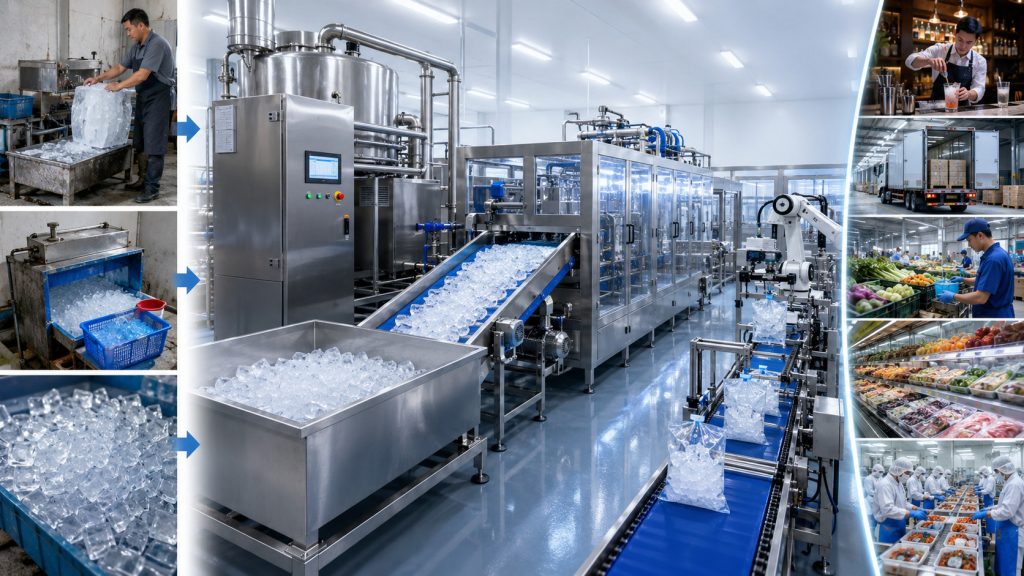
With the continuous development of the catering, cold-chain logistics, fresh food distribution, supermarket, and food processing industries, edible ice production is gradually evolving from traditional small-batch manufacturing toward continuous and automated production.
From ice making and forming to conveying, temporary storage, weighing, and packaging, a modern edible ice production line involves multiple material handling and storage processes.
Among these processes, the ice storage bin serves as an important buffer between the ice-making equipment and downstream packaging equipment.
If the ice storage bin has already reached its high-level limit while the upstream ice maker or conveyor continues feeding ice, excessive accumulation or even overflow may occur.
Conversely, if the ice level becomes too low while downstream packaging equipment continues operating, the production line may experience insufficient feeding, unstable package weights, or unnecessary equipment idling.
For this reason, installing a reliable edible ice cube level detection system in the storage bin is essential for high-level alarms, low-level detection, and automatic interlocking with upstream and downstream conveying equipment.
In this type of application, the user normally does not need to continuously measure the exact height of the ice inside the bin. Instead, the key requirement is to determine whether the ice has reached a specific position.
For such point-level detection, a rotary paddle level switch, featuring a simple operating principle and direct switching output, provides a practical solution.
2. What Are the Challenges of Edible Ice Cube Level Detection?
Compared with common bulk solids such as flour, cement, or plastic pellets, edible ice cubes are also solid materials but have very different physical characteristics.
These characteristics create several specific challenges for level detection.
2.1 Large Ice Pieces Produce Significant Mechanical Impact
Edible ice is available in various forms, including cube ice, tube ice, pellet ice, and irregular crushed ice.
When ice cubes are discharged from conveyors or elevators into a storage bin, they carry a certain amount of weight and falling velocity.
If a level switch is installed directly in the material impact zone, the sensing shaft and paddle may be continuously subjected to mechanical impact.
Therefore, compared with applications involving fine powders or lightweight particles, mechanical strength and impact resistance are particularly important when selecting a level switch for ice cubes.
2.2 Low-Temperature Conditions Place Additional Demands on Instruments
Ice storage bins generally operate in relatively low-temperature environments, and some production sites may also experience significant temperature differences.
The level switch must not only tolerate the low temperature of the ice itself but also withstand the effects of ambient temperature variations on mechanical transmission components, electrical parts, and sealing structures.
Therefore, when selecting a rotary paddle level switch, the actual process and ambient temperatures must be checked against the instrument’s specified operating ranges.
2.3 Humidity and Condensation Require Reliable Enclosure Protection
Water vapor and condensation may occur around ice conveying and storage equipment.
As a result, enclosure protection, cable entry orientation, and installation position are also important considerations.
For side-mounted level switches in particular, improper cable-entry orientation may allow condensation or moisture to accumulate around the electrical connection, increasing the risk of long-term maintenance problems.
2.4 Food Production Places Greater Emphasis on Material Selection
Food processing applications generally require greater attention to the materials of components that may come into contact with the measured medium, as well as equipment cleanliness and corrosion resistance.
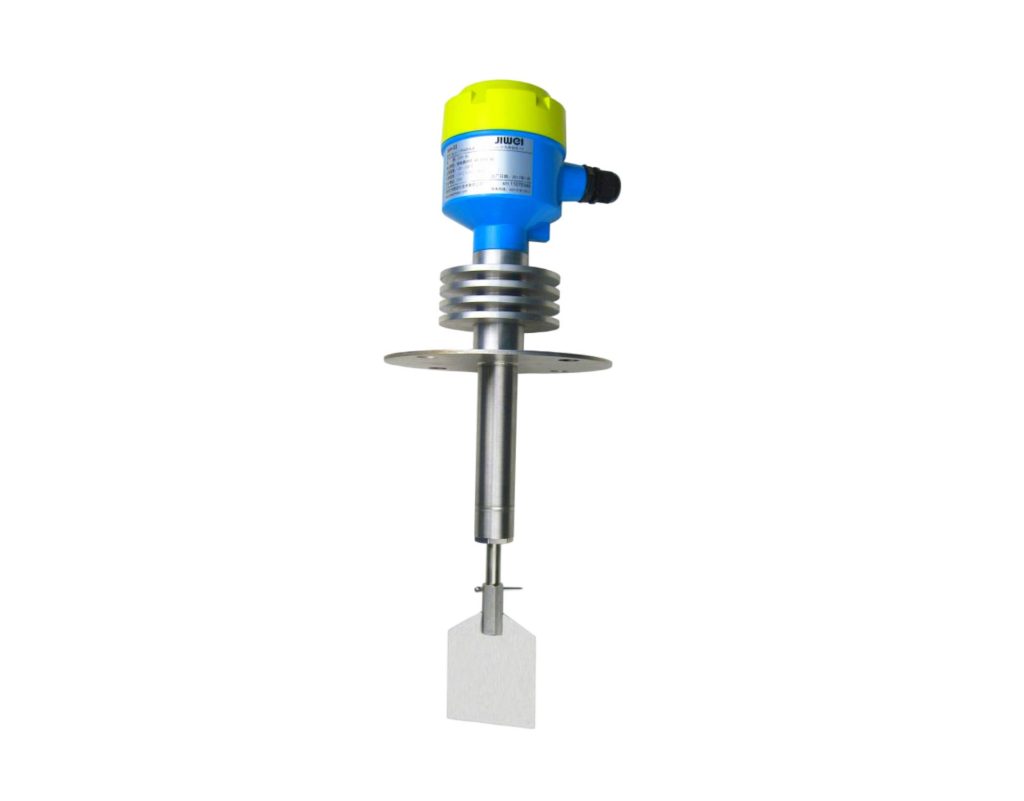
The Spin-11 series rotary paddle level switches can be supplied with 304 or 316L stainless steel process connection materials.
The Spin-11P Guard Rotary Paddle Level Switch is additionally equipped with a 304 or 316L stainless steel protective tube, providing enhanced mechanical protection for the main shaft.
For specific food production projects, the instrument materials, installation configuration, and cleaning requirements should still be evaluated according to the user’s own hygiene standards and process requirements.
3. Application Background: High-Level Detection in an Edible Ice Storage Bin
An edible ice production line uses an automated process for ice making, conveying, storage, and packaging.
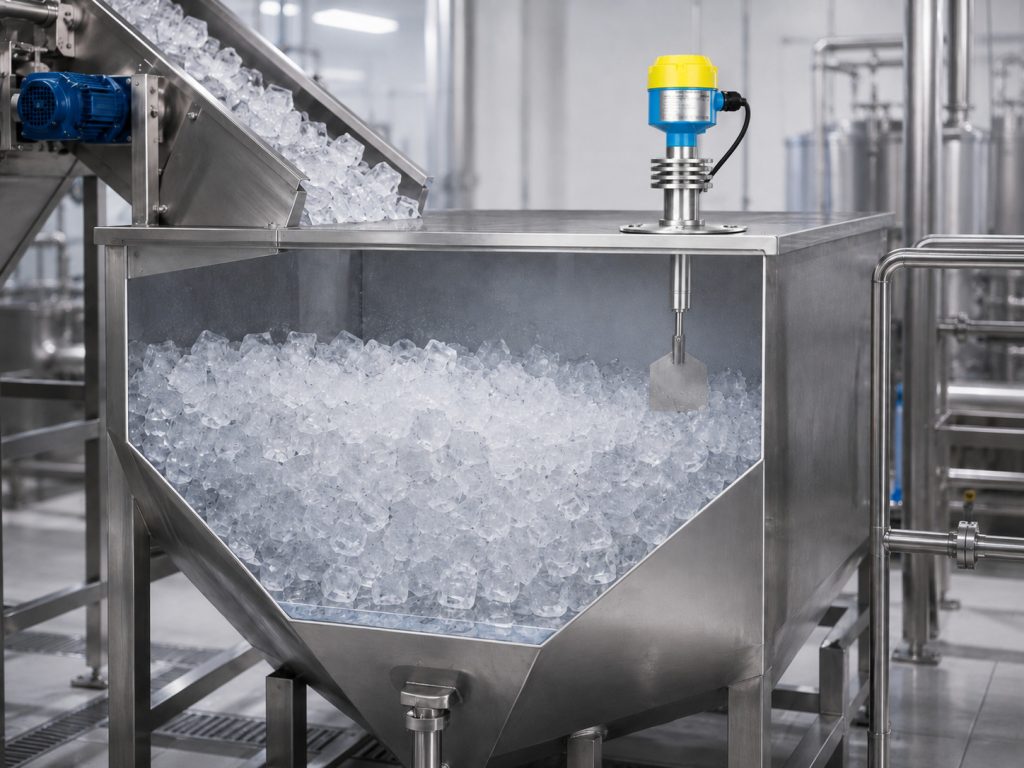
After production, the ice cubes are transported by conveying equipment into a stainless steel storage bin before being discharged from the bottom of the bin to a quantitative packaging system.
The production line requires a high-level switch to be installed in the upper section of the ice storage bin.
Under normal operating conditions, upstream equipment continuously feeds ice cubes into the bin.
When the accumulated ice reaches the preset high-level position and comes into contact with the level switch, the instrument sends a switching signal to the control system.
The PLC then generates a high-level alarm and, according to the programmed control logic, stops or delays the upstream feeding equipment.
As downstream equipment consumes the stored ice, the material level gradually falls.
Once the ice cubes move away from the sensing paddle, the level switch returns to its normal state, allowing the upstream conveying system to resume operation.
Because edible ice cubes are relatively large and can generate considerable impact when falling from conveying equipment into the storage bin, the application places particular emphasis on protecting the sensing shaft against mechanical impact.
For this reason, the Jiwei Spin-11P Guard Rotary Paddle Level Switch was selected for high-level detection.
4. Why Choose the Spin-11P Guard Rotary Paddle Level Switch?
The Jiwei Spin-11P Guard Rotary Paddle Level Switch is designed with the mechanical impact of bulk solids in mind.
A stainless steel protective tube is installed around the main shaft, helping protect it from direct material impact.
According to Jiwei’s official product information, the Spin-11P is especially suitable for solid particulate materials with relatively high bulk density. It is designed for solid particles and powders with a recommended medium density of ≥0.3 g/cm³.
This structural design makes the Spin-11P well suited to the requirements of ice storage bins.
4.1 Stainless Steel Protective Tube Reduces Impact on the Main Shaft
Ice cubes may strike the sensing assembly directly when entering the storage bin.
The protective tube of the Spin-11P allows part of this mechanical impact to be absorbed by the protection structure rather than directly by the transmission shaft.
This helps reduce the risk of mechanical damage caused by continuous falling material.
It is also one of the key reasons why the protected version is more suitable than a conventional rotary paddle switch for relatively large particles and high-impact applications.
4.2 304/316L Stainless Steel for Industrial Applications
According to Jiwei’s official specifications, the process connection and relevant structural components of the Spin-11P can be manufactured from 304 or 316L stainless steel.
These materials provide good mechanical strength and corrosion resistance.
In ice storage environments where moisture and condensation may be present, stainless steel construction also helps reduce the possibility of corrosion associated with long-term exposure to humid conditions.
4.3 Simple Operating Principle for Reliable Point-Level Detection
The Spin-11 series rotary paddle level switches use a motor to drive a sensing paddle.
When the paddle is not covered by ice cubes, the motor continuously rotates the paddle.
As the ice level rises and the material blocks the paddle, resistance prevents the paddle from rotating.
The internal detection mechanism then changes the state of the microswitch and outputs a switching signal.
When the ice level drops below the paddle, the obstruction disappears, the paddle starts rotating again, and the switch returns to its original state.
This measurement principle does not require complex algorithms and is particularly suitable for point-level applications involving simple conditions such as “material present/material absent” or “level reached/not reached.”
4.4 Suitable for Low-Temperature Production Environments
According to Jiwei’s official product specifications, the standard Spin-11P has a process temperature range of -20 to 70°C and an ambient temperature range of -40 to 85°C.
Power supply options include 24 V DC and 220 V AC, 50/60 Hz, allowing the instrument to be integrated with different industrial control systems.
Therefore, provided that the actual temperature inside the ice storage bin remains within the specified operating range, the Spin-11P can be applied to corresponding low-temperature ice level detection applications.
If the process temperature falls below the specified minimum temperature, the actual operating conditions should be carefully reviewed before selecting the instrument.
5. Installation Position Is Critical to Reliable Ice Level Detection
Selecting the right rotary paddle level switch is only the first step.
For relatively large ice cubes that create considerable mechanical impact, the installation method often has a direct influence on service life and detection reliability.
5.1 Avoid Direct Ice Impact Whenever Possible
The rotary paddle level switch should not be installed directly beneath the outlet of a conveyor or feed chute.
If the paddle is continuously hit by falling ice cubes, even a protected design will be subjected to unnecessary mechanical stress.
In addition, direct material impact may cause the switch to respond even before the ice has formed a genuine high-level condition, resulting in false triggering.
Jiwei’s installation guidelines also recommend installing the rotary paddle level switch away from the material inlet.
If this cannot be avoided, a protective baffle can be installed approximately 200 mm above the level switch to reduce direct material impact on the sensing components.
5.2 Install the Switch at a Slight Downward Angle for Side Mounting
For high-level detection in an ice storage bin, the rotary paddle switch can be installed horizontally through the side wall, depending on the bin structure.
According to Jiwei’s installation recommendations, when mounted horizontally, the sensing assembly should be installed at a downward angle of approximately 10° to 20° relative to the horizontal direction.
This helps reduce the impact of falling material on the paddle.
The cable entry of the electrical housing should also face downward, and the cable gland should be properly tightened.
This detail is particularly important in ice-making environments where condensation may occur.
5.3 Use a Recessed Installation for Large Particles and Heavy Impact
If the storage-bin structure makes it impossible to avoid vertical impact from falling ice cubes, a recessed or pocket-type installation can be considered.
By positioning the sensing element inside a protected recess in the bin wall, the instrument can be shielded from the most direct material impact.
Jiwei’s installation instructions similarly recommend recessed installation for relatively dense and large-particle materials when falling solids may directly impact the sensing probe.
For cube ice, tube ice, and other relatively large edible ice products, this installation method can significantly improve mechanical protection.
6. How Is the Rotary Paddle Level Switch Integrated into the Ice Production Control System?
For high-level control in an ice storage bin, the switching output from the Spin-11P can be connected directly to a PLC or other industrial control system.
A typical operating sequence is as follows:
Under normal feeding conditions, the ice cubes have not yet reached the high-level detection point, and the rotary paddle continues to rotate normally.
As more ice enters the storage bin and reaches the preset detection position, the material blocks the paddle.
The rotary paddle level switch then changes its output state and sends a high-level signal to the PLC.
The control system subsequently activates an alarm and stops the elevator, conveyor, or other relevant feeding equipment to prevent further accumulation inside the ice storage bin.
As downstream packaging equipment continues consuming ice, the material level gradually falls below the paddle.
The level switch then resets, allowing the control system to restart the upstream feeding process according to the programmed logic.
For production lines requiring a higher degree of automation, an additional low-level switch can be installed in the lower section of the ice storage bin.
This arrangement provides both high- and low-level control.
The high-level switch prevents overfilling, while the low-level switch helps prevent insufficient material supply to the downstream packaging equipment.
Together, they create a more stable buffer between the ice-making, storage, conveying, and packaging processes.
7. Application Benefits: From Manual Observation to Automatic Level Control
The main purpose of using a rotary paddle level switch in an edible ice storage bin is not to provide a continuous numerical level reading.
Instead, it provides a clear and reliable point-level signal for process control.
With automatic ice cube level detection, operators no longer need to frequently inspect the storage bin manually or rely solely on experience to judge the material level.
When the ice reaches the preset detection point, the control system automatically receives a high-level signal and executes the programmed control sequence.
This helps reduce the risk of overfilling, ice overflow, unnecessary conveyor operation, and ineffective feeding.
At the same time, the protective shaft structure of the Spin-11P makes the rotary paddle level switch better suited to the mechanical impact associated with falling ice cubes.
From the perspective of the entire production process, a seemingly simple ice level switch actually plays an important role in coordinating the operation of the storage bin with upstream and downstream equipment.
8. What Else Should Be Considered When Selecting an Ice Cube Level Switch?
Edible ice products vary considerably in shape, dimensions, storage-bin configuration, and operating temperature.
Therefore, it is not advisable to assume that one level switch configuration is suitable for every ice application.
Before selecting a level switch, the following operating conditions should be confirmed:
- Ice cube size and shape
- Actual temperature inside the storage bin
- Ambient temperature
- Material feeding direction
- Installation method
- Required detection position
- Power supply voltage
- Control system interface
- Mechanical impact at the installation point
One particularly important consideration is temperature.
The standard Spin-11P has a specified process temperature range starting from -20°C.
If the instrument is intended for a colder freezer or a special ultra-low-temperature environment, the actual minimum operating temperature should be communicated to the instrument manufacturer in advance so that the appropriate product configuration can be confirmed.
The standard configuration should not be applied directly without verifying the operating conditions.
In addition, a rotary paddle level switch is a point-level detection device.
If the application requires continuous information such as the remaining percentage of ice in the storage bin, real-time level trends, or inventory volume, a continuous level measurement solution should be considered according to the actual process conditions.
9. Conclusion
Edible ice cubes may appear to be a relatively simple solid material, but their large particle size, mechanical impact during loading, low-temperature operating conditions, humidity, and condensation create specific challenges for reliable level detection.
For high- and low-level detection in ice storage bins, the rotary paddle level switch provides a practical solution thanks to its straightforward operating principle, direct switching output, and suitability for solid particulate materials.
The Jiwei Spin-11P Guard Rotary Paddle Level Switch features a stainless steel protective tube designed to provide additional protection for the main shaft.
With 304/316L stainless steel structural options and a design suitable for solid particulate point-level detection, the Spin-11P can be used for high- or low-level detection in edible ice storage bins when properly selected and correctly installed.
By avoiding direct material impact and selecting the installation position according to the storage-bin structure, the level switch can provide a reliable signal for automatic interlocking between ice making, storage, conveying, and packaging equipment.
For cube ice, tube ice, pellet ice, crushed ice, and other edible ice applications, the final instrument selection should always be based on the actual ice dimensions, storage-bin structure, operating temperature, and installation conditions in order to achieve stable and reliable edible ice cube level detection.