1. What Are Medium Parameters?
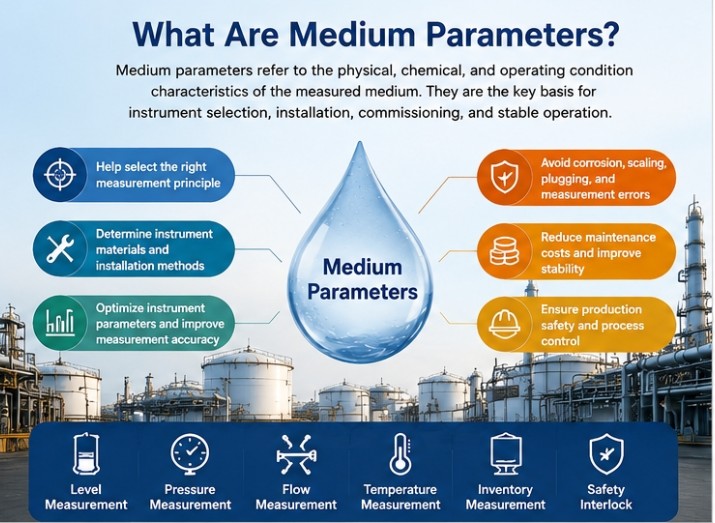
In industrial production and automatic measurement, the word “medium” usually refers to the substance being measured, transported, or processed, such as water, oil products, acid and alkali solutions, solvents, slurry, steam, powders, granular materials, and various chemical raw materials. Medium parameters refer to a series of data used to describe the physical properties, chemical properties, and operating condition characteristics of these substances.
In simple terms, medium parameters answer the basic questions of “what is being measured, what characteristics it has, and under what conditions it operates.” For instrument engineers, process engineers, and equipment selection personnel, medium parameters are not optional supplementary information. They are key data that determine whether a measurement solution can operate stably.
For example, when measuring tank level, if the medium is clean water, instrument selection is relatively simple. However, if the medium is high-temperature heavy oil, strong corrosive acid, an easily crystallized solution, or slurry containing foam, the instrument type, installation method, material selection, and parameter settings will all change significantly. This is why medium parameters are so important.
2. Why Are Medium Parameters Important?
In industrial sites, many measurement problems are not caused by poor instrument quality, but by ignoring medium characteristics during selection. If medium parameters are unclear, instruments may produce inaccurate measurements, unstable signals, frequent alarms, and even safety risks such as corrosion, blockage, or false operation.
For example, a differential pressure level transmitter needs to consider medium density during measurement. If the density changes significantly, level conversion errors may occur. A float level meter needs to contact the medium directly. If the medium has high viscosity, is easy to scale, or contains impurities, the float may become stuck. An ultrasonic level meter is easily affected by steam, foam, and temperature gradients. Although radar level meters have stronger adaptability, engineers still need to understand the dielectric constant, foam condition, volatility, and internal tank structures of the medium in order to achieve more stable echo recognition.
Therefore, the role of medium parameters is mainly reflected in three aspects. First, they help select the proper measurement principle. Second, they help determine instrument materials, measuring range, installation form, and protection rating. Third, they help engineers optimize parameters during commissioning, reducing false alarms and maintenance workload.
3. What Are the Common Medium Parameters?
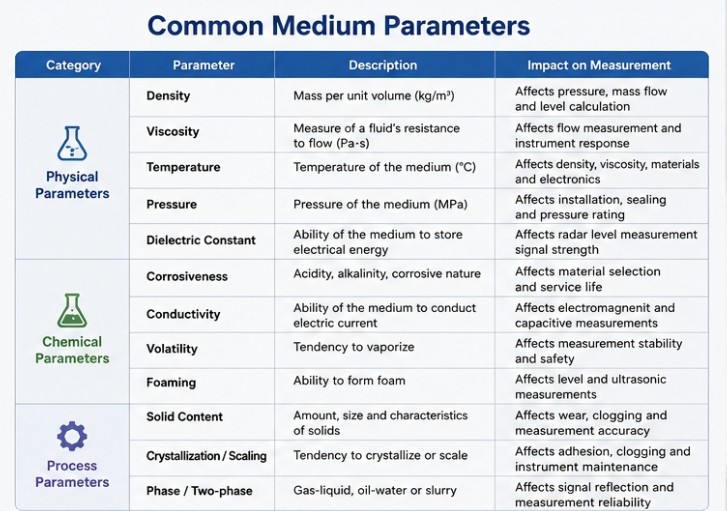
Medium parameters can usually be divided into three major categories: physical parameters, chemical parameters, and operating condition parameters.
1. Density
Density refers to the mass of a medium per unit volume. Common units include kg/m³ or g/cm³. Density has a direct impact on differential pressure level measurement, mass flow measurement, and tank inventory calculation. If medium density changes with temperature, concentration, or composition, compensation should be considered during selection and calculation.
2. Viscosity
Viscosity reflects how easily a medium flows. Water has low viscosity, while heavy oil, syrup, resin, and slurry have higher viscosity. High-viscosity media can increase pipeline resistance and may also cause delay, adhesion, and blockage in contact-type level meters, flowmeters, or impulse lines.
3. Temperature
Medium temperature determines whether the instrument requires a high-temperature-resistant structure, heat dissipation design, or special sealing materials. High-temperature media may damage electronic components and sealing parts, while low-temperature media may cause condensation, frost formation, or material embrittlement. Temperature also affects density, viscosity, dielectric constant, and vapor pressure.
4. Pressure
Pressure is an important operating parameter in pressure vessels, reactors, storage tanks, and pipeline systems. For pressurized vessels, the instrument process connection, sealing structure, and explosion-proof rating must meet site pressure requirements. Pressure fluctuations may also affect liquid surface stability, causing changes in the measurement signal.
5. Dielectric Constant
The dielectric constant is a very important parameter in radar level meter selection. It affects the reflection strength of radar waves on the medium surface. Generally speaking, water, acid solutions, and alkali solutions have higher dielectric constants and stronger echoes. Light oil products, liquefied gas, and some organic solvents have lower dielectric constants and weaker echoes, which place higher requirements on the sensitivity and signal processing capability of radar level meters.
6. Conductivity
Conductivity is often used to determine whether a medium is conductive. It has an important influence on electromagnetic flowmeters, guided wave radar level meters, and capacitive level meters. Conductive liquids and non-conductive liquids are not always suitable for the same measurement principles.
7. Corrosiveness
Corrosiveness determines the material selection of wetted instrument parts. Strong acids, strong alkalis, media with high chloride ion content, organic solvents, or high-temperature corrosive media may require special materials such as stainless steel, Hastelloy, titanium, PTFE, or PFA. Ignoring corrosiveness can shorten instrument service life and, in severe cases, may create leakage risks.
8. Volatility and Vapor
Some media are easy to volatilize and form vapor, mist, or condensate layers inside the tank. Vapor can affect ultrasonic wave propagation and may also change the radar measurement environment. For flammable and explosive volatile media, explosion-proof certification, sealing rating, and safety standards must also be considered.
9. Foam
Foam is a common interference factor in level measurement. Foam may absorb or scatter measurement signals, causing the instrument to misjudge the liquid surface position. Foaming problems may occur in fermentation tanks, sewage pools, washing towers, reactors, solvent recovery systems, and similar applications.
10. Solid Content and Particles
For slurry, mud, powder, and granular media, attention should be paid to solid content, particle size, settling behavior, and abrasiveness. Media with high solid content can easily cause blockage, wear, and sedimentation, and may also affect the stability of level, flow, and pressure measurement.
11. Crystallization, Scaling, or Adhesion
Some media are prone to crystallization, scaling, or adhesion on the instrument surface when temperature changes, concentration changes, or shutdown occurs. For these applications, contact-type measurement should be minimized as much as possible, or instruments with purging, heat tracing, and anti-adhesion structures should be selected.
4. How Do Medium Parameters Affect Instrument Selection?
Medium parameters directly determine the direction of instrument selection. Taking level measurement as an example, clean liquids can be measured by many different methods. Corrosive media require attention to material compatibility. High-temperature and high-pressure vessels require attention to process connection and pressure resistance. Low-dielectric-constant media require attention to radar frequency and signal processing capability. Tanks with foam, vapor, or agitation require attention to anti-interference algorithms and installation position.
In flow measurement, whether the medium is conductive affects whether an electromagnetic flowmeter can be used. Viscosity, density, and Reynolds number affect the applicability of vortex flowmeters, turbine flowmeters, Coriolis flowmeters, and differential pressure flowmeters. In pressure measurement, corrosiveness, crystallization, and temperature affect diaphragm material, diaphragm seal structure, and pressure tapping method. In temperature measurement, medium flow velocity, corrosiveness, and insertion depth affect the selection of thermocouples, RTDs, and thermowells.
Therefore, the more complete the medium parameters are, the more accurate the instrument selection will be, and the more stable the later operation will be. On the contrary, the more parameters are missing, the greater the uncertainty in site commissioning and maintenance.
5. What Should Be Considered When Collecting Medium Parameters?
Before project design, technical communication, or instrument procurement, it is recommended to prepare a medium parameter table in advance. At minimum, the table should include medium name, composition, normal temperature, maximum temperature, normal pressure, maximum pressure, density, viscosity, corrosiveness, dielectric constant, whether solids are present, whether foam is present, whether crystallization occurs, whether the medium is flammable or explosive, installation position, and measurement range.
It should be noted that medium parameters should not only focus on “normal values.” Extreme operating conditions must also be considered. For example, during startup, shutdown, cleaning, purging, heating, cooling, concentration fluctuation, and pressure fluctuation, the medium state may be completely different from normal production. Many instrument failures occur under unstable or non-routine operating conditions.
In addition, medium parameters should preferably come from process packages, material safety data sheets, laboratory data, or site operating experience, rather than simple estimation based on experience. For complex mixtures, the main components and variation range should also be clearly stated. Vague names such as “mixed liquid,” “waste liquid,” or “oil-water mixture” should not be used as substitutes for specific information.
6. Common Misunderstanding: Looking Only at Measuring Range and Ignoring the Medium
Many users only focus on measuring range, accuracy, and output signal when selecting instruments, while ignoring medium parameters. This is a common misunderstanding. In fact, the measuring range only tells the instrument “how large the measurement span is,” while medium parameters tell the instrument “under what environment it must measure.”
For example, two storage tanks may both have a measuring range of 0 to 10 meters. However, one is a normal-temperature water tank, while the other is a high-temperature solvent tank with vapor and low dielectric constant. The selection schemes for these two tanks may be completely different. If the instrument is selected only according to measuring range, unstable site measurement can easily occur.
Another misunderstanding is believing that high-end instruments can adapt to all operating conditions. In reality, even the most advanced instrument still requires proper selection and correct installation. If medium parameters are unclear, it is difficult for the instrument to fully perform as expected.
7. Conclusion
Medium parameters are basic information in industrial measurement and an important basis for instrument selection, installation, commissioning, and maintenance. They include not only physical parameters such as density, viscosity, temperature, pressure, dielectric constant, and conductivity, but also operating condition information such as corrosiveness, volatility, foam, crystallization, solid content, and flammable or explosive characteristics.
For level meters, flowmeters, pressure transmitters, temperature instruments, and automation control systems, accurately understanding medium parameters can reduce measurement errors, lower maintenance costs, and improve production safety and operational stability. Whether for a new project or an old plant retrofit, medium parameters should be clarified before selecting instruments. Only by truly understanding the measured medium can engineers choose a more suitable and more reliable industrial measurement solution.