1. Project Background: Level Measurement Challenges in Jam Production
A food processing enterprise mainly produces strawberry jam, blueberry jam, and mixed fruit jam. The production line is equipped with multiple stainless steel storage tanks and heating mixing tanks. The height of each tank is about 3 to 6 meters. The tanks are equipped with agitators, and the material temperature is usually maintained between 60°C and 90°C. Because steam is generated during the heating process of jam, and the material surface is constantly fluctuating due to stirring, traditional level measurement methods cannot meet the requirements of stable production.
The company had previously tried submersible level measurement, ultrasonic level meters, and pressure level transmitters, but all of them showed different degrees of problems during actual use. For example, contact-type instruments were easily adhered to by jam and required frequent cleaning; ultrasonic level meters were easily affected by steam and foam; pressure level transmitters were greatly affected by changes in material density, and installation and maintenance were inconvenient. In order to improve the automation level of the production line, the customer hoped to adopt a non-contact, low-maintenance, and more stable level measurement solution.
2. Working Condition Analysis: Why Radar Level Meters Are Suitable for Jam Level Measurement
The core difficulty of jam storage tank level measurement lies in the complex characteristics of the medium. Jam is a typical high-viscosity food material. Its dielectric constant is relatively high, which can form a good reflection signal for radar waves. This provides a good foundation for the application of radar level meters.
A radar level meter adopts the microwave measurement principle. The antenna emits electromagnetic waves toward the material surface and receives the reflected signal. The level height is calculated according to the round-trip time of the signal. Unlike ultrasonic level meters, radar waves do not rely on air as the transmission medium, so they are not easily affected by steam, temperature changes, gas stratification, or pressure changes. This is very important for jam heating tanks, cooking tanks, and mixing tanks.
In this case, the customer’s site had the following typical working conditions:
First, the material viscosity was high. Jam easily adheres to tank walls, pipelines, and contact-type probes. After long-term operation, this can cause measurement drift. A non-contact radar level meter is installed on the top of the tank and does not directly contact the material, effectively avoiding maintenance problems caused by material adhesion.
Second, steam existed inside the tank. During the heating and concentration process of jam, water vapor is generated. Ultrasonic signals are easily attenuated, while an 80GHz high-frequency radar level meter has a small beam angle, concentrated energy, and stronger anti-interference capability.
Third, there was agitation inside the tank. The agitator blades cause surface fluctuation and may also create false echoes. The radar level meter can improve measurement stability through empty tank mapping, echo curve optimization, and false echo suppression.
Fourth, the food industry has high hygiene requirements. Instruments need to meet requirements such as stainless steel construction, hygienic connections, easy cleaning, and corrosion resistance, so as to avoid contamination of the food production environment.
After comprehensive comparison, the project finally selected an 80GHz FMCW radar level meter as the level measurement solution for the jam storage tanks and mixing tanks.
3. Selection Solution: Application of 80GHz Radar Level Meter in Jam Storage Tanks
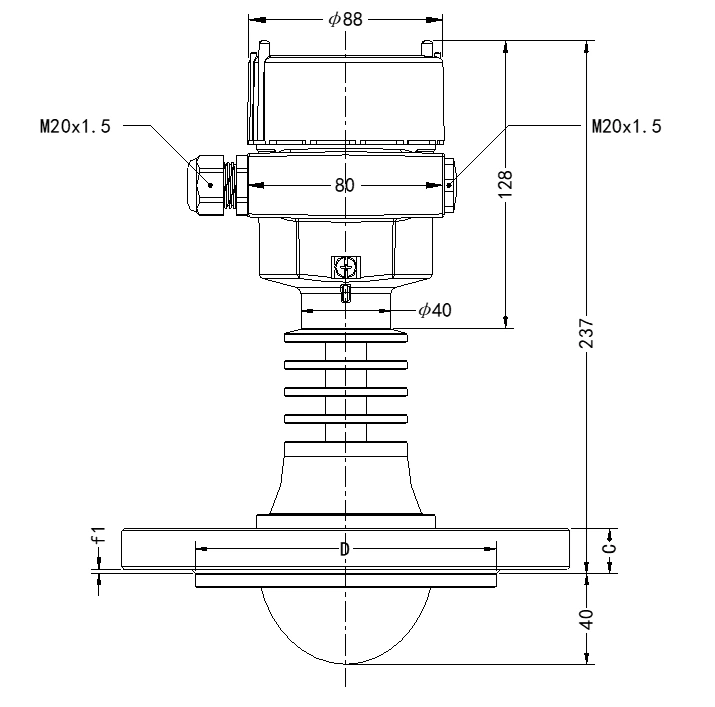
According to the customer’s site conditions, a compact 80GHz radar level meter was recommended. This product has the advantages of a small beam angle, small blind zone, high resolution, and flexible installation. It is especially suitable for small-range storage tanks, hygienic containers, high-viscosity liquids, and complex internal tank structures.
In this project, the radar level meter was mainly configured as follows:
Measurement range: 0 to 10 meters, set according to the tank height
Output signal: 4-20mA, supporting HART communication
Process connection: hygienic clamp or flange connection
Antenna material: PTFE or food-grade anti-corrosion material
Housing material: stainless steel or aluminum alloy housing
Protection grade: suitable for humid cleaning environments in food workshops
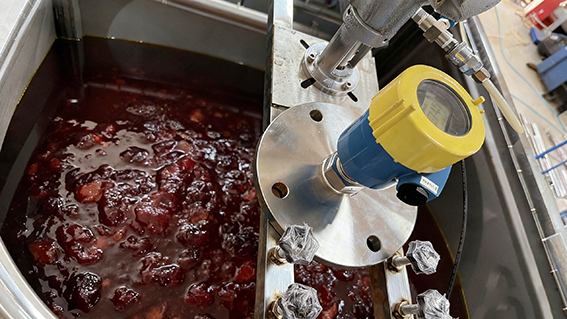
Installation position: tank top, avoiding the inlet and the central area of the agitator blades
For jam storage tank level measurement, the installation position is very important. If the radar level meter is installed directly near the feeding inlet, the falling material will create strong interference and affect echo recognition. Therefore, during on-site installation, the instrument should be installed as far as possible away from the feeding inlet, agitator blades, tank wall welds, and internal supports. At the same time, the radar beam should be directed vertically toward the material surface to obtain a more stable reflected signal.
In the mixing tank, in order to reduce false echoes generated by the agitator blades, engineers recorded the empty tank echo during the commissioning stage and blocked fixed interference signals through software. After commissioning, the instrument could stably identify the real echo from the jam surface. Even under stirring conditions and with slight foam, the output signal remained stable.
4. Implementation Process: From Site Survey to Commissioning Optimization
Before project implementation, technical personnel first carried out a detailed confirmation of the customer’s site conditions, including storage tank height, tank diameter, installation interface, material temperature, cleaning method, stirring frequency, feeding method, and control system interface. Through these parameters, it was possible to determine whether the measuring range, antenna type, process connection, and signal output mode of the radar level meter met the site requirements.
After installation, engineers performed empty tank calibration and full tank range setting for each radar level meter. Because the jam production line involved many batch changes, and the viscosity and surface condition of different flavors of jam were slightly different, strawberry jam, blueberry jam, and mixed fruit jam were tested separately during commissioning. The test results showed that the radar level meter could obtain clear echoes under different jam media, and the level output was basically consistent with manual measurement data.
During the continuous operation test, the system mainly observed the measurement performance in three stages: feeding stage, heating and stirring stage, and discharging stage. During the feeding stage, the liquid level rose rapidly, and the radar level meter responded quickly without obvious signal delay. During the heating and stirring stage, steam and surface fluctuation existed inside the tank, but the measured value fluctuated only slightly. During the discharging stage, the liquid level gradually decreased, and the instrument could continuously track the level change without signal jumping or echo loss.
Through the PLC system, the customer could view the real-time level data of each jam storage tank in the central control room and set high-level alarms, low-level alarms, and automatic feeding logic. This not only improved production efficiency, but also reduced the frequency of manual inspection.
5. Application Results: Improving Measurement Stability and Production Efficiency
After the radar level meter was put into operation, the most obvious improvement reported by the customer was the increase in measurement stability. In the past, when contact-type instruments were used, jam adhesion and probe contamination often caused inaccurate data, requiring shutdown and cleaning. After replacing them with non-contact radar level meters, the instruments no longer contacted the material directly, and the maintenance workload was significantly reduced.
Second, the production process became more controllable. Jam production has high requirements for ingredient ratio, heating time, and filling volume. Stable level data can help enterprises more accurately control inventory and production rhythm. Through the continuous level signal output by the radar level meter, the PLC system can realize automatic feeding, automatic alarm, and data recording, reducing human errors.
Third, food hygiene and safety were better guaranteed. The radar level meter is installed on the tank top and does not extend into the material, reducing cleaning dead zones and contamination risks. For food production lines that require CIP cleaning, the non-contact measurement method is easier to meet hygiene management requirements.
Fourth, the overall cost was reduced. Although the initial investment of a radar level meter is higher than that of some traditional instruments, considering later maintenance, shutdown losses, manual inspection, and costs caused by measurement errors, the radar level meter has a higher overall cost performance in jam level measurement. Especially for food enterprises with continuous production, stable and reliable level data can directly improve production management.
6. Case Summary: Radar Level Meter Is the Preferred Solution for Jam Level Measurement
Through this case of jam storage tank level measurement, it can be seen that radar level meters are very suitable for continuous level measurement of high-viscosity food materials. Facing complex working conditions such as viscous jam medium, easy wall adhesion, steam, agitation, and uneven liquid surface, the 80GHz radar level meter can provide stable and reliable measurement results with its advantages of non-contact measurement, high accuracy, strong anti-interference capability, and low maintenance.
For food processing enterprises, choosing the right level measurement instrument is not only related to the accuracy of data from a single storage tank, but also related to the automation level and product quality stability of the entire production line. In high-viscosity material measurement scenarios such as jam, syrup, honey, seasoning sauce, and tomato paste, radar level meters have become the preferred choice for more and more enterprises.
If there are problems on site such as high-temperature steam, agitation interference, foam, wall adhesion, or high hygiene requirements, it is recommended to give priority to 80GHz radar level meters and carry out professional selection, installation, and commissioning according to the actual storage tank structure. Reasonable product selection, correct installation position, and accurate parameter setting are the keys to ensuring the long-term stable operation of radar level meters.
In summary, using a radar level meter to measure jam can not only solve the problems of frequent maintenance, inaccurate measurement, and weak anti-interference capability commonly found in traditional level meters, but also help food enterprises achieve more efficient, safer, and smarter production management. For jam manufacturers that are upgrading their automated production lines, the radar level meter is a reliable measurement solution worthy of long-term investment.