
1. What Is the Difference Between 26GHz and 80GHz Radar Level Transmitters?
A radar level transmitter is a non-contact instrument that uses microwave signals to continuously measure the level of liquids or bulk solids. Radar level measurement is widely used in industries such as chemicals, petroleum, water and wastewater treatment, food and beverage, pharmaceuticals, power generation, cement, mining, and grain storage.
The two most common types of high-frequency radar level transmitters used in industrial applications are 26GHz radar level transmitters and 80GHz radar level transmitters.
Their basic measurement principles are similar. The instrument transmits a radar signal toward the surface of the measured material. When the radar wave reaches the surface of a liquid or solid, part of the signal is reflected back to the instrument. The transmitter calculates the distance to the material surface based on the time difference or frequency difference between the transmitted and received signals.
The most important difference between the two technologies is their operating frequency.
A higher operating frequency produces a shorter wavelength. With a comparable antenna size, a shorter wavelength generally creates a narrower and more focused radar beam. As a result, 80GHz radar level transmitters often offer significant advantages in complex vessels, small mounting connections, narrow tanks, and applications where internal obstacles are present.
However, this does not mean that an 80GHz radar transmitter is always better than a 26GHz model.
The final selection must also consider the properties of the measured material, vapor, condensation, foam, dust, vessel geometry, installation conditions, temperature, pressure, and required measuring range. In some applications involving heavy vapor or relatively simple vessel structures, a 26GHz radar transmitter—or even a lower-frequency radar instrument—may still be the more suitable solution.
2. Parameter Comparison: 26GHz vs. 80GHz Radar Level Transmitters
| Comparison Item | 26GHz Radar Level Transmitter | 80GHz Radar Level Transmitter |
|---|---|---|
| Operating frequency | Approximately 26GHz | Approximately 80GHz |
| Radar wavelength | Longer | Shorter |
| Beam angle | Relatively wide | Narrower and more focused |
| Antenna size | Usually larger | Smaller antennas are possible |
| Mounting opening | Generally requires a larger opening | Suitable for small process connections |
| Ability to avoid obstacles | Moderate | Strong |
| Short-distance measurement | Dead zone may be more noticeable, depending on the model | Some models offer a very small dead zone or near-zero blocking distance |
| Suitability for small vessels | Moderate | Very good |
| Suitability for complex vessels | Requires careful installation to avoid interference | Narrow beam can avoid agitators, coils, supports, and other internal structures |
| Bulk-solid measurement | Suitable for conventional silos | Well suited to tall, narrow silos and complex material surfaces |
| Typical accuracy | Depends on model and process conditions | High-performance models can provide millimeter-level accuracy |
| Commissioning complexity | May require more false-echo suppression | Focused beam often simplifies setup |
| General cost | Often lower, with many mature product options | Initial purchase cost may be higher |
| Typical applications | Standard storage tanks, simple silos, and retrofit projects | Precision measurement, complex vessels, small connections, and tall silos |
It is important to understand that measurement accuracy, maximum measuring range, process temperature, and process pressure are not determined by operating frequency alone.
These specifications also depend on:
- Transmitting power
- Antenna design
- Signal-processing algorithms
- Process connection
- Sealing materials
- Sensor construction
- Electronics design
- Installation quality
For example, some modern 80GHz industrial radar instruments can offer millimeter-level accuracy and measuring ranges exceeding 100 meters in bulk-solid applications. However, these specifications should not be applied to every 80GHz radar transmitter. The actual performance must always be confirmed using the technical datasheet for the selected model.
3. Beam Angle Comparison: Why Is 80GHz Better for Complex Vessels?
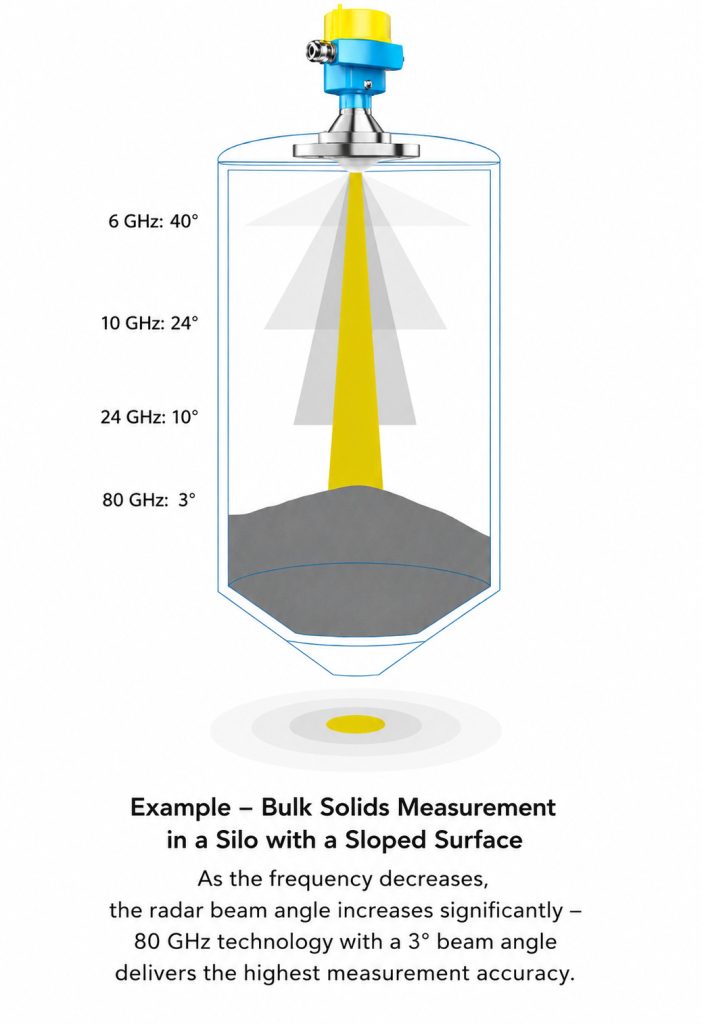
Beam angle is one of the most important parameters affecting radar level measurement stability.
A wider radar beam covers a larger area inside the vessel. This increases the possibility that the radar signal will contact the tank wall, heating coils, agitators, inlet pipes, reinforcement structures, ladders, or other internal components.
These objects may create false echoes that interfere with the actual material-level signal.
With a similar antenna size, an 80GHz radar transmitter normally produces a much narrower beam than a 26GHz radar transmitter.
For example, with an antenna diameter of approximately 75 to 80 millimeters, some 80GHz radar transmitters can achieve a beam angle of about 3° to 4°. By comparison, a similarly sized 26GHz radar antenna may have a beam angle of approximately 10°, although actual values vary by manufacturer and antenna design.
A narrow radar beam provides several practical advantages:
- It can avoid agitators, heating coils, pipes, and vessel-wall attachments more effectively.
- It is better suited for installation close to the tank wall.
- It can operate through smaller flanges, threaded connections, or mounting openings.
- It reduces reflections from the vessel wall and internal structures.
- It is easier to aim at the material surface in narrow tanks, deep wells, and tall silos.
- It can improve measurement reliability when only a limited installation position is available.
For vessels with complex internal structures, restricted mounting locations, or small existing openings, an 80GHz radar level transmitter usually makes it easier to obtain a strong and stable level echo.
4. Measurement Accuracy and Resolution
An 80GHz radar transmitter has a shorter wavelength and can support a wider signal bandwidth. These characteristics provide the technical basis for improved distance resolution and more accurate echo identification.
In small vessels, precision liquid-level applications, and processes where level changes are very small, an 80GHz radar transmitter can often distinguish the true level signal from nearby interference more clearly.
Some high-performance 80GHz radar liquid level transmitters offer a stated measurement accuracy of approximately ±1 millimeter. Certain compact models can provide accuracy of around ±2 millimeters.
However, actual field accuracy may be affected by many factors, including:
- Dielectric constant of the measured material
- Liquid turbulence
- Agitation
- Foam on the liquid surface
- Angle of repose in bulk-solid applications
- Dust concentration
- Vapor density
- Condensation on the antenna
- Material buildup or adhesion
- Installation direction
- Measurement-range configuration
- False-echo suppression settings
- Strong reflective structures inside the vessel
Therefore, when comparing 26GHz and 80GHz radar level transmitters, users should not focus only on the best accuracy stated in a product brochure.
The quality of the actual echo signal, stability under process conditions, repeatability, installation tolerance, and long-term reliability are equally important.
5. Antenna Size and Installation Requirements
A 26GHz radar level transmitter generally requires a relatively large antenna to achieve good signal focusing.
For storage tanks that already have a large flange connection, this is usually not a problem. There are also many mature 26GHz radar models available, supported by extensive industrial application experience.
Because 80GHz radar operates at a higher frequency, it can form a narrow beam using a smaller antenna.
This makes 80GHz radar transmitters particularly suitable for:
- Small storage tanks
- Compact process vessels
- Reactors with limited installation space
- Small threaded process connections
- Small-diameter nozzles
- Measurement through plastic vessel roofs
- Retrofit projects with small existing openings
- Mounting points close to the vessel wall
- Hygienic or sanitary applications
- Skid-mounted processing equipment
Some 80GHz radar level sensors can measure through the top of a non-conductive plastic container. Others use compact threaded or flange connections, helping reduce the need for vessel modification, large openings, additional flanges, and extended shutdown periods.
For retrofit projects, the ability to install a radar transmitter through a small existing process connection can significantly reduce installation costs.
6. Comparison for Liquid and Bulk-Solid Measurement
6.1 Liquid Storage Tanks
Both 26GHz and 80GHz radar liquid level transmitters can be used to measure water, wastewater, acids, alkalis, oils, fuels, solvents, slurries, and many other liquids.
When the storage tank has a simple structure, a large diameter, and no significant internal obstacles, a 26GHz radar transmitter can normally meet standard liquid-level measurement requirements.
The technology is mature, widely used, and often provides a good balance between performance and cost.
An 80GHz radar transmitter is usually more advantageous when the tank contains:
- Agitators
- Heating coils
- Baffles
- Internal piping
- Support structures
- Narrow chambers
- Restricted mounting points
The narrow radar beam helps prevent interference from these internal components.
An 80GHz radar level transmitter is also a strong choice for small process vessels, hygienic tanks, reactors, batching vessels, and applications requiring high measurement accuracy.
6.2 Bulk-Solid Silos
Bulk-solid surfaces are often uneven. The material may form a sloping surface, a funnel-shaped surface, or an irregular pile during filling and discharge.
Bulk-solid applications may also involve:
- Heavy dust
- Material buildup
- Long measuring distances
- Weak reflections
- Pneumatic filling
- Strong inlet impact
- Internal support structures
- Narrow or tall silo geometry
Typical materials include cement, coal powder, mineral ore, plastic pellets, grain, animal feed, fly ash, sand, limestone, and chemical powders.
The focused beam of an 80GHz radar level transmitter can be directed toward the preferred measuring point at the bottom of the silo or toward the main material surface.
This reduces reflections from the silo wall and internal supports.
Some 80GHz radar transmitters designed for bulk solids provide measuring ranges of up to approximately 120 meters and beam angles of around 3°. These characteristics make them suitable for tall silos, large storage facilities, and complex bulk-solid applications.
However, frequency alone does not guarantee successful measurement.
In applications involving extremely heavy dust, complete antenna burial, severe material buildup, strong condensation, or special gases that absorb radar energy, users must also consider:
- Antenna design
- Antenna purge systems
- Mounting angle
- Sensor aiming devices
- Signal sensitivity
- Dynamic range
- Echo mapping
- Installation location
- Protective covers
A field test or detailed application review may be necessary before final selection.
7. Resistance to Dust, Vapor, Foam, and Condensation
Radar level transmitters are generally less affected by temperature, pressure, and changes in the speed of sound than ultrasonic level transmitters.
This makes radar technology suitable for process vessels involving vapor, pressure fluctuations, temperature changes, and difficult atmospheric conditions.
An 80GHz radar transmitter provides strong beam focusing and high echo resolution. Under many operating conditions, it can produce a clear measurement signal despite moderate dust, condensation, light antenna buildup, or complex vessel geometry.
Modern 80GHz radar transmitters are widely used in applications involving:
- Dust
- Condensation
- Adhesive materials
- Corrosive liquids
- Steam
- Process vapor
- Turbulent surfaces
- Complex internal structures
However, a higher operating frequency does not automatically provide stronger penetration.
In environments with extremely dense vapor, thick foam, severe coating on the antenna, or gases with strong microwave absorption characteristics, a 26GHz radar transmitter or a lower-frequency radar instrument may provide more suitable propagation characteristics.
For this reason, users should not select a radar instrument simply according to the idea that a higher frequency is always more advanced.
A complete process description should be provided to the radar level transmitter supplier, including information about:
- Material type
- Dielectric constant
- Temperature
- Pressure
- Vapor
- Dust
- Foam
- Condensation
- Corrosion
- Material buildup
- Tank dimensions
- Internal structures
- Required accuracy
8. Main Advantages of a 26GHz Radar Level Transmitter
Although 80GHz radar technology has developed rapidly, 26GHz radar level transmitters still provide important advantages in many industrial applications.
The main benefits include:
- Mature and proven measurement technology
- Extensive global application experience
- A wide selection of antennas, flanges, and process connections
- Stable performance in simple, large storage tanks
- Easy replacement of older radar instruments with compatible mounting dimensions
- Potentially lower purchase cost
- Good cost-effectiveness for standard measurement projects
- Suitable performance in certain vapor, condensation, or special-material applications
- Broad availability from multiple instrument manufacturers
- Familiar commissioning and maintenance procedures
When the vessel structure is simple, installation space is sufficient, the material has good reflective properties, and extremely high accuracy is not required, a 26GHz radar level transmitter can still be a dependable and economical choice.
9. Main Advantages of an 80GHz Radar Level Transmitter
The main advantages of an 80GHz high-frequency radar level transmitter include:
- Narrower beam angle
- Reduced interference from vessel walls and internal structures
- Smaller antenna size
- Compatibility with small process connections
- Better performance in small vessels
- Strong short-distance measuring capability
- High echo resolution
- Easier identification of the true material-level signal
- Suitability for narrow tanks and tall silos
- Reduced commissioning complexity
- Lower dependence on extensive false-echo suppression
- Millimeter-level accuracy on high-performance models
- Very long measuring ranges on selected bulk-solid models
- Greater flexibility for difficult mounting locations
- Improved performance near agitators, coils, and pipes
An 80GHz radar level transmitter is particularly suitable for new automation projects, precision chemical processes, hygienic applications, compact reactors, complex storage tanks, tall bulk-solid silos, and applications requiring flexible installation.
10. How to Select Between 26GHz and 80GHz Radar Level Transmitters
The correct radar level transmitter should be selected according to the complete application rather than operating frequency alone.
The following factors should be carefully evaluated.
10.1 Measured Material
Determine whether the material is a liquid, slurry, powder, granule, or bulk solid.
Important material properties include:
- Dielectric constant
- Corrosiveness
- Adhesiveness
- Conductivity
- Volatility
- Density
- Dust generation
- Surface movement
- Foam formation
Materials with a low dielectric constant generate weaker radar reflections. These applications may require a radar transmitter with a high dynamic range and advanced signal-processing capability.
10.2 Measuring Range
Select the required measuring range according to the vessel height and reserve an appropriate safety margin.
For bulk-solid silos, consider:
- Sloping material surfaces
- Filling cones
- Discharge funnels
- Variations during filling and emptying
- Mounting distance from the silo bottom
- Possible material buildup
The maximum measuring range should not be the only consideration. The minimum measuring distance and blocking distance are also important.
10.3 Vessel Structure
When the vessel contains agitators, coils, supports, pipes, ladders, or reinforcement structures, an 80GHz radar transmitter with a narrow beam is usually preferred.
When the vessel has a simple internal structure and an unobstructed signal path, both 26GHz and 80GHz instruments may be suitable.
The final choice can then be based on budget, required accuracy, installation conditions, and maintenance expectations.
10.4 Process Connection
An 80GHz radar transmitter offers a clear advantage when the installation opening is small or when the mounting point is close to the vessel wall.
A 26GHz radar transmitter may be more convenient when an existing tank already has a large flange or when an older 26GHz instrument is being replaced directly.
Users should verify:
- Thread size
- Flange size
- Nozzle diameter
- Nozzle length
- Antenna extension requirements
- Hygienic connection standards
- Sealing materials
10.5 Process Temperature and Pressure
The temperature and pressure capabilities of a radar level transmitter depend on its process connection, antenna, housing, sealing materials, and mechanical design.
These limits cannot be determined by frequency alone.
High-temperature, high-pressure, vacuum, cryogenic, or strongly corrosive applications require careful review of the technical datasheet.
10.6 Vapor, Dust, Foam, and Condensation
Determine whether the application involves:
- Heavy dust
- Thick foam
- Steam
- Dense vapor
- Condensation
- Antenna coating
- Sticky materials
- Material buildup
When necessary, select a radar transmitter with:
- An antenna purge connection
- An anti-condensation design
- A non-stick antenna surface
- An extended antenna
- A protective cover
- A suitable sealing system
- A high dynamic range
10.7 Output and Communication Options
Common output and communication options include:
- Two-wire 4–20mA
- HART
- RS485
- Modbus
- Profibus
- Foundation Fieldbus
- Industrial Ethernet
- Bluetooth commissioning
- Wireless configuration
For smart-factory projects, users may also consider remote diagnostics, historical data recording, condition monitoring, digital communication, and mobile-device configuration.
11. Frequently Asked Questions
Is an 80GHz radar level transmitter always better than a 26GHz transmitter?
No.
An 80GHz radar transmitter usually offers better beam focusing, smaller process connections, improved performance in complex vessels, and higher measurement resolution.
However, a 26GHz radar transmitter can still provide excellent performance in standard storage tanks, retrofit projects, and certain vapor or condensation applications.
The most suitable technology depends on the complete process conditions.
Will 26GHz radar level transmitters become obsolete?
They are unlikely to disappear in the near future.
Industrial applications vary significantly, and no single radar frequency is ideal for every process.
The 26GHz technology is mature and continues to provide stable and reliable measurement in many standard liquid tanks and bulk-solid silos.
Is 80GHz radar suitable for measuring solid particles?
Yes.
The narrow radar beam reduces interference from silo walls and internal structures and can be aimed more precisely at sloping or irregular material surfaces.
For this reason, 80GHz radar is commonly used to measure cement, ore, coal powder, grain, plastic pellets, animal feed, and other bulk materials.
Is a longer radar measuring range always better?
No.
The measuring range should match the actual vessel height and process requirements.
In addition to maximum range, users should evaluate:
- Minimum measuring distance
- Blocking distance
- Signal dynamic range
- Material reflectivity
- Antenna size
- Beam angle
- Mounting position
- Required accuracy
A radar transmitter with an extremely long stated range may not necessarily provide the best result in a small or complex vessel.
Can an 80GHz radar level transmitter be installed close to the tank wall?
In many applications, yes.
Its narrow beam helps reduce reflections from the vessel wall, making it more tolerant of mounting positions close to the side of the tank.
However, the installation must still follow the manufacturer’s recommended clearance and alignment requirements.
Can radar measure through a plastic tank?
Some radar level transmitters can measure through non-conductive plastic vessel walls or roofs.
The feasibility depends on the plastic material, thickness, vessel structure, mounting arrangement, and radar model.
Metal structures, conductive coatings, reinforcement, and moisture may affect the measurement.
12. Conclusion
A 26GHz radar level transmitter offers mature technology, broad application experience, stable performance, and good cost-effectiveness.
It is well suited to liquid storage tanks and bulk-solid silos with simple internal structures, sufficient installation space, and standard measurement requirements.
An 80GHz radar level transmitter provides a narrower beam, smaller antenna, higher resolution, and stronger ability to avoid internal obstacles.
It is particularly suitable for:
- Small vessels
- Complex storage tanks
- Tall silos
- Narrow containers
- Mounting points close to vessel walls
- Small process connections
- High-accuracy measurement
- Difficult bulk-solid applications
In practical radar level transmitter selection, frequency should not be considered as the only deciding factor.
Users should evaluate the measured material, vessel geometry, measuring range, process connection, process temperature, pressure, vapor, dust, foam, condensation, communication requirements, and installation conditions.
Selecting the right operating frequency, antenna design, process connection, and instrument model according to actual field conditions is the best way to achieve stable long-term measurement while reducing installation, commissioning, and maintenance costs.