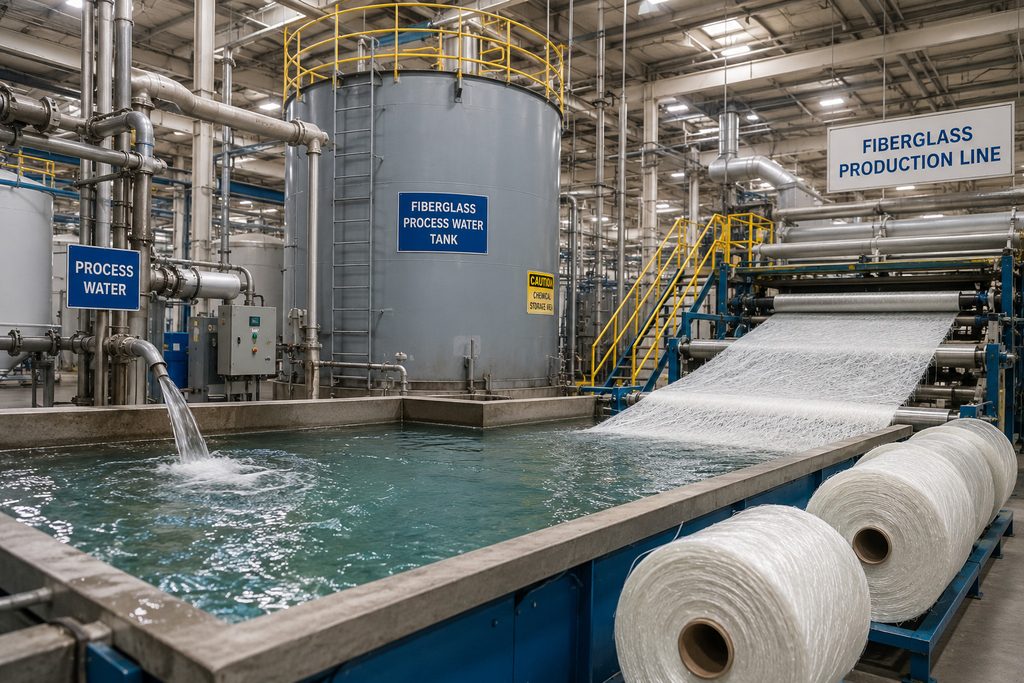
In fiberglass manufacturing, water is not only an important utility medium but also plays a key role in cleaning, circulation, cooling, slurry preparation, and certain wet-process production operations. Particularly in fiberglass mat and other wet-laid fiberglass production lines, process water may contain chopped glass fibers, suspended solids, and small amounts of process additives. As a result, the liquid surface conditions can be considerably more complex than those found in an ordinary clean-water storage tank.
For fiberglass process water tanks, recycling tanks, and intermediate water tanks, stable and reliable level measurement is essential. Accurate liquid level data directly affects water replenishment, drainage, circulation pump operation, and the continuous operation of the production line. If the level measurement fluctuates, produces false high-level readings, or loses the signal, it may lead to pump dry running, tank overflow, or disruption of downstream processes.
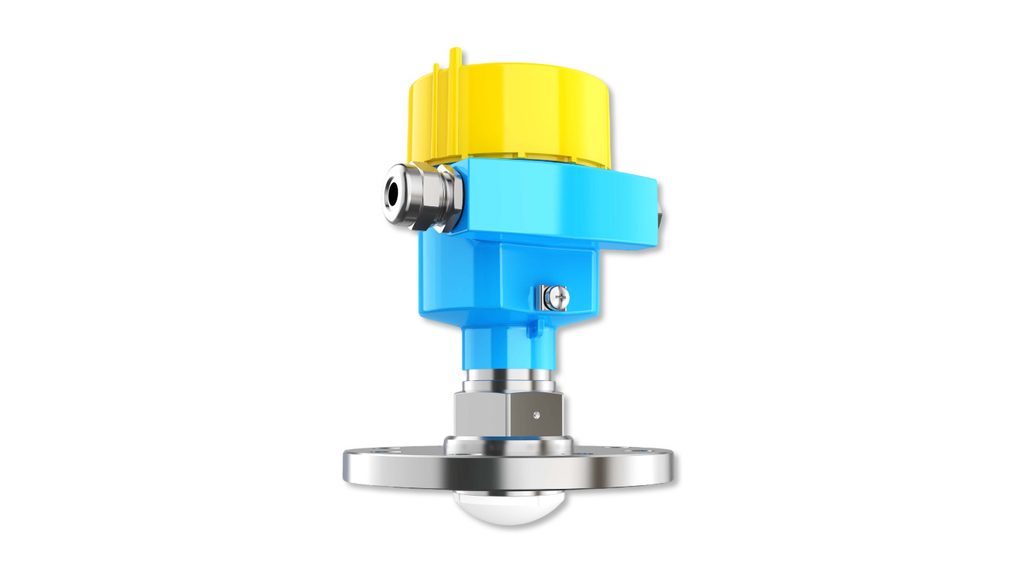
During an automation upgrade at a fiberglass manufacturing plant, continuous level measurement was required for a fiberglass process water tank. Considering the presence of water vapor, liquid surface fluctuations, suspended glass fibers, and internal tank obstructions, the JWrada-32 radar level meter was selected for non-contact liquid level measurement.
After installation and parameter configuration, the JWrada-32 provided continuous and stable level monitoring, supplying reliable level signals for water replenishment, transfer pumps, and high/low-level control.
Why Does Fiberglass Process Water Require Continuous Level Measurement?
Fiberglass manufacturing involves more than melting raw materials and drawing fibers. In the production of fiberglass mats and other wet-process fiberglass products, water is widely used for cleaning, circulation, slurry preparation, white-water recycling, and wastewater treatment.
For example, process water generated during fiberglass mat production may contain small amounts of chopped glass fibers and production additives. After collection, filtration, sedimentation, and other treatment processes, part of the water can be returned to the production system for reuse.
For this reason, fiberglass plants commonly use various process water tanks, recycling tanks, intermediate tanks, and water collection pits.
The liquid level in these tanks must often be coordinated with pump operation. For example, when the water reaches a predefined high level, a transfer pump may start automatically. When the liquid level drops to a low setpoint, the pump may stop, or the water replenishment system may be activated.
Without accurate and continuous level information, it is difficult to automate the entire process water circulation system.
Manual level inspection can only provide an approximate indication of the water level. It cannot deliver continuous measurement data and is unsuitable for direct integration with a PLC or DCS.
Therefore, a continuous level measurement instrument is an important component in the automation of fiberglass production facilities.
Challenges of Fiberglass Process Water Level Measurement
At first glance, fiberglass process water may appear to be simply “water,” which can lead to the assumption that measuring its level is no different from measuring clean water.
In practice, however, the operating conditions can be much more complicated.
In this application, the liquid inside the tank came from the fiberglass production water circulation system and contained a small amount of suspended glass fibers. As water entered the tank and was continuously circulated and pumped out, the liquid surface was constantly changing.
Several measurement challenges had to be considered.
1. Continuous Liquid Surface Fluctuations
When process water enters the storage tank through a pipeline, the incoming flow can cause significant turbulence and surface fluctuations.
If a radar level meter is installed too close to the inlet, the reflected signal may vary as the liquid surface moves, resulting in unstable level readings.
For this reason, the instrument must have reliable echo-processing capability, and its installation position should be selected away from the direct impact zone of the incoming water.
2. Glass Fibers and Suspended Solids in the Water
Unlike tap water or purified water, fiberglass process water may contain chopped glass fibers and other suspended materials.
These fibers can accumulate near the liquid surface and create an uneven surface condition.
For contact-type level instruments, continuous exposure to this type of medium may also increase the risk of material buildup, fiber entanglement, and maintenance requirements.
A non-contact radar level meter avoids direct contact between the sensing element and the fiberglass process water, reducing the influence of fiber buildup and contamination.
3. Internal Tank Obstructions
Process water tanks may contain inlet pipes, support structures, reinforcement ribs, ladders, or other internal components.
When radar signals strike these fixed objects, additional reflections can be generated.
If the level meter cannot correctly distinguish between the actual liquid surface echo and false echoes generated by internal structures, inaccurate or false level readings may occur.
This makes interference suppression and proper installation especially important when selecting a radar level meter for complex tanks.
4. Water Vapor and Condensation
Depending on process water temperature and ambient conditions, water vapor or condensation may develop near the top of the tank.
For some contact measurement technologies, contamination and buildup can gradually affect measurement reliability.
Radar level measurement uses electromagnetic waves. With proper instrument selection, installation, and configuration, it can reduce the influence of many environmental factors on continuous liquid level measurement.
5. Stable Signals Are Required for Process Automation
In this application, the objective was not simply to display a liquid level value. The measurement signal had to be transmitted to the plant control system.
The level data was used for water replenishment, transfer operations, and high/low-level control.
Frequent signal fluctuations, false readings, or signal loss could therefore result in incorrect control actions.
For this type of application, long-term measurement stability is just as important as measurement accuracy.
Why Was the JWrada-32 Radar Level Meter Selected?
For the fiberglass process water tank, both contact and non-contact level measurement technologies were evaluated.
After considering the characteristics of the medium, tank configuration, installation conditions, maintenance requirements, and automation requirements, the JWrada-32 radar level meter was selected.
The JWrada-32 uses 80 GHz FMCW radar technology. The antenna transmits high-frequency electromagnetic waves toward the liquid surface. When the radar signal reaches the surface of the medium, part of the signal is reflected back toward the antenna.
The instrument processes the transmitted and reflected signals to determine the distance between the radar antenna and the liquid surface. Combined with the configured tank dimensions, this distance is converted into the actual liquid level.
Because the radar antenna does not need to be immersed in the process liquid, the JWrada-32 is particularly suitable for applications where reducing material buildup and maintenance is important.
For this fiberglass process water application, the radar level meter offered several significant advantages.
Why Is 80 GHz Radar Suitable for Fiberglass Process Water Tanks?
Narrow Beam Angle Helps Avoid Internal Obstructions
A higher radar frequency does not automatically mean that it is the best solution for every level measurement application. However, in tanks containing pipes, supports, reinforcement structures, or other fixed obstacles, a narrower radar beam can help reduce unwanted reflections.
The JWrada-32 uses 80 GHz radar technology, providing a relatively focused radar beam.
With proper installation, the radar beam can be directed toward a stable section of the liquid surface while avoiding inlet pipes, tank walls, and other internal structures as much as possible.
This characteristic is particularly useful for process water tanks with limited diameter or complex internal construction.
Non-Contact Measurement Reduces Fiber Buildup and Entanglement
When a level sensor is continuously immersed in process water containing glass fibers, fibers may gradually adhere to the probe or sensing element.
Under some operating conditions, fiber entanglement may also occur.
The JWrada-32 uses non-contact measurement. Under normal installation conditions, its radar antenna is positioned above the process medium and does not need to be submerged in the fiberglass water.
This helps reduce measurement problems associated with fiber adhesion and entanglement while also decreasing routine cleaning and maintenance requirements.
FMCW Technology Supports Continuous Level Monitoring
FMCW stands for Frequency-Modulated Continuous Wave.
The radar continuously transmits a frequency-modulated signal and analyzes the frequency difference between the transmitted signal and the reflected echo to determine the distance to the liquid surface.
For industrial storage and process tanks, the requirement is generally not a simple “full” or “empty” indication. Operators need continuous information about the actual liquid level.
The JWrada-32 provides a continuous level signal that can be transmitted to a PLC, DCS, or other automation system.
Based on the process requirements, high-level alarms, low-level alarms, pump start/stop logic, and other control functions can then be implemented.
JWrada-32 Configuration for the Fiberglass Water Application
The JWrada-32 was configured according to the tank height, process connection, and plant control system requirements.
The 80 GHz radar level meter provided a measurement range sufficient to cover the complete operating level of the fiberglass process water tank.
A 4–20 mA output was used to transmit the continuous level signal to the PLC analog input module, allowing operators to monitor the real-time liquid level from the control room.
For applications requiring digital communication, HART or RS485/Modbus communication can also be selected according to the automation architecture and project requirements.
The process connection was selected according to the existing tank-top connection, using a suitable flange or other mounting arrangement to ensure secure installation of the radar level meter.
It is important to note that measurement range, process connection, antenna material, output signal, and other configuration parameters should not be selected solely according to general product specifications.
The actual tank dimensions, medium characteristics, connection size, process conditions, and control system requirements should all be evaluated before finalizing the instrument configuration.
Installation Position Is Critical for Reliable Level Measurement
Correct instrument selection does not guarantee good measurement performance if the radar level meter is installed incorrectly.
For radar level measurement, the mounting position has a significant influence on actual performance.
Several factors were considered when installing the JWrada-32 in this application.
1. Avoid Installing Directly Above the Water Inlet
When process water enters the tank, the incoming stream continuously disturbs the liquid surface.
If the radar beam is directed at this area, the instrument may detect turbulent water, splashing, or the incoming stream instead of a stable liquid surface.
The radar level meter should therefore be installed at a reasonable distance from the inlet and away from areas experiencing strong turbulence.
2. Avoid Mounting Too Close to the Tank Wall
If the radar level meter is installed too close to the tank wall, part of the radar beam may strike the wall, reinforcement ribs, or other structural components.
These objects can generate unwanted echoes.
The mounting position should therefore be selected according to the tank diameter and available top connections so that the main radar beam is directed toward the actual liquid surface.
3. Avoid Internal Pipes and Support Structures
In an existing tank, internal structures usually cannot be relocated simply to accommodate a level instrument.
The practical solution is to select a radar mounting position that avoids inlet pipes, ladders, support rods, and other fixed obstructions.
If some structures cannot be completely avoided, false-echo suppression can be performed during commissioning based on the actual echo profile.
4. Ensure Correct Antenna Orientation
The radar antenna should be directed toward the target liquid surface.
If the mounting flange is significantly inclined or the antenna points toward the tank wall, the quality of the effective return signal may be reduced.
After mechanical installation, the antenna orientation should therefore be checked carefully rather than simply confirming that the process connection has been tightened.
Commissioning the JWrada-32 Radar Level Meter
After installation, the radar level meter must be configured according to the actual process conditions.
For this project, the measurement reference point, empty-tank distance, and actual operating level range were first confirmed. The corresponding measurement parameters were then entered into the instrument.
The radar echo and level trend were observed while the tank was filling and draining under normal operating conditions.
Reflections generated by fixed pipes, tank structures, and other internal components were identified during commissioning. Where necessary, false-echo suppression was used so that the instrument could reliably track the actual liquid surface.
Because the fiberglass process water surface could experience short-term fluctuations, the response time and damping parameters also had to be adjusted according to the actual process conditions.
Excessive damping is not always desirable.
If damping is set too high, the displayed level may appear extremely stable, but the instrument may respond too slowly when the actual liquid level changes rapidly.
If damping is too low, short-term fluctuations caused by incoming water may be transmitted directly to the control system.
The optimum setting therefore depends on tank volume, pumping rate, process dynamics, and the requirements of the level control system.
Results After the Radar Level Meter Was Put into Operation
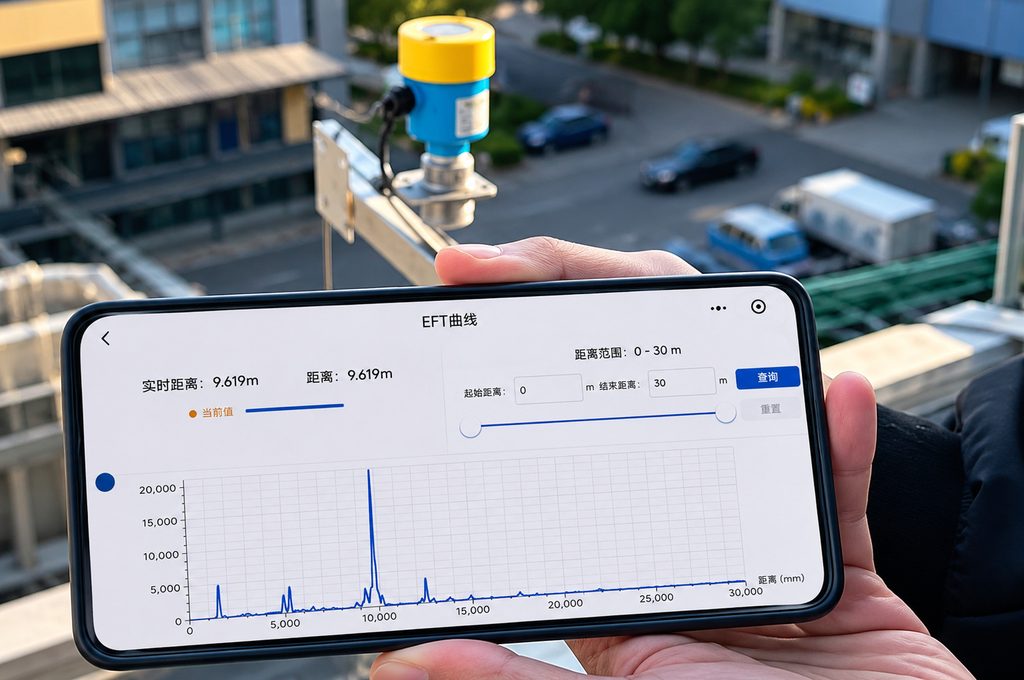
After installation and commissioning, the JWrada-32 provided continuous level monitoring for the fiberglass process water tank.
During operation, the radar level meter continuously transmitted the liquid level signal to the control system, allowing operators to monitor tank conditions in real time.
Compared with manual level inspection, continuous radar level measurement first solved the problem of not having real-time level information.
Operators no longer needed to frequently visit the tank to check the approximate water level. Instead, the actual level trend could be viewed directly through the control system.
The continuous 4–20 mA level signal also provided the basis for automatic process control.
Depending on the production requirements, high and low liquid level setpoints could be configured. For example, when the liquid level reached the high-level setpoint, a transfer or circulation pump could be started. When the level dropped to the low-level setpoint, the relevant pump could be stopped to help prevent dry running.
For production lines requiring additional protection, high-high and low-low level alarms could also be configured to improve tank management and process safety.
Another important benefit was the non-contact measurement principle.
Because the radar sensor did not need to remain immersed in process water containing glass fibers, maintenance issues associated with fiber adhesion or entanglement were reduced.
Radar Level Meter vs. Contact Level Measurement
Different level measurement technologies have their own advantages, and no single technology is suitable for every application.
However, for process water tanks containing suspended glass fibers where reduced maintenance is a priority, non-contact radar level measurement provides several practical benefits.
The first advantage is that the measuring element does not need to contact the process medium.
This reduces the possibility of glass fibers, suspended solids, and other contaminants accumulating directly on an immersed sensing element.
The second advantage is the absence of mechanical moving parts used for level tracking.
Traditional mechanical level measurement devices may be affected by buildup, jamming, or fiber entanglement when exposed to liquids containing fibrous materials. Radar level meters rely on electromagnetic waves for measurement and do not require a float to move with the liquid surface.
The third advantage is straightforward integration with automated control systems.
A continuous radar level signal can be connected to a PLC or DCS and used for water replenishment, drainage, pump protection, alarms, and production data logging.
However, radar level meters still require correct installation.
If the radar beam is directed toward an inlet stream, a large internal obstruction, or an unsuitable measurement area, performance can still be affected.
Reliable liquid level measurement is therefore the result of correct instrument selection, proper installation, and appropriate commissioning.
Key Factors When Selecting a Radar Level Meter for Fiberglass Process Water
For similar fiberglass process water applications, several parameters should be evaluated before selecting a radar level meter.
First, determine the tank height and maximum measurement distance. The maximum measuring range specified for a radar level meter does not mean the instrument should always be configured for that full range. The measurement range should correspond to the actual tank dimensions.
Second, evaluate the medium characteristics. Determine whether the process water contains glass fibers, suspended particles, foam, or other materials. Process temperature and pressure should also be confirmed.
Third, review the internal tank structure. The positions of inlet pipes, outlet pipes, agitators, reinforcement ribs, ladders, and other components may influence the best radar mounting position.
Fourth, confirm the tank-top process connection. Thread size, flange dimensions, nozzle length, and available mounting openings should be checked before ordering the instrument.
Fifth, determine the control system interface. If the PLC uses analog inputs, a 4–20 mA output may be appropriate. If digital communication is required, HART, RS485/Modbus, or other applicable communication options should be evaluated.
Finally, consider the installation environment. For hazardous areas or applications involving special temperature, pressure, protection, or explosion-proof requirements, the appropriate instrument configuration should be selected according to actual process and site requirements.
Why Is Level Automation Becoming More Important in the Fiberglass Industry?
As fiberglass production lines become increasingly automated, continuous, and data-driven, liquid level is no longer simply an auxiliary process parameter.
In process water, recycling water, and wastewater treatment systems, level data can directly influence pump operation, tank utilization, water balance, and production continuity.
When multiple tanks still depend on manual inspection, operators face a higher workload, and it becomes difficult to collect continuous historical data.
By using radar level meters for real-time monitoring, liquid level data can be transmitted to a PLC, DCS, SCADA, or other supervisory system and combined with flow, pressure, temperature, and other process variables.
Historical level trends can also help production personnel analyze daily water consumption, tank turnover patterns, abnormal level events, and process variations.
From this perspective, the purpose of fiberglass process water level measurement is not simply to determine how much water is in a tank.
Reliable level data provides an important foundation for process automation, water resource management, equipment protection, and continuous production.
Conclusion: JWrada-32 for Fiberglass Process Water Level Measurement
Fiberglass manufacturing involves various process water, circulation water, recycling water, and wastewater systems. Compared with ordinary clean water, these liquids may contain chopped glass fibers, suspended solids, and process additives. The measurement environment may also involve surface fluctuations, water vapor, condensation, and complex internal tank structures.
These factors can increase the difficulty of continuous liquid level measurement.
In this application, the JWrada-32 radar level meter used 80 GHz FMCW radar technology to perform non-contact level measurement. Through appropriate instrument selection, mounting position optimization, and on-site parameter configuration, continuous monitoring of the fiberglass process water tank was achieved.
The non-contact measurement principle reduced the potential impact of glass fiber adhesion and entanglement on the sensing element. The focused radar beam helped minimize interference from certain internal tank structures, while continuous level output enabled direct integration with the PLC or DCS for pump control, level alarms, and process automation.
For fiberglass manufacturing plants with process water tanks, circulation water tanks, recycling water tanks, intermediate tanks, or other liquid vessels containing fibrous suspended materials, radar level meter selection should not be based simply on the fact that the medium is “water.”
Tank dimensions, internal structures, liquid surface conditions, suspended glass fibers, installation position, process connections, and automation requirements should all be considered.
Only by combining the correct radar level meter selection, installation, and commissioning can a stable and reliable long-term level measurement solution be achieved.
Frequently Asked Questions About Fiberglass Process Water Level Measurement
Can the JWrada-32 radar level meter measure fiberglass process water?
Yes. The JWrada-32 can be used for continuous level measurement of fiberglass process water, circulation water, and liquids containing small amounts of suspended glass fibers, subject to the actual process conditions. The appropriate configuration should be selected according to tank height, temperature, pressure, process connection, and installation conditions.
Do glass fibers affect radar level measurement?
Small amounts of suspended glass fibers generally do not create the same fiber-entanglement problem associated with immersed contact probes because radar level measurement is non-contact. However, if a large quantity of fibers accumulates and forms a thick or highly uneven floating layer, the actual echo conditions should be evaluated.
Should a radar level meter be installed directly above the water inlet?
Generally, no. The liquid surface near an inlet is often highly turbulent, and the incoming stream itself may generate unwanted reflections. The radar level meter should normally be installed away from the direct inlet area and major internal obstructions.
What are the advantages of an 80 GHz radar level meter?
An 80 GHz radar level meter typically provides a relatively narrow and focused beam, which helps reduce interference from tank walls, pipes, support structures, and other internal components. This can be particularly useful for tanks with limited installation space or complex internal structures.
Can the JWrada-32 be connected to a PLC?
Yes. Depending on the selected configuration, the level signal can be connected to a PLC using a 4–20 mA output. Appropriate digital communication options can also be selected according to project requirements, allowing the level data to be used for monitoring, alarms, pump control, and process automation.
What is the most important factor in fiberglass process water level measurement?
Instrument model is only one part of the solution. Medium characteristics, tank height, internal structures, inlet position, mounting connection, radar antenna orientation, and on-site commissioning can all influence measurement performance.
Providing complete process and tank information before selecting the radar level meter is therefore more important than comparing measurement range or accuracy alone.