
As home energy storage, RV solar systems, outdoor power solutions, off-grid homes, and commercial backup power systems continue to grow in popularity, more people are becoming interested in combining solar panels with battery storage.
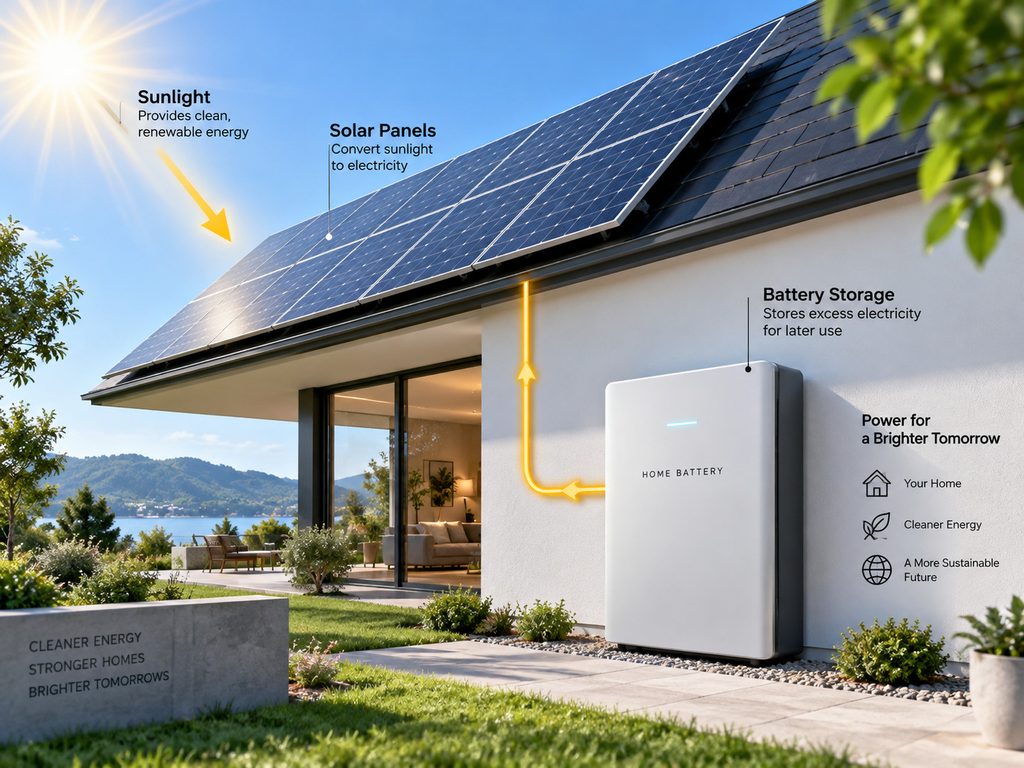
Solar panels convert sunlight into electricity, while batteries store unused energy so it can be used later at night, during cloudy weather, or during a power outage.
However, building a reliable solar energy storage system involves more than simply buying a few solar panels and connecting them to a large battery. Solar panel wattage, battery capacity, system voltage, inverter size, and charge controller specifications all need to be properly matched.
This guide explains how solar panels and batteries work together, how to calculate battery capacity, how to choose the right type of battery, and what to consider when designing and installing a solar-plus-storage system.
1. How Do Solar Panels and Batteries Work Together?
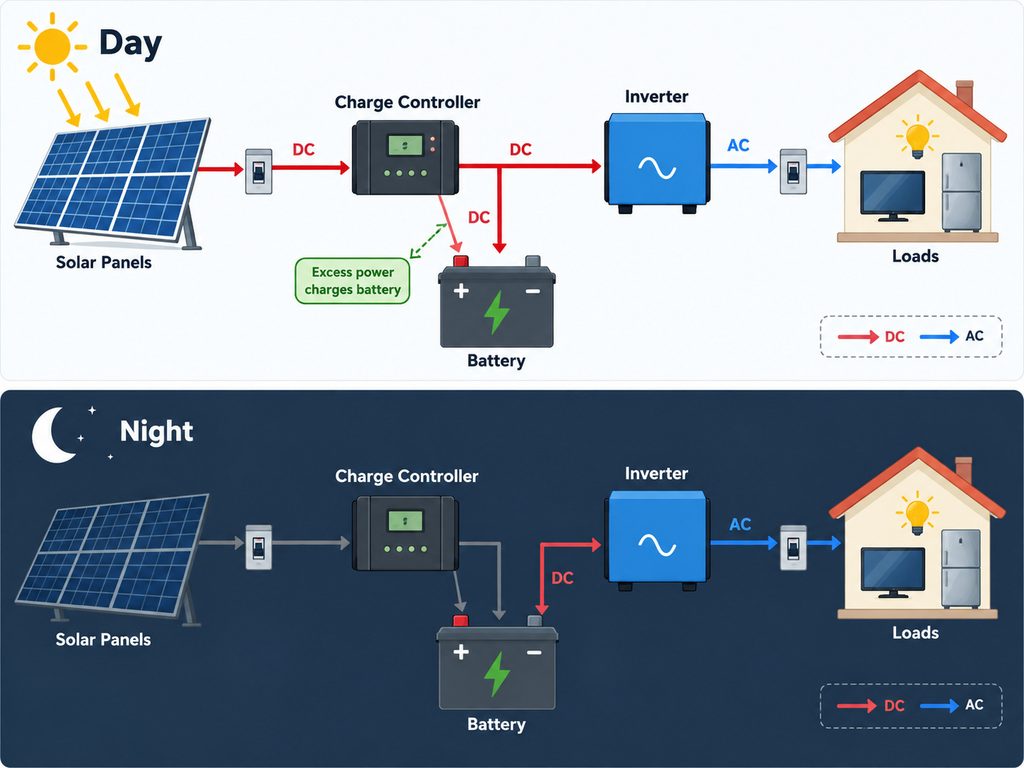
A typical solar energy storage system usually includes the following components:
- Solar panels
- Solar charge controller
- Battery or battery bank
- Inverter
- Cables, fuses, breakers, and electrical protection devices
- Electrical loads
During the daytime, solar panels generate direct current (DC) electricity from sunlight. The electricity can be used to power connected loads first, while excess solar energy can be sent through the charge controller and stored in the battery.
At night, or whenever solar production is lower than electricity demand, the system can draw stored energy from the battery.
If your home or equipment uses 120V, 230V, or other AC appliances, an inverter is required to convert DC electricity from the battery into alternating current (AC).
In simple terms:
Solar panels generate electricity, batteries store electricity, and the inverter converts electricity into a form that household appliances can use.
Properly matching these components is essential for creating an efficient and reliable solar energy system.
2. Why Do Solar Systems Need Battery Storage?
One of the main characteristics of solar power is that electricity generation changes according to sunlight conditions.
Solar panels may produce significant amounts of electricity around midday when sunlight is strong. At night, however, solar panels cannot generate electricity.
Without battery storage, surplus solar energy generated during the day cannot normally be saved for nighttime use in a standalone system.
Adding a battery allows you to increase the amount of solar energy you can use yourself.
For example, suppose your solar panels generate 5 kWh of electricity during the day while your household consumes only 2 kWh during daylight hours.
The remaining 3 kWh can potentially be stored in a battery and used later in the evening.
Battery storage is even more important in an off-grid solar system because there is no utility grid available as a backup power source. When solar production is insufficient, the battery becomes the primary source of electricity.
For this reason, batteries are commonly used in applications such as:
- RVs and camper vans
- Camping systems
- Remote cabins
- Farms
- Telecommunications equipment
- Remote homes
- Off-grid power systems
In many of these applications, the battery is one of the most important components of the entire solar system.
3. What Size Battery Do You Need for Solar Panels?
One of the most common questions when designing a solar system is:
“What size battery do I need for a 1000W solar panel system?”
Solar panel wattage alone is not enough to determine the correct battery size.
The most important factors are your daily electricity consumption and how much energy you want to store.
First, calculate your daily energy consumption:
Daily Energy Consumption (Wh) = Appliance Power (W) × Daily Operating Time (Hours)
For example, suppose a household uses the following equipment:
A 100W refrigerator runs an average of 10 hours per day:
100W × 10 hours = 1,000Wh
A 100W television operates for four hours:
100W × 4 hours = 400Wh
50W of lighting is used for five hours:
50W × 5 hours = 250Wh
Other appliances consume approximately:
1,350Wh
Total daily electricity consumption would therefore be approximately:
1,000 + 400 + 250 + 1,350 = 3,000Wh
That equals:
3kWh per day.
If you want the battery to store at least one full day of electricity consumption, approximately 3kWh should be used as the starting point for battery sizing.
However, batteries usually should not be sized on the assumption that 100% of their rated capacity will always be available. You also need to consider depth of discharge and inverter losses.
For example, suppose you use a lithium battery with approximately 90% usable capacity and assume an inverter efficiency of around 92%.
The estimated battery capacity would be:
3kWh ÷ 0.9 ÷ 0.92 ≈ 3.62kWh
In this example, selecting approximately 4kWh or more of battery storage may be appropriate, depending on the required safety margin and whether the system needs to operate through cloudy weather.
For a 48V battery system:
Battery Capacity (Ah) = 3,620Wh ÷ 48V ≈ 75Ah
In practice, a 48V 100Ah battery could provide additional capacity and system flexibility.
Keep in mind that recommended depth of discharge, charging rates, discharge rates, and temperature limits vary between battery manufacturers. Always check the specifications of the battery you plan to use.
4. How Much Solar Panel Capacity Do You Need?
Once you know how much electricity you consume each day, you can estimate the required solar panel capacity.
A useful basic formula is:
Solar Panel Power = Daily Energy Consumption ÷ Peak Sun Hours ÷ System Efficiency
Suppose your system needs 3kWh of electricity per day.
If your location receives approximately four peak sun hours per day and you estimate an overall system efficiency of 75%:
3,000Wh ÷ 4 ÷ 0.75 ≈ 1,000W
Theoretically, you would need approximately 1kW of solar panels.
However, actual solar energy production can be affected by many factors, including:
- Weather conditions
- Seasonal changes
- Panel installation angle
- Panel orientation
- Dust and dirt
- Shading
- Cable losses
- Charge controller efficiency
- Battery charging losses
- Solar panel temperature
For this reason, solar arrays are often designed with additional capacity.
For example, if your theoretical requirement is 1,000W, you might consider installing 1,200W, 1,500W, or more depending on local solar conditions, electricity demand, and the level of system reliability you need.
5. What Type of Battery Is Best for Solar Energy Storage?
Two common categories of batteries used in solar systems are lead-acid batteries and lithium batteries.
Lead-Acid Batteries
Lead-acid batteries have been used for many years and are based on mature, well-established technology.
Their initial purchase cost is often lower, which is why they have traditionally been popular in off-grid solar systems, UPS systems, and backup power applications.
However, conventional lead-acid batteries are relatively heavy and generally have lower usable capacity compared with modern lithium batteries.
Frequent deep discharging can also shorten their service life.
When designing a solar system with lead-acid batteries, additional battery capacity is often required to reduce the likelihood of excessive depth of discharge.
LiFePO4 Batteries
In recent years, LiFePO4, or lithium iron phosphate batteries, have become a popular choice for home battery storage, RV solar systems, and off-grid installations.
Typical advantages include:
- Long cycle life
- High usable battery capacity
- Lower weight compared with many lead-acid batteries
- High charge and discharge efficiency
- Ability to support relatively high charge and discharge currents
- Low maintenance requirements
Many lithium batteries also include an integrated Battery Management System (BMS).
The BMS may monitor battery voltage, current, temperature, overcharging, over-discharging, and other operating conditions.
However, cycle life, BMS performance, low-temperature charging protection, maximum current ratings, and communication features vary significantly between manufacturers.
Therefore, battery selection should not be based on capacity and price alone.
6. Should You Choose a 12V, 24V, or 48V Solar System?
Small solar systems commonly use 12V architectures. Medium-sized systems often use 24V, while larger residential and off-grid energy storage systems increasingly use 48V configurations.
The reason is relatively simple.
For the same amount of power, a higher system voltage results in lower current.
The basic relationship is:
Power = Voltage × Current
For example, at a load of 2,400W:
A 12V system would theoretically require approximately:
200A
A 24V system would require approximately:
100A
A 48V system would require approximately:
50A
Reducing current can help lower cable heating and voltage drop while reducing the need for extremely large conductors in higher-power systems.
As a general guideline:
A 12V system may be suitable for camping, lighting, and small electrical loads.
A 24V system may work well for medium-sized RVs, boats, and smaller off-grid installations.
A 48V system is often more suitable for home energy storage, larger inverters, and higher-power off-grid systems.
The final system voltage should always be compatible with the inverter, charge controller, battery, and other system components.
7. What Does a Solar Charge Controller Do?
Solar panels generally should not be connected directly to a battery without appropriate charging control.
A solar charge controller manages the charging process between the solar array and battery.
Its purpose is to regulate charging voltage and current and help prevent inappropriate charging conditions.
Two common types of solar charge controllers are:
- PWM charge controllers
- MPPT charge controllers
PWM controllers have a relatively simple design and may still be appropriate for small or budget-sensitive solar systems.
MPPT charge controllers, on the other hand, continuously track a suitable operating point of the solar array.
They can provide better energy utilization in many situations, particularly when solar panel voltage is significantly higher than battery voltage or when sunlight conditions change throughout the day.
When selecting a charge controller, make sure it can safely handle the maximum voltage and current produced by the solar array.
This is particularly important when solar panels are connected in series because their voltages are added together.
Solar panel open-circuit voltage can also increase in cold weather, so adequate voltage safety margin should always be included in the system design.
8. What Size Inverter Do You Need?
Inverter size should primarily be determined by the maximum AC load that may operate at the same time.
It should not be selected solely according to solar panel wattage.
For example, your appliances might include:
- Refrigerator: 200W
- Television: 150W
- Computer: 300W
- Lighting: 150W
- Water pump: 800W
If all of these devices can operate simultaneously, the total running load could reach approximately:
1,600W
In this situation, choosing an inverter rated at exactly 1,600W would normally provide very little safety margin.
Additional inverter capacity is generally recommended.
Appliances containing motors or compressors—such as refrigerators, pumps, air conditioners, and power tools—can also require significantly more power for a short period during startup.
For this reason, both the inverter’s continuous output power and surge power rating should be considered.
For televisions, computers, household appliances, and sensitive electronics, a pure sine wave inverter is generally preferred.
9. Common Mistakes When Pairing Solar Panels with Batteries
Mistake 1: Assuming a Bigger Battery Is Always Better
A larger battery is not automatically better.
If the battery bank is very large but the solar array is too small, the solar panels may not generate enough energy to recharge the battery adequately each day.
This can reduce system performance and lead to an unsatisfactory user experience.
Solar array size and battery capacity should always be designed together according to daily energy production and consumption.
Mistake 2: Looking Only at Battery Ah Ratings
A 100Ah battery does not always contain the same amount of energy.
For example:
A 12V 100Ah battery has a theoretical energy capacity of approximately:
1.2kWh
A 48V 100Ah battery has a theoretical capacity of approximately:
4.8kWh
That is four times as much energy.
Therefore, when comparing batteries, it is often more useful to look at Wh or kWh, rather than Ah alone.
Mistake 3: Ignoring Cloudy or Rainy Weather
If an off-grid system is designed only around one normal sunny day, battery capacity may become insufficient during several consecutive days of poor weather.
Depending on the required level of reliability, an off-grid system may be designed with enough stored energy for one to three days—or even longer—without sufficient solar generation.
A backup generator or another energy source can also be included in the system.
Mistake 4: Ignoring Component Compatibility
Solar panels, batteries, inverters, and charge controllers must be compatible in terms of:
- Voltage
- Current
- Charging parameters
- Communication protocols
This is especially important when combining lithium batteries with hybrid inverters that use communication interfaces such as CAN or RS485.
Before purchasing equipment, check whether the battery and inverter are officially compatible.
10. How to Design a Well-Balanced Solar and Battery System
A good solar energy storage system should not be designed by purchasing equipment first and figuring out how to connect it later.
Instead, start with your actual electricity requirements.
A practical design process is:
Step 1: List all electrical appliances, their power ratings, and daily operating times.
Step 2: Calculate total daily electricity consumption in kWh.
Step 3: Determine the required battery capacity based on the desired backup time.
Step 4: Calculate the required solar panel capacity using local peak sun hours.
Step 5: Select the inverter according to the maximum simultaneous load and surge requirements.
Step 6: Choose a suitable MPPT or other solar charge controller based on solar array voltage and current.
Step 7: Install appropriately sized cables, fuses, breakers, grounding equipment, and surge protection.
For residential or off-grid systems with several kilowatts of capacity, battery short-circuit currents can be extremely high.
DC electrical protection and installation requirements therefore need careful attention.
Larger systems should generally be designed and installed by qualified professionals in accordance with applicable local electrical codes and safety regulations.
11. Where Are Solar Panels and Battery Storage Systems Used?
Solar-plus-storage systems can be used in a wide range of applications.
In residential homes, battery storage can increase solar self-consumption and, when properly designed, provide backup power during utility outages.
In RVs and camping systems, solar energy can power refrigerators, lighting, mobile phones, laptops, and other small devices.
In remote locations without reliable grid access, solar panels and batteries can form a completely independent off-grid power system.
Solar battery systems are also widely used in:
- Agriculture
- Telecommunications
- Security and monitoring systems
- Remote islands
- Farms and ranches
- Outdoor projects
- Remote industrial equipment
As energy storage technology continues to develop, solar systems are evolving from simple daytime electricity generation systems into integrated solutions combining solar generation, battery storage, and intelligent energy management.
12. Frequently Asked Questions About Solar Panels and Batteries
Can a solar panel charge a battery directly?
In most cases, directly connecting a solar panel to a battery is not recommended.
A suitable solar charge controller should normally be installed between the solar array and battery to manage charging voltage, current, and charging behavior.
How much electricity can a 1000W solar panel system generate per day?
You cannot determine daily energy generation based only on the 1,000W rated capacity.
Actual electricity generation depends on:
- Peak sun hours
- Weather
- Solar panel angle
- Panel orientation
- Temperature
- Shading
- System losses
For example, with approximately four peak sun hours, a 1,000W solar array could theoretically generate around:
4kWh per day
Actual usable energy will generally be lower because of real-world system losses.
Can solar panel wattage be larger than battery capacity?
Solar panel power and battery capacity use different units and describe different things, so they cannot be directly compared.
Solar panels are generally rated in watts (W), which measure power.
Batteries are commonly rated in watt-hours (Wh), kilowatt-hours (kWh), or amp-hours (Ah), which relate to energy storage capacity.
The correct approach is to size both components according to daily energy requirements and the amount of time available for charging.
Are lithium batteries or lead-acid batteries better for solar systems?
Both can be used in solar energy systems.
Lead-acid batteries often have a lower initial purchase price.
LiFePO4 batteries generally offer advantages in cycle life, usable capacity, weight, charging efficiency, and maintenance requirements.
The best choice depends on your budget, operating conditions, frequency of use, temperature, and expected system lifetime.
How much battery storage does a home solar system need?
Battery capacity depends on your daily electricity usage, the number of backup hours or days you need, and whether the property remains connected to the utility grid.
For example, an off-grid system consuming 3kWh per day will require a very different battery configuration from a home using 20kWh per day.
Conclusion
Combining solar panels with battery storage allows electricity generated during the day to be stored and used later at night, during cloudy weather, or during a power outage.
However, the goal of a well-designed system is not simply to install the largest possible solar array or battery bank.
The key is to create the right balance between solar generation, battery storage capacity, and actual electrical loads.
When planning a solar energy storage system, start by calculating your daily electricity consumption.
Then determine the appropriate battery capacity and solar panel wattage before selecting the inverter, charge controller, cables, and electrical protection equipment.
By designing the system around real energy requirements, you can build a solar-plus-battery system that offers reliable power, efficient energy storage, and better long-term value.