
What Is Radar Beam Angle?
Radar is widely used in aviation, weather monitoring, marine navigation, automotive safety, industrial sensing, security systems, and defense. At its core, radar works by transmitting electromagnetic waves and receiving the reflected signals from objects. By analyzing those echoes, a radar system can estimate a target’s distance, speed, direction, and sometimes even its shape or movement behavior.
However, radar does not usually radiate energy evenly in all directions like a light bulb. It works more like a flashlight. Most of the radar energy is concentrated in a certain direction, forming what is commonly called a radar beam. The angular width of this beam is known as the radar beam angle, or more technically, radar beamwidth.
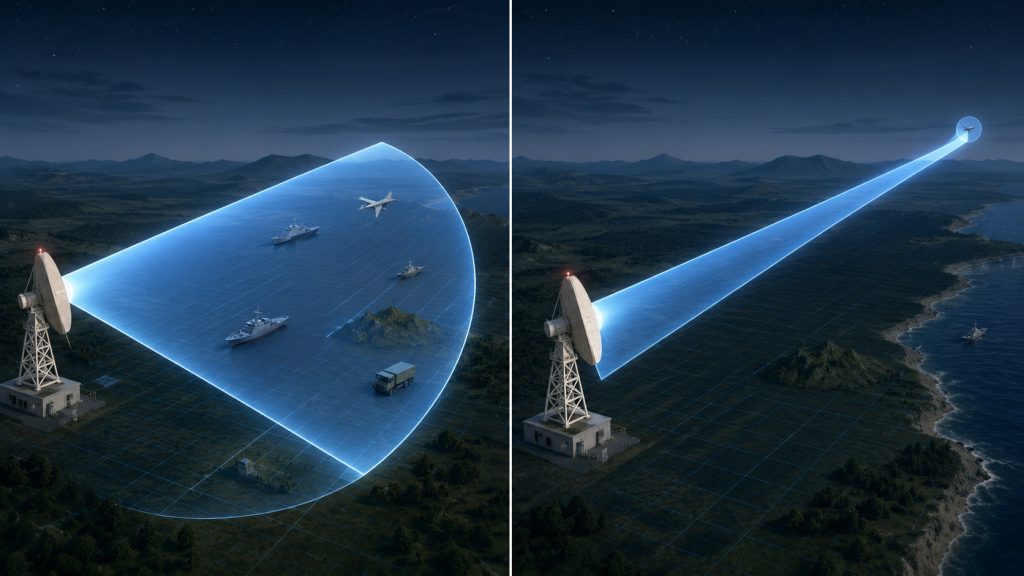
In simple terms, radar beam angle refers to the angular range over which a radar antenna effectively transmits or receives electromagnetic energy. A larger beam angle means the radar can cover a wider area. A smaller beam angle means the energy is more focused in one direction, which usually improves long-range detection and directional accuracy.
For example, a radar with a 60-degree beam angle can monitor a wide sector, making it suitable for short-range coverage or area surveillance. A radar with a 2-degree beam angle, on the other hand, produces a narrow and focused beam, which is better for long-range tracking and precise target positioning.
Different radar applications require very different beam angles. Automotive radar, weather radar, marine radar, airport surveillance radar, security radar, and military radar systems all use different antenna designs and beam patterns because their detection tasks are not the same.
Why Radar Beam Angle Matters
Radar beam angle is one of the most important parameters in radar system design. It directly affects how wide the radar can “see,” how far it can detect, and how accurately it can distinguish between objects in different directions.
A wide radar beam covers a larger area at once. This is useful when the radar needs to search for targets quickly or monitor a broad region. However, when radar energy spreads over a wider angle, the energy density in any single direction becomes lower. As a result, detection range and angular accuracy may decrease.
A narrow radar beam concentrates energy in a smaller angular region. This improves signal strength in the main direction, making it easier to detect distant objects. It also helps the radar distinguish between two targets that are close together in angle. The trade-off is that a narrow beam covers a smaller area at one time. To monitor a wide region, the radar may need mechanical scanning, electronic scanning, or multiple beams.
This is why radar beam angle is not simply “the wider, the better” or “the narrower, the better.” The best beam angle depends on the task. A car radar may need both wide-angle coverage for nearby pedestrians and narrow-beam sensing for distant vehicles. A weather radar must scan large volumes of the atmosphere. A ship radar needs to detect vessels and obstacles on the sea surface. A precision tracking radar may prioritize accuracy over coverage.
Radar Beam Angle Explained with a Flashlight Analogy
One of the easiest ways to understand radar beam angle is to compare radar with a flashlight.
A flashlight in floodlight mode spreads light across a wide area. It is useful for seeing nearby surroundings. A flashlight in spotlight mode concentrates light into a narrow beam. It does not cover as much area, but it can illuminate objects farther away.
Radar works in a similar way. A wide radar beam is like a floodlight. It covers more space but with less energy concentration. A narrow radar beam is like a spotlight. It covers less space but delivers stronger energy in a specific direction.
There is one important difference: radar does not simply “see” objects visually. It receives and processes echoes. These echoes contain information about distance, velocity, direction, and signal strength. Because of this, radar beam angle affects not only coverage but also the quality of target detection and measurement.
How Radar Beam Angle Is Usually Defined
Radar beam angle is usually measured in degrees. Common related terms include horizontal beamwidth, vertical beamwidth, half-power beamwidth, main lobe width, and antenna beam pattern.
Horizontal beamwidth describes the angular coverage in the horizontal direction. For example, a forward-looking automotive radar may have a relatively wide horizontal field of view so it can monitor multiple lanes ahead of the vehicle.
Vertical beamwidth describes the angular coverage in the vertical direction. It affects whether the radar can distinguish objects at different heights, such as bridges, road signs, drones, terrain slopes, or cloud layers.
Half-power beamwidth, also known as the 3 dB beamwidth, is one of the most widely used engineering definitions. It refers to the angular width between the two points on the main beam where the radiated power drops to half of its maximum value.
This definition is necessary because radar beams do not have sharp physical edges. The energy is strongest at the center of the main beam and gradually decreases toward the sides. Therefore, engineers use standard reference points, such as the half-power points, to define the effective beam angle.
Radar Beam Angle and Antenna Size
Radar beam angle is closely related to antenna size. In general, for the same operating wavelength, a larger antenna aperture produces a narrower beam, while a smaller antenna aperture produces a wider beam.
A simple rule of thumb is:
Beamwidth is approximately proportional to wavelength divided by antenna aperture.
This means that radar beamwidth depends heavily on both the radar wavelength and the physical size of the antenna. Although real antenna design involves more complex factors, this basic relationship explains a key principle: radar beam angle cannot be chosen freely without considering hardware constraints.
A large radar antenna can form a narrow, highly directional beam. This is why many long-range surveillance and tracking radars use large antenna arrays or dish antennas. Small radar modules, such as those used in consumer electronics or compact sensors, often have wider beam patterns unless they use advanced antenna arrays and signal processing.
This also explains why millimeter wave radar is popular in automotive and industrial applications. Millimeter wave radar operates at high frequencies, which means the wavelength is short. A shorter wavelength allows engineers to build compact radar modules while still achieving useful beam control and angular resolution.
Does Higher Frequency Mean a Narrower Radar Beam?
If the antenna size remains the same, a higher radar frequency usually results in a shorter wavelength and therefore a narrower beam. This is one reason why high-frequency radar systems can offer better angular resolution in compact designs.
For example, 77 GHz and 79 GHz millimeter wave radar systems are widely used in modern vehicles. Their short wavelengths make it possible to integrate radar sensors into bumpers, grilles, and body panels while still providing reliable distance and velocity measurements.
However, higher frequency is not always better. Higher-frequency signals may experience greater propagation loss and can be more sensitive to rain, fog, atmospheric absorption, and manufacturing tolerances. Higher-frequency radar systems may also require more advanced components, tighter design accuracy, and higher system cost.
Lower-frequency radar, by contrast, may have wider beams for the same antenna size but often provides stronger propagation characteristics in certain environments. This is why radar frequency selection depends on detection range, resolution requirements, environmental conditions, antenna size, regulatory limits, and cost.
How Radar Beam Angle Affects Detection Range
Radar beam angle affects detection range because it determines how concentrated the transmitted energy is.
A narrow radar beam focuses energy into a smaller angular region. This increases the energy density in the main direction and often improves the radar’s ability to detect distant targets. For long-range tracking, narrow beams are generally preferred.
A wide radar beam spreads energy over a larger area. This helps cover more space, but the energy in each direction is weaker. If the transmitted power, antenna gain, and receiver sensitivity remain the same, a wide-beam radar may have a shorter effective detection range than a narrow-beam radar.
The flashlight analogy works here as well. A spotlight can illuminate a distant object more effectively because the light is concentrated. A floodlight covers more area nearby but may not reach as far.
That said, detection range is not determined by beam angle alone. It also depends on transmit power, antenna gain, receiver sensitivity, signal processing, target radar cross section, operating frequency, environmental clutter, interference, and system design. Radar beam angle is a major factor, but it is only one part of the full radar performance equation.
How Radar Beam Angle Affects Angular Resolution
Angular resolution describes a radar’s ability to separate two objects that are close together in direction. If two targets are at a similar distance and have only a small angular separation, a radar with a wide beam may merge them into one target. A radar with a narrow beam, or a radar with advanced array processing, is more likely to distinguish them as two separate objects.
In general, a smaller radar beam angle usually improves angular resolution.
This is especially important in automotive radar, drone detection, robotics, precision tracking, and defense applications. In traffic scenarios, radar may need to distinguish a vehicle in the same lane from a vehicle in the next lane, a pedestrian near the roadside, a guardrail, or a stationary obstacle. If angular resolution is poor, the radar may struggle to determine the exact position of each object.
Modern radar systems do not rely only on one physical beam to achieve angular resolution. Technologies such as phased array radar, MIMO radar, digital beamforming, and advanced signal processing can estimate target angles more precisely. These methods allow compact radar systems to achieve better angular performance than traditional single-antenna designs.
Main Lobe and Side Lobes in Radar Beam Patterns
To understand radar beam angle more clearly, it is helpful to know two important terms: main lobe and side lobes.
The main lobe is the strongest part of the antenna radiation pattern. It points in the primary detection direction and contains most of the transmitted or received energy. When people talk about radar beam angle, they usually refer to the width of the main lobe.
Side lobes are smaller beams outside the main lobe. Although they are weaker than the main lobe, they can still receive echoes or interference. High side lobes may cause false detections, inaccurate angle estimates, or unwanted sensitivity to objects outside the intended detection direction.
Good radar antenna design is not only about making the main beam narrow. Engineers also need to control side-lobe levels, antenna gain, scanning range, polarization, array errors, and signal processing performance.
In practical radar systems, a low side-lobe level can improve anti-interference capability and reduce false alarms. This is especially important in complex environments such as airports, highways, ports, industrial sites, and defense scenarios.
Why Automotive Radar Uses Different Beam Angles
Automotive radar is a great example of why different radar beam angles are needed in the same system. A vehicle needs to detect both distant objects and nearby objects. It also needs to monitor the front, rear, sides, and blind spots.
A forward long-range radar usually uses a relatively narrow beam. It is designed to detect vehicles far ahead and support functions such as adaptive cruise control, forward collision warning, and automatic emergency braking. A narrow beam helps improve long-range detection and lane-level target estimation.
Corner radar and side radar usually need wider beam angles. These sensors monitor nearby areas around the vehicle and support blind spot detection, lane change assistance, rear cross-traffic alert, door opening warning, and low-speed maneuvering assistance.
As a result, a modern vehicle may use multiple radar sensors with different beam angles and installation positions. Some sensors focus on long-range detection. Others focus on wide-angle short-range coverage. Together, they help the vehicle build a more complete understanding of its surroundings.
In advanced driver assistance systems and autonomous driving, radar is often combined with cameras, lidar, ultrasonic sensors, and high-definition maps. Radar beam angle remains a key parameter because it affects how much of the environment the radar can cover and how accurately it can locate targets.
Radar Beam Angle in Weather Radar
Weather radar uses electromagnetic waves to detect precipitation, cloud structures, hail, storm cells, and wind-related phenomena. In weather radar, beam angle affects spatial resolution and scanning efficiency.
A narrow radar beam provides finer spatial detail. It helps meteorologists observe rainfall distribution, storm structure, convective cells, and severe weather features more clearly. However, a narrower beam may require more scanning steps to cover the same atmospheric volume, which can increase scan time.
A wider radar beam can scan faster and cover larger regions more efficiently, but the spatial detail is lower. For weather monitoring, radar designers must balance update speed and resolution. This is especially important for rapidly changing weather events such as thunderstorms, heavy rainfall, hailstorms, and tornado-producing systems.
Another important point is that a radar beam becomes physically wider as distance increases. Even if the angular beamwidth stays the same, the actual width of the beam at 100 kilometers is much larger than it is at 10 kilometers. This means weather radar can observe fine details better at shorter ranges, while distant weather structures may appear more blurred.
Radar Beam Angle in Marine Radar and Security Radar
Marine radar is used to detect ships, coastlines, buoys, reefs, obstacles, and other objects on or near the sea surface. Since most marine targets are distributed horizontally, marine radar often prioritizes horizontal scanning and azimuth resolution. A narrower horizontal beam helps separate nearby vessels or objects, while an appropriate vertical beam helps compensate for ship motion, waves, and pitch.
Security radar, on the other hand, often focuses on area coverage and stable target detection. Perimeter radar, airport security radar, warehouse radar, and facility monitoring radar need to detect people, vehicles, drones, or moving objects across a defined area. If the beam is too narrow, blind spots may appear. If the beam is too wide, more clutter and interference may enter the system.
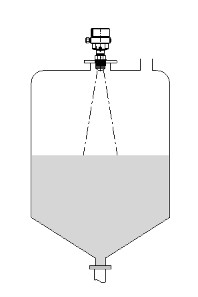
In industrial applications, radar can be used for level measurement, material monitoring, personnel detection, robotics, and obstacle avoidance. The ideal beam angle depends heavily on the use case. A radar level sensor may use a narrow beam to avoid reflections from tank walls or internal structures. A mobile robot radar may use a wider beam to detect obstacles across a broad forward area.
Is a Smaller Radar Beam Angle Always Better?
No. A smaller radar beam angle is not always better.
A narrow beam improves energy concentration, long-range detection, and angular resolution, but it covers less area at one time. Without scanning, a narrow-beam radar may miss targets outside its main direction. If the radar needs to cover a wide field of view, it may require mechanical rotation, phased-array scanning, digital beamforming, or multiple radar modules.
These additional technologies can increase cost, power consumption, hardware complexity, and system design difficulty.
For many short-range sensing applications, a wide beam is more practical. For example, an indoor human presence radar may not need a very narrow beam. Its main task may be to detect whether a person is present or moving within a room. If the beam is too narrow, the sensor may cover only a small part of the room and create a poor user experience.
Therefore, the right radar beam angle depends on the mission. Is the radar designed for long-range detection or short-range coverage? Does it need precise angle measurement or general presence detection? Is it fixed, scanning, or electronically steered? Does it need to track one target or many targets?
How to Choose the Right Radar Beam Angle
A simple way to understand radar beam angle selection is this:
If you want wider coverage, choose a larger beam angle. If you want longer range and better angular accuracy, choose a smaller beam angle. If you want both wide coverage and high precision, you usually need more advanced antenna design and signal processing.
For wide-area search, radar systems often use wide beams or fast scanning.
For precision tracking, they often use narrow beams or high-resolution antenna arrays.
For short-range sensing, wide beams may be more economical and practical.
For long-range detection, narrow beams usually offer better performance.
For complex multi-target environments, beam design must be combined with antenna array architecture, digital processing, and target tracking algorithms.
Modern radar systems increasingly rely on digital beamforming, phased-array antennas, MIMO technology, and intelligent signal processing. In older radar systems, the beam was mainly determined by the physical antenna. In modern radar systems, software and algorithms can also influence how the radar “looks” at the world.
Electronically scanned radar can change beam direction rapidly without mechanical movement. Some systems can even generate multiple beams at the same time. This makes radar more flexible for automotive sensing, low-altitude surveillance, smart transportation, robotics, industrial automation, and security monitoring.
Conclusion: Radar Beam Angle Determines How Radar Sees the World
Radar beam angle is a key factor in radar performance. It describes how radar energy is distributed in space and directly affects detection coverage, detection range, angular resolution, interference resistance, and application suitability.
A large radar beam angle provides wider coverage and is useful for search, short-range sensing, and area monitoring. A small radar beam angle concentrates energy, improving long-range detection, precise angle measurement, and target tracking. Antenna size, operating frequency, array structure, beam pattern, and signal processing all influence the final beamwidth.
In real-world applications, there is no single ideal radar beam angle. Automotive radar must balance long-range sensing and wide-angle coverage. Weather radar must balance scanning speed and spatial resolution. Marine radar focuses on sea-surface target separation. Security radar emphasizes stable coverage and low false alarms. Industrial radar chooses beamwidth based on measurement conditions and installation environment.
Understanding radar beam angle helps us understand how radar “sees” the world. It is not just a technical parameter. It is one of the core design choices behind every radar system, shaping how far, how wide, and how accurately radar can detect its surroundings.