In chemical processing plants, nitric acid is an important basic chemical raw material and a critical process medium used in oxidation, nitration, adipic acid production, fine chemicals, fertilizers, and many other industrial applications. Radar level meter
Because nitric acid is highly corrosive and strongly oxidizing, its storage, transfer, and process handling place demanding requirements on tanks, pipelines, valves, and process instrumentation.
Continuous nitric acid tank level measurement is particularly challenging. The measuring instrument must not only provide accurate and continuous liquid-level data but must also operate reliably in an environment involving corrosive acid vapor, condensation, temperature fluctuations, and changing process conditions.
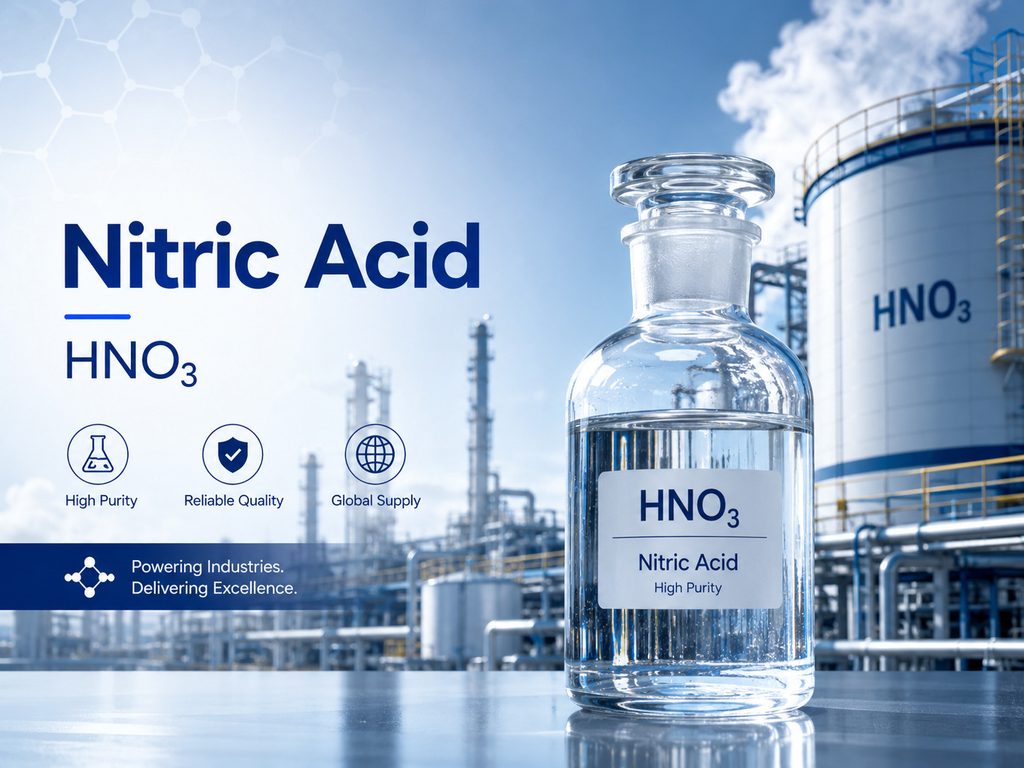
If the level measurement becomes unstable or inaccurate, it may affect material inventory management, feed control, transfer operations, and high- or low-level protection. For this reason, selecting a suitable nitric acid storage tank level meter is an important part of chemical process instrumentation design.
In a large integrated refining and chemical project involving an adipic acid production unit, continuous liquid-level measurement was required for several critical applications, including nitric acid storage tanks, oxidation process vessels, and mother liquor tanks.
These measurement points presented several typical chemical-industry challenges, including corrosive media, temperature variations, vapor and condensation, foam, and interference caused by internal vessel structures.
To address these operating conditions, an 80GHz non-contact radar measurement solution was selected for continuous level monitoring.
1. Why Is Nitric Acid Tank Level Measurement Challenging?
Compared with water tanks or conventional liquid storage vessels, nitric acid tanks create significantly more demanding conditions for level instrumentation.
The primary issue is not simply whether the instrument can detect the liquid surface. The real challenge is whether the level meter can continue to provide stable and reliable measurements while exposed to a highly corrosive chemical environment.
Strong Corrosion Places Higher Demands on Instrument Materials
Nitric acid is a highly corrosive chemical medium with strong oxidizing properties.
Its corrosive behavior may also vary depending on concentration, process temperature, operating pressure, and the materials used in the process equipment.
Traditional contact-type level measurement devices generally require sensing components such as probes, floats, or electrodes to remain directly exposed to the process medium.
If the wetted materials are not properly selected, long-term exposure to nitric acid can cause corrosion, measurement drift, structural degradation, sealing problems, or even instrument failure.
Therefore, reducing unnecessary direct contact between the sensing system and nitric acid is an important way to improve long-term measurement reliability.
Acid Vapor and Condensation Can Affect Level Measurement
The vapor space inside a nitric acid storage tank is not always stable.
During filling, discharging, changes in ambient temperature, or variations in process conditions, acid vapor, mist, and condensation may form inside the tank.
Some measurement technologies can be affected by changing vapor conditions, resulting in weaker measurement signals, false echoes, or unstable level readings.
Chemical storage tanks therefore require a continuous level measurement technology with strong echo recognition and interference suppression capabilities.
Internal Tank Structures Can Generate False Echoes
Large chemical storage tanks often contain various structural components and process connections, including:
- Inlet pipes
- Nozzles
- Manways
- Venting systems
- Reinforcement structures
- Internal piping
- Other process equipment
If the radar beam is too wide, part of the transmitted energy may strike these structures and generate unwanted reflections.
For continuous nitric acid level measurement, accurately distinguishing the true liquid-surface echo from interference signals is critical.
Level Data Is Often Part of the Process Control System
Nitric acid storage tanks typically serve as raw-material tanks, buffer tanks, or process supply tanks.
Their level signals are commonly transmitted to a DCS, PLC, or other control system for:
- Inventory monitoring
- Filling management
- Discharge control
- Material balance
- High-level alarm
- Low-level alarm
- Process interlocking
As a result, a nitric acid level instrument must do more than display the level locally. It must provide stable signal output and reliable integration with the plant control system.
2. Why Use the JWrada-35 Radar Level Meter for Nitric Acid?
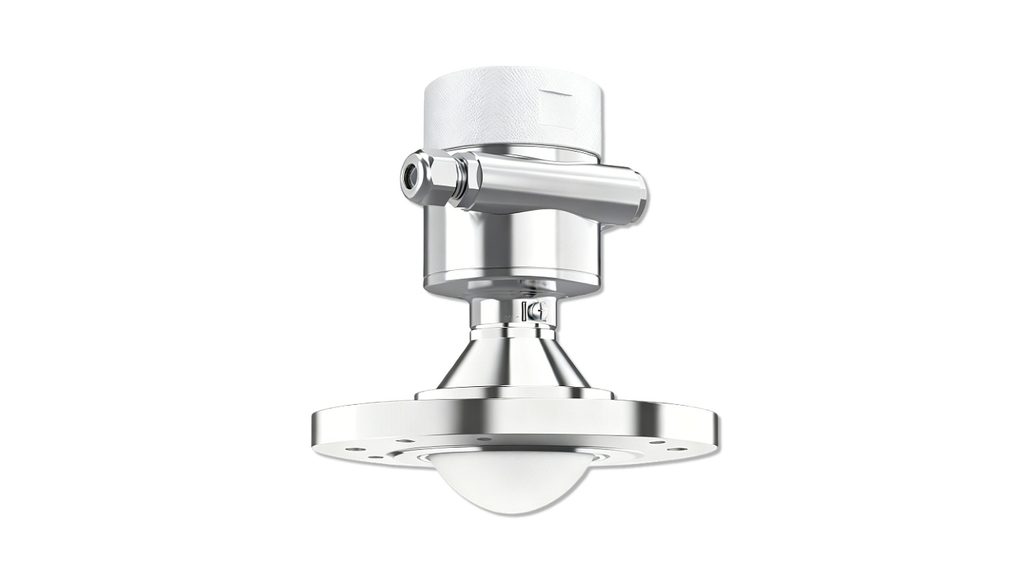
The JWrada-35 radar level meter is designed for demanding industrial liquid-level applications.
It uses 80GHz FMCW, or Frequency Modulated Continuous Wave, radar technology to measure the distance between the radar antenna and the liquid surface without direct contact with the process liquid.
The instrument calculates the actual liquid level based on the measured distance and configured vessel parameters.
Compared with measurement technologies that require probes or sensing elements to remain immersed in nitric acid, non-contact radar measurement significantly reduces direct exposure of the core sensing components to the corrosive liquid.
The JWrada-35 uses a 76 mm lens antenna and is designed for long-range, high-accuracy industrial level measurement.
It incorporates corrosion-resistant structural features suitable for demanding chemical environments and supports common industrial communication signals such as:
- 4–20 mA
- HART
- RS485
- Modbus
Wireless commissioning and diagnostic functions are also available, making the instrument suitable for complex industrial conditions involving corrosive media, vapor, and demanding installation environments.
For nitric acid storage tanks, its main advantages include the following.
3. Non-Contact Measurement Helps Reduce Corrosion Risks
The JWrada-35 is typically installed at the top of the storage tank.
The radar antenna transmits electromagnetic waves toward the nitric acid surface. The signal is reflected by the liquid surface and received by the radar instrument, which calculates the distance and converts it into a level value.
Unlike float-type instruments or probe-based measurement devices, this method does not require a long sensing element to remain immersed in nitric acid.
This non-contact measurement principle reduces potential maintenance issues associated with:
- Corrosion of long probes
- Mechanical wear
- Float sticking
- Material buildup
- Direct process exposure
For strongly corrosive liquids, this represents an important operational advantage.
However, it is important to understand that non-contact measurement does not eliminate the need for chemical compatibility evaluation.
Process connections, sealing structures, antenna protection components, and any parts exposed to acid vapor or condensate must still be selected according to the actual nitric acid concentration, process temperature, pressure, and operating conditions.
4. 80GHz Narrow Beam Helps Avoid Tank Obstructions
One of the key advantages of 80GHz radar technology is its narrow and highly focused measuring beam.
For nitric acid tanks containing internal pipes, inlet structures, vessel walls, or other fixed components, a narrow radar beam makes it easier to direct the measurement energy toward the actual liquid surface.
This helps reduce unwanted reflections from surrounding structures.
The advantage is particularly important in retrofit projects.
In many existing chemical plants, the tank nozzle positions have already been determined and it may not be practical to create a new installation opening in the ideal location.
A highly focused radar beam provides greater flexibility when working with existing tank configurations.
By properly selecting the installation position and radar orientation, interference from nearby tank structures can be minimized.
5. Intelligent Echo Processing Supports Complex Process Conditions
Chemical storage tanks rarely provide perfectly clean and stable measuring conditions.
During normal operation, the liquid surface may be disturbed by filling. Vapor and condensation may develop in the upper part of the tank, while fixed internal structures can generate multiple reflected signals.
A radar level meter that simply identifies the strongest reflected signal may occasionally interpret an unwanted reflection as the actual liquid level.
The JWrada-35 uses intelligent echo processing, adaptive signal analysis, and interference echo recognition to distinguish the true liquid-surface signal from fixed or unwanted reflections.
After proper installation and commissioning, these functions help improve measurement stability in complex tank environments.
For nitric acid storage applications, this capability is particularly valuable when operating conditions involve:
- Acid mist
- Vapor
- Condensation
- Liquid turbulence
- Internal structures
- Changing process conditions
6. Corrosion-Resistant Design for Aggressive Chemical Applications
For strongly corrosive acids, alkalis, and other aggressive chemical media, the radar level meter must use an appropriate corrosion-resistant process structure.
The JWrada-35 incorporates corrosion-resistant materials and protective design features intended for demanding chemical environments.
PTFE is commonly used in chemical instrumentation because of its excellent chemical stability and resistance to many corrosive substances.
For nitric acid service, however, instrument selection should never be based only on the name of the medium.
The following information should be evaluated before confirming the final configuration:
- Nitric acid concentration
- Normal operating temperature
- Maximum process temperature
- Operating pressure
- Design pressure
- Acid vapor conditions
- Condensation conditions
- Process connection requirements
- Seal material compatibility
This is one of the major differences between chemical-industry instrumentation and standard water-level measurement.
The same chemical medium may have significantly different effects on instrument materials at different concentrations and temperatures.
7. JWrada-35 Nitric Acid Storage Tank Level Measurement Solution
In large chemical plants, nitric acid is often transferred to storage tanks from upstream production facilities, tank trucks, or process pipelines.
It is then pumped from the storage tank to downstream production units.
Continuous and stable tank-level monitoring is therefore essential for both production and inventory management.
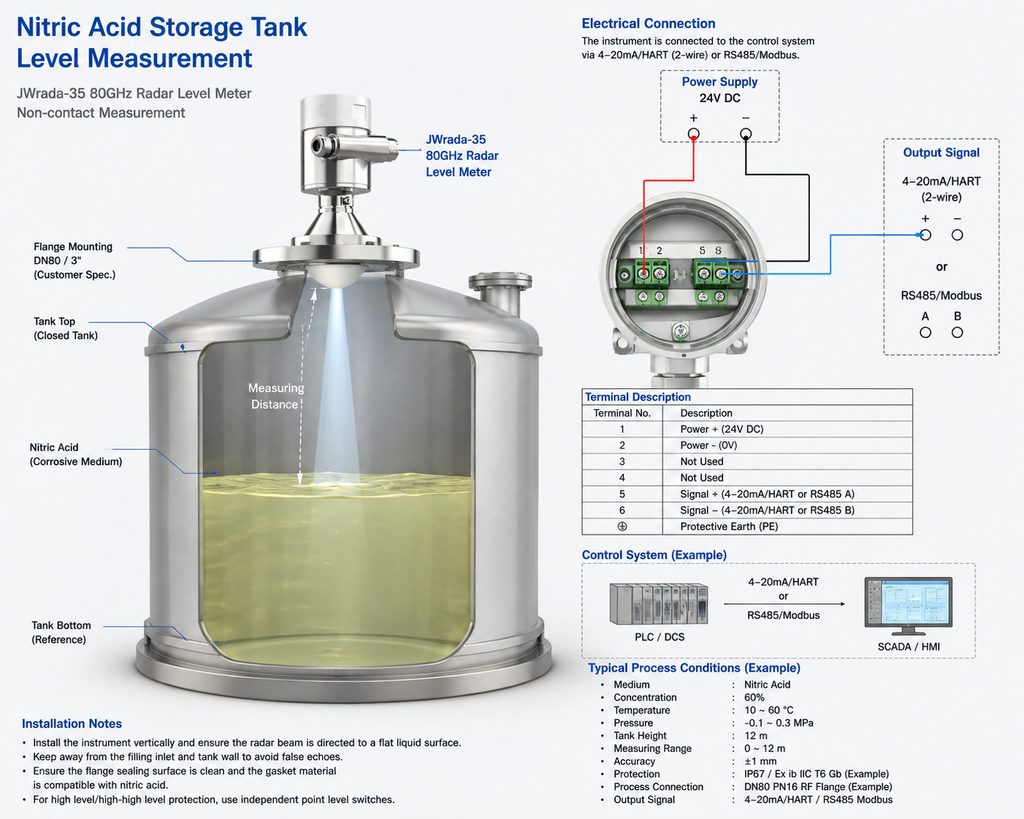
For this type of application, the JWrada-35 can be installed on the top of the nitric acid tank through a suitable process flange.
The radar antenna should be positioned so that its measuring axis points toward the liquid surface while avoiding major internal obstructions.
The radar continuously measures the distance to the nitric acid surface and converts this distance into a real-time liquid-level value.
The measured level can then be transmitted to the plant control system through a 4–20 mA/HART or digital communication signal.
Operators in the control room can monitor tank-level trends and use this information to manage:
- Nitric acid inventory
- Filling operations
- Discharge operations
- Material transfer
- Process supply
For safety-critical storage tanks, a useful instrumentation architecture may combine:
Continuous radar level measurement + independent point-level switch
In this configuration, the radar level transmitter provides continuous level measurement and trend monitoring, while an independent level switch performs high-high or low-low alarm and interlock functions.
Using independent measurement technologies for separate process and safety functions can provide a more comprehensive tank-level monitoring strategy.
8. Correct Installation Is Critical for Stable Nitric Acid Level Measurement
Even a high-performance radar level meter can generate unstable measurements if installed incorrectly.
For JWrada-35 applications on nitric acid storage tanks, several installation factors deserve particular attention.
Avoid Installing Directly Above the Filling Inlet
The radar instrument should not normally be installed directly above the incoming liquid stream.
If the radar beam measures directly through a high-velocity filling stream, the instrument may detect the falling liquid or a highly disturbed section of the surface instead of the representative tank level.
Installing the radar away from the filling zone helps improve echo quality and measurement stability.
Maintain an Appropriate Distance from the Tank Wall
If the radar is installed too close to the vessel wall, reflections from the wall may interfere with the true liquid-level signal.
The installation position should therefore be selected according to:
- Tank diameter
- Measuring range
- Nozzle location
- Internal geometry
The main radar beam should remain as clear as possible from the vessel wall.
Avoid Major Internal Obstacles
If the storage tank contains internal pipes, reinforcement members, or other structures, their positions should be considered before determining the radar installation point.
Whenever possible, the radar beam should avoid these structures.
When certain fixed obstacles cannot be avoided, echo mapping and interference suppression can be used during commissioning to improve measurement performance.
Pay Attention to Sealing in Acid Vapor and Condensation Conditions
Corrosion protection for nitric acid tanks should not focus only on whether the liquid directly reaches the radar antenna.
Acid mist and condensate may also reach:
- Flanges
- Seals
- Process connections
- Protective components
The instrument configuration should therefore be selected according to nitric acid concentration, temperature, vapor conditions, and process safety requirements.
Proper sealing and material compatibility are essential for long-term reliability.
9. Wireless Commissioning Helps Improve Maintenance Efficiency
Traditional radar level transmitters often require maintenance engineers to physically approach the instrument for parameter configuration and troubleshooting.
On large chemical storage tanks, instruments are frequently installed at elevated positions.
Nitric acid tank farms may also have strict access and operating requirements because of the corrosive and hazardous process environment.
The JWrada-35 supports wireless commissioning, allowing technicians to perform functions such as:
- Parameter configuration
- Echo curve analysis
- Measurement status checking
- Fault diagnosis
from a compatible mobile terminal.
This can reduce unnecessary close-range operations and make commissioning more convenient, subject to the plant’s safety and wireless communication regulations.
The echo curve is especially useful during startup and troubleshooting.
Instead of looking only at a numerical level value, technicians can analyze the distribution of reflected signals to determine whether the radar is detecting the actual liquid surface or an unwanted fixed reflection.
This makes fault diagnosis more efficient when process conditions change.
10. Benefits of Using JWrada-35 for Nitric Acid Storage Tanks
Using an 80GHz non-contact radar level meter for nitric acid is not simply a matter of choosing a higher radar frequency.
The measurement technology needs to match the combined challenges of:
- Corrosion
- Vapor
- Condensation
- Internal tank interference
- Continuous operation
- Process control requirements
First, non-contact measurement reduces the need for sensing elements to remain continuously immersed in nitric acid, helping minimize risks associated with corrosion of probes and moving components.
Second, the narrow beam of 80GHz radar provides strong directionality, making it easier to avoid tank walls, inlet structures, internal pipes, and other potential sources of false echoes.
Third, intelligent echo processing helps identify the true liquid surface when vapor, condensation, turbulence, and fixed internal structures are present.
In addition, standard analog and digital communication interfaces make it easy to integrate the instrument into a DCS or PLC.
As a result, nitric acid tank measurement becomes more than a local level indication. It becomes part of the plant’s broader digital monitoring and process-control architecture.
For large refining, adipic acid, nitration, fertilizer, and other chemical production facilities using nitric acid, reliable tank-level data is important not only for inventory management but also for feed control, tank transfer operations, alarm management, and continuous production.
11. Nitric Acid Level Meter Selection Should Not Focus Only on Measuring Range
When selecting a radar level meter, many users first consider the required measuring range.
For nitric acid applications, however, range is usually not the most difficult selection parameter.
A complete instrument selection should confirm the following information:
- Nitric acid concentration and possible concentration variations
- Normal and maximum process temperatures
- Normal operating pressure and vessel design pressure
- Presence of acid mist, vapor, or condensation
- Tank height and diameter
- Process nozzle size
- Location of inlet pipes
- Internal structures or agitators
- Material requirements for process connections and seals
- Hazardous-area classification and required explosion protection
- Required output signal, such as 4–20 mA/HART or RS485/Modbus
- Requirement for independent high-high or low-low level protection
Only after these operating conditions are evaluated together with the radar measuring principle, antenna structure, corrosion-resistant design, and process connection can a reliable nitric acid storage tank level measurement solution be established.
12. Application Summary
Nitric acid storage tanks represent a typical continuous level measurement application involving highly corrosive chemical liquids.
Industrial chemical projects have demonstrated that 80GHz radar technology can be applied to critical continuous level measurement points such as nitric acid tanks, oxidation process vessels, and mother liquor tanks.
The JWrada-35 radar level meter combines 80GHz FMCW technology with non-contact measurement, a narrow radar beam, corrosion-resistant construction, intelligent echo processing, and convenient commissioning capabilities.
These characteristics make it a suitable solution for continuous level measurement of nitric acid and other aggressive chemical liquids under demanding industrial conditions.
For chemical plant operators, selecting a nitric acid level instrument should not simply mean choosing a device labeled as an “acid-resistant level meter.”
A reliable solution requires a comprehensive evaluation of:
medium concentration + temperature + pressure + tank structure + process connection + corrosion resistance + signal output + safety requirements
When the instrument configuration is correctly matched to the actual process conditions, the radar level meter can provide stable and reliable level data for process control, inventory management, and safe plant operation.
Frequently Asked Questions
1. Can a radar level meter measure nitric acid?
Yes. A radar level meter uses a non-contact measurement principle and does not require a long sensing probe to remain immersed in nitric acid. This makes radar technology well suited to continuous level measurement of corrosive liquids.
However, the process connection, sealing system, antenna protection, and other potentially exposed components must still be selected according to nitric acid concentration, temperature, pressure, and vapor conditions.
2. Why is non-contact radar suitable for nitric acid storage tanks?
The main advantage is that the primary sensing system does not need to remain directly immersed in the corrosive liquid.
This helps reduce measurement problems associated with corrosion, material buildup, mechanical movement, and degradation of long contact probes.
3. What are the advantages of an 80GHz radar level meter for nitric acid?
An 80GHz radar level meter provides a narrow and concentrated beam.
This makes it easier to avoid interference from tank walls, inlet pipes, internal piping, and other structures.
Combined with intelligent echo processing, it can provide stable measurement in complex chemical storage tanks.
4. Can the JWrada-35 be connected to a DCS or PLC?
Yes. The JWrada-35 supports industrial communication options including 4–20 mA/HART and RS485/Modbus, allowing the level signal to be integrated into DCS, PLC, or other plant automation systems.
5. What should be considered when installing a radar level meter on a nitric acid tank?
Key considerations include the installation position, distance from the tank wall, filling inlet location, internal obstacles, acid vapor and condensation, process connection materials, sealing design, and hazardous-area requirements.
For safety-critical storage tanks, an independent high-level or high-high-level switch may also be used together with continuous radar level measurement to create a more complete protection system.