
1. What Is a Magnetic Level Indicator?
A magnetic level indicator is a common industrial level measurement instrument mainly used for measuring and displaying the liquid level in storage tanks, vessels, reactors, wastewater tanks, acid and alkali tanks, and other containers. Its biggest advantages are clear display, reliable structure, and easy maintenance. In simple terms, a magnetic level indicator is like a “liquid level translator” installed beside a tank: when the liquid level rises, it translates the change into the movement of red and white magnetic flaps; when the liquid level falls, it follows honestly and displays the change clearly.
In industrial sites, liquid level measurement is never a small matter. A level that is too high may cause overflow, while a level that is too low may lead to pump dry running. For corrosive media, abnormal liquid levels may even create safety risks. Therefore, choosing the right magnetic level indicator is important for industries such as chemical processing, environmental protection, power generation, water treatment, pharmaceuticals, food production, and storage and transportation.
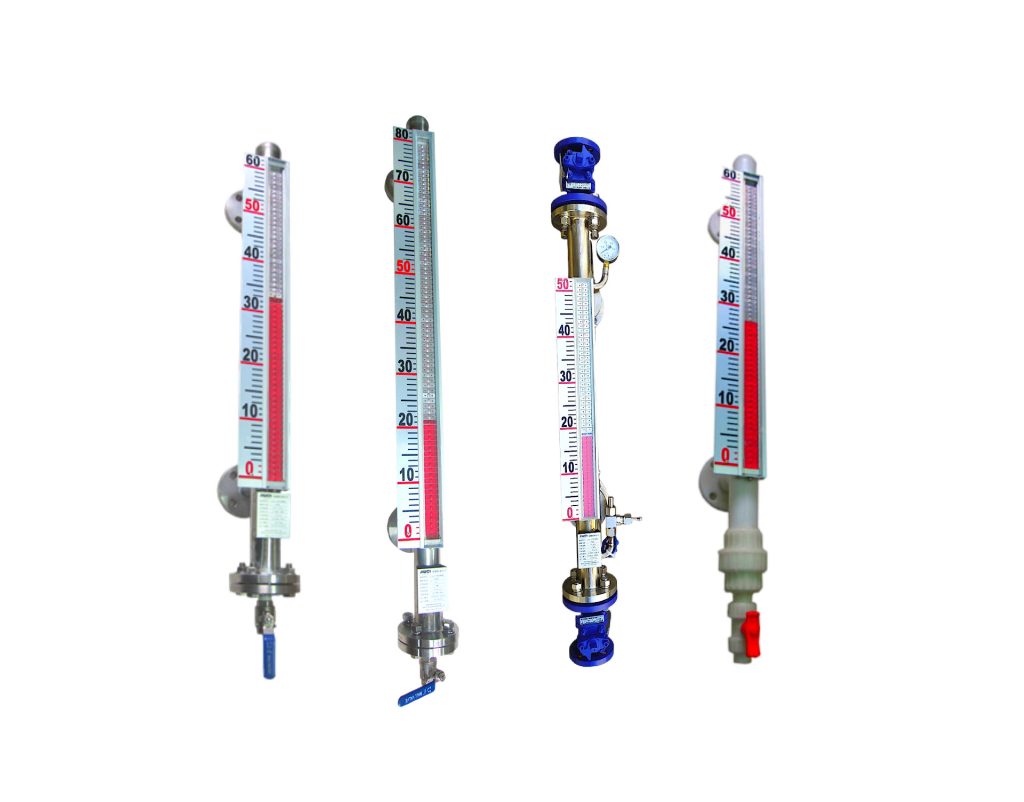
Jiwei’s Flap-11 series magnetic level indicators include several types, such as standard magnetic level indicators, economical magnetic level indicators, plastic magnetic level indicators, and lined anti-corrosion magnetic level indicators. They can be selected according to different media, temperatures, pressures, corrosion levels, and installation conditions. For applications that require remote monitoring, magnetic switches and reed-chain remote transmitters can also be added to achieve local indication, switch alarm, and 4–20 mA signal transmission.
2. Magnetic Level Indicator Principle: Why Do the Flaps “Change Faces”?
The working principle of a magnetic level indicator is mainly based on two concepts: the communicating vessel principle and magnetic coupling.
A side-mounted magnetic level indicator is usually connected to the vessel through upper and lower flanges or process connections. The chamber of the level indicator and the vessel form a communicating structure. When the liquid level inside the vessel rises, the liquid level inside the chamber rises at the same time. When the liquid level inside the vessel drops, the level inside the chamber drops accordingly. In other words, the tank and the level indicator chamber “share the same liquid level,” and neither side gets special treatment.
Inside the chamber, there is a magnetic float. The float moves up and down with the liquid level. The permanent magnet inside the float drives the magnetic flaps outside the chamber through magnetic coupling. The magnetic flaps are usually red on one side and white on the other. When the liquid level rises, the flaps turn from white to red. When the liquid level falls, the flaps turn back from red to white. The boundary between red and white indicates the current liquid level.
The core working process of a magnetic level indicator can be summarized as follows:
Liquid level changes → float moves → magnetic field is transmitted → flaps turn over → liquid level is displayed locally.
It may sound like a small magic show, but behind it is a mature mechanical and magnetic coupling design. The flaps are not performing a stage trick; they are simply doing exactly what the magnet inside the float tells them to do.
3. Magnetic Level Indicator Structure: Simple Appearance, Thoughtful Design
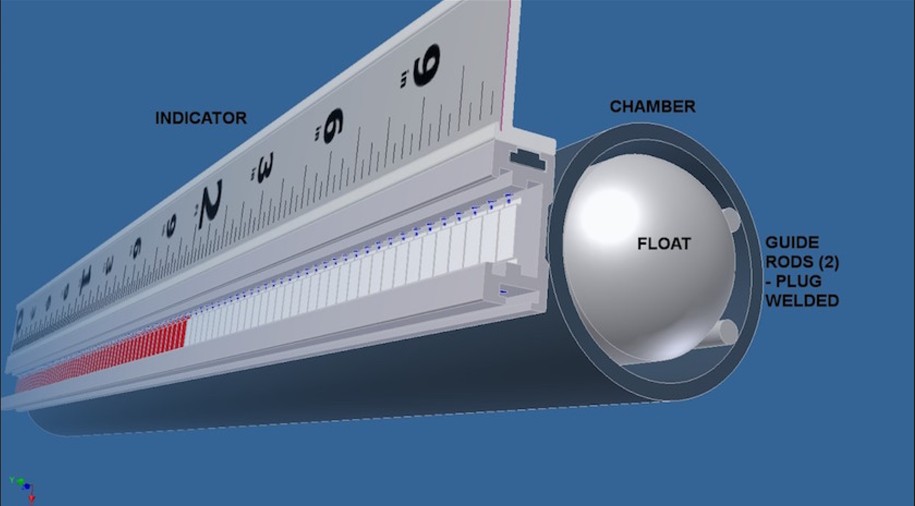
A complete magnetic level indicator usually consists of a chamber, magnetic float, magnetic flap indicator, connection flanges, vent and drain devices, and optional accessories such as magnetic switches, remote transmitters, insulation, and heat tracing devices.
3.1 Chamber
The chamber is an important pressure-bearing part of the magnetic level indicator and also the operating channel for the magnetic float. Depending on the medium and working conditions, the chamber material can be 304 stainless steel, 316L stainless steel, PP plastic, F4/PTFE lining, or F46/FEP lining.
For example, Jiwei’s Flap-11A standard magnetic level indicator uses 316L stainless steel and is suitable for most weakly corrosive liquids. The Flap-11Px lined magnetic level indicator provides F4/PTFE and F46/FEP lined chambers, making it more suitable for measuring the level of strongly corrosive liquids. Material selection should never be based on guesswork. If the medium “loses its temper,” the instrument may retire earlier than expected.
3.2 Magnetic Float
The magnetic float is one of the core components of a magnetic level indicator. It floats inside the chamber and moves with the liquid level. A magnet inside the float drives the external flaps through magnetic coupling.
Float selection is closely related to medium density, viscosity, temperature, and pressure. If the medium density is too low, the float may not float properly. If the medium viscosity is too high, the float may not move smoothly. Once the float gets stuck, the level display may turn into “yesterday’s news.” Therefore, during magnetic level indicator selection, it is necessary to confirm the medium density, viscosity, operating temperature, and process pressure.
3.3 Magnetic Flap Indicator
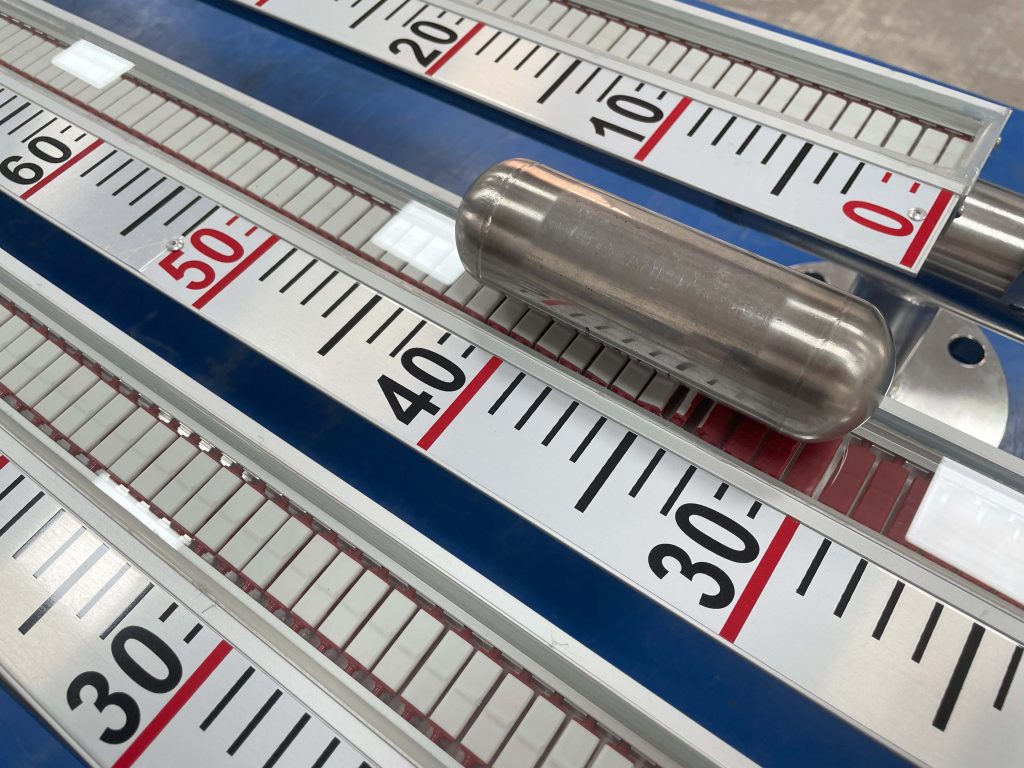
The magnetic flap indicator is the most visible display part of a magnetic level indicator. It consists of a row of magnetic flaps with different colors on each side. The red-white boundary shows the liquid level position. Jiwei’s Panel-11 magnetic flap indicator adopts a widened panel design, which improves viewing distance and viewing angle. The scale and numbers are clearer, making it easier for operators to read the liquid level quickly during site inspections.
In one sentence: the float “moves behind the scenes,” while the flaps “hold up the sign” outside.
3.4 Magnetic Switches and Remote Transmitters
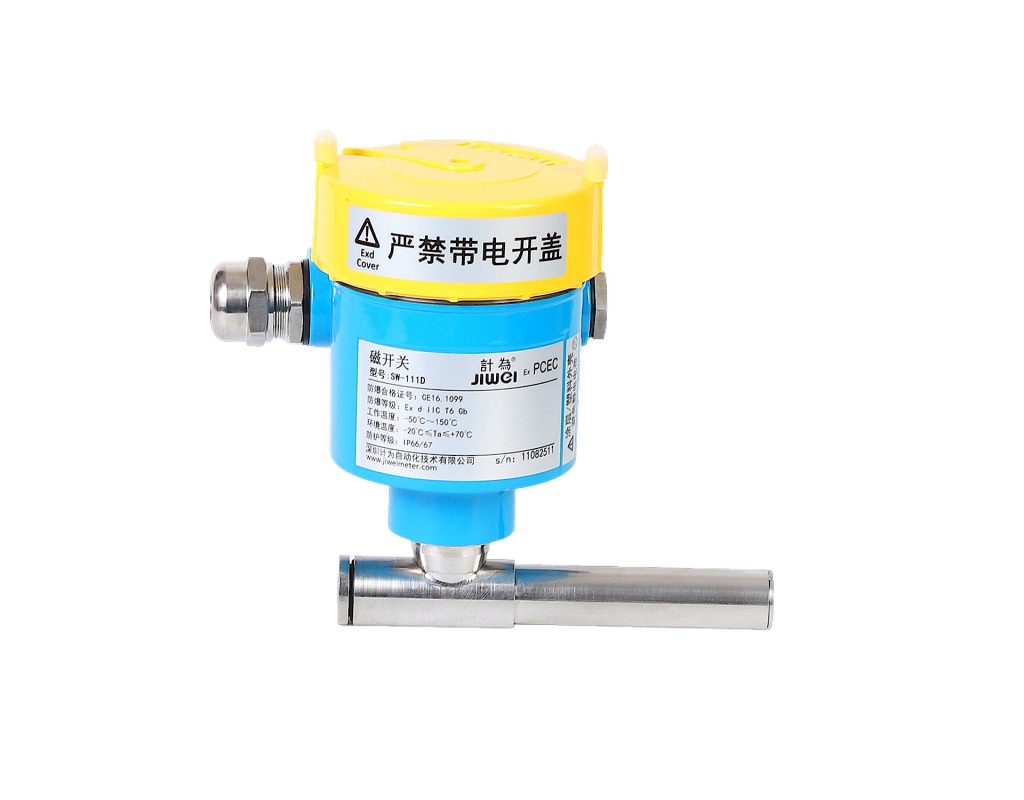
For applications requiring level alarms or remote monitoring, a magnetic level indicator can be equipped with magnetic switches and reed-chain remote transmitters.
Magnetic switches are commonly used for high-level and low-level alarms, such as preventing tank overflow or pump dry running. Reed-chain remote transmitters can convert the local level signal into a 4–20 mA current signal and transmit it to the control room, PLC, or DCS system for remote level monitoring. In this way, the magnetic level indicator can both “show itself clearly” on site and “report accurately” to the control system.
4. Typical Applications of Magnetic Level Indicators
Magnetic level indicators are widely used, especially in applications requiring local direct reading, continuous indication, corrosion resistance, remote transmission, or alarm functions.
4.1 Chemical Industry
In chemical production, acids, alkalis, salt solutions, solvents, chemical liquids, and other media can be complex. These applications often require higher standards for material compatibility and sealing reliability. Magnetic level indicators can be used in hydrochloric acid, sulfuric acid, nitric acid, alkali liquids, ammonia water, hydrogen peroxide systems, and ion-exchange membrane electrolysis systems. For strongly corrosive media, lined anti-corrosion magnetic level indicators are recommended.
4.2 Environmental Protection and Water Treatment
In industrial wastewater treatment, sewage treatment, chemical dosing tanks, and acid-base neutralization systems, magnetic level indicators are commonly used for tank level measurement. If the medium is highly corrosive, plastic or lined magnetic level indicators can be selected. If the working conditions are relatively ordinary, stainless steel magnetic level indicators can be selected according to pressure and temperature requirements.
4.3 Storage and Tank Farm Level Measurement
Magnetic level indicators can provide intuitive local level display for storage tanks, buffer tanks, intermediate tanks, and measuring tanks. For large tank farms, when used together with remote transmitters and magnetic switches, they can also achieve remote monitoring and level alarms, reducing the workload of manual inspection.
4.4 Special Corrosive Media Applications
For highly corrosive or highly permeable media such as liquid chlorine and bromine water, ordinary stainless steel may not meet long-term service requirements. In such cases, F4/PTFE or F46/FEP lined anti-corrosion magnetic level indicators can be considered to improve the instrument’s compatibility with corrosive media.
5. Key Points for Magnetic Level Indicator Selection
To keep a magnetic level indicator working reliably over the long term, proper selection is more important than simply comparing prices. The following factors should be considered during selection.
First, check the medium. It is necessary to confirm the medium name, density, viscosity, corrosiveness, crystallization tendency, and whether it contains solid particles. The more complex the medium is, the less room there is for casual selection.
Second, check the working conditions. Process pressure, process temperature, ambient temperature, installation method, connection flange specifications, and measuring range should all be confirmed.
Third, check the material. For ordinary working conditions, 304 or 316L stainless steel magnetic level indicators can be selected. For more corrosive media, PP plastic or F4/F46 lined anti-corrosion magnetic level indicators can be selected.
Fourth, check the required functions. If only local display is needed, a basic magnetic level indicator is sufficient. If alarm functions are required, magnetic switches can be added. If remote monitoring is needed, a reed-chain remote transmitter can be added to output a 4–20 mA signal.
Fifth, check protection and explosion-proof requirements. For flammable and explosive environments, explosion-proof magnetic switches, remote transmitters, and supporting accessories should be selected according to the hazardous area classification.
6. Usage Precautions for Magnetic Level Indicators
Magnetic level indicators are reliable in structure, but proper installation and maintenance are still essential. Many site problems are not caused by the product “not working hard enough,” but by installation or operation mistakes that prevent it from doing its job properly.
6.1 Confirm the Float Direction Before Installation
The magnetic float must be installed in the correct direction. In general, the end with the arrow and the heavier magnetic end should be placed according to the instruction manual. If the float is installed upside down, the level indicator may display incorrectly or even fail to work normally.
6.2 Install Valves Between the Level Indicator and the Vessel
Valves should be installed between the magnetic level indicator and the vessel to facilitate cleaning, maintenance, and material isolation. This allows the instrument to be serviced without forcing the entire system to “stop work and take a tea break.”
6.3 Keep Away from Ferromagnetic Objects and Avoid Iron Clamps
A magnetic level indicator works through magnetic coupling, so ferromagnetic objects should not be placed near the chamber. Iron clamps should also be avoided. Otherwise, the magnetic field may be affected, causing the flaps to turn incorrectly, miss turns, or display inaccurate readings.
6.4 Open Valves Slowly During Startup
When putting a magnetic level indicator into operation, the medium should enter the chamber smoothly. Sudden liquid impact may cause the float to rise too quickly, resulting in flap malfunction or disorder. A level indicator is not a roller coaster, and the float is not designed for high-speed racing.
6.5 Prevent Impurities from Entering the Chamber
Solid impurities should not enter the chamber, as they may block the float and affect measurement accuracy. For media that crystallize easily, deposit easily, or contain impurities, the chamber should be cleaned regularly to keep the float moving smoothly.
6.6 Pay Attention to Grounding When Using Remote Transmission, Magnetic Switches, or Heat Tracing
For magnetic level indicators equipped with reed-chain remote transmitters, magnetic switches, electric heat tracing, or other accessories, reliable grounding should be performed after installation. Wiring should also comply with explosion-proof, electrical, and site safety requirements.
6.7 Do Not Disassemble Lined Anti-Corrosion Models Without Authorization
The chamber and flange connection of lined anti-corrosion magnetic level indicators involve special sealing structures. Unauthorized on-site disassembly is not recommended. When dealing with strongly corrosive media, sealing reliability is not a minor detail. Do not let a wrench become the start button for an accident.
7. Conclusion: A Reliable Level Measurement Solution Behind a Simple Appearance
Magnetic level indicators are widely used because they combine local direct reading, reliable structure, strong adaptability, and expandable remote transmission and alarm functions. For different media such as water, acid and alkali liquids, industrial wastewater, chemical liquids, ammonia water, liquid chlorine, and bromine water, users can choose standard magnetic level indicators, economical magnetic level indicators, plastic magnetic level indicators, or lined anti-corrosion magnetic level indicators according to actual working conditions.
For a more complete level measurement solution, magnetic level indicators can also be combined with magnetic switches, reed-chain remote transmitters, magnetic flap indicators, insulation, and heat tracing devices to achieve local display, remote transmission, upper and lower limit alarms, and automatic control.
Overall, the magnetic level indicator may not be the flashiest instrument on an industrial site, but it is certainly a practical and reliable level measurement device. It does not rely on fancy screens to attract attention. It simply uses red and white flaps to tell you clearly: this is where the liquid level is.