Measuring liquid level in a clean water tank is usually straightforward. However, level measurement becomes significantly more challenging in rivers, sedimentation tanks, wastewater basins, slurry tanks, tailings ponds, intake wells, and industrial circulating water systems.
One commonly overlooked problem is that sediment and suspended solids in water can gradually accumulate on the probes of contact-type level instruments.
At first, the instrument may only show a small measurement error. As operating time increases, however, sediment can continue to build up on the sensor surface. Eventually, this may result in measurement drift, slow response, false level readings, unstable signals, or even complete sensor failure.
For this reason, when selecting a level sensor for sediment-rich water, it is not enough to ask:
“Can the instrument measure the water level?”
A more important long-term question is:
Will the sensor still operate reliably after months or years of exposure to the actual process conditions?
This is one of the key reasons why level measurement problems frequently occur in wastewater treatment, river monitoring, water conservancy, mining, and other applications involving dirty or sediment-laden liquids.
1. Why Is Sediment-Rich Water Particularly Challenging for Level Measurement?
Natural and industrial water is rarely completely clean.
Rivers, channels, reservoirs, and other natural water bodies may contain:
- Sand and sediment
- Clay particles
- Organic suspended solids
- Plant fragments
- Floating debris
- Biological deposits
Wastewater treatment systems, mining operations, and industrial processes can be even more challenging. Their liquids may contain sludge, mineral particles, flocculated solids, grease, oils, and other suspended materials.
When water velocity is relatively high, many of these particles remain suspended.
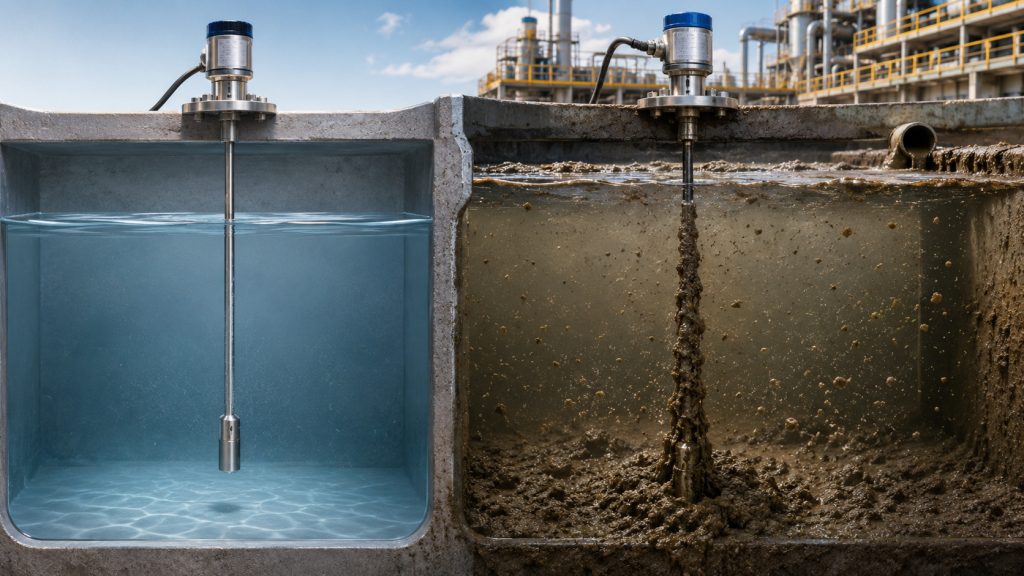
Once the water enters a tank, well, basin, or other low-velocity area, the flow slows down and solid particles begin to settle.
If a level sensor probe remains submerged in the liquid for long periods, the sensor itself can become a surface on which these particles accumulate.
Sediment gradually adheres to the probe.
Initially, only a very thin layer may form. Over time, additional particles deposit on top of the existing layer, eventually creating a thick coating of sludge or hardened sediment.
Therefore, a contact level sensor in a dirty-water application is not simply exposed to water. It is exposed to a complex mixture of water, sediment, suspended solids, sludge, and deposits.
This explains why some instruments perform perfectly during clean-water testing but begin experiencing frequent problems after operating for several months in a real river, wastewater tank, or slurry application.
2. What Is a Contact Level Sensor?
A contact level measurement instrument requires at least part of the sensing element to come into direct contact with the process medium.
Common technologies include:
- Hydrostatic pressure level sensors
- Submersible level transmitters
- Conductivity level sensors
- Capacitance level sensors
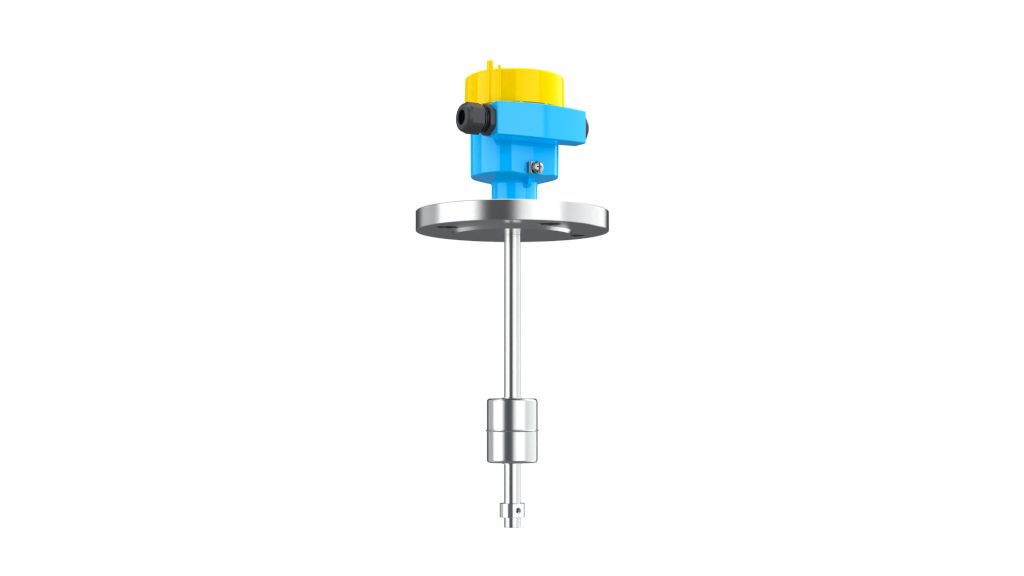
- Float level switches
- Certain guided-wave measurement systems
Although these technologies operate according to different physical principles, they share one important characteristic:
Some part of the sensing system is directly exposed to the liquid being measured.
In clean and stable liquids, this may not create a serious problem.
In water containing large amounts of sediment, sludge, or suspended solids, however, continuous contact with the process medium exposes the sensor to:
- Contamination
- Coating
- Scaling
- Entanglement
- Sediment buildup
Once deposits alter the environment around the sensing element, the instrument’s measurement performance can also change.
3. How Does Sediment Gradually Build Up on a Level Sensor Probe?
Many operators encounter a familiar situation:
A newly installed level transmitter works correctly at first, but several months later the readings begin to become unstable.
In many cases, the instrument has not suddenly failed. Instead, the problem has developed gradually.
3.1 Suspended particles begin to adhere to the probe surface
Not all fine sediment immediately settles to the bottom of a tank.
Small particles can remain suspended in water for long periods.
As these particles move past the sensor, some may remain on the probe due to surface roughness, adhesion, local flow conditions, or interactions with other suspended materials.
At first, the deposited layer may be extremely thin and have almost no noticeable effect on the measurement.
As a result, operators may not recognize the problem during the early stages.
3.2 The first sediment layer becomes a surface for further deposition
Once a layer of sediment forms on the sensor, conditions begin to change.
The original smooth sensor surface becomes rougher.
New particles can adhere more easily.
If the water also contains sludge, organic matter, grease, or biological growth, the coating may become increasingly sticky.
This can create a “snowball effect”:
The more material that accumulates, the easier it becomes for additional material to accumulate.
3.3 The deposit becomes increasingly thick
As operating time increases, a coating that was initially only a fraction of a millimeter thick can gradually develop into a much thicker deposit.
This is particularly common in:
- Sedimentation tanks
- Sludge tanks
- Tailings ponds
- Mining water systems
- High-sediment rivers
- Wastewater collection pits
Some deposits may also become compacted, dehydrated, chemically bonded, or hardened over time.
Once this happens, normal water flow may no longer be sufficient to remove the buildup.
The sensor is no longer measuring under its original design conditions. Instead, it may be operating through or inside a layer of sediment or sludge.
4. Why Does Sediment Buildup Affect Level Measurement?
Different types of contact level sensors respond to sediment buildup in different ways.
The underlying problem, however, is similar:
Deposits alter the physical conditions on which the original measurement principle depends.
Hydrostatic and Submersible Level Sensors: Pressure Transmission Can Be Affected
Submersible level transmitters commonly determine liquid level by measuring hydrostatic pressure.
In simple terms:
The higher the liquid level, the greater the pressure applied to the sensor.
However, when a sensor is surrounded by sediment or buried in sludge, deposits may cover the pressure-sensing area.
As the coating becomes thicker, pressure changes may no longer be transmitted to the sensing element in the same way or at the same speed.
Common symptoms can include:
- Slow response when liquid level rises
- Delayed response when liquid level falls
- Zero-point drift
- Increasing deviation between indicated and actual level
- Unstable measurement values
If a sensor becomes completely buried in accumulated sludge, the problem may become even more severe.
Conductivity Level Sensors: Deposits Can Change the Electrical Path
Conductivity level switches typically detect the presence of liquid by using its electrical conductivity.
When the electrodes are clean, the switching condition can remain relatively stable.
When conductive sludge, sediment, or deposits coat the electrodes, however, an unintended electrical path may form.
The instrument may then indicate that liquid is still present even after the actual level has fallen.
In other cases, the sensor may activate before the liquid reaches the intended switching point.
In an automatic control system, these false signals can affect:
- Pump start and stop operations
- Drainage control
- High-level alarms
- Low-level alarms
- Process interlocks
Capacitance Level Sensors: Coating Changes the Dielectric Environment
Capacitance level measurement depends on the dielectric characteristics of the material surrounding the probe.
If a stable coating of sediment develops on the probe, the sensor effectively gains an additional layer of material around its measuring surface.
The original measurement condition may change from:
Probe – Liquid
to:
Probe – Sediment Layer – Liquid
As the thickness and composition of the coating change, the measured capacitance may also change.
This is one reason capacitance level sensors require careful consideration in applications involving sticky materials, heavy coating, scaling, or sediment buildup.
Float Level Sensors: Sediment Can Restrict Mechanical Movement
Float level switches may appear simple and robust, but sludge and sediment can also affect their operation.
If deposits accumulate around a guide rod, pivot, hinge, or other moving component, mechanical resistance may gradually increase.
In severe cases, the float can become stuck.
The real liquid level may change while the float remains in its previous position.
This can be particularly important in pump control applications because an incorrect level signal can directly result in incorrect pump operation.
5. Why Is Regular Probe Cleaning Not Always the Best Solution?
One common response to probe fouling is periodic manual cleaning.
In the short term, this can certainly work.
Operators remove the sensor, clean away the sludge or sediment, reinstall the instrument, and normal measurement is restored.
The fundamental problem, however, remains:
The sediment is still present in the process.
As soon as the cleaned probe is returned to the same sediment-rich water, the accumulation process begins again.
Over the complete service life of the instrument, repeated cleaning can introduce substantial hidden costs.
Labor and Maintenance Costs
Personnel must regularly inspect, remove, clean, and reinstall the sensor.
For an accessible ground-level tank, this may be relatively simple.
For a deep well, remote river station, underground pumping station, reservoir, or large wastewater basin, maintenance can become much more difficult and expensive.
Process Downtime
Some level sensors are an important part of process control.
When an instrument is removed for maintenance, operators may need to switch to a backup measurement system or temporarily interrupt part of the process.
Difficult or Hazardous Maintenance Environments
Some wastewater tanks, chemical basins, pits, and underground structures may be classified as confined spaces or hazardous areas.
Requiring personnel to enter difficult locations frequently just to clean a level probe adds additional operational and safety concerns.
For this reason, reducing maintenance requirements during the initial level sensor selection process can often be more effective than relying on increasingly frequent cleaning later.
6. Why Should Non-Contact Level Measurement Be Considered for Sediment-Rich Water?
If a major problem is caused by keeping a probe continuously submerged in the process liquid, one practical engineering solution is simple:
Keep the sensing element out of the liquid whenever possible.
This is one of the reasons non-contact technologies such as radar level sensors and ultrasonic level sensors are widely used in water treatment, wastewater, water resources, and industrial liquid-level applications.
These instruments are generally mounted above the liquid surface.
They transmit a signal toward the liquid and determine the level from the reflected signal.
The sensor does not need to remain submerged in the water.
As a result, sediment, sludge, and most suspended solids cannot directly coat the measuring element in the same way they can coat an immersed probe.
This can significantly reduce maintenance problems associated with probe fouling and sediment accumulation.
However, an important point should be understood:
Non-contact measurement does not mean that environmental conditions no longer matter.
Foam, heavy vapor, condensation, severe turbulence, internal obstacles, and poor installation can still affect the performance of different measurement technologies.
Instrument selection must therefore always be based on the actual application.
7. Why Are Radar Level Sensors Commonly Used for Challenging Water Applications?
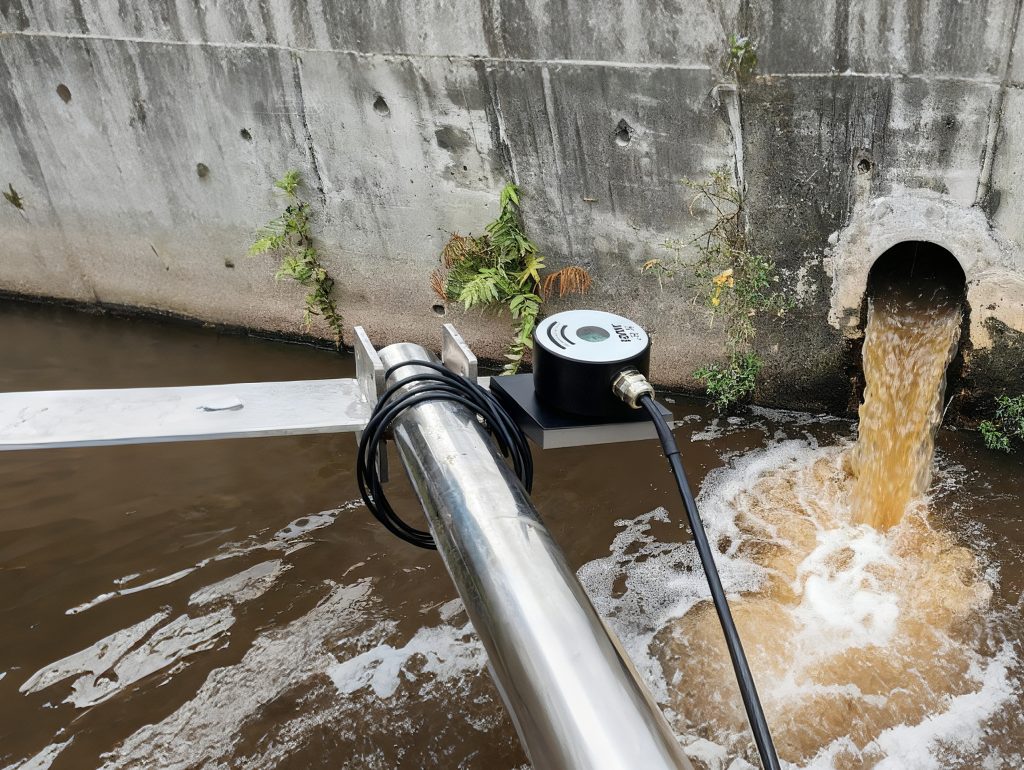
Radar level sensors use electromagnetic waves to determine the distance between the instrument and the material surface.
The basic measurement process can be understood as:
The radar transmits a signal → the signal reaches the water surface → the surface reflects the signal → the instrument receives the echo → the distance to the surface is calculated.
The antenna is generally installed above the liquid surface.
Under normal installation conditions, it does not remain immersed in sediment-rich water in the same way that a submersible level transmitter does.
This characteristic can provide significant advantages in applications such as:
- River level monitoring
- Reservoir level monitoring
- Wastewater pumping stations
- Municipal wastewater tanks
- Sedimentation basins
- Mining drainage systems
- Tailings ponds
- Industrial wastewater tanks
- Stormwater wells
- Underground collection pits
The advantage becomes particularly important at locations where maintenance is difficult or where the instrument must operate unattended for long periods.
Reducing direct contact between the sensor and the process medium can help lower the risk of failures caused by sediment accumulation.
8. Why Can a Non-Contact Level Sensor Still Give Unstable Readings?
Avoiding probe immersion solves one category of problems, but it does not eliminate the need for correct installation.
Many measurement problems in the field are actually caused by poor sensor positioning.
Sensor Installed Too Close to the Inlet
The area around a water inlet can contain severe turbulence, waves, splashing, and foam.
The liquid surface may be highly unstable.
This can make reliable signal processing more difficult.
Whenever possible, the sensor should generally be installed above a relatively stable section of the liquid surface.
Fixed Obstacles Inside the Measurement Area
Ladders, pipes, brackets, beams, structural supports, and other internal objects can generate unwanted reflections.
When installing a radar level sensor, these obstacles should ideally be kept outside the primary measurement beam.
Incorrect Measuring Range or Dead-Zone Considerations
Different level sensors have different operating ranges and minimum measuring distances.
If the maximum liquid level comes too close to the sensor, it may enter an area where reliable measurement cannot be guaranteed.
For this reason, system design should clearly identify:
- Maximum liquid level
- Minimum liquid level
- Sensor mounting height
- Required measuring range
before the instrument is selected.
9. What Should You Consider When Selecting a Level Sensor for Sediment-Rich Water?
For wastewater, rivers, slurry, and other challenging liquids, simply comparing which level sensor offers the highest stated accuracy is rarely enough.
The complete operating environment and service life should be considered.
9.1 Does the Liquid Contain Significant Sediment or Suspended Solids?
If the liquid is relatively clean, many contact level measurement technologies can operate reliably.
If the medium continuously contains sediment, sludge, slurry, mineral particles, or high concentrations of suspended solids, the risk of probe fouling and deposition should be carefully evaluated.
9.2 Is Sediment Likely to Settle?
Different water systems have very different sediment concentrations and settling rates.
Sedimentation tanks, tailings ponds, low-flow basins, and similar applications are particularly prone to accumulation.
If the level sensor is installed directly in an area where solids naturally settle, the risk of a contact probe becoming buried can increase significantly.
9.3 How Easy Is the Instrument to Maintain?
This question is often overlooked.
Consider a sensor that requires cleaning every three months.
If it is installed in a small ground-level water tank, maintenance may be simple and inexpensive.
If the same sensor is installed in a deep well, remote river monitoring station, underground chamber, or hazardous wastewater environment, the maintenance cost can be much greater.
Level sensor selection should therefore consider more than the initial purchase price.
Long-term maintenance requirements are equally important.
9.4 Is the Measurement Used for Automatic Control?
If level data is only used for local indication, a temporary measurement problem may have limited consequences.
If the measurement is directly connected to:
- Pump control
- Valve operation
- High-level alarms
- Low-level alarms
- Safety interlocks
then long-term reliability becomes much more important.
In these situations, measurement technologies that are highly susceptible to sediment-related false signals should be evaluated carefully.
10. Level Sensor Selection Should Consider Lifecycle Cost, Not Only Purchase Price
A common mistake in industrial instrumentation purchasing is to compare only the initial price of the instrument.
The real cost of level measurement should include:
Purchase Cost + Installation Cost + Commissioning Cost + Maintenance Cost + Downtime Cost + Failure Risk
For example, a contact level transmitter may have a relatively low initial purchase price but require manual cleaning every few months.
Over several years, the accumulated labor and maintenance expenses may exceed the original cost of the instrument.
By comparison, a non-contact measurement technology designed for challenging media may have a different initial cost but substantially reduce the number of maintenance interventions.
Its total lifecycle cost may therefore be lower.
This consideration is particularly important for:
- Remote water monitoring stations
- Unmanned pumping stations
- Reservoirs
- Underground wastewater facilities
- Hard-to-access industrial sites
11. Reliable Level Measurement Means More Than Getting the Right Reading on Day One
Level measurement may appear simple.
The objective is only to determine how high the liquid is.
In real industrial applications, however, the most difficult question is not whether the instrument provides an accurate reading immediately after installation.
The more important questions are:
Will it still measure correctly after one month?
Will it still operate reliably after six months?
Will the measurement remain stable after one year?
How much maintenance will be required over several years of operation?
These questions become particularly important in liquids containing sediment, sludge, and suspended solids.
When a contact sensor remains immersed in such media, coating and sediment accumulation can gradually increase over time.
As deposits alter the measurement environment around the sensing element, the instrument may begin to experience:
- Slow response
- Zero drift
- Measurement errors
- False alarms
- Unstable output
- Complete measurement failure
Therefore, when selecting level instrumentation for rivers, reservoirs, wastewater tanks, sedimentation basins, slurry tanks, tailings ponds, and industrial wastewater applications, engineers should evaluate more than range, accuracy, and output signal.
They should also ask:
Is the process medium likely to contaminate or bury the sensor, and how much maintenance will the instrument require over its service life?
Where sediment, sludge, or heavy solids accumulation is a significant concern, a suitable non-contact level measurement technology can reduce the risk of failure associated with immersed sensing elements.
In industrial level measurement, the best solution should not simply provide an accurate reading.
It should provide:
Long-term stability, low maintenance requirements, and reliable performance under real process conditions.
Frequently Asked Questions
1. Can sediment in water affect a level sensor?
Yes. The extent of the effect depends on the measurement principle. For contact-type sensors that remain submerged in the process, sediment, sludge, and suspended solids may accumulate on the sensing element. This can affect pressure transmission, electrical conductivity, dielectric properties, or mechanical movement, eventually causing measurement errors or failure.
2. Can a submersible level transmitter be used in sediment-rich water?
It can be used in some applications, but the sediment concentration, settling rate, installation position, and maintenance conditions should be evaluated carefully. If the sensor is installed in an area where sludge or sediment tends to accumulate, there is a greater risk that the sensing area will become coated or buried.
3. Why do wastewater level sensors require frequent cleaning?
Wastewater often contains sludge, suspended solids, grease, oils, biological matter, and other substances that can adhere to sensor surfaces. Contact probes that remain immersed in the wastewater can gradually become coated or fouled, requiring periodic cleaning to maintain reliable measurement.
4. Can sediment accumulate on a radar level sensor?
Under normal installation conditions, a radar level sensor is mounted above the liquid surface and does not remain submerged in the water. Therefore, sediment in the liquid generally does not accumulate on the sensor in the same way it does on an immersed probe. However, condensation, dust, foam, internal obstacles, and severe surface turbulence should still be considered.
5. What type of level sensor is suitable for river water level measurement?
The correct technology depends on the measuring range, installation conditions, water flow, sediment concentration, floating debris, power supply, and communication requirements. For river monitoring locations with high sediment content or difficult maintenance access, non-contact level measurement can offer significant practical advantages.
6. What are the most important factors when selecting a wastewater level sensor?
In addition to measuring range and accuracy, consider the characteristics of the liquid, installation environment, presence of sludge or sediment, minimum and maximum levels, temperature, pressure, foam, condensation, and maintenance accessibility. For unattended applications, long-term stability and low maintenance requirements may be more important than achieving the highest possible measurement accuracy.