
1. Basic Definition
A reed switch is a small electrical component that opens or closes a circuit when exposed to a magnetic field. In most designs, two thin metal reeds are sealed inside a narrow glass capsule. When a magnet comes close enough, the metal reeds become magnetized, move toward each other, and touch. That contact allows current to pass through the circuit. When the magnet moves away, the reeds separate again and the circuit returns to its original state.
This simple magnetic action makes the device useful in many types of detection and control systems. It can sense whether a door is open, whether a float has reached a certain level, whether a rotating part has passed a fixed point, or whether a mechanical component is in the correct position. Because it works without physical contact between the magnet and the sealed capsule, it is often used in hidden, low-power, and long-life sensing designs.
You may find this component in door and window alarms, refrigerator door detectors, water level sensors, gas meters, electric meters, smart home devices, automotive systems, and industrial equipment. Although it is small and inexpensive, it is still an important part of many reliable sensing solutions.

2. Internal Structure
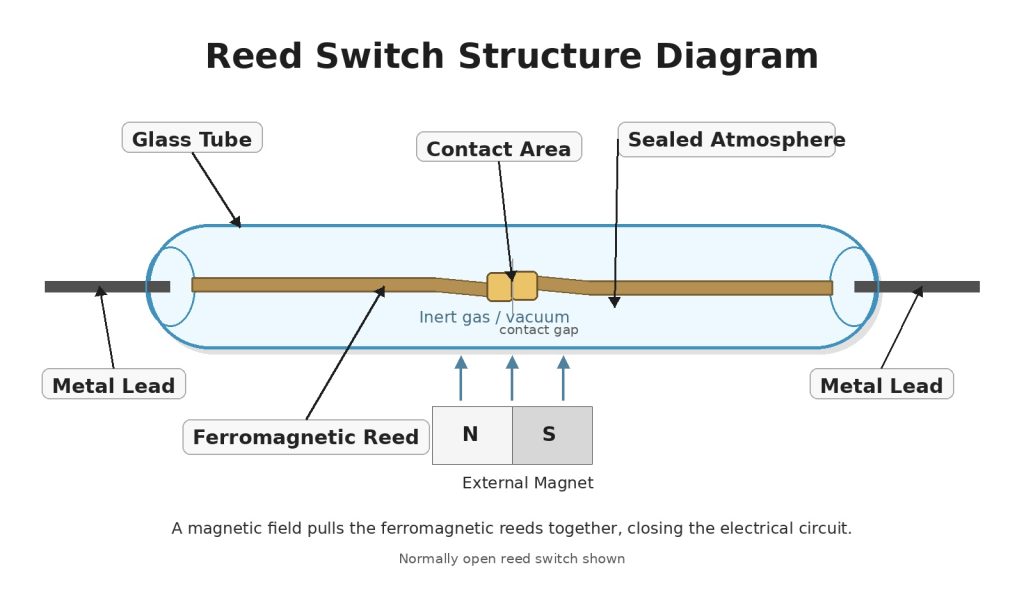
A typical magnetic reed device has a compact but carefully designed structure. The most visible part is the glass envelope, which protects the internal contacts from air, dust, moisture, and corrosion. This sealed design is one reason the component can work reliably for a long time.
Inside the glass tube are two flexible metal blades, usually made from magnetic alloy materials. These blades are called reeds. Their ends overlap slightly but do not normally touch in the open state. The overlapping area forms the electrical contact point.
The contact surfaces are often plated with precious metals such as gold, rhodium, or ruthenium. These coatings help reduce contact resistance, improve wear resistance, and protect against oxidation. The choice of coating affects electrical life, switching capacity, and suitability for different loads.
The inside of the capsule is usually filled with inert gas or maintained as a vacuum. This environment helps reduce arcing and contact damage when the circuit opens or closes. As a result, the part is better protected than many exposed mechanical switches.
3. How It Works
The working principle is based on magnetism and the elasticity of the reeds. In a normally open version, the two contacts remain separated when no magnetic field is present. Once a magnet approaches, magnetic flux passes through the reeds and causes them to attract each other. When the magnetic force is strong enough, the contacts close and the circuit becomes conductive.
After the magnet is removed, the magnetic force decreases. The reeds then spring back to their original position, opening the circuit again. This process happens quickly and does not require external power for the sensing element itself.
There are also normally closed versions. In this design, the contacts are connected when no magnet is present and separate when the magnetic field is applied. Another option is the changeover type, which can switch between two output states. This is useful when a system needs more than simple on-off detection.
Because the device responds to magnetic field strength, performance depends heavily on magnet size, polarity, direction, distance, and movement path. In real product design, the magnetic actuator and the sensor should always be tested together.
4. Difference from a Mechanical Switch
A traditional mechanical switch usually requires direct pressure, sliding, rotation, or another physical action to move the contacts. A magnetically controlled contact does not need direct contact with the object being detected. The magnet can be placed on a moving part, while the sensor remains fixed and protected behind a housing.
This non-contact method provides several benefits. It reduces mechanical wear, allows concealed installation, and helps protect the sensing element from dirt and moisture. For example, a door sensor can be installed inside a frame, while the magnet is mounted on the moving door panel. When the door opens, the distance changes and the circuit state changes with it.
Another major difference is power consumption. The magnetic contact itself is passive, meaning it does not require a continuous supply voltage to detect the magnet. This makes it attractive for battery-powered equipment, especially smart home sensors and portable instruments.
However, the contact rating is limited. These components are best used for signal-level switching or low-power circuits. They should not be treated like heavy-duty power switches unless the selected model is specifically rated for the load.
5. Main Types
The first common type is normally open. In this version, the circuit is open without a magnetic field and closes when a magnet is nearby. This is widely used in door contacts, position detection, counting applications, and safety interlocks.
The second type is normally closed. Here, the circuit stays closed in its default state and opens when the magnetic field reaches the operating range. It is useful when a system needs a default connected condition and a magnetic trigger to break the circuit.
The third type is changeover. It usually has three terminals: a common terminal, a normally open terminal, and a normally closed terminal. The output changes from one contact path to another when the magnetic field is applied.
Packaging styles also vary. Bare glass capsules are compact and suitable for embedded designs. Plastic-encapsulated versions provide better mechanical protection and easier mounting. Surface-mount types are designed for printed circuit boards. Pre-wired sensor modules are convenient for engineering projects because they may include a housing, cable, connector, or mounting holes.
6. Important Electrical and Magnetic Parameters
When choosing a reed switch, several specifications matter.
The operate value indicates how much magnetic field is needed to close or change the contacts. A lower operate value means higher sensitivity. A higher value requires a stronger magnet or a shorter distance.
The release value describes the point at which the contacts return to their original state as the magnetic field weakens. The gap between operate and release values provides hysteresis, which helps prevent unstable output near the trigger point.
Switching voltage and switching current define the load the contacts can safely handle. These limits should not be exceeded. In practical designs, it is wise to leave a safety margin instead of operating continuously at the maximum rating.
Contact resistance is another key factor. Lower resistance provides better signal quality and less loss when the contacts are closed.
Operate time and release time are important in counting or speed-sensing applications. Although magnetic reed contacts are generally fast, very high-speed systems may need a different sensing technology.
Mechanical life and electrical life should also be checked. Mechanical life is measured under light-load or no-load conditions. Electrical life depends on voltage, current, load type, and protection circuits. Inductive loads such as coils, motors, and solenoids are more demanding because they can produce voltage spikes when switched off.
7. Advantages
The first advantage is non-contact sensing. The magnet and the sealed contact do not need to touch, and the magnetic field can often pass through non-magnetic materials such as plastic, wood, or glass. This allows flexible installation and better protection.
The second advantage is low power consumption. Since the sensing element is passive, it can help extend battery life in low-energy devices.
The third advantage is a simple circuit design. In many cases, the component can be connected directly to a microcontroller input with a pull-up or pull-down resistor. This makes the surrounding circuit easy to design.
The fourth advantage is compact size. Small glass or molded packages can fit into narrow spaces where larger switches would be difficult to install.
The fifth advantage is good isolation. The magnetic actuator and the electrical contacts are not electrically connected. This can be helpful in systems that require separation between the moving part and the circuit.
The sixth advantage is reliability in protected environments. Because the contacts are sealed, they are less exposed to dust, moisture, and oxidation than many open mechanical contacts.
8. Limitations and Design Precautions
Despite its benefits, this component has limits. The most important limitation is contact capacity. If too much current flows through the contacts, they may overheat, arc, weld together, or fail early. For motors, lamps, solenoid valves, relay coils, and other demanding loads, use the magnetic contact only as a signal input and let a relay, transistor, MOSFET, or driver circuit handle the power.
Inductive loads require special care. When a coil is switched off, it may generate a high reverse voltage. A flyback diode, RC snubber, varistor, or other suppression method can protect the contact and extend service life.
Mechanical handling also matters. Many basic versions use a fragile glass capsule. Do not bend the leads too close to the glass seal, clamp the body tightly, or subject it to impact. If the application involves vibration or rough handling, consider a molded or housed sensor.
Another consideration is contact bounce. When the contacts close or open, they may briefly bounce before settling. For digital circuits, software debouncing or hardware filtering can prevent false triggering.
Finally, magnetic placement must be validated. A small change in magnet orientation or distance can affect operation. Testing should cover temperature, tolerance, housing thickness, and real movement conditions.
9. Common Applications
In security systems, this magnetic sensing component is commonly used for door and window detection. One part is fixed to the frame, and the magnet is attached to the moving panel. When the door or window opens, the magnet moves away and the control system detects the state change.
In smart home products, it can help monitor cabinets, drawers, garage doors, pet doors, and access panels. Its low standby power is useful for wireless sensors that run on small batteries.
In household appliances, the device may detect refrigerator doors, washing machine lids, dishwasher panels, water tanks, and removable containers. The control board can then decide whether the appliance should operate, pause, warn the user, or turn on a light.
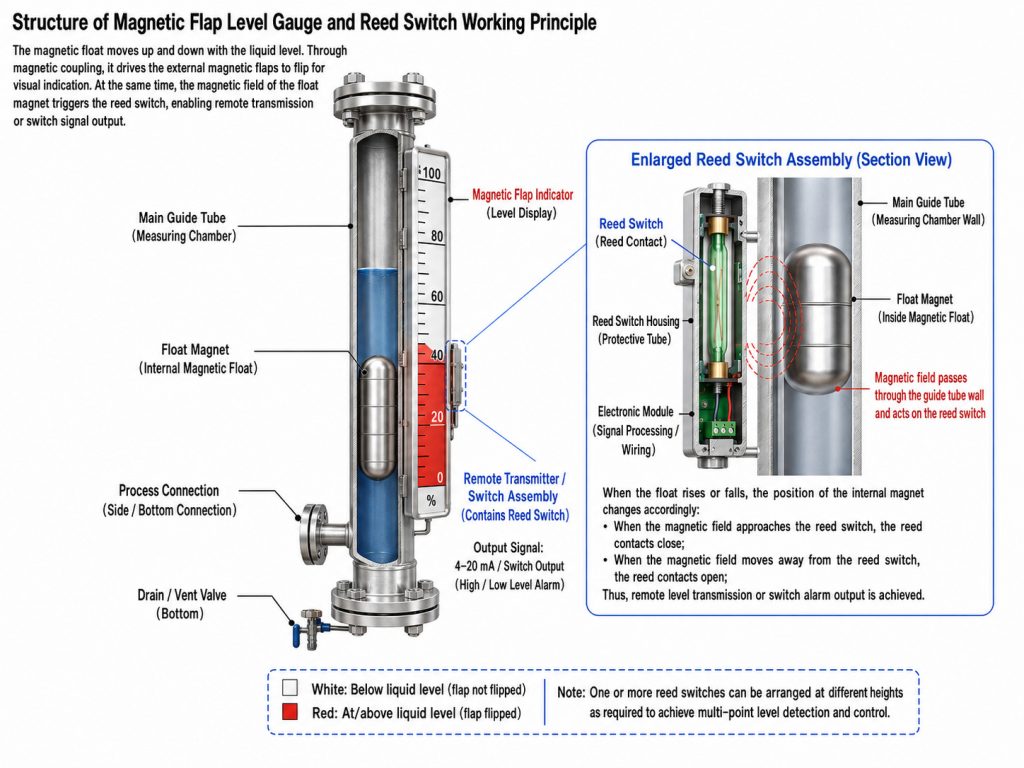
In liquid level sensing, a magnetic float moves with the fluid level. When the float reaches a certain height, the internal magnet triggers a fixed contact. This design is common in water tanks, water purifiers, coffee machines, heaters, and industrial level indicators.
In metering systems, the component can generate pulses as a magnetic wheel or rotating element passes by. These pulses may be counted to measure water flow, gas consumption, or mechanical rotation.
In automotive and electric mobility applications, it can support brake detection, seat position sensing, cover detection, and basic safety interlocks. It is also found in industrial automation equipment, pneumatic cylinders, limit detection assemblies, and simple position feedback systems.
10. Comparison with Hall Effect Sensors
A Hall effect sensor is another popular magnetic sensing option. The two technologies are often compared because both respond to magnetic fields.
A magnetic reed contact is a mechanical contact device. It behaves like a simple open or closed circuit and does not require power for the sensing element. This makes it excellent for low-power and straightforward on-off detection.
A Hall sensor is a semiconductor device. It requires power and can provide digital or analog output. It has no mechanical contact wear, handles vibration well, and is suitable for high-speed or precise magnetic field sensing.
For a simple door, float, or position signal, the reed-based option is often economical and easy to apply. For high-speed rotation, strong vibration, miniaturized electronics, or applications that need more detailed magnetic information, a Hall device may be the better choice.
11. How to Choose the Right Model
Start with the application. A door sensor, a water level detector, a meter pulse output, and an industrial limit sensor may all require different sensitivity, package strength, lead style, and contact rating.
Next, check the electrical load. For microcontroller input, the load is usually very small. For higher current circuits, use an external driver and keep the magnetic contact within its rated limits.
Then review magnetic sensitivity. The sensor must operate reliably at the planned distance from the magnet and must release reliably when the magnet moves away. Both actions are important.
Consider the package. Bare glass parts are compact and inexpensive, but they require careful handling. Molded parts and finished modules are easier to install and more durable.
Environmental conditions are also important. Temperature, vibration, moisture, chemicals, dust, and enclosure material can all influence performance and lifetime.
Finally, test the real assembly. Datasheet values are helpful, but final performance depends on the magnet, mounting position, tolerance stack-up, and movement path.
12. Installation Tips
Mount the glass body carefully and avoid mechanical stress. When bending leads, support the wire and bend away from the sealed end.
Place the magnet in a consistent and repeatable position. The best orientation depends on the magnetic field pattern and the sensor design, so practical testing is essential.
For microcontroller circuits, add a pull-up or pull-down resistor and use software filtering if the input must be stable. For long cable runs, consider noise filtering and proper grounding.
For inductive or higher-energy circuits, add protection components and keep the switched load within the specified rating. This prevents premature contact damage.
13. Conclusion
A reed switch is a compact magnetic contact used to open or close a circuit without direct mechanical contact from the moving object. It is simple, low-power, easy to integrate, and widely used in security, smart home, appliance, metering, automotive, liquid level, and industrial sensing applications.
Its biggest strengths are passive operation, sealed contacts, compact size, and straightforward on-off output. Its main limits are contact rating, glass fragility, magnetic placement sensitivity, and possible bounce. With correct selection, proper load protection, and careful installation, this small component can provide dependable performance in many detection systems.
FAQ
1. Does this magnetic contact need power?
The sensing element itself does not need power. The external circuit that reads its state usually does.
2. Can it directly control a motor?
Usually no. A motor can draw high current and generate electrical noise. Use the component as a signal input and let a driver, relay, or MOSFET control the motor.
3. Is a stronger magnet always better?
Not always. A magnet that is too weak may fail to trigger the contact, but one that is too strong or too close may prevent reliable release. The best choice should be verified through testing.
4. Why does the output sometimes flicker?
The contacts may bounce during opening or closing. Add software debouncing or hardware filtering to stabilize the signal.
5. Can it be used outdoors?
Yes, but it should be protected with a proper enclosure. The internal contact is sealed, but leads, solder joints, cables, and connectors still need waterproofing and corrosion protection.
6. Is it the same as a reed relay?
No. A reed relay combines a magnetic reed contact with a coil. When the coil is energized, it creates the magnetic field needed to operate the contact.