
In powder, granular, and bulk solids handling applications, vibrating level switches are widely used for point level detection. They are commonly installed on silos, storage tanks, hoppers, and conveying systems for high-level alarms, low-level detection, overflow prevention, and empty-bin protection.
One question often arises during product selection:
Should you choose a single-rod or a dual-rod vibrating level switch? What are the actual differences between the two?
At first glance, both designs use rod-type sensing elements and operate according to similar principles. However, there can be significant differences in vibration structure, energy transmission, sensitivity, and adaptability to challenging process conditions.
For materials such as coal powder, plastic pellets, lime, cement, grain, dust, and low-density powders, understanding these differences can help users select a more suitable level switch.
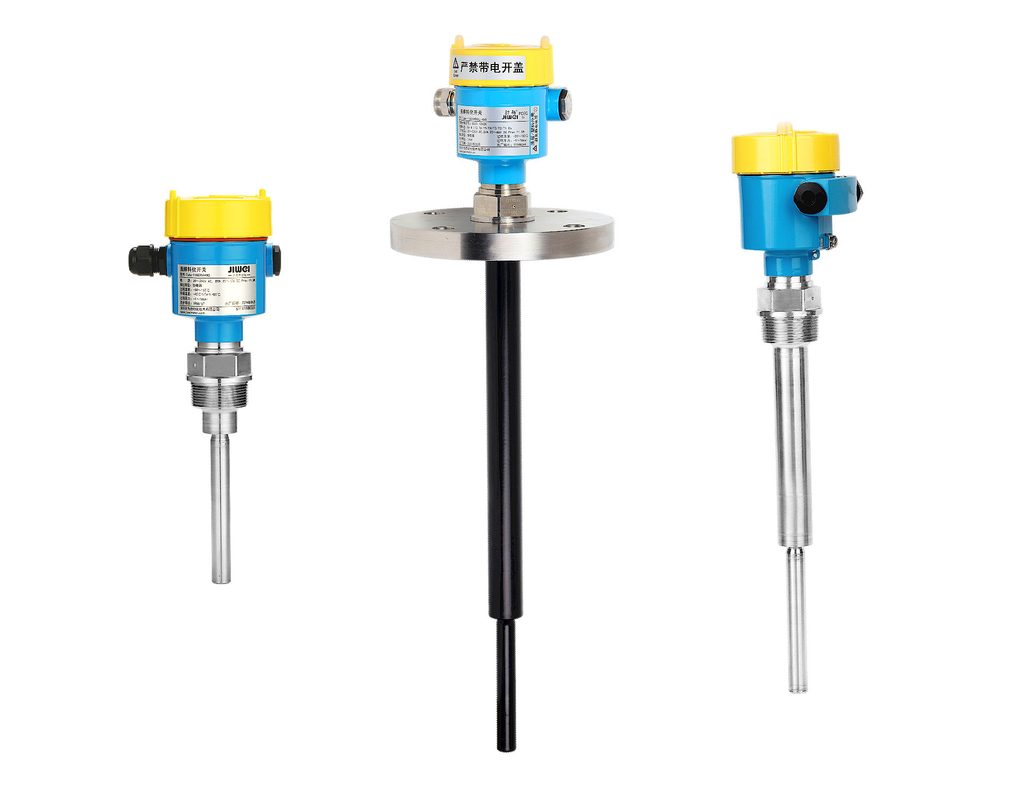
1. How Does a Vibrating Level Switch Detect Material?
A vibrating rod level switch is a type of vibration-based point level switch.
Its operating principle is relatively straightforward. An internal drive element keeps the sensing probe vibrating at a specific frequency or vibration state. When bulk material rises and covers the probe, the material creates a damping effect, causing the vibration characteristics to change.
The electronic unit detects changes in vibration amplitude, frequency, or other related parameters and then generates a switching output.
Unlike continuous level transmitters, a vibrating level switch does not continuously measure the exact material level. Instead, it answers a simple question:
“Is material present at this position?”
For example, when installed near the top of a silo, it can serve as a high-level alarm. When mounted near the bottom, it can be used for low-level or empty-bin detection.
This operating principle makes vibrating rod level switches particularly suitable for powders, granules, and many other bulk solid materials.
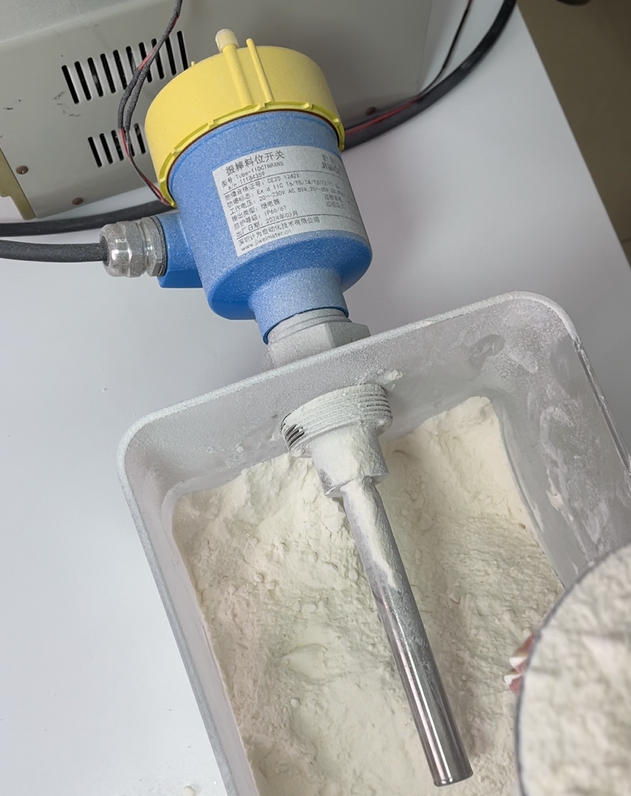
2. What Is a Single-Rod Vibrating Level Switch?
A single-rod vibrating level switch generally uses one main rod-shaped vibrating element as the sensing structure.
During operation, a piezoelectric or similar drive element excites the sensing rod and causes it to vibrate mechanically. When the rod comes into contact with the material, its vibration is damped. The electronic circuitry detects this change and determines whether the probe is covered.
One of the main characteristics of the single-rod design is its relatively straightforward mechanical structure.
For conventional granular materials, high- and low-level alarms, and relatively stable operating conditions, a well-designed single-rod vibrating level switch can provide reliable point level detection.
However, the performance of a vibrating level switch depends on more than whether the probe vibrates.
Important factors also include:
- stability of vibration energy;
- influence from the mounting structure;
- sensitivity to changes in material density;
- external mechanical vibration;
- material buildup on the probe.
In applications involving very low-density powders, heavy buildup, or strong equipment vibration, the stability and sensitivity of the vibration system become especially important.
3. What Is a Dual-Rod Vibrating Level Switch?
The term “dual-rod” does not necessarily mean that two separate rods are visibly mounted side by side.
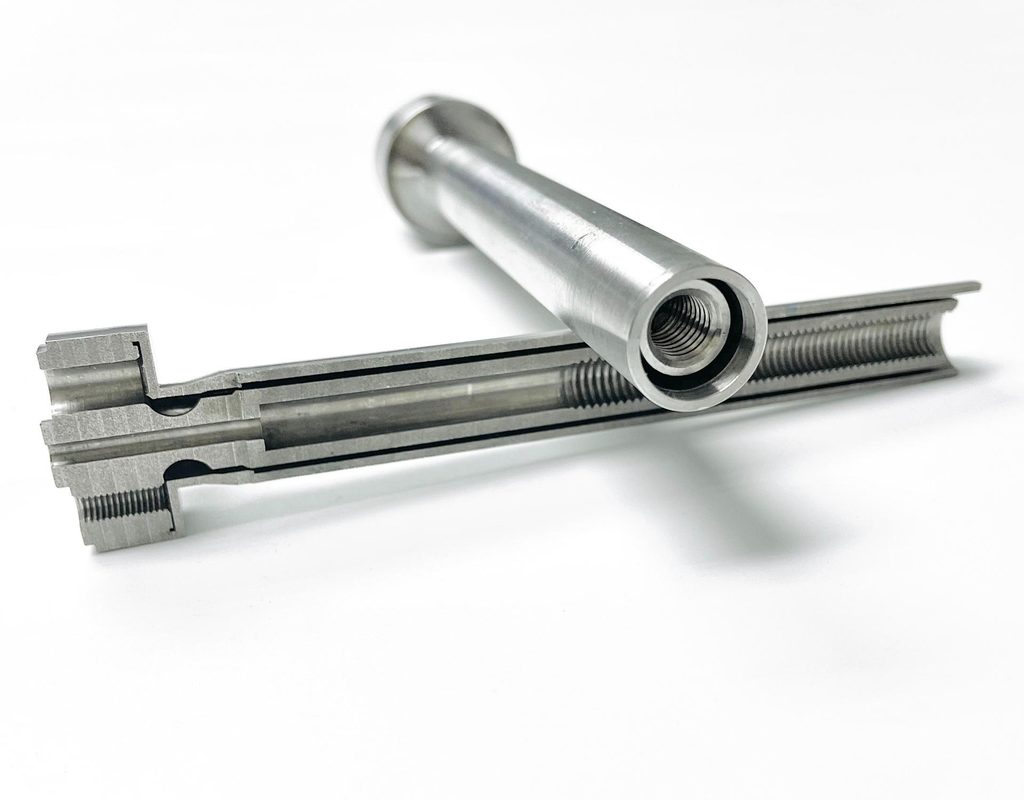
The Jiwei Tube-11 vibrating level switch, for example, adopts an inner-and-outer nested dual-tube vibration structure. From the outside, the probe still appears as a cylindrical rod, but its internal vibration system consists of two interacting tubular elements.
The key purpose of this design is to allow the inner and outer vibration tubes to operate in a coordinated resonant state.
When the probe is in air and not in contact with material, the inner and outer structures maintain a stable vibration condition.
Once the outer vibration tube comes into contact with powder or granular material, its vibration characteristics change. The original resonance condition is disturbed, and the electronic system detects this change and produces a switching signal.
The Tube-11 uses piezoelectric components for vibration excitation and signal detection. Its nested dual-tube resonance structure is designed for point level detection of powders and granular solids.
According to its product specifications, the minimum detectable bulk density can be as low as 0.02 g/cm³, making it suitable for certain lightweight and low-density bulk solids.
4. What Are the Main Differences Between Single-Rod and Dual-Rod Vibrating Level Switches?
4.1 Different Vibration Structures
The most fundamental difference lies in the vibration structure.
A single-rod design relies mainly on one vibrating sensing element, while a dual-rod or dual-tube design uses two mechanically coupled vibration elements to create a resonant system.
Although both belong to the category of vibration-based level switches, their internal mechanical vibration systems are not identical.
4.2 Different Vibration Energy Transmission
After installation, a vibrating level switch does not operate in complete isolation.
The probe is mechanically connected to the process fitting, mounting socket, and silo or vessel wall.
If too much vibration energy is transferred into the mounting structure, the effective vibration behavior of the sensing probe may be affected.
A dual-tube resonance design aims to keep more of the useful vibration energy within the sensing structure itself, thereby reducing the influence of the mounting point and surrounding mechanical structure.
However, this does not mean that every single-rod level switch is necessarily more sensitive to vessel vibration.
Actual performance also depends on probe design, drive technology, electronic signal processing, installation conditions, and factory calibration.
Therefore, product performance should not be judged only by whether the sensor is described as “single-rod” or “dual-rod.”
4.3 Differences in Low-Density Material Detection
Lightweight powders are often more difficult to detect than dense materials.
This may sound counterintuitive, but low-density powders exert less damping force on a vibrating probe. As a result, the sensor must be able to detect relatively small changes in vibration.
For this reason, minimum detectable bulk density is an important parameter when selecting a vibrating level switch.
Materials such as plastic powder, lightweight granules, chemical powders, and dust may have much lower bulk density than sand, minerals, or coarse particles.
In these applications, users should pay particular attention to the manufacturer’s specified minimum material density rather than comparing only the sensor’s appearance or purchase price.
With its inner-and-outer dual-tube resonant structure, the Tube-11 has a specified minimum detectable material density of 0.02 g/cm³, making it a potential option for applications where low-density powder detection is a key requirement.
4.4 Performance in Material Buildup Applications
Material buildup is a common challenge in powder handling applications.
Materials such as cement, lime, coal powder, dust, and moisture-sensitive powders may gradually adhere to the sensing probe during long-term operation.
If this buildup continuously changes the probe’s vibration characteristics, it may affect switching reliability.
One practical advantage of a rod-shaped probe, compared with fork-type sensing elements, is the absence of a narrow gap between two fork tines.
This helps reduce the possibility of particles becoming trapped between sensing elements.
A smooth cylindrical probe surface may also be less prone to certain types of bridging or clogging.
For buildup-prone applications, however, users should still consider:
- probe geometry;
- vibration sensitivity;
- material adhesion characteristics;
- installation angle;
- long-term stability under coating conditions.
A dual-tube design should not be interpreted as being completely immune to buildup.
Its main benefit is that a stable resonant vibration system can help the instrument distinguish between normal vibration conditions and true material coverage under certain coating conditions.
5. What Are the Advantages of a Single-Rod Vibrating Level Switch?
A single-rod structure should not be considered outdated.
For conventional granular materials, relatively high bulk densities, and stable operating conditions without severe buildup or impact, a properly designed single-rod vibrating level switch can perform very well.
Its typical advantages include:
- relatively simple sensing structure;
- straightforward operating principle;
- suitability for conventional high- and low-level alarms;
- convenient use with free-flowing granular materials;
- effective point level detection in standard industrial applications.
For example, if the application involves ordinary grain, plastic pellets, or other relatively dense and free-flowing solids, a mature single-rod vibrating level switch may fully meet the process requirements.
There is no need to select a more complex structure simply because it appears more advanced.
The correct level switch should always be selected according to actual process conditions.
6. When Is a Dual-Rod Vibrating Level Switch More Suitable?
A dual-tube or dual-rod resonant vibrating level switch may deserve greater consideration when the process involves more demanding operating conditions.
One typical application is low-density powder detection.
The lighter the material, the weaker the damping effect on the probe, which generally increases the sensitivity requirements of the level switch.
Another situation is powder buildup.
When material continuously adheres to the probe surface, a stable vibration system becomes increasingly important for maintaining reliable switching performance.
Dual-tube designs can also be considered when process conditions fluctuate significantly, such as when:
- different materials are handled in the same silo;
- bulk density changes frequently;
- external mechanical vibration is present;
- process conditions are less stable.
Vibrating rod level switches are commonly used for bulk materials such as coal powder, dust, lime, PVC, sand, grains, and other granular or powdered solids.
The Tube-11 uses an inner-and-outer nested dual-tube structure and is specifically designed for point level detection of powders and granular solids.
It can therefore be considered when comparing solutions for low-density materials, powder applications, and more demanding silo conditions.
7. Do Not Select a Vibrating Level Switch Based Only on “Single Rod” or “Dual Rod”
A common mistake in instrument selection is assuming that one structural feature determines the overall performance of the product.
In reality, many factors influence the reliability of a vibrating level switch.
The first factor is bulk density.
This is especially important for lightweight powders, because low-density materials create less damping force on the vibrating probe.
The second factor is particle size and flowability.
For large particles or materials with strong impact forces, mechanical strength and installation position should be carefully considered.
The third factor is material buildup or caking.
For humid, sticky, or highly adhesive powders, the sensor should be installed away from locations where severe accumulation is likely to occur.
Other important factors include:
- process temperature;
- process pressure;
- explosion-proof requirements;
- mounting connection;
- probe length;
- material impact;
- mechanical vibration;
- required switching output.
The installation location is also critical.
A vibrating level switch should generally not be installed directly in the path of falling material.
If the discharge stream cannot be avoided, the sensor orientation, mounting position, or protective measures should be optimized to reduce direct mechanical impact on the probe.
8. How Should You Choose Between a Single-Rod and Dual-Rod Vibrating Level Switch?
If the material has relatively high bulk density, good flowability, and stable process conditions, and the sensor is only required for conventional high- or low-level detection, a reliable single-rod vibrating level switch may be sufficient.
If the application involves:
- low-density powders;
- significant buildup;
- external mechanical vibration;
- changing process conditions;
- higher sensitivity requirements;
- greater demands on long-term detection stability,
then a dual-tube resonant design may be worth further consideration.
For products such as the Jiwei Tube-11, the important point is not simply that the sensor has “two rods.”
Its key characteristic is the nested inner-and-outer vibration structure that forms a resonant mechanical system.
From the user’s perspective, the real question is whether this design provides the sensitivity and stability required for the specific bulk density, buildup conditions, and installation environment.
Conclusion
The comparison between single-rod and dual-rod vibrating level switches is not about determining which structure is universally better.
The real issue is determining which vibration system is better suited to the actual process conditions.
Single-rod vibrating level switches feature a relatively straightforward structure and are widely suitable for conventional bulk solids level detection.
Dual-rod or dual-tube resonant designs provide another technical approach for low-density materials, challenging powders, and applications requiring higher vibration sensitivity and stability.
When selecting a vibrating level switch, users should not compare only product names, structures, or prices.
Instead, the following factors should be evaluated together:
material bulk density, particle size, buildup tendency, temperature, pressure, mounting position, mechanical impact, external vibration, and hazardous-area requirements.
Only by first understanding the material, installation environment, and actual operating challenges can users make an appropriate choice between a single-rod and dual-rod vibrating level switch.