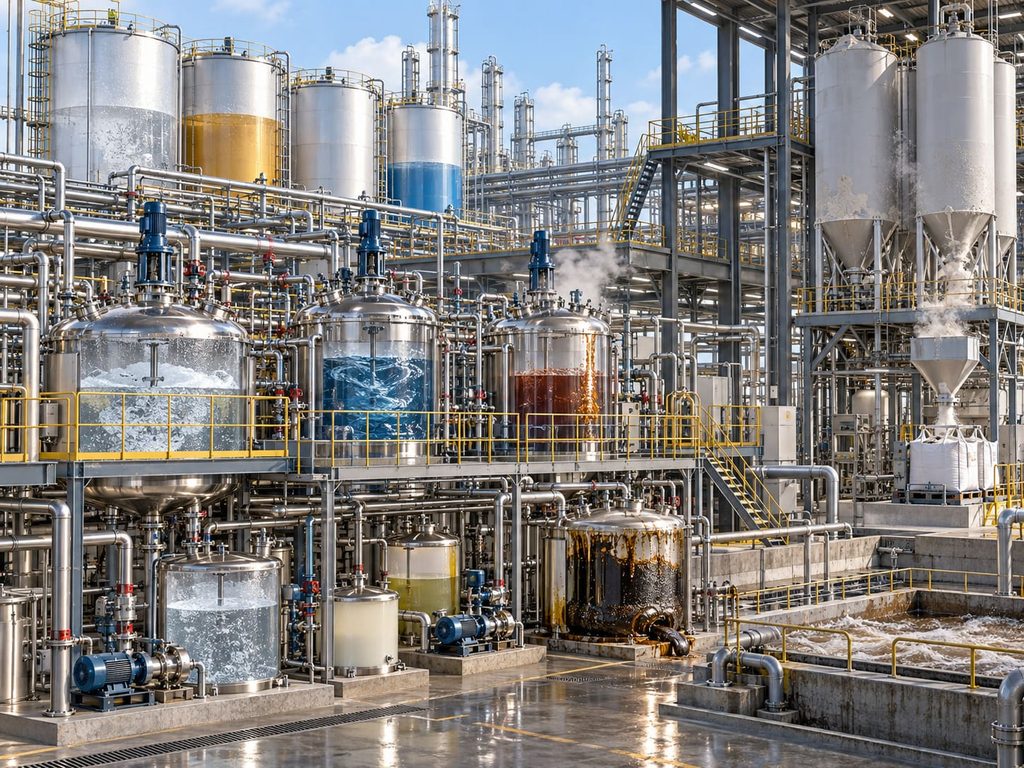
Fine chemical plants rarely have only one type of level measurement problem. A single production line may include solvent storage tanks, acid and alkali tanks, reaction vessels, dosing tanks, intermediate buffers, viscous product vessels, powder silos, packaging hoppers, and wastewater collection tanks. The media may change from batch to batch, while temperature, pressure, agitation, foam, vapor, buildup, dust, and corrosion can vary from one measuring point to the next.
For this reason, selecting a level instrument for a fine chemical plant should not begin with the question, “Which sensor is best?” A better starting point is, “What does this measuring point need to accomplish, and what process conditions can interfere with it?”
This guide explains a practical way to select continuous level measurement and point level detection technologies for fine chemical applications.
1. Start by Defining the Measurement Task
The first step is to decide whether the process needs continuous level measurement, point level detection, or both.
A continuous level transmitter provides a changing measurement value that represents the level inside a vessel. This information can be used for inventory indication, batch control, dosing, process monitoring, trend analysis, and automated filling or emptying.
A point level switch answers a simpler question: has the material reached a specific position? Typical functions include high-level alarm, high-high overfill protection, low-level alarm, pump dry-run protection, and material presence detection.
These two tasks should not be confused. A continuous transmitter can generate software alarm points in a PLC or DCS, but a separate physical switch may still be useful when the plant requires an independent protective function.
In many fine chemical installations, the most practical architecture is therefore a continuous level transmitter for process information plus one or more point level switches for protection.
2. Classify the Medium Before Choosing the Technology
Fine chemicals cover a very wide range of material behavior. The same instrument configuration that works well on a clean solvent tank may not be suitable for a resin reactor or a low-density powder hopper.
Before selecting an instrument, document the medium in practical terms:
- liquid, slurry, paste, powder, or granule;
- minimum and maximum density;
- viscosity at operating temperature;
- corrosiveness and material compatibility;
- dielectric behavior if radar or capacitance is considered;
- conductivity if an electrical principle depends on it;
- tendency to foam, crystallize, polymerize, or coat surfaces;
- vapor generation and condensation;
- particle size and bulk density for solids;
- whether the material is abrasive or sticky;
- whether the product changes between batches.
This information is often more useful than the chemical name alone.
For example, “resin” can describe a low-viscosity liquid during charging, a strongly agitated reaction mixture during processing, and a high-viscosity product near discharge. A level instrument must be selected for the full operating cycle rather than for only one convenient condition.
3. Where Non-Contact Radar Fits
Radar level meters are widely used when the process requires continuous measurement without inserting a probe into the medium.
A radar transmitter is installed above the product surface and sends electromagnetic energy toward the material. The reflected signal is processed to determine the distance between the sensor and the surface, which is then converted into level.
In fine chemical plants, non-contact radar is attractive for several reasons.
First, the measuring element does not normally contact the process material. This can reduce problems associated with probe coating, mechanical wear, and direct chemical attack.
Second, radar is well suited to applications where operators want continuous measurement without moving parts.
Third, modern high-frequency radar can use a relatively narrow measuring beam, which helps when the tank contains agitators, pipes, coils, support structures, or other internal components.
However, radar should not be treated as a universal solution. Installation geometry remains important. A sensor mounted directly above an inlet stream, too close to a wall, or in front of a strong obstruction may receive unwanted echoes. Heavy foam, unusual dielectric properties, condensation, very small vessels, and severe buildup may also require careful application review.
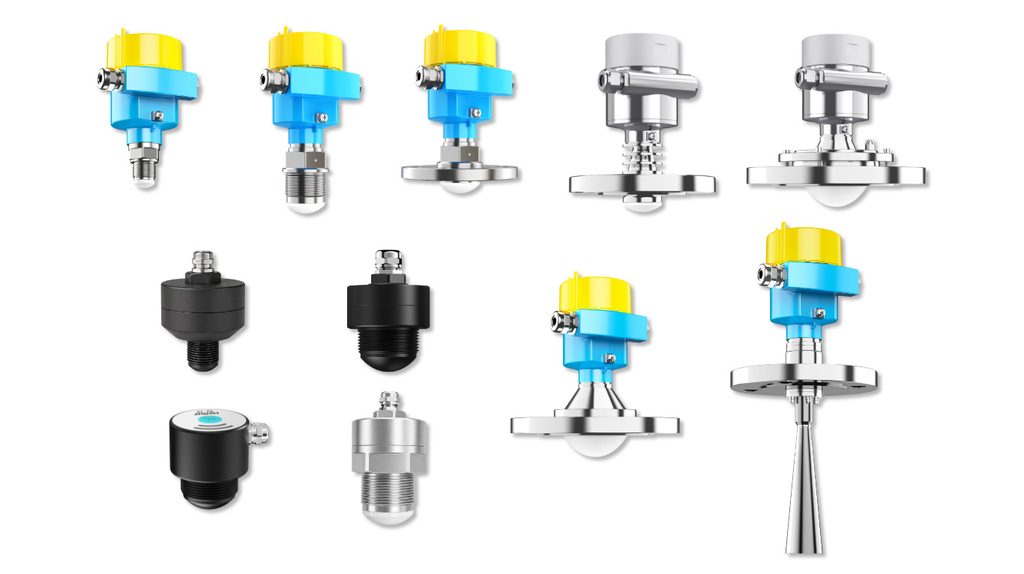
Jiwei JWrada series radar level meters provide options for compact liquid tanks, general process vessels, corrosive applications, and larger tanks or silos. The final model should be selected after checking range, process connection, temperature, pressure, hazardous-area requirements, antenna materials, and mounting position.
4. When a Tuning Fork Level Switch Is More Appropriate
For high- or low-level detection in liquids, a tuning fork level switch is often a practical choice.
The sensing fork is excited at its resonant condition. When liquid covers the fork, its vibration changes. The electronics recognize this change and provide a switching output.
This measurement task is very different from continuous level measurement. The tuning fork does not tell the control system the exact liquid height. Instead, it provides a clear switching signal at the installation position.
Fine chemical applications commonly use point level switches for overfill alarm in storage tanks, pump dry-run protection, low-level shutdown in dosing vessels, high-level interlock in process tanks, and presence detection in pipelines or small vessels.
For aggressive media, the wetted materials and protective coating are critical. A stainless-steel probe should never be assumed to be compatible with every acid, alkali, solvent, or mixed chemical. Concentration, temperature, impurities, and cleaning chemicals can change compatibility.
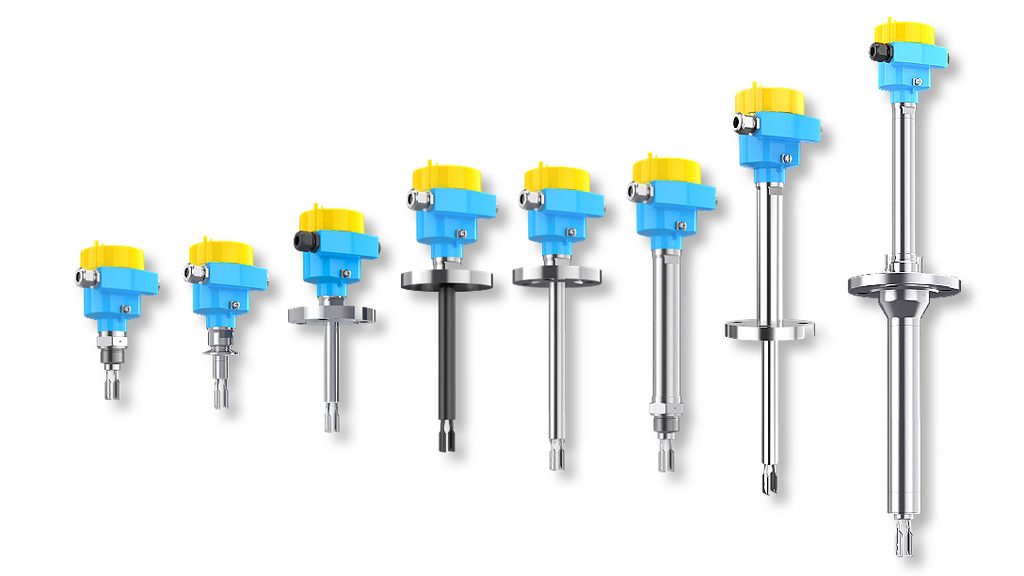
The Jiwei Ring-11 family includes configurations intended for general industrial liquids and corrosion-resistant applications. Selection should be based on the actual chemical and process conditions.
5. How to Approach Powder and Granular Materials
Fine chemical and new-material plants frequently store pigments, fillers, additives, catalysts, plastic powder, fumed silica, carbon materials, and other bulk solids.
These applications create a different measurement problem.
A powder silo may contain heavy airborne dust during pneumatic filling, an uneven material surface, changing bulk density, wall buildup, bridging or ratholing, low-density powder with weak mechanical loading, and material impact near the filling point.
If the objective is continuous inventory monitoring, non-contact radar can be considered. If the objective is only a high or low level signal, a vibrating rod or solids tuning fork may be more economical and easier to integrate.
Jiwei Tube-11 and Fork-11 level switches are designed for point level detection of powders and granular materials. Tube-11 is suitable for many common powders and granules, while Fork-11 is particularly relevant when the material is fine or has relatively low bulk density.
Again, the sensor should not be installed directly in the falling material stream. Mechanical impact can shorten service life or create unstable switching.
6. Reaction Vessels Need a Different Review Than Storage Tanks
A storage tank often has a comparatively stable surface. A reaction vessel may not.
During a batch, the level can be influenced by charging, agitation, gas release, heating, cooling, reflux, foam, viscosity changes, and product buildup. Agitator blades, shafts, coils, nozzles, and internal pipes may also create false echoes for non-contact measurement.
When selecting radar for a reactor, collect a vessel drawing before deciding the mounting position. The drawing should show the tank diameter, height, nozzle dimensions, agitator location, coil position, inlet direction, normal operating level, maximum level, and any internal structures.
The best installation point is usually one that provides a clear line of sight to the product surface and avoids direct exposure to the filling stream. False-echo suppression or echo-learning functions can then be used during commissioning where appropriate.
7. Corrosion Is a System Issue, Not Only a Sensor Issue
In chemical applications, “corrosion-resistant level meter” is too broad a description.
The actual compatibility review should include the antenna or sensing probe, process connection, flange face, gasket and seal, coating, housing exposure if chemical vapor is present, temperature at the process connection, and cleaning or flushing chemicals.
A material that is suitable at room temperature may behave differently at elevated temperature. Likewise, a chemical that is normally mild can become much more aggressive at a different concentration.
For critical service, verify compatibility using the chemical concentration, operating temperature, and expected exposure conditions instead of selecting by chemical name alone.
8. Consider Safety and Control Philosophy Early
The instrument is only one part of the level protection function.
Before selecting a device, determine how the signal will be used. Will it only display inventory? Will it stop a transfer pump? Will it close an inlet valve? Will it trigger an alarm? Is an independent high-high switch required? Does the plant have a hazardous-area classification? Is a safety integrity requirement specified?
These questions determine the required output, certification, fail-safe direction, proof testing strategy, and control-system integration.
The engineering team should also define what the system should do if the instrument loses power or reports a fault. A well-designed level system does not only measure correctly during normal operation; it also fails in a predictable way.
9. Installation Often Determines Real-World Performance
Many level measurement problems that appear to be sensor problems are actually installation problems.
Before installation, verify nozzle diameter and length, sensor orientation, distance from the tank wall, distance from agitators and internal structures, location of filling and discharge points, expected buildup on the antenna or probe, access for maintenance, electrical grounding and cable routing, environmental exposure, and whether vibration from nearby machinery is significant.
For solids, pay particular attention to the filling stream and the expected material slope. For liquids, check foam, turbulence, and whether the sensor can see the true liquid surface.
10. A Practical Selection Workflow
A useful selection process can be summarized in seven steps.
First, define whether the task is continuous measurement or point detection.
Second, classify the medium and document its worst-case behavior.
Third, record the full process temperature and pressure range.
Fourth, review vessel geometry and available process connections.
Fifth, identify corrosion, hazardous-area, and safety requirements.
Sixth, choose the measuring principle before choosing the exact model.
Seventh, review installation and commissioning requirements before purchase.
This workflow prevents a common mistake: selecting a familiar instrument first and trying to make the application fit later.
Conclusion
Fine chemical level measurement is not a single-technology problem. Storage tanks, reactors, dosing vessels, powder silos, and packaging hoppers create different measurement tasks, and each task should be reviewed on its own process conditions.
Non-contact radar is a strong option for continuous level measurement in many tanks and vessels. Tuning fork switches provide reliable point level detection for many liquid applications. Vibrating rod and solids tuning fork switches are practical for powders and granules. In many plants, the best solution combines continuous measurement with independent point level protection.
The most reliable selection begins with the process: what is being measured, how the medium behaves, how the vessel is built, what the control system needs, and what failure modes must be prevented.
FAQ
What is the best level sensor for fine chemical tanks?
There is no single best technology. Non-contact radar is widely used for continuous measurement, while tuning fork switches are commonly used for high- and low-level detection. The correct choice depends on the medium, process conditions, vessel geometry, and control objective.
Can radar measure through foam?
Radar can work in many foaming applications, but foam properties vary. Thick, wet, conductive, or highly aerated foam can influence the reflected signal. The application should be evaluated rather than assuming that all foam is transparent to radar.
Should a high-level alarm use the same sensor as continuous measurement?
A PLC can generate a high-level alarm from a continuous transmitter, but some processes require an independent physical switch for additional protection. The required architecture should be determined by the plant’s safety and control philosophy.
What information should be provided when requesting a level instrument quotation?
Provide the medium, density or bulk density, viscosity if relevant, temperature, pressure, measuring range, tank dimensions, process connection, installation drawing, hazardous-area requirements, and whether the task is continuous level measurement or point detection.