Introduction
Chemical additives play an essential role in modern paper and board production.
A paper mill does not simply mix pulp fibers with water and form a sheet. Depending on the grade being produced, multiple chemicals may be added to control strength, sizing, retention, drainage, color, foam, pH, wet strength, surface properties, and other characteristics.
These chemicals are normally stored, prepared, diluted, or mixed in tanks before being transferred to the paper machine.
As a result, paper mill chemical tank level measurement is an important part of both process automation and chemical management.
However, chemical tanks should not all be treated as the same application.
A starch preparation tank may contain a warm, viscous liquid that tends to coat surfaces. An AKD emulsion tank behaves differently from an ASA preparation system. Retention aids may be stored at different concentrations and viscosities. Acids and alkalis introduce corrosion concerns, while dyes and optical brighteners may create entirely different material-compatibility requirements.
Therefore, selecting a level meter simply because the vessel is called a “chemical tank” is not enough.
The correct measurement technology should be selected according to the actual chemical, concentration, viscosity, temperature, corrosion characteristics, foam conditions, tank geometry, process connection, and required measurement function.
This guide explains the major chemical tank applications in paper mills and how technologies such as radar level meters, magnetic level indicators, and vibrating fork level switches can be applied.
Why Are Chemical Additives Important in Paper Manufacturing?
Paper and board mills use different combinations of process chemicals depending on the raw material, machine design, paper grade, and product requirements.
Common chemical functions include:
- Improving paper strength
- Controlling liquid absorption
- Improving retention of fibers and fillers
- Controlling drainage
- Reducing foam
- Adjusting pH
- Improving wet strength
- Controlling color and brightness
- Improving surface properties
- Supporting coating and converting performance
Starch alone can be used at several stages of papermaking. For example, it may be applied at the wet end, used as surface size, or used as a binder. Valmet notes that starch is used for purposes including retention and drainage control, surface strength, dust reduction, and pigment binding.
Sizing chemicals are another major group. Industrial paper production commonly uses AKD, ASA, and rosin-based sizing systems to control liquid absorption by paper and board.
Because each chemical performs a specific process function, reliable storage and dosing are important.
Level measurement provides one of the basic signals needed to ensure that the chemical is available when the production process requires it.
1. Starch Tank Level Measurement
Starch is one of the most common chemical additives used in paper and board manufacturing.
Depending on the process, starch systems may include:
- Dry starch storage
- Starch slurry preparation
- Cooking tanks
- Conversion tanks
- Intermediate tanks
- Storage tanks
- Surface-size preparation tanks
- Day tanks
From a level measurement perspective, cooked starch can be considerably more difficult than ordinary water.
Why Is Starch Difficult to Measure?
Prepared starch solutions may be:
- Viscous
- Sticky
- Warm or hot
- Prone to coating surfaces
- Agitated
- Subject to foam
- Stored in relatively small process vessels
These characteristics can create problems for contact measurement technologies.
A probe that remains continuously in contact with the starch may gradually become coated.
Mechanical float systems can also require additional consideration if deposits affect free float movement.
Why Consider Radar for Starch Tanks?
Non-contact radar can be attractive because the antenna is mounted above the material surface.
The sensing element therefore does not normally need to remain immersed in the starch.
This can help reduce the direct effects of:
- Starch coating
- Viscous deposits
- Mechanical fouling
- Product adhesion
An 80 GHz radar also produces a focused measuring beam, which can be useful in relatively small preparation tanks containing mixers, inlet pipes, or internal structures.
The installation location should still be selected carefully.
The radar should not normally point directly at an agitator shaft or filling stream.
2. AKD Sizing Agent Tank Level Measurement
AKD, or alkyl ketene dimer, is widely used as an internal sizing chemistry in paper and board production.
Sizing helps control the absorption of liquids into the finished sheet. AKD is one of the established sizing technologies used alongside ASA and rosin-based systems.
AKD may be handled as an emulsion or prepared product depending on the mill and chemical supply system.
Measurement Challenges
An AKD tank may involve:
- Emulsion behavior
- Product coating
- Small tank dimensions
- Agitation
- Changing surface conditions
- Chemical compatibility requirements
For continuous inventory measurement, non-contact radar may be considered where the product provides a suitable radar reflection and the tank geometry permits proper installation.
Because chemical formulations vary between suppliers, the actual product data should be reviewed before instrument selection.
The term “AKD” alone is not enough to determine material compatibility.
Concentration, carrier liquid, temperature, formulation, and cleaning chemicals may all need to be considered.
3. ASA Sizing System Level Measurement
ASA, or alkenyl succinic anhydride, is another widely used internal sizing chemistry.
ASA handling systems can differ from AKD systems because preparation and dosing arrangements depend on the particular process and chemical formulation.
Typical equipment may include:
- Chemical storage
- Preparation vessels
- Emulsion tanks
- Day tanks
- Intermediate vessels
For instrumentation engineers, the important lesson is that an ASA application should be evaluated according to the actual process rather than simply grouped together with all sizing chemicals.
Important information includes:
- Chemical composition
- Concentration
- Operating temperature
- Vessel material
- Agitation
- Tank dimensions
- Required measuring range
- Process connection
- Required output
Where non-contact continuous measurement is preferred, radar may offer an effective option.
For very small vessels, however, installation space and nozzle geometry should be considered carefully.
4. Retention Aid Tanks
Retention aids play an important role in controlling how fibers, fines, and fillers are retained in the paper sheet.
Their influence extends beyond chemical consumption.
Valmet has documented that disturbances in retention-aid supply can affect wet-end stability and machine runnability, illustrating why reliable chemical delivery is important in paper production.
Retention systems may include:
- Concentrated chemical storage
- Dilution tanks
- Polymer preparation systems
- Aging or maturation tanks
- Day tanks
- Dosing tanks
Why Level Measurement Matters
If a retention aid tank unexpectedly runs empty, the chemical dosing system may lose supply.
Depending on the process, this can affect:
- Retention
- Drainage
- Sheet properties
- Wet-end stability
- Paper machine operation
Continuous level measurement allows operators to monitor available chemical inventory and establish low-level alarms before the dosing system loses supply.
For small day tanks, point-level detection may also be useful as an independent low-level or high-level signal.
5. Defoamer and Antifoam Tanks
Foam can interfere with many operations in pulp and paper production.
For this reason, mills frequently use defoamers or antifoam chemicals at selected process locations.
From a level measurement perspective, defoamer tanks may appear simple, but the chemical itself may have properties that require careful evaluation.
Depending on formulation, the liquid may be:
- Oily
- Viscous
- Adhesive
- Low dielectric
- Chemically aggressive to some seal materials
A radar instrument can reduce direct contact with the product.
However, low dielectric properties can reduce radar reflection under some conditions.
For this reason, tank dimensions, product dielectric behavior, antenna selection, measuring range, and installation arrangement should be reviewed before assuming that every defoamer can be measured using the same configuration.
6. Dye and Optical Brightener Tanks
Colored paper grades and specialty products may require dyes, pigments, optical brightening agents, or related chemicals.
These liquids can create another set of instrumentation concerns.
Some products may stain or coat sensing surfaces.
Others may be used in relatively small tanks where installation space is limited.
Radar measurement has the advantage that it does not depend on liquid color or optical transparency.
For a radar instrument, a dark dye and a transparent liquid are not distinguished by visual appearance.
Instead, successful measurement depends primarily on electromagnetic reflection, vessel design, installation conditions, and the characteristics of the material.
This can make radar attractive where optical sensors or direct visual inspection are inconvenient.
7. Acid and Alkali Storage Tanks
Paper mills may also use acids and alkaline chemicals for:
- pH control
- Cleaning
- Bleaching-related processes
- Chemical preparation
- Water treatment
- Process adjustment
Examples can include sodium hydroxide and various acidic solutions, although the exact chemicals depend on the mill.
These applications require particular attention to corrosion.
Chemical Compatibility Comes First
Before selecting any level instrument, confirm:
- Exact chemical name
- Concentration
- Normal temperature
- Maximum temperature
- Tank pressure
- Wetted materials
- Process connection material
- Seal material
- Cleaning chemicals
A statement such as “stainless steel is suitable for chemical tanks” is not technically sufficient.
Chemical compatibility depends on the specific chemical and operating conditions.
This principle applies to radar, tuning fork switches, magnetic level indicators, and virtually all other instrumentation technologies.
Why 80 GHz Radar Can Be Useful for Paper Mill Chemical Tanks
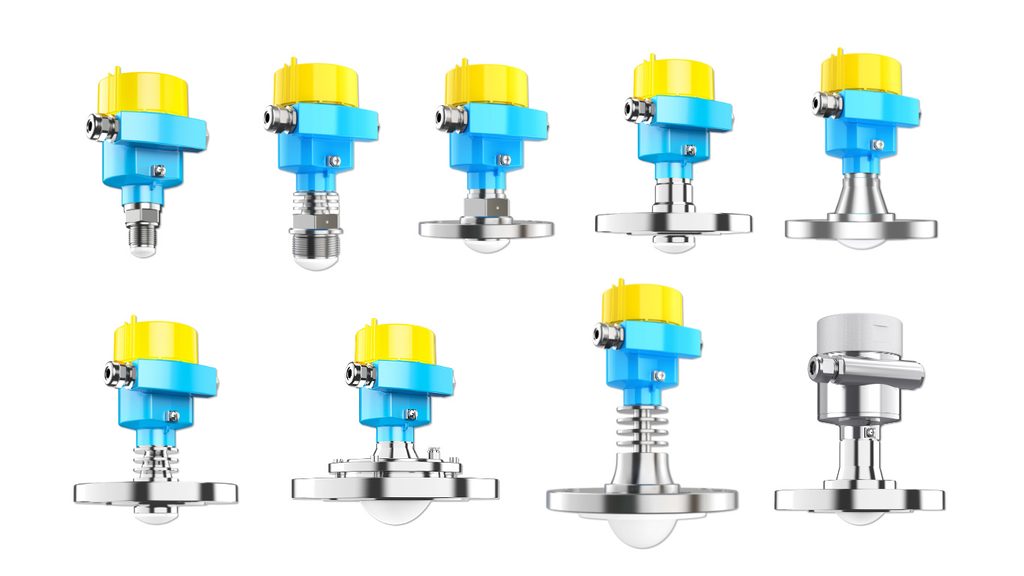
The Jiwei JWrada-32 uses 80 GHz FMCW radar technology for continuous non-contact level measurement. Jiwei also describes echo-learning and adaptive signal-processing functions designed to distinguish the process surface from fixed interference echoes.
For chemical tanks, several characteristics are particularly useful.
Non-Contact Measurement
The antenna normally remains above the process material.
This can reduce direct exposure to:
- Sticky chemicals
- Viscous liquids
- Coating products
- Suspended solids
It can also reduce the number of instrument components continuously immersed in the chemical.
Narrow Beam
Chemical preparation tanks are often relatively small and may contain:
- Agitators
- Heating coils
- Inlet pipes
- Support structures
A focused radar beam makes it easier to select a measurement path that avoids these structures.
No Mechanical Float Movement
Radar does not require a float to move vertically with the product surface.
This can be useful where viscosity or product buildup might otherwise interfere with mechanical movement.
Continuous Output
A radar transmitter can provide real-time level information to the PLC or DCS for:
- Inventory monitoring
- Refill control
- Pump operation
- High-level alarms
- Low-level alarms
- Dosing system management
When Should a Magnetic Level Indicator Be Considered?
Radar is not automatically the best instrument for every chemical vessel.
Some applications require a clear local indication that operators can see directly at the tank.
A magnetic level indicator (MLI) can be useful in these situations.
The instrument typically uses a side-mounted chamber containing a magnetic float. As the liquid level changes, the float moves and activates the external visual indicator.
Jiwei’s magnetic level gauge design can provide local liquid-level indication without requiring electrical power for the basic visual display.
Depending on configuration, a magnetic level indicator can also be combined with:
- Remote level transmission
- High-level switches
- Low-level switches
This can make it suitable where both local visual indication and automation signals are required.
However, because the float and chamber are in contact with the process liquid, chemical compatibility and product viscosity must be evaluated carefully.
Highly viscous, sticky, crystallizing, or solids-containing chemicals may not be ideal for every MLI design.
When Should a Vibrating Fork Level Switch Be Used?
A vibrating fork level switch performs a different function from a radar transmitter.
Radar provides continuous level measurement.
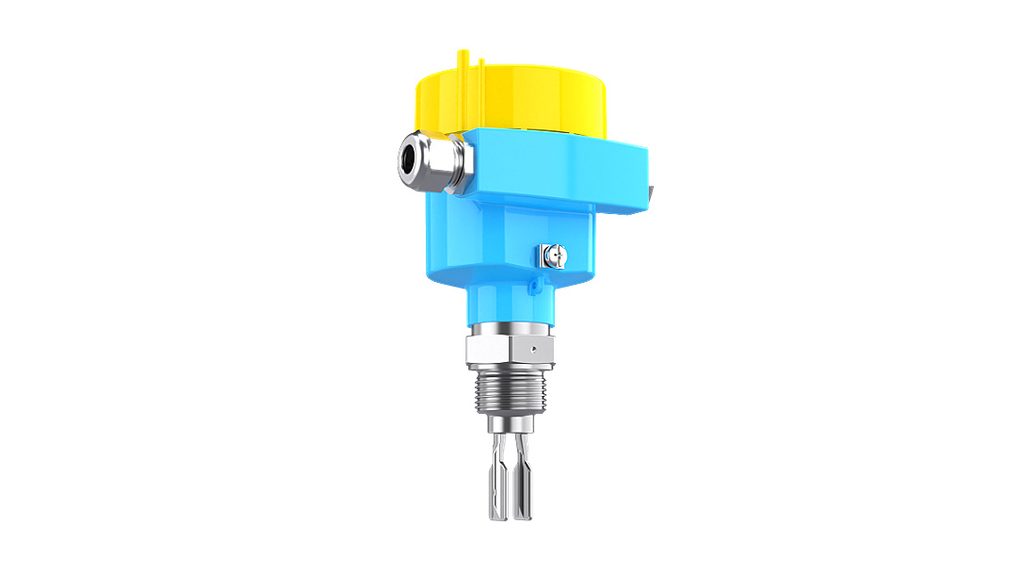
A vibrating fork provides point-level detection.
The fork vibrates at its natural resonant condition. When liquid covers the fork, the vibration behavior changes and the electronics switch the output.
Typical paper mill chemical tank applications include:
- High-level alarm
- High-high overflow protection
- Low-level alarm
- Pump dry-run protection
- Refill control
For example, a starch day tank may use a radar transmitter for continuous measurement and an independent high-level switch for overflow protection.
Similarly, a chemical supply tank may use a low-level switch to prevent a transfer pump from operating after the tank becomes empty.
This combination provides different layers of information rather than forcing one instrument to perform every function.
Radar vs. Magnetic Level Indicator vs. Level Switch
A simple comparison is useful.
| Measurement requirement | Typical technology |
|---|---|
| Continuous remote measurement | Radar level meter |
| Local visual level indication | Magnetic level indicator |
| High-level alarm | Vibrating fork level switch |
| Low-level / pump protection | Vibrating fork level switch |
| Sticky or coating liquid | Non-contact radar often preferred |
| Small simple liquid tank | Technology depends on process |
| Corrosive chemical | Select according to material compatibility |
| Redundant overfill protection | Continuous transmitter + independent switch |
The correct technology depends on the measurement objective as much as the chemical itself.
Important Installation Guidelines for Chemical Tanks
Even a properly selected instrument can perform poorly if installed incorrectly.
Avoid the Filling Stream
Do not install a radar directly above the point where chemical enters the tank if another location is available.
The filling stream can create turbulence and strong temporary reflections.
Avoid Agitator Shafts
The radar beam should normally be directed toward a clear area of the surface rather than toward the agitator.
Check Small Tank Geometry
Chemical day tanks are often relatively small.
Verify:
- Tank diameter
- Nozzle position
- Beam path
- Maximum level
- Minimum level
- Agitator location
A narrow radar beam is especially valuable in confined vessels.
Consider Condensation and Buildup
Warm starch and other process chemicals may create vapor or condensation.
Direct splashing onto the antenna should also be minimized.
Check the Process Connection
Do not select an instrument first and then assume it will fit the existing nozzle.
Nozzle diameter, length, flange standard, thread size, and available installation height should all be confirmed.
Information Required Before Selecting a Paper Mill Chemical Tank Level Meter
For a reliable recommendation, provide:
- Exact chemical name
- Chemical concentration
- Liquid temperature
- Maximum temperature
- Operating pressure
- Tank height
- Tank diameter
- Minimum and maximum level
- Viscosity
- Foam conditions
- Agitation conditions
- Crystallization or buildup tendency
- Tank material
- Existing process connection
- Internal structures
- Required measurement type
- Required output signal
- Hazardous-area classification, if applicable
For chemical applications, the exact medium and concentration should always be provided.
“Paper chemical,” “additive,” or “alkali” is normally not enough information for final instrument selection.
How Jiwei Level Instruments Can Be Applied
A paper mill may require several different measurement principles across its chemical preparation and storage system.
The Jiwei product range includes radar level meters, magnetic level indicators, reed level transmitters, ultrasonic instruments, and vibrating fork level switches.
For difficult continuous measurement applications involving viscosity, coating, agitation, or limited installation space, an 80 GHz radar level meter may provide a practical non-contact solution.
For local visual indication, a magnetic level indicator can be considered where process conditions and chemical compatibility permit.
For independent high- or low-level detection, vibrating fork technology can provide a separate switching signal for alarms or interlocks.
The objective should not be to install the same technology on every tank.
The better approach is to match the measuring principle to the actual medium, vessel, process conditions, and control requirement.
Conclusion
Chemical tank level measurement in a paper mill covers a much wider range of applications than the term “chemical tank” initially suggests.
Starch may be warm, viscous, and adhesive.
AKD and ASA systems have their own formulation and handling characteristics.
Retention aids require reliable inventory monitoring to support stable chemical dosing.
Defoamers can present viscosity or low-dielectric challenges.
Acids and alkalis require careful material compatibility evaluation.
For many of these applications, non-contact 80 GHz radar provides advantages because the measuring antenna does not need to remain continuously immersed in the chemical.
Its focused beam is also useful in small tanks containing agitators, pipes, and other internal structures.
However, radar should not automatically replace every other measurement technology.
Magnetic level indicators can provide convenient local indication, while vibrating fork level switches are useful for independent high-level, low-level, overflow, and pump-protection functions.
The most reliable paper mill level measurement system therefore begins with a simple question:
What exactly is being measured, under what conditions, and what does the plant need the measurement to do?
Once the chemical composition, tank dimensions, temperature, pressure, viscosity, foam, corrosion conditions, process connection, and control requirements are known, the appropriate level measurement technology can be selected with much greater confidence.
Frequently Asked Questions
What level sensor is best for a starch tank?
Non-contact radar is often a strong option for cooked or prepared starch because it reduces direct contact with sticky and viscous material. Actual temperature, foam, agitation, tank size, and buildup conditions should still be evaluated.
Can radar measure AKD emulsion?
Radar can be considered for many AKD storage and preparation tanks, but the actual formulation, dielectric properties, vessel dimensions, and installation arrangement should be reviewed before selection.
Can radar be used for ASA tanks?
It may be suitable for continuous ASA tank level measurement. The exact chemical formulation, process configuration, measuring range, and tank geometry should be confirmed first.
Which level sensor is suitable for retention aid tanks?
The answer depends on the tank and product. Radar can provide continuous inventory measurement, while a point level switch may be used for high- or low-level protection.
Is radar affected by chemical viscosity?
Radar measures from above the material rather than relying on mechanical movement through the liquid. This can provide an advantage with viscous media, although surface conditions, foam, and antenna contamination must still be considered.
What is the best solution for corrosive chemicals?
There is no universal answer. Instrument wetted materials, process connections, seals, coatings, concentration, temperature, and the exact chemical must all be evaluated.
Can one radar model measure every chemical tank in a paper mill?
Normally no. Different tank sizes, process connections, temperatures, chemical properties, hazardous-area requirements, and installation conditions may require different configurations.
Should a chemical tank use both radar and a level switch?
For important tanks, this can be a useful arrangement. The radar transmitter provides continuous process measurement, while an independent level switch can provide high-high overflow protection or low-low pump protection.