Introduction: Sugar Syrup Measurement — A Critical but Often Overlooked Process in Sugar Production
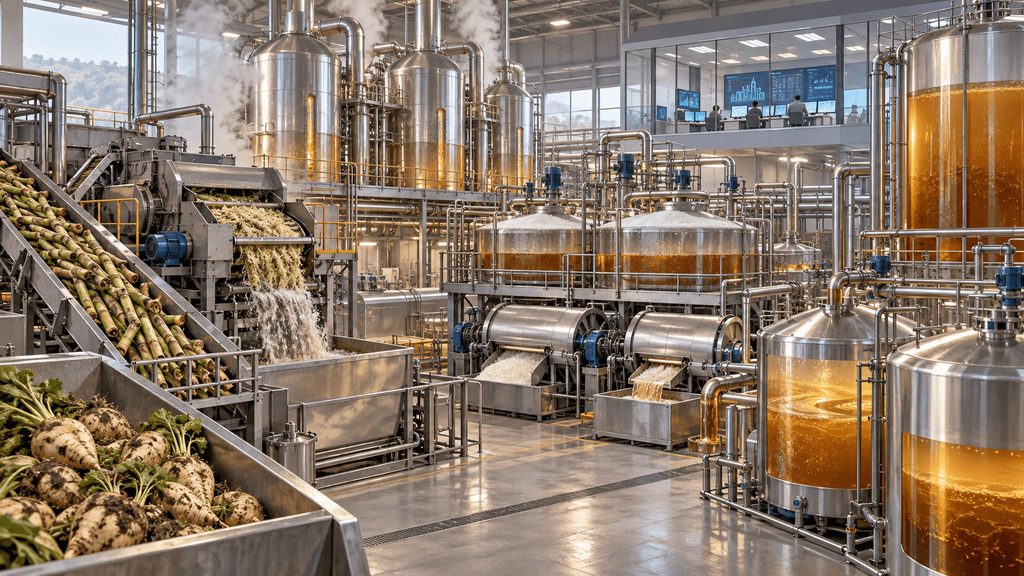
In modern sugar factories, every stage of production, from sugarcane and beet juice extraction to evaporation, crystallization, centrifugation, and finished syrup storage, relies on accurate process measurement. Among these processes, sugar syrup level measurement in storage tanks, evaporators, buffer vessels, and mixing tanks plays a vital role in production efficiency, energy consumption, and product quality.
However, many sugar manufacturers discover that measuring sugar syrup is far more challenging than measuring ordinary liquids. Due to its characteristics, including high viscosity, high temperature, crystallization tendency, foam formation, impurities, and complex operating conditions, traditional level measurement instruments often experience problems such as inaccurate readings, unstable signals, and frequent maintenance.
For sugar factories aiming to improve automation and move toward smart manufacturing, selecting a reliable level measurement technology suitable for syrup applications has become a key factor in improving production stability.
This article analyzes the major challenges of sugar syrup level measurement and explains how advanced level measurement technologies can help sugar plants achieve more accurate and reliable liquid level management.
1. Why Is Sugar Syrup Level Measurement Challenging?
Sugar syrup is not a typical liquid. During the sugar manufacturing process, its physical properties change significantly as concentration increases.
For example:
- Higher sugar concentration leads to increased viscosity;
- Temperature fluctuations affect density and flow characteristics;
- Long-term storage may cause sugar crystal buildup;
- Mixing processes generate foam;
- Evaporation creates steam and condensation.
All of these factors can affect the performance of level measurement instruments.
For sugar factories, level measurement is not simply about displaying liquid height. It directly affects:
- Raw material utilization;
- Steam consumption;
- Production continuity;
- Automatic control accuracy;
- Product quality consistency.
A small measurement error can result in equipment running empty, tank overflow, production interruptions, or instability throughout the production line.
2. Five Major Challenges of Sugar Syrup Level Measurement in Sugar Factories
Challenge 1: High Viscosity Causes Unstable Measurement
As sugar syrup becomes more concentrated, its viscosity increases significantly.
Traditional contact level instruments, such as float level gauges and magnetic level indicators, may experience difficulties in high-viscosity applications.
Common problems include:
- Increased resistance to float movement;
- Syrup accumulation on measurement components;
- Mechanical sticking;
- Slow response to level changes.
Especially during the boiling and concentration stages, high-density syrup may approach a semi-solid state, making it difficult for conventional level instruments to maintain long-term accuracy.
Therefore, sugar manufacturers need measurement technologies that can handle high-viscosity media reliably.
Challenge 2: Sugar Crystallization Leads to Frequent Maintenance
One of the biggest characteristics of sugar syrup is its tendency to crystallize.
In storage tanks, evaporators, and process vessels, sugar crystals may gradually form and stick to equipment surfaces when temperature or concentration changes.
For contact-type level instruments, common issues include:
- Probe coating and buildup;
- Float blockage;
- Pressure diaphragm contamination;
- Shorter cleaning intervals.
Frequent maintenance increases labor costs and reduces production efficiency.
For large sugar plants operating continuously, level instruments that require regular cleaning are difficult to integrate into highly automated production systems.
Challenge 3: Foam and Steam Affect Level Measurement Accuracy
During syrup evaporation and concentration processes, large amounts of steam and foam are generated.
These conditions create significant challenges for level measurement.
For example:
Although radar level meters provide non-contact measurement, improper configuration may allow foam layers to create false reflections, causing inaccurate high-level readings.
Ultrasonic level meters can also be affected by:
- Steam density changes;
- Foam absorbing ultrasonic signals;
- Temperature variations.
Therefore, sugar syrup applications require careful selection of measurement principles based on actual operating conditions rather than simply choosing a standard instrument.
Challenge 4: High Temperature Reduces Instrument Reliability
Sugar production processes often involve high-temperature environments.
Examples include:
- Evaporators operating under elevated temperatures;
- Heated syrup tanks;
- Vacuum boiling systems with steam exposure.
Continuous high-temperature operation can affect:
- Electronic component lifespan;
- Sealing performance;
- Measurement accuracy;
- Instrument stability.
If a level meter cannot withstand these conditions, measurement drift, alarms, or equipment failures may occur.
Therefore, high-temperature syrup applications require instruments designed for demanding thermal environments.
Challenge 5: Manual Measurement Cannot Meet Smart Factory Requirements
Some traditional sugar plants still rely on manual observation and periodic inspection for liquid level monitoring.
This approach has several limitations:
- Poor data availability;
- Human measurement errors;
- Lack of remote monitoring capability;
- Difficulty supporting automatic control.
With the development of Industry 4.0 and smart manufacturing, more sugar factories are upgrading their automation systems to achieve:
- Real-time level monitoring;
- Automatic material feeding control;
- Production data analysis;
- Reduced manual intervention.
Accurate and reliable level measurement has become a foundation for intelligent sugar production.
3. Which Level Measurement Technologies Are Suitable for Sugar Syrup Applications?
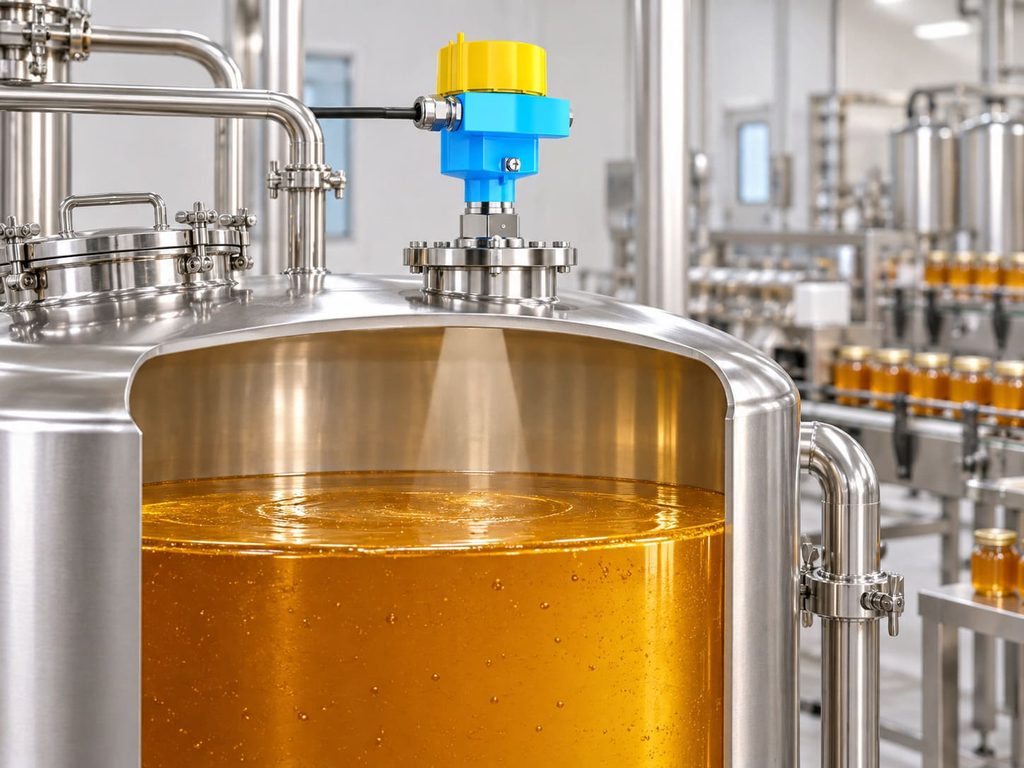
1. 80GHz Radar Level Meter: A New Choice for Sugar Syrup Measurement
In recent years, radar level meters have become increasingly popular in industries such as food processing, chemical production, and pharmaceuticals.
Compared with traditional measurement methods, radar level technology offers several advantages.
Non-Contact Measurement
The radar antenna does not directly contact the syrup:
- Not affected by viscosity;
- Less affected by crystallization;
- Reduced maintenance requirements.
High Stability
High-frequency radar signals can perform well in complex environments:
- Reduced foam interference;
- Lower impact from steam;
- Longer measurement ranges.
Easy Integration with Automation Systems
Radar level meters can provide standard output signals, including:
- 4-20mA;
- HART communication;
- Industrial communication protocols.
This allows easy connection with PLC and DCS control systems for automated production management.
4. Key Factors When Selecting a Level Meter for Sugar Factories
1. Choose the Measurement Method Based on Syrup Concentration
Low-concentration syrup and highly concentrated syrup have very different operating conditions.
Factories should consider:
- Syrup viscosity;
- Temperature range;
- Tank height;
- Agitation conditions;
- Foam generation.
Level instruments should be selected based on actual process requirements rather than general liquid measurement standards.
2. Pay Attention to Anti-Crystallization Capability
For media that easily create buildup, manufacturers should prioritize:
- Non-contact measurement technology;
- Designs without moving parts;
- Easy-maintenance structures.
This reduces cleaning frequency and improves equipment availability.
3. Select Instruments Suitable for Food Processing Environments
Because sugar production belongs to the food processing industry, measurement equipment should meet requirements for:
- Hygienic operation;
- Long-term reliability;
- Safety;
- Easy cleaning and maintenance.
A good level instrument must not only provide accurate measurement but also adapt to food production conditions.
5. How Accurate Level Measurement Improves Sugar Factory Efficiency
Implementing a suitable level measurement solution can bring several benefits:
Improved Production Continuity
Reducing instrument failures and manual maintenance helps maintain stable production operations.
Reduced Material Waste
Accurate syrup monitoring prevents tank overflow and avoids unnecessary empty-running conditions.
Optimized Energy Consumption
Precise level control helps optimize the use of steam, water, and electricity during production.
Supporting Smart Manufacturing
Digital level instruments enable transparent production data and integration with modern control systems.
Conclusion: Accurate Syrup Measurement Is a Key Step Toward Smart Sugar Manufacturing
In sugar production, syrup level measurement may appear to be a simple monitoring task, but it plays a critical role in the stability of the entire manufacturing process.
High viscosity, crystallization, high temperatures, foam, and steam make sugar syrup one of the more challenging applications for level measurement technology.
As the sugar industry continues moving toward automation and digital transformation, selecting reliable level measurement solutions will help manufacturers reduce maintenance costs, improve efficiency, and achieve smarter production processes.
For sugar factories, solving syrup level measurement challenges is not only about improving one instrument — it is an important step toward upgrading the entire production system.