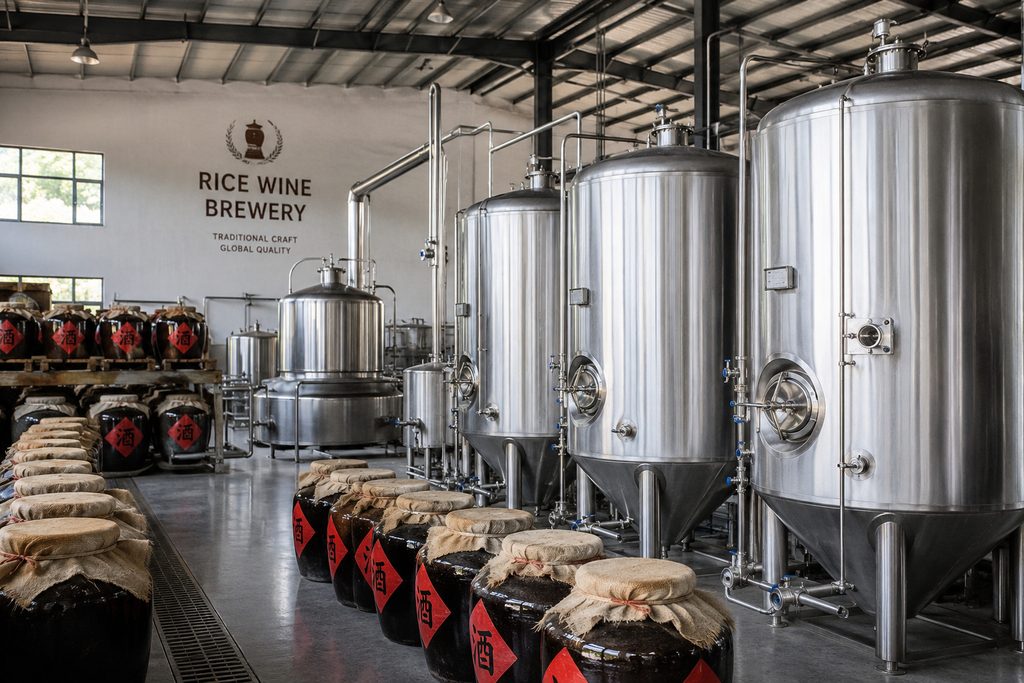
Rice wine is a traditional fermented beverage generally produced from glutinous rice, rice, or other grains through a series of processes such as steaming, saccharification, fermentation, filtration, blending, storage, and filling.
As rice wine manufacturing evolves from traditional small-scale production toward standardized, automated, and large-scale processing, manufacturers are placing greater emphasis on accurate control of process parameters such as temperature, pressure, flow, and liquid level.
Among these parameters, liquid level detection may appear to be a relatively simple part of the production process, but it directly affects fermentation tank overflow prevention, pump dry-run protection, material transfer, and the continuous operation of the entire production line.
Unlike clean water, the media encountered during rice wine production may include rice slurry, fermentation broth, rice wine mash, finished wine, foam, bubbles, and suspended solids. At the same time, equipment used in food and beverage production requires frequent cleaning, placing higher demands on instrument materials, surface finish, process connections, and hygienic design.
For high- and low-level alarms and pump protection in rice wine processing, a sanitary tuning fork level switch therefore provides a practical and reliable point-level detection solution.
Why Is Reliable Level Detection Important in Rice Wine Production?
A typical rice wine production line may include raw material preparation, soaking, steaming, cooling, saccharification, fermentation, filtration, storage, blending, sterilization, and filling.
Many tanks and process vessels involved in these stages require reliable level control.
For example, fermentation tanks need high-level protection to prevent excessive filling and product overflow. Storage tanks require both high- and low-level detection, while buffer tanks and transfer systems may need low-level alarms to protect pumps against dry running.
If these operations depend primarily on manual inspection, the process becomes less efficient and more vulnerable to human error.
When operators fail to identify a high or low liquid level in time, the consequences can include product overflow, material loss, pump damage, contamination of the production area, or even an interruption of the entire production process.
For this reason, automated rice wine production lines often install point level switches at critical locations to transmit switching signals to a PLC or other process control system.
Typical functions include:
- High-level alarm in fermentation tanks
- High- and low-level detection in rice wine storage tanks
- Overflow prevention in buffer tanks
- Dry-run protection for transfer pumps
- Low-level alarm in filling systems
- Automatic pump and valve interlocking
Unlike continuous level measurement, these applications do not necessarily require operators to know whether a tank is exactly 52% or 55% full.
The essential requirement is to determine reliably whether the liquid has reached a predefined critical point.
This is exactly where a tuning fork level switch can be particularly effective.
Challenges of Level Detection in Rice Wine Processing
At first glance, rice wine is simply a liquid, so detecting its level may seem straightforward. In an actual fermentation process, however, the operating conditions are significantly more complicated than those found in a clean-water tank.
1. Foam and Bubbles During Fermentation
During saccharification and fermentation, microbial activity, agitation, and material movement can generate bubbles and foam.
For some level measurement technologies, foam can cause unstable measurements or false alarms. A sensor may detect the foam layer as the actual liquid surface, causing the system to trigger a high-level alarm before the liquid has reached the intended switching point.
This becomes particularly problematic when a high-level signal is directly connected to automatic filling, valve, or pump control.
A vibrating tuning fork level switch works differently.
Its sensing fork is continuously excited at its natural resonant frequency. When the fork is uncovered and surrounded by air, it vibrates at a specific frequency. When liquid covers the fork, the damping effect of the medium causes the vibration characteristics to change.
The electronics detect this change and convert it into a switching signal.
Because the measurement is based on the vibration characteristics of the fork rather than simply detecting the surface of the medium, tuning fork technology is well suited to point-level detection applications involving bubbles, turbulence, and certain foaming conditions.
2. Adhesive and Viscous Fermentation Media
Finished rice wine is not the only medium found in a rice wine plant.
Depending on the production stage, instruments may come into contact with rice slurry, saccharified liquid, fermentation mash, and media containing small quantities of suspended solids.
These materials can adhere to instrument surfaces.
When a level switch contains complicated mechanical structures, moving components, floats, or linkages, material buildup can increase maintenance requirements and make hygienic cleaning more difficult.
A tuning fork level switch has no float, linkage, or other moving mechanical sensing mechanism. Its compact sensing structure is therefore advantageous for applications requiring regular cleaning.
For relatively viscous or adhesive media, the mounting orientation should also be carefully considered. Correct installation can help reduce material buildup on the sensing fork and improve measurement reliability.
3. Strict Hygienic Requirements
A level switch designed for a conventional industrial chemical tank cannot automatically be considered suitable for rice wine production.
Any component that comes into direct contact with rice wine, fermentation liquid, or other food products must be evaluated from a hygienic perspective.
Several questions become particularly important:
Can the sensor be cleaned effectively?
Could product residue remain on its surface?
Does the process connection create difficult-to-clean areas?
Is the wetted material suitable for food and beverage processing?
Is the surface finish appropriate for hygienic applications?
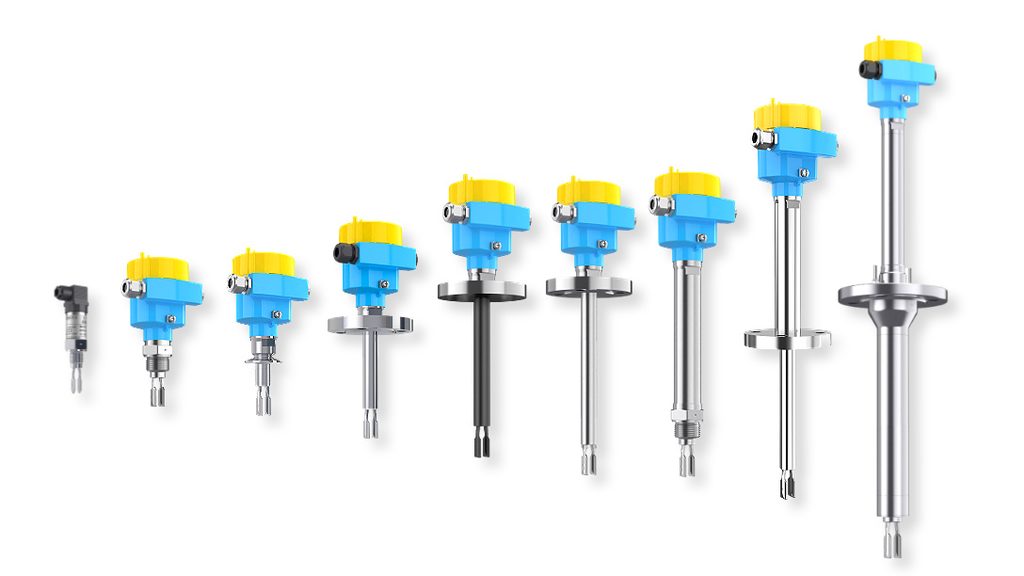
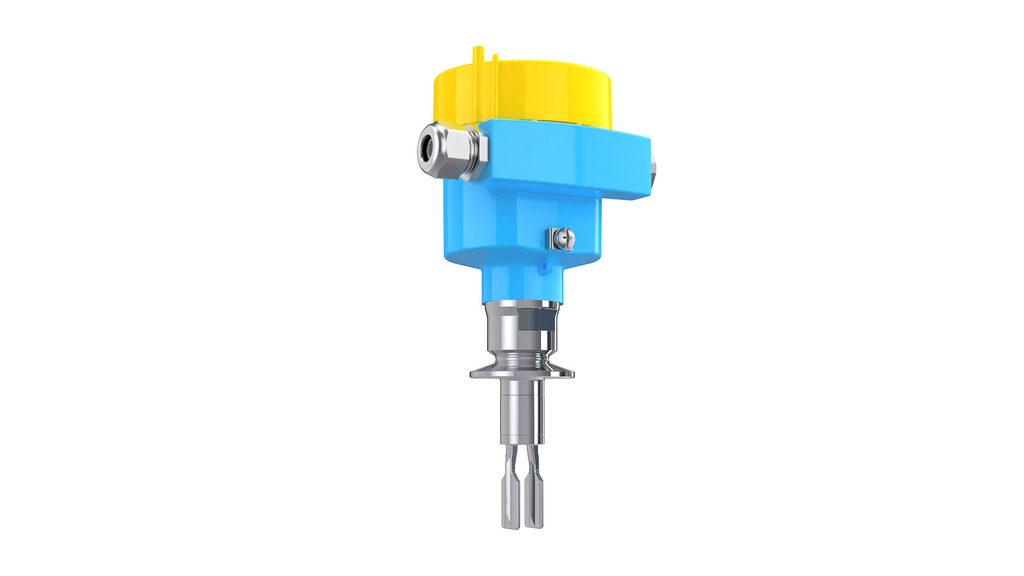
A sanitary tuning fork level switch such as the Ring-11 Food-Grade Tuning Fork Level Switch is designed for hygienic liquid point-level applications. Its wetted surface can achieve a surface roughness of Ra < 0.5 μm, while sanitary clamp process connections facilitate installation, removal, inspection, and cleaning.
These characteristics make this type of level switch suitable for rice wine, beverages, dairy products, and other food-processing applications.
How Does a Sanitary Tuning Fork Level Switch Work?
The core sensing element of a sanitary tuning fork level switch consists of two vibrating fork tines.
A piezoelectric element inside the instrument excites the fork at its resonant frequency.
When the fork is exposed to air, it maintains a particular vibration state. As the rice wine or fermentation liquid rises and covers the fork, the surrounding liquid damps its vibration, causing a detectable change in frequency.
The electronic module identifies this change and determines whether the sensor is in a wet or dry condition. It then generates the corresponding switching output.
For this reason, a tuning fork level switch is classified as a point-level detection instrument rather than a continuous level transmitter.
For example, a sanitary tuning fork level switch can be installed near the upper section of a rice wine fermentation tank.
During normal operation, the liquid remains below the fork.
As the fermentation liquid rises and eventually covers the sensing fork, the instrument detects the change in vibration and immediately sends a high-level signal to the PLC.
The control system can then stop the inlet pump or close the inlet valve, preventing further filling and reducing the risk of tank overflow.
Similarly, a tuning fork level switch installed near the bottom of a rice wine storage tank can provide low-level protection.
When the liquid falls below the fork, the switch changes its output state. The PLC can then stop the discharge pump to prevent prolonged dry running.
In simple terms, one switch can be used to prevent overflow, while another can be used to prevent dry running.
Together, they provide a straightforward and dependable level protection system.
Application Case: High-Level Protection in a Rice Wine Fermentation Tank
Consider a typical automated rice wine production line.
After steaming, cooling, inoculation, and other preparation processes, the material is transferred into fermentation tanks.
During fermentation, the medium may contain bubbles, foam, suspended material, and a fluctuating liquid surface. The manufacturer therefore needs an independent high-level protection device near the top of each fermentation tank.
Previously, if tank filling depended heavily on operator observation, unexpected changes in inlet flow or delayed manual inspection could allow the fermentation liquid to approach the top of the vessel or even overflow.
To address this risk, a Ring-11 sanitary food-grade tuning fork level switch can be installed at the predetermined maximum safe level of the fermentation tank.
The sensor is mounted using a sanitary process connection, with the vibrating fork extending into the vessel.
Under normal operating conditions, the fermentation liquid remains below the sensing fork and the switch stays in its normal state.
As the tank fills, the fermentation liquid eventually reaches and covers the fork. The resulting change in vibration is detected immediately, causing the level switch to change its output state.
The signal is transmitted to the PLC, where an automatic interlock can be configured as follows:
High-level signal → Stop inlet pump → Close inlet valve → Activate alarm → Operator inspection
This provides an independent layer of high-level protection.
Even if upstream flow suddenly increases or a control valve fails to close as expected, the point-level switch can help prevent the fermentation tank from being continuously filled beyond its safe operating level.
For highly automated rice wine plants, the tuning fork level switch can also be used as an independent backup to a continuous level transmitter.
In such a configuration, the continuous level transmitter monitors the overall liquid level and provides real-time process data, while the tuning fork switch acts as an independent high-high or low-low level protection device.
This combination can improve the redundancy and reliability of the overall tank level control system.
Low-Level Detection and Pump Protection in Rice Wine Storage Tanks
Overflow prevention is only one application.
Low-level protection in finished rice wine storage tanks is equally important.
After fermentation and filtration, rice wine is typically transferred to intermediate storage or finished-product tanks before being sent to blending, sterilization, or filling equipment.
Sanitary pumps are commonly used to transfer the product between these processing stages.
If the storage tank is almost empty but the transfer pump continues operating, the pump may run dry. Repeated dry running can increase mechanical wear, damage seals, reduce equipment life, and interrupt downstream production.
A practical solution is to install a sanitary tuning fork level switch slightly above the bottom of the storage tank.
When the sensing fork is covered by rice wine, the control system permits the transfer pump to operate.
As the liquid level falls below the fork, the instrument changes its switching state. The PLC then stops the pump and generates a low-level alarm.
The basic control logic is straightforward:
Liquid detected → Pump operation permitted
No liquid detected → Pump stopped + Low-level alarm
This type of control does not require complicated continuous level calculations, making it particularly suitable for equipment protection and process interlocking.
Why Is Sanitary Design Important for Rice Wine Production?
In the food and beverage industry, instrument selection is not simply a question of whether a device can detect the medium.
The equipment must also support hygienic production.
Rice wine and fermentation liquids can contain sugars, starches, microorganisms, and fermentation by-products. If product-contact surfaces are rough or process connections contain difficult-to-clean gaps, residue may accumulate over time.
Consequently, hygienic process equipment places considerable importance on surface finish and sanitary connection design.
The Ring-11 food-grade tuning fork level switch features a sanitary process connection and a wetted surface finish of Ra < 0.5 μm.
A smooth wetted surface helps reduce product adhesion, while a sanitary clamp connection makes installation, removal, inspection, and cleaning more convenient.
This is particularly important in rice wine production lines where tanks and process equipment are regularly cleaned.
If a level sensor has a complicated structure or is difficult to remove, routine maintenance and sanitation become more time-consuming.
A compact sanitary tuning fork level switch can therefore integrate more effectively into the hygienic design of food-processing equipment.
Performance in Foam, Bubbles, and Turbulent Liquid Conditions
Foam is one of the most common challenges encountered in fermentation tank level measurement.
Certain measurement technologies require additional adjustment when a thick foam layer is present. In contrast, a tuning fork level switch determines the presence or absence of liquid based on changes in fork vibration.
The Ring-11 tuning fork level switch can detect liquids with densities as low as approximately 0.5 g/cm³ and is designed for point-level applications involving foam, bubbles, and liquids with a certain degree of viscosity.
For rice wine and many common fermentation liquids, density is therefore generally not the primary limitation for tuning fork point-level detection.
However, every application should still be evaluated individually.
Before final instrument selection, engineers should confirm the medium density, viscosity, process temperature, pressure, solids content, hygienic requirements, and cleaning conditions.
This ensures that the selected configuration matches the actual operating environment.
Installation Considerations for Tuning Fork Level Switches in Rice Wine Plants
Reliable sensor performance depends not only on instrument quality but also on correct installation.
Several factors should be considered when installing a tuning fork level switch on a rice wine fermentation or storage tank.
Determine the Correct Switching Point
A high-level switch should not simply be installed as close as possible to the top of the tank.
The correct position should be determined according to usable tank volume, process requirements, fermentation expansion, foam generation, and the required safety margin.
The switching point should provide sufficient time for the control system to stop filling before the vessel reaches an unsafe level.
Avoid Direct Installation in the Inlet Flow
The sensing fork should generally not be positioned directly in front of a high-velocity inlet stream.
Continuous direct impact from incoming liquid can cause unstable switching and unnecessary mechanical stress on the sensor.
Installing the level switch away from the primary filling stream can therefore improve measurement stability and instrument service life.
Consider Fork Orientation
The orientation of the vibrating fork should take the direction of process flow into account.
Proper alignment can reduce flow resistance and help minimize material accumulation on the sensing element.
This consideration becomes particularly important when the medium has higher viscosity or contains suspended material.
Consider Cleaning Requirements
The installation position should allow cleaning liquid to reach and wash the wetted components effectively.
At the same time, maintenance personnel should have sufficient access to remove and inspect the instrument when required.
This is particularly important for production lines using CIP (Clean-in-Place) procedures.
Configure the Correct Fail-Safe Mode
High-level and low-level applications have different safety requirements.
A high-level switch is generally intended to prevent overflow, whereas a low-level switch may be used to protect a pump against dry running.
The Ring-11 can be configured in High/Low operating modes according to the required control logic, allowing the switching behavior to correspond with the intended safety function.
Benefits of Using Sanitary Tuning Fork Level Switches in Rice Wine Production
A level switch may be a relatively small component in a complete rice wine production facility, but it can perform an important role in maintaining safe and continuous operation.
Installing sanitary tuning fork level switches at critical points in fermentation tanks, storage tanks, and buffer vessels provides independent high- and low-level protection.
The main benefits include:
Reduced Risk of Tank Overflow
Once the liquid reaches the predetermined high-level switching point, the sensor immediately sends a signal to the control system.
The PLC can stop the inlet pump or close the inlet valve, reducing product loss, floor contamination, and cleanup requirements caused by overflow.
Pump Dry-Run Protection
A low-level signal can be incorporated into pump interlocking logic.
When the liquid falls below the safe operating level, the transfer pump is automatically stopped, helping reduce the risk of equipment damage caused by dry running.
Reliable Point-Level Detection Under Fermentation Conditions
Vibration-based detection is well suited to applications involving bubbles, turbulent liquid surfaces, and certain foaming conditions commonly encountered during fermentation.
Hygienic Process Compatibility
Sanitary process connections and a smooth wetted surface help reduce difficult-to-clean areas and make the instrument easier to integrate into hygienic food-processing systems.
Improved Process Automation
The switching signal can be connected directly to a PLC or other control system, allowing pumps, valves, alarms, and other equipment to operate according to automatic interlock logic.
This reduces dependence on manual inspection and improves overall process consistency.
How to Select a Sanitary Level Switch for Rice Wine Production
Selecting a sanitary tuning fork level switch should be based on the actual process conditions rather than price alone.
First, identify the medium. Determine whether the sensor will detect filtered rice wine, fermentation broth, rice slurry, or mash containing significant quantities of rice particles or solids. Media with a high solids concentration require additional evaluation to determine whether vibrating fork technology is suitable.
Second, confirm the process and cleaning temperatures. The normal rice wine production temperature may be relatively moderate, but the sensor may be exposed to higher temperatures during CIP cleaning. Both conditions should be considered during instrument selection.
Third, determine the required process connection. Sanitary clamp connections are generally preferable for food and beverage equipment because they facilitate installation, removal, inspection, and cleaning.
Fourth, verify wetted materials and surface finish. All product-contact components should meet the hygienic and material requirements of the specific production process.
Fifth, confirm the electrical output. The output signal must be compatible with the plant’s PLC, relay, DCS, or other control equipment.
Finally, determine the correct mounting location. A high-level overflow switch, low-level pump protection switch, and pipeline liquid-presence detector perform different functions and therefore require different installation positions.
Ideally, these requirements should be considered during the equipment and process design stage rather than after the production line has already been commissioned.
From Simply Detecting Liquid to Reliable Level Control
Modern rice wine production is becoming increasingly standardized, continuous, hygienic, and automated.
Reliable level detection is an essential part of this transformation.
Fermentation tanks must cope with foam, bubbles, and fluctuating liquid surfaces. Storage tanks require dependable high- and low-level alarms. Transfer systems need protection against pump dry running. At the same time, all product-contact equipment must satisfy the hygienic and cleaning requirements of food and beverage production.
These conditions mean that a level switch used in rice wine processing must do more than simply detect whether liquid is present.
It should provide stable point-level detection, reliable switching, hygienic process compatibility, convenient cleaning, and straightforward integration with automated control systems.
A sanitary tuning fork level switch detects the presence or absence of liquid through changes in vibration frequency. It does not rely on a mechanical float mechanism and can be installed on fermentation tanks, storage vessels, buffer tanks, and suitable process pipelines using sanitary connections.
This makes vibrating fork technology particularly suitable for high-level alarms, low-level detection, overflow prevention, and pump dry-run protection in rice wine, fermented beverages, liquid foods, and other hygienic processing applications.
From high-level protection in fermentation tanks to low-level alarms in finished-product storage tanks, and from overflow prevention to pump interlocking, a seemingly simple level switch can play a significant role in production safety, product handling, and process automation.
For rice wine manufacturers upgrading their production facilities, properly selected and correctly installed sanitary tuning fork level switches can help create a safer, cleaner, more stable, and more automated production process.