In industrial wastewater treatment and odor control systems, accurate level measurement is essential for pump control, storage tank management, overflow prevention, and the continuous operation of the entire treatment process.
An inaccurate or interrupted level signal may cause pump dry-running, wastewater overflow, equipment overload, or even a complete shutdown of the treatment system. Therefore, selecting a stable, reliable, and low-maintenance radar level meter for wastewater treatment is an important step toward improving the automation and safety of environmental protection facilities.
In a wastewater treatment and odor control project at an industrial park in Taizhou, Jiangsu Province, the Jiwei JWrada-22 radar level meter was installed at critical measuring points, including lift stations and wastewater storage tanks. It provides continuous and stable level signals to the site’s PLC control system.
What Are the Main Challenges of Wastewater Level Measurement?
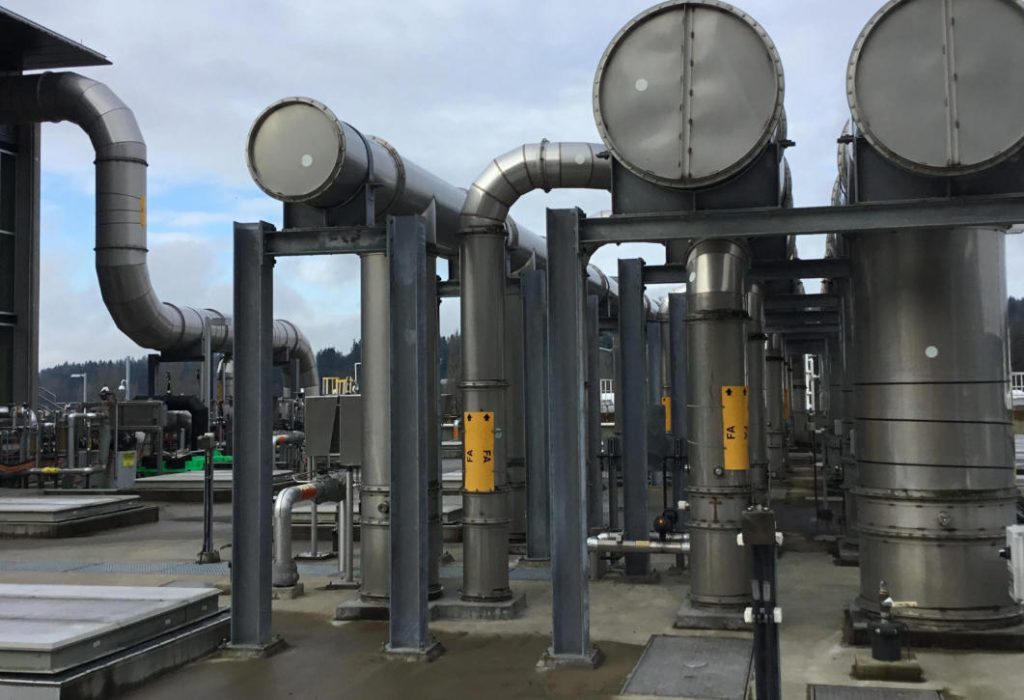
The project includes wastewater storage tanks, lift stations, aeration tanks, and odor treatment equipment. Some measuring points have a measurement range of up to 10 meters.
Because the wastewater contains complex substances and the operating environment is highly humid, the level instruments must provide reliable measurement while withstanding challenging industrial conditions.
The project faced several key difficulties.
1. Traditional Float Level Devices Were Prone to Jamming
Some measuring points originally used float level switches. After long-term operation, suspended solids, sludge, and deposits could restrict the movement of the floats.
This resulted in delayed signal responses, false alarms, and increased maintenance requirements.
2. Continuous Level Measurement Was Required
A point-level switch can only provide high- or low-level alarms. It cannot continuously indicate how the liquid level is changing.
However, lift pump control, tank management, and remote process monitoring all require continuous and reliable level data.
3. The Environment Was Humid and Potentially Corrosive
Wastewater and associated chemicals may be corrosive. The instruments must also operate in conditions involving high humidity, condensation, and outdoor exposure.
The compatibility of the antenna, housing, sealing materials, and mounting components must therefore be carefully considered.
4. Level Signals Needed to Be Integrated with the PLC
To enable automatic pump start and stop control, high-level alarms, and remote monitoring, the level instruments needed to provide standard industrial output signals and integrate easily with the existing PLC system.
Why Was the JWrada-22 Radar Level Meter Selected?
After considering the measuring range, installation space, operating environment, and automation requirements, the JWrada-22 radar level meter was selected for the project.
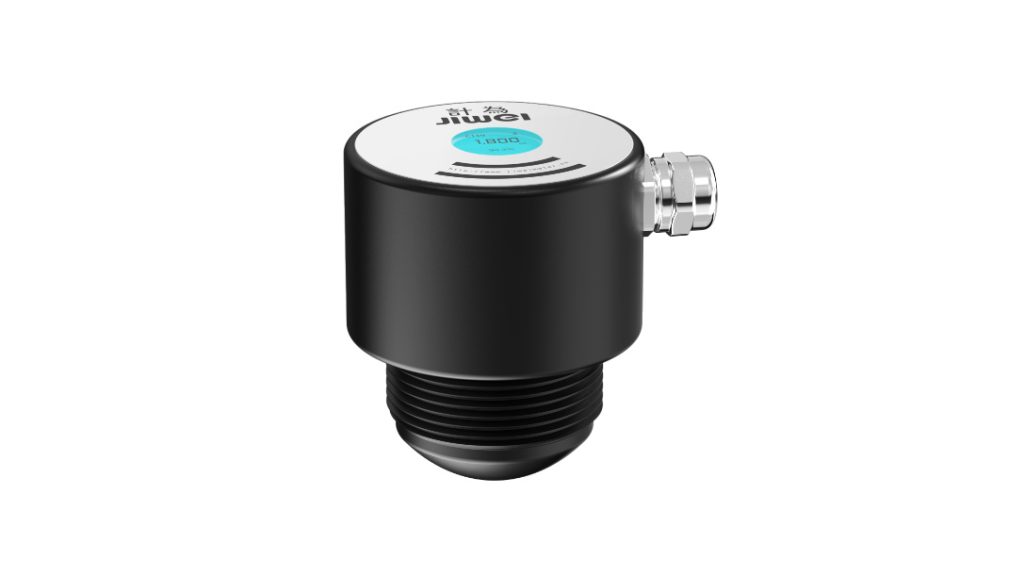
The JWrada-22 uses 80GHz frequency-modulated continuous-wave radar technology. It offers a measuring range of up to 30 meters, accuracy of up to ±1 mm, and a narrow 6° beam angle.
The instrument supports two-wire 4–20mA/HART and four-wire RS485/Modbus outputs. With an IP66/68 protection rating, it is suitable for wastewater treatment, water management, drainage systems, and other industrial level measurement applications.
80GHz Radar Technology for Complex Installations
The JWrada-22 transmits high-frequency electromagnetic waves toward the liquid surface and receives the reflected signal.
By calculating the distance between the instrument and the liquid surface, the device determines the actual level inside the tank, pit, or basin.
Its narrow beam angle helps reduce interference from tank walls, pipes, supports, ladders, and other internal structures. This makes it suitable for wastewater tanks, pump stations, and measuring points with limited installation space.
Non-Contact Measurement Reduces the Risk of Buildup
The radar level meter is installed above the tank or basin and does not require mechanical components to come into direct contact with the liquid.
Compared with float-based devices, non-contact measurement reduces the risk of mechanical jamming, corrosion, and component wear. It is especially suitable for wastewater containing suspended solids, sludge, or other contaminants.
Standard Output Signals Simplify PLC Integration
The JWrada-22 can communicate with PLC, DCS, and remote monitoring systems through 4–20mA/HART or RS485/Modbus signals.
The control system can use the real-time level data to start and stop lift pumps, regulate tank levels, and activate high- or low-level alarms.
This improves process automation and reduces delays associated with manual inspections.
Local Display and Wireless Configuration
The instrument features a simple local display and an integrated Bluetooth module.
Operators can view measurement data and adjust parameters directly at the measuring point. Wireless configuration and monitoring can also be performed through a compatible application, making installation, commissioning, and maintenance more convenient.
Protection for Outdoor and Humid Environments
The JWrada-22 features an integrated nylon housing and lens antenna design with an IP66/68 protection rating.
When correctly selected and installed, it can be used in outdoor, humid, and condensation-prone industrial environments.
For highly corrosive wastewater, the compatibility of the instrument materials and seals should be confirmed according to the chemical composition, process temperature, and operating pressure.
JWrada-22 Radar Level Meter Applications
Continuous Level Monitoring in Lift Stations
Some lift station measuring points originally used float level devices, which were prone to jamming and delayed responses.
After the radar level meters were installed, the PLC could continuously receive accurate level signals from the lift stations.
The PLC uses preset level thresholds to control the start and stop of the lift pumps. This helps maintain stable operation while reducing the risks of high-level overflow and low-level pump dry-running.
Wastewater Storage Tank Level Control
In storage tanks with a measuring range of approximately 0–7 meters, the radar level meters were installed at the top of the tanks and connected to the PLC through 4–20mA signals.
The control system can display the tank level in real time and perform filling control, discharge control, and high- or low-level alarming according to process requirements.
This allows operators to monitor the operating condition of each wastewater storage tank more effectively.
Level Monitoring in Tanks Containing Corrosive Media
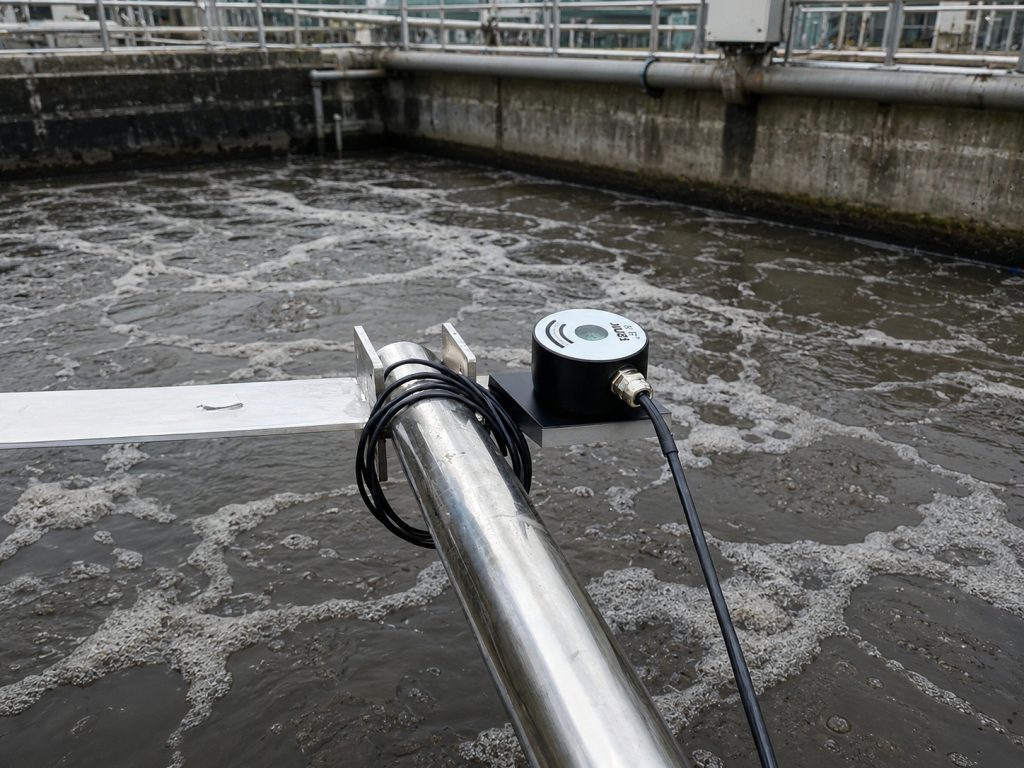
For wastewater tanks containing acids, alkalis, or other corrosive substances, suitable mounting structures and compatible materials were selected according to the properties of the process medium.
This helps reduce the impact of corrosion on measurement reliability and instrument service life.
Radar Level Meter Installation and Commissioning Guidelines
To achieve stable level measurement in wastewater tanks and sewage basins, several installation guidelines should be followed:
- Install the instrument away from inlets, agitators, ladders, and large pipes whenever possible.
- Minimize fixed obstacles within the radar beam path.
- Select an installation position that allows convenient inspection, configuration, and removal.
- Configure the empty distance, full distance, and measurement range according to the actual tank or basin depth.
- Perform false-echo suppression when fixed internal structures produce unwanted reflections.
- After connecting the instrument to the PLC, verify the level values corresponding to 4mA and 20mA.
- Configure high-level, low-level, and instrument fault alarms according to process safety requirements.
After installation and commissioning were completed, the level signals remained stable, and the PLC pump control logic operated correctly.
Project Results
The installation of the JWrada-22 radar level meters brought several improvements to the wastewater treatment system.
More Continuous and Visible Level Data
The radar level meters continuously transmit level data to the control system.
Compared with point-level switches that only generate alarms at fixed positions, continuous measurement gives operators a clearer understanding of lift station and storage tank conditions.
Reduced Risk of Mechanical Jamming
Non-contact radar measurement does not rely on floats, connecting rods, or other moving mechanical components.
This reduces the risk of instrument failure caused by sludge, suspended solids, and material buildup.
Improved Process Automation
Once the level signals were integrated into the PLC, the system could automatically control pump operation, trigger level alarms, and support remote monitoring.
This reduced dependence on manual inspections and operator judgment.
Lower Maintenance and Downtime Risks
Reliable level signals help reduce false alarms and unnecessary troubleshooting.
As a result, maintenance work is less likely to interrupt the continuous operation of the wastewater treatment process.
Frequently Asked Questions About Radar Level Meters for Wastewater Treatment
Can a Radar Level Meter Replace a Float Level Switch?
In wastewater tanks, lift stations, and storage vessels that require continuous level measurement, a radar level meter can be used as an upgrade from a traditional float device.
However, when an independent high-high-level safety interlock is required, a separate point-level switch may still be retained.
This creates a combined solution using continuous level measurement for process control and independent point-level detection for safety protection.
Can a Radar Level Meter Measure Wastewater with Foam?
The effect of foam depends on its thickness, density, dielectric properties, and surface movement.
A thin layer of ordinary foam may have little influence on the measurement. However, thick or highly absorbent foam may weaken the radar echo.
Before selecting an instrument, information about the wastewater, foam conditions, agitation, installation structure, and measuring range should be provided so that the application can be properly evaluated.
How Should the Measuring Range Be Selected?
The measuring range should be based on the maximum distance between the instrument mounting position and the lowest possible liquid level.
The radar blind zone, liquid surface fluctuations, tank roof space, and installation tolerances should also be considered.
The instrument should not be selected only according to the normal operating level. A reasonable margin should be included for abnormal low-level conditions and installation deviations.
Can the Radar Level Meter Be Connected Directly to a PLC?
Yes. The JWrada-22 supports 4–20mA/HART and RS485/Modbus outputs.
The appropriate version can be selected according to the PLC input module, communication requirements, and site wiring arrangement.
Conclusion
The wastewater treatment and odor control project in Taizhou demonstrates how the JWrada-22 radar level meter can provide continuous level data for lift stations, wastewater storage tanks, and other critical equipment.
Its 80GHz radar technology, non-contact measurement principle, standard industrial outputs, and convenient configuration functions help reduce the mechanical jamming problems associated with traditional level devices while improving wastewater treatment automation.
When selecting a radar level meter for wastewater treatment, factors such as measuring range, corrosiveness, foam, vapor, internal obstacles, mounting connections, and control system signal requirements should all be considered.
Correct instrument selection and proper installation are essential for achieving stable measurement, low maintenance requirements, and reliable integration with the wastewater treatment control system.