
When people talk about radar level transmitters in industrial applications, one question often comes up immediately:
“Do I need a PLC to use one?”
Not necessarily.
A PLC is certainly powerful. It can collect signals, perform calculations, manage interlocks, run control logic, and coordinate an entire automation system. In many plants, it is basically the “project manager” of industrial control.
But not every tank, silo, water reservoir, or small process system needs a full-time project manager.
Sometimes the requirement is very simple:
What is the current level? Is the tank almost full? Is it nearly empty?
If the only goal is to display one level measurement, installing a PLC, analog input modules, programming software, an HMI, and commissioning the entire system can feel a little excessive.
It is somewhat like building a commercial kitchen just to make one bowl of instant noodles.
This is exactly where a digital panel meter, also called a secondary display instrument, process indicator, or digital display meter, becomes extremely useful.
It can receive the output signal from a radar level transmitter, convert that signal into an easy-to-read engineering value, and display the liquid level directly.
In other words:
The radar level transmitter does the measuring, while the digital display meter tells you what the measurement actually means.
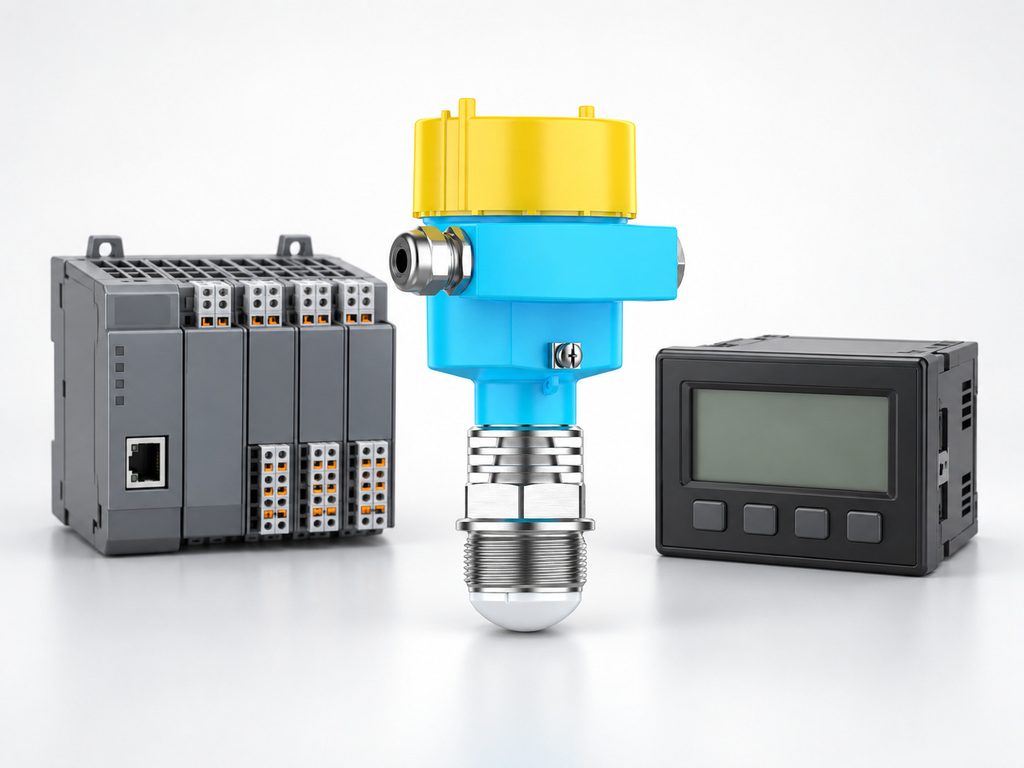
1. A Radar Level Transmitter Can Measure the Level, but Someone Still Has to Display It
Let us start with the basic job of a radar level transmitter.
A radar level transmitter sends microwave signals toward the surface of a liquid or bulk material. The signal reflects back to the sensor, allowing the instrument to determine the distance between the antenna and the material surface.
Based on tank height, reference points, and configuration parameters, the transmitter can then calculate the actual level.
Radar level transmitters are widely used in applications such as:
water tanks,
chemical storage tanks,
wastewater basins,
fuel tanks,
oil tanks,
powder silos,
and bulk material storage vessels.
They are intelligent instruments, but there is one practical issue.
The measurement still needs to be visible to the operator.
Many radar level transmitters provide a standard 4-20 mA output signal. Some models may also support HART, RS485, Modbus, or other communication protocols.
For a PLC, a 4-20 mA signal is completely normal. The signal enters an analog input module, the PLC scales it, and the operator sees a level value on an HMI or SCADA screen.
But what happens if there is no PLC?
Technically, someone could connect a multimeter and look at a reading such as 12.6 mA.
Then the operator could stand there thinking:
“Excellent. Now is that three meters, four meters, or should I call the engineer?”
Not exactly the most convenient solution.
This is where a digital display meter for radar level transmitters becomes the translator between the instrument signal and the person who actually needs to understand it.
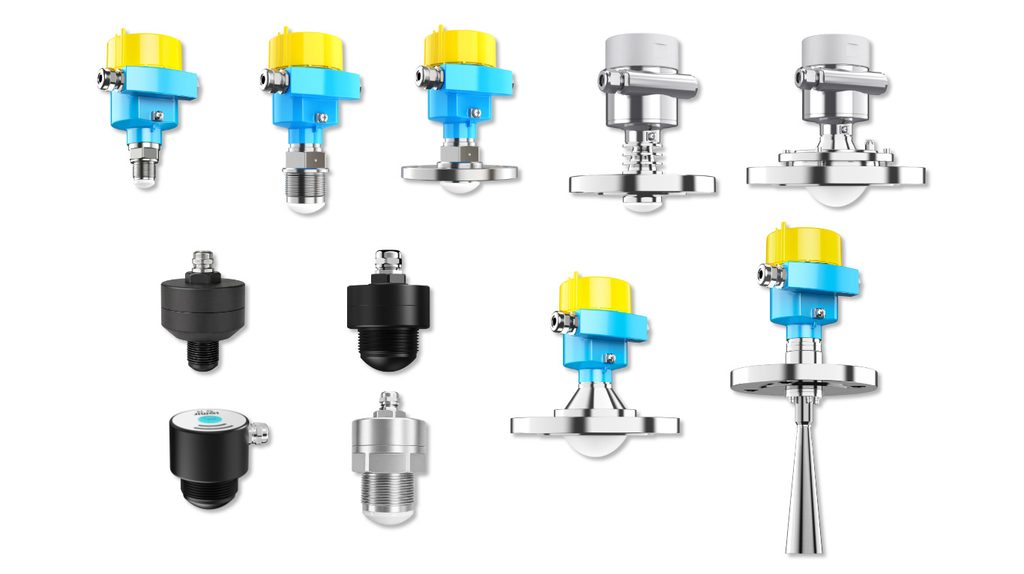
2. What Does a Digital Display Meter Actually Do?
The main job of a secondary display instrument can be summarized in one word:
Translation.
Here is a simple example.
Suppose a storage tank has a level measurement range of 0 to 10 meters, and the radar level transmitter outputs a 4-20 mA signal.
The system can be configured so that:
4 mA = 0 meters
20 mA = 10 meters
Any signal between 4 and 20 mA represents a proportional level value.
For example, if the radar transmitter outputs 12 mA, the digital display meter can calculate the corresponding value and show:
5.00 m
That is much more useful.
The operator does not need to understand analog signals.
There is no need to memorize conversion formulas.
There is no need to pull out a calculator and determine what 16 mA means.
The operator simply looks at the display.
“Five meters remaining.”
Done.
That is the biggest advantage of using a digital panel meter with a radar level transmitter when no PLC is available: it converts an electrical signal into a value that people can understand immediately.
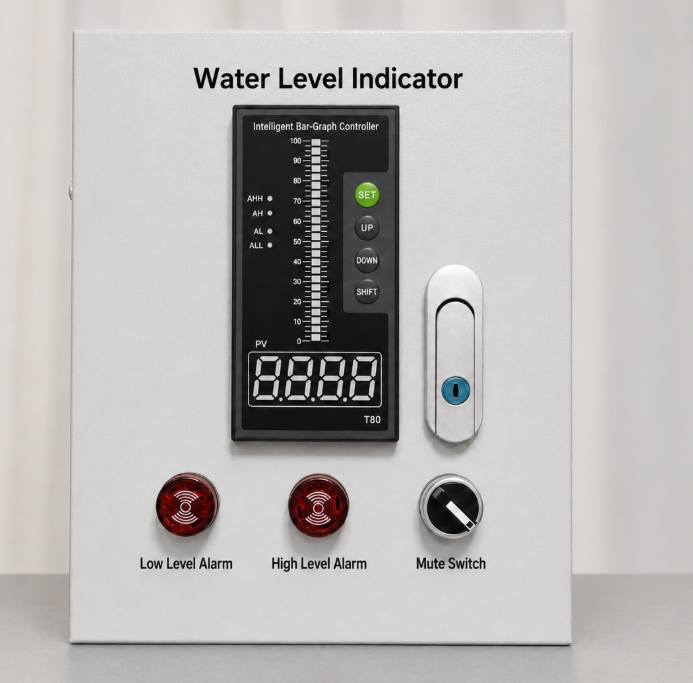
3. No PLC? A Radar Level Transmitter Can Still Form a Simple and Effective Level Monitoring System
Many small industrial systems do not need a complicated automation architecture.
For example:
a single water tank,
a diesel storage tank,
a raw material vessel,
a wastewater basin,
a small silo,
or a skid-mounted system.
In these applications, the user may only need to see the current level and perhaps receive a high-level or low-level alarm.
A very simple configuration can often do the job:
Radar level transmitter + digital display meter + power supply
The radar level transmitter measures the level and sends a 4-20 mA signal to the display meter.
The display meter converts that signal and shows the actual level value.
If the selected display meter includes relay outputs, the system can also provide functions such as:
high-level alarm,
low-level alarm,
high-high level alarm,
low-low level alarm,
audible or visual alarm activation,
and simple pump or valve control.
Of course, if the process involves complex interlocks, multiple devices, safety functions, coordinated sequences, or plant-wide automation, a PLC or DCS is still the more appropriate solution.
But if all you need is a local level indication and a couple of alarm points, installing a full PLC system may be a little like installing a city traffic control center just to operate one parking-lot light.
Possible?
Yes.
Necessary?
Probably not.
4. A Digital Display Meter Does More Than Display a Number
Another useful feature of a secondary display instrument is engineering-unit scaling.
The raw information from a radar level transmitter may ultimately be represented by a current signal, distance value, or another process variable.
But the operator may not want to see an electrical signal.
The operator usually wants to see something meaningful, such as:
liquid level,
percentage,
remaining capacity,
tank volume,
or another calculated process value.
For example, a 10-meter-high tank can be configured so that the digital meter displays:
0.00 to 10.00 m
or
0 to 100%
Instead of showing:
“Current signal: 13.7 mA”
the display can show:
“Current level: 60.6%”
That makes much more sense.
It is similar to a weather forecast telling you that the temperature is 28°C instead of reporting:
“The temperature sensor output voltage is currently 1.372 volts.”
The second statement may be technically correct.
The first one is much more useful to actual human beings.
5. Digital Display Meters Are Especially Useful for Retrofit Projects
Older equipment upgrades often create an interesting situation.
A plant may originally use:
a float switch,
a magnetic level gauge,
a mechanical level indicator,
or even manual visual inspection.
Later, the user decides to upgrade the measurement system and install a radar level transmitter.
Good idea.
But then someone opens the control cabinet and discovers:
There is no PLC.
Now what?
One option is to redesign the entire control system, install a PLC, add analog input modules, modify the control cabinet, rewrite the wiring, develop software, and commission everything.
What started as “replace the old level instrument” has suddenly become “launch a small automation project.”
A much simpler option is to connect the radar level transmitter to a digital level display meter.
The existing control system can remain largely unchanged, while the new radar level measurement is displayed on the control panel or at a convenient local location.
For projects with limited budgets, short installation schedules, or systems where major modifications are undesirable, this approach can be particularly practical.
A secondary display instrument is basically the industrial equivalent of saying:
“Do not rebuild the entire house just because you want a better doorbell.”
6. What Should You Consider When Connecting a Radar Level Transmitter to a Digital Display Meter?
The concept is simple, but that does not mean every instrument should be connected by matching wire colors and hoping for the best.
Several points should be checked carefully.
Check the Signal Type
If the radar level transmitter provides a 4-20 mA output, the digital display meter must support a compatible 4-20 mA input.
You should also verify whether the radar transmitter is:
two-wire,
three-wire,
or four-wire.
Different wiring configurations may require different power and signal connections.
Check the Power Supply
Some digital panel meters only receive the process signal.
Others can provide loop power to a two-wire transmitter.
Before selecting the instruments, make sure you understand which device provides power and how the current loop is configured.
Otherwise, you may end up with two perfectly good instruments sitting next to each other while neither one knows who is supposed to power the circuit.
Match the Measurement Range
The scaling settings of the radar level transmitter and the digital display meter must match.
For example, if the radar level transmitter is configured so that:
4 mA = 0 m
20 mA = 8 m
then the digital display meter must use the same scaling relationship.
If the radar transmitter thinks 20 mA means 8 meters while the display meter thinks 20 mA means 10 meters, both instruments may be operating perfectly.
They are simply having different conversations.
Check Alarm and Output Requirements
If the application requires high-level alarms, low-level alarms, relay outputs, or retransmission of the 4-20 mA signal, these functions should be confirmed before selecting the display meter.
A basic indicator may only display the measured value.
A more advanced process indicator can also provide relay contacts, analog retransmission, and communication outputs.
7. A Digital Display Meter Is Not a Replacement for a PLC
One thing should be made clear:
A digital display meter is not intended to replace a PLC in every application.
PLCs are designed for:
complex control logic,
sequence control,
multi-device coordination,
communication networks,
data processing,
remote monitoring,
and advanced automation functions.
If a project includes dozens or hundreds of measurement points, multiple pumps, valves, motors, interlocks, control loops, and remote supervision, then a proper PLC or DCS architecture is usually the right approach.
The strength of a secondary display instrument lies somewhere else.
It is:
simple, direct, and independent.
Need to display one liquid level?
No problem.
Have a storage tank with no PLC but still need to display radar level readings?
No problem.
Need a high-level or low-level alarm?
Choose the right model, and that is possible too.
Upgrading an old level measurement system without rebuilding the entire control cabinet?
Again, no problem.
The digital display meter is not trying to take the PLC’s job.
It simply steps in when a PLC would be overqualified for the task and says:
“I can handle this one.”
8. Conclusion: No PLC Does Not Mean No Level Display
Industrial automation is not about using the largest number of devices possible.
A good instrumentation solution is one that matches the actual requirements of the application.
A radar level transmitter can provide stable and continuous level measurement, while a digital display meter can convert a 4-20 mA signal into an easy-to-read value such as liquid level, percentage, or another engineering unit.
For level monitoring applications without a PLC, combining a radar level transmitter with a digital panel meter is a simple, practical, and cost-effective solution.
This configuration is particularly suitable for:
single-point level indication,
small storage tanks,
water tanks,
wastewater basins,
material silos,
skid-mounted equipment,
and retrofit projects.
After all, a radar level transmitter can be extremely intelligent, but if nobody at the site can understand what its output signal means, its intelligence is not particularly helpful.
That is where the digital display meter comes in.
It stands beside the radar level transmitter and translates the message into something everyone can understand:
“No need to calculate it yourself. This is how much is left in the tank.”
Simple, clear, and surprisingly useful.