
1. What Is a Relay?
A relay is a common electrical control component. Its main function is to use a small electrical signal to control the connection or disconnection of another circuit. In simple terms, a relay is like an “automatic switch.” Instead of being operated manually, it is controlled by signals such as current, voltage, time, temperature, liquid level, or material level.
Relays are widely used in electrical control systems. They can be found in household appliances, automotive electronics, industrial automation equipment, pump control systems, level meter alarms, motor start-stop circuits, and PLC control cabinets. Although a relay is usually small in size, it plays an important role in circuit control, isolation, protection, signal conversion, and interlocking.
For example, suppose we want to use a low-voltage button to control a 220V lamp. If the button is connected directly to the 220V circuit, there may be a risk of electric shock. A relay can solve this problem. The button only controls the relay coil. When the coil is energized, it drives the relay contacts to operate, and the contacts then control the 220V lamp. In this way, the low-voltage control circuit and the high-voltage load circuit are isolated, making the system safer and more convenient.
Therefore, the core idea of a relay can be summarized in one sentence: a relay is an automatic switch that uses a small signal to control a larger circuit.
2. Working Principle of a Relay
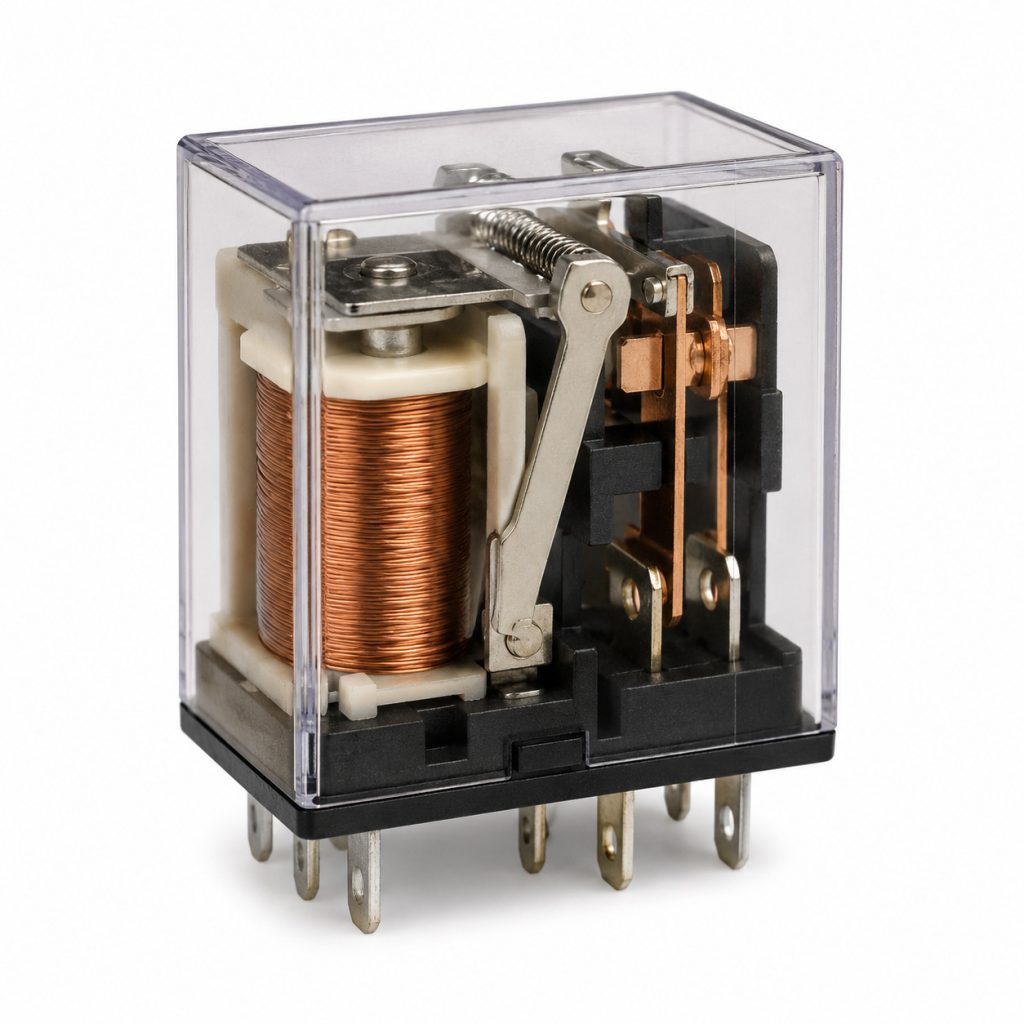
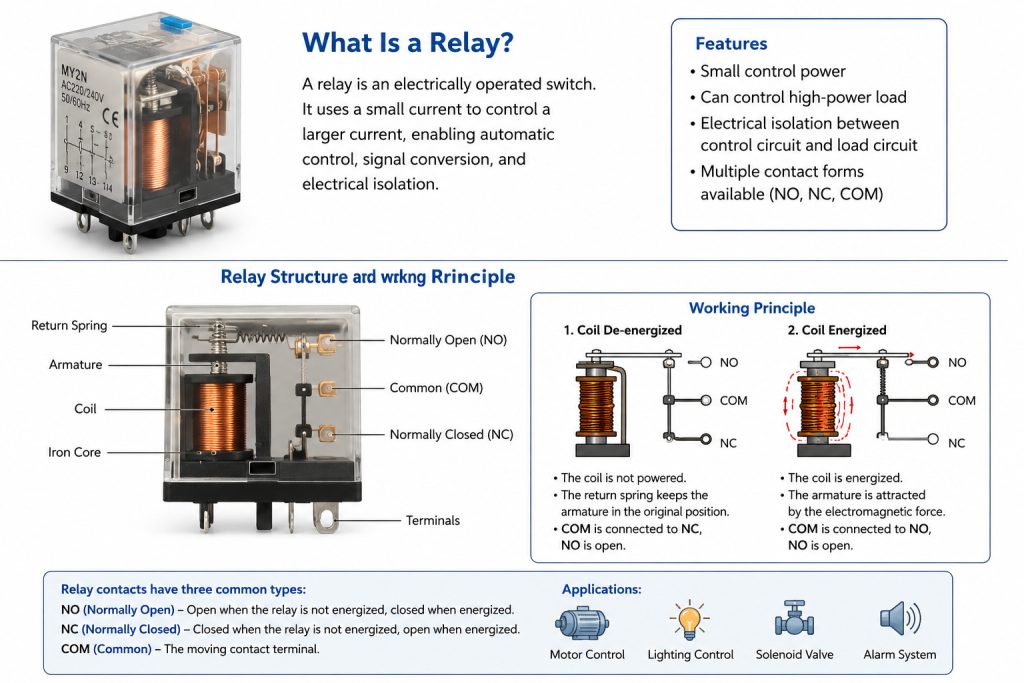
The most common type of relay is the electromagnetic relay. An electromagnetic relay usually consists of a coil, iron core, armature, spring, and contacts. When the coil is energized, it generates electromagnetic force, which attracts the armature and causes the contacts to close or open. When the coil is de-energized, the electromagnetic force disappears, and the spring returns the armature to its original position, restoring the contacts to their initial state.
The working process of a relay can be divided into three simple steps:
First, the control circuit supplies power to the relay coil.
Second, the coil generates a magnetic field and drives the internal mechanical structure.
Third, the contact state changes, thereby connecting or disconnecting the load circuit.
Relay contacts generally include normally open contacts, normally closed contacts, and changeover contacts. A normally open contact is open when the relay is not activated and closes after the relay is energized. A normally closed contact is closed when the relay is not activated and opens after the relay is energized. A changeover contact can switch between two circuits.
In actual wiring, you will often see the markings NO, NC, and COM. NO stands for normally open, NC stands for normally closed, and COM stands for common terminal. Different contact wiring methods can be selected according to different control requirements.
For example, if a device needs to start after the relay is activated, the normally open contact can be used. If a device needs to stop after the relay is activated, the normally closed contact can be used. Because the contact state can change flexibly, relays are widely used in automatic control systems.
3. Main Functions of a Relay
Relays are widely used because they solve many practical problems in electrical control.
First, a relay can use a small current to control a large current. Many buttons, sensors, control boards, PLC output points, or microcontroller pins have limited output capacity and cannot directly control loads such as pumps, motors, solenoid valves, or heaters. Through a relay, a small signal can be converted into a switching signal capable of controlling a larger current load.
Second, a relay can provide electrical isolation. The control side and the load side can be independent of each other. A low-voltage control circuit does not need to directly contact a high-voltage or high-current circuit. This improves system safety and reduces the influence of interference on the control circuit.
Third, a relay can achieve automatic control. For example, a time relay can provide delayed start or delayed stop; a thermal relay can cut off the control circuit when a motor is overloaded; and in a liquid level or material level control system, a relay can automatically start a pump, stop feeding, or trigger an alarm according to the signal from a level meter.
Fourth, a relay can expand control logic. Multiple relays can be combined to achieve self-locking, interlocking, sequential control, linked control, and fault protection. Before PLC and DCS systems became widely used, relay control was an important method in industrial automation. Even today, relays remain essential components in electrical control cabinets.
4. Common Types of Relays
There are many types of relays, and different types are suitable for different application scenarios. According to working principles and usage, common relays mainly include the following types.
1. Electromagnetic Relay
An electromagnetic relay is the most common type of relay. It uses the electromagnetic force generated by a coil to drive the contacts. Electromagnetic relays have a simple structure, relatively low cost, and wide application range. They are commonly used in household appliances, industrial control, automotive circuits, and power distribution systems.
2. Solid State Relay
A solid state relay, often abbreviated as SSR, has no traditional mechanical contacts. Instead, it uses semiconductor devices to switch circuits on and off. Solid state relays offer fast response, long service life, no contact sparks, and no mechanical wear. They are suitable for frequent switching and applications with higher noise requirements. However, solid state relays usually have some leakage current and heat generation, so heat dissipation and load matching should be considered during use.
3. Time Relay
A time relay can delay action or delayed reset according to a preset time. It is commonly used for motor delayed start, equipment sequential start, lighting delayed shutdown, and automatic control processes. For example, if a system needs to start a fan first and then start the main machine, a time relay can be used to achieve sequential control.
4. Thermal Relay
A thermal relay is mainly used for motor overload protection. When a motor is overloaded for a long time, the current increases and causes the thermal element to heat up. The thermal relay then operates and cuts off the control circuit, protecting the motor from burning out. Thermal relays are often used together with contactors and are common protection components in motor control systems.
5. Intermediate Relay
An intermediate relay is often used for signal amplification, signal conversion, and contact expansion in control systems. When one control signal needs to control multiple circuits at the same time, an intermediate relay can provide additional contacts and serve as a transfer and expansion component. Intermediate relays are very common in PLC control cabinets.
6. Automotive Relay
Automotive relays are usually used to control headlights, horns, windshield wipers, fuel pumps, cooling fans, power windows, and other vehicle loads. Because automotive working environments involve vibration, high temperature, low temperature, and voltage fluctuations, automotive relays usually require high reliability and strong vibration resistance.
5. Common Relay Parameters
When selecting a relay, it is not enough to only look at its appearance. Key parameters must also be considered. Common relay parameters include coil voltage, contact rating, contact form, operate time, release time, insulation resistance, withstand voltage, and operating temperature.
Coil voltage refers to the voltage required by the relay control side, such as 5V, 12V, 24V, 110V, or 220V. When choosing a relay, the coil voltage must match the control circuit. If the control circuit outputs 24V DC, a relay with a 24V DC coil should be selected. If the control board outputs 12V, a relay with a 12V coil should be selected.
Contact rating indicates the maximum voltage and current that the relay contacts can withstand. For example, a common marking such as “10A 250VAC” means that the contact can carry a certain load current under 250V AC conditions. In actual use, the load current must not exceed the rated contact capacity; otherwise, the contacts may overheat, burn, stick, or fail.
The load type is also very important. Resistive loads such as heating wires and incandescent lamps are relatively simple. Inductive loads such as motors, solenoid valves, and contactor coils may generate reverse electromotive force at the moment of disconnection, causing impact on the relay contacts. For inductive loads, a flyback diode, RC snubber, or varistor can be added when necessary to protect the contacts and control circuit.
In addition, the installation method, pin arrangement, ambient temperature, and insulation performance of the relay should also be considered. Industrial sites may involve dust, humidity, vibration, and corrosive gases. Therefore, relay selection should be based on actual working conditions, rather than relying only on rated current.
6. What Is the Difference Between a Relay and a Contactor?
Many beginners confuse relays with contactors. Both can control circuit switching, but their application focuses are different.
Relays are usually used for low-power control, signal conversion, logic control, and protection circuits. Their contact capacity is relatively small, making them suitable for control signals or small to medium loads. Contactors are mainly used to frequently control high-power loads, such as three-phase motors, large heating equipment, and industrial lighting systems. Contactors have larger contact capacity and stronger arc extinguishing ability, making them more suitable for high-current applications.
A simple way to understand the difference is this: a relay is more focused on “control signals,” while a contactor is more focused on “controlling high-power equipment.”
In actual electrical systems, the two are often used together. For example, a PLC output signal first controls an intermediate relay, the intermediate relay then controls the contactor coil, and finally the contactor controls the motor start or stop. This protects the PLC output point and improves the control capacity and safety of the system.
7. Application Scenarios of Relays
Relays are used in a wide range of applications. In household appliances, relays can control compressors, heating tubes, pumps, fans, and lighting circuits. In automobiles, relays can control headlights, starting systems, horns, cooling fans, and fuel pumps. In industrial automation, relays are often used for PLC output expansion, motor control, alarm systems, safety interlocking, and equipment start-stop control.
In smart homes, relay modules can control lights, curtains, access control systems, sockets, and small appliances. Many smart switches, smart sockets, and control modules rely on relays or similar switching components.
In electronic DIY projects and microcontroller applications, relays are also very common. For example, when using Arduino, ESP32, or STM32 to control a lamp, pump, electromagnetic lock, or solenoid valve, a relay module is usually used to achieve low-voltage control of a high-voltage load. A microcontroller itself cannot directly drive high-power devices, so the relay serves as an intermediate switch.
In industrial sites, relays are also commonly used for alarm control. For example, when the temperature is too high, a relay can trigger a fan to start; when pressure is abnormal, a relay can stop equipment operation; and when equipment fails, a relay can activate a sound and light alarm. These control logics may seem simple, but they are very important for equipment safety and production stability.
8. Relay Applications in Level Measurement
Relays are also widely used in level measurement systems. A level meter is mainly used to detect the liquid level, material level, or interface position in containers, silos, water tanks, oil tanks, storage tanks, and other equipment. When the liquid level or material level reaches a preset upper limit, lower limit, or alarm point, the level meter can output a switching signal, which is then used by a relay to control external equipment.
For example, in a water tank level control system, when the level meter detects that the water level is below the lower limit, the relay can start the pump to refill water. When the water level reaches the upper limit, the relay disconnects the pump control circuit and stops the pump. This enables automatic water replenishment and prevents overflow.
In silos or storage tanks, a level meter can also output high-level alarm, low-level alarm, empty-bin alarm, or full-bin alarm signals through a relay. When the material reaches a high level, the relay can trigger a sound and light alarm or stop the feeding equipment. When the material falls below the set value, the relay can start replenishment, water filling, or conveying systems.
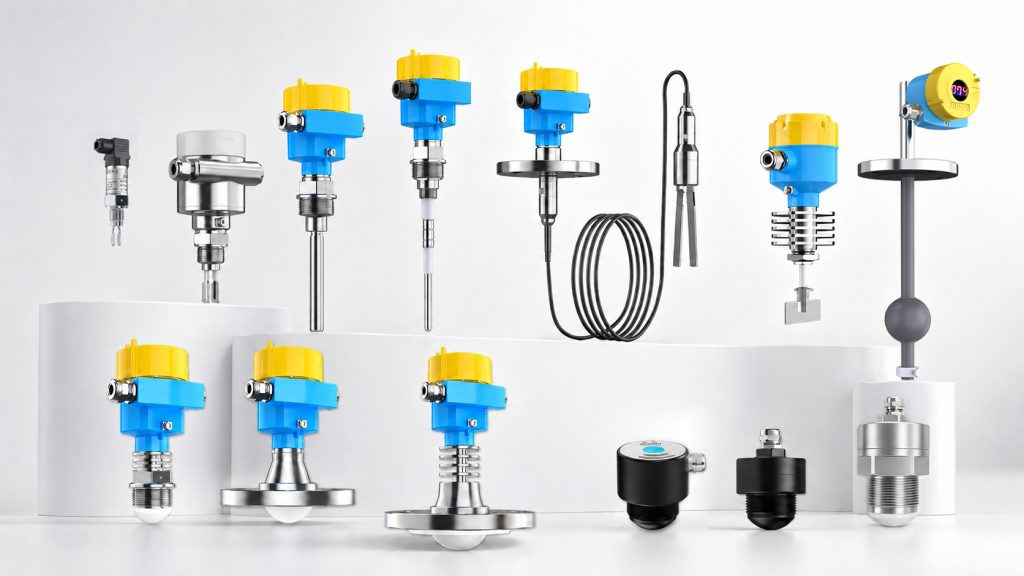
In level measurement systems, relays mainly provide signal conversion, equipment linkage, and safety protection. Many level meters have limited output capacity and cannot directly drive pumps, solenoid valves, conveyors, alarms, or contactor coils. Through a relay, the small signal from the level meter can be converted into a switching signal capable of controlling external loads, allowing the detection signal to truly participate in automatic control.
Common devices such as radar level meters, tuning fork level switches, float level switches, capacitive level meters, and rotary paddle level switches can all work with relays. In industries such as water treatment, environmental protection, chemical processing, food, building materials, cement, grain storage, and petroleum storage and transportation, the combination of level meters and relays is very common.
For example, in a sewage lifting pump station, when a level meter detects that the liquid level has risen, the relay can start the pump to discharge wastewater. When the liquid level drops to a low level, the relay stops the pump to prevent dry running. In a powder silo, when a level switch detects a high material level, the relay can stop the feeding equipment to prevent blockage and overflow. In a storage tank system, when the liquid level reaches a high-high level, the relay can trigger interlock protection to prevent medium overflow.
It should be noted that level measurement applications often involve complex site conditions, such as water, dust, corrosive media, high temperature, high pressure, or flammable and explosive environments. Therefore, the selection of both the relay and the level meter should be based on actual working conditions. Ordinary water tank control can use conventional relay output. For complex environments such as chemical plants, petroleum storage, grain silos, cement plants, and coal powder systems, factors such as explosion-proof rating, contact capacity, load type, signal isolation, and anti-interference ability must be considered.
Proper use of relays allows a level meter not only to perform detection, but also to achieve automatic control, alarm protection, and production interlocking, improving the safety and automation level of the entire system.
9. How to Select the Right Relay
When selecting a relay, several aspects should be considered.
First, check the control voltage. The relay coil voltage should match the output voltage of the control circuit. For example, microcontroller projects often use 5V or 3.3V control signals, industrial control systems often use 24V DC, and some household appliances or control cabinets may use 220V AC relays.
Second, check the load voltage and load current. The relay contact rating must be higher than the actual load requirement, with a certain safety margin. This is especially important for inductive loads such as motors, pumps, solenoid valves, and contactor coils, because the starting or switching impact can be large. The relay should not be selected only according to the normal operating current.
Third, check the contact form. If the device needs to turn on after the relay is energized, a normally open contact can be selected. If the device needs to turn off after the relay is energized, a normally closed contact can be selected. If switching between two circuits is required, a changeover contact can be selected.
Fourth, consider the switching frequency. If the load needs frequent switching, a solid state relay may be more suitable. If the switching frequency is not high and cost is a concern, a conventional electromagnetic relay is usually more economical.
Fifth, consider the working environment. If the relay is installed in a high-temperature, humid, dusty, vibrating, corrosive, or explosion-proof environment, a product that meets the environmental requirements should be selected. In level measurement systems, special attention should be paid to site media characteristics and protection requirements to avoid malfunction or safety risks caused by improper relay selection.
10. Precautions for Using Relays
When using a relay, the first step is to confirm whether the coil voltage and contact rating match the actual application. If the coil voltage is too low, the relay may not pull in reliably. If the coil voltage is too high, the coil may overheat or burn out. If the contact capacity is insufficient, the contacts may burn, stick, or fail to disconnect.
Second, relay contacts should not be overloaded. For inductive loads such as pumps, motors, and fans, starting current and surge current should be considered. When necessary, a contactor should be used for power control instead of using a small relay to directly control high-power equipment.
Third, anti-interference and protection measures should be taken. DC coils are often used with flyback diodes, while AC inductive loads can be used with RC snubbers or varistors to reduce voltage impact and extend relay service life.
Fourth, when dealing with 220V mains electricity or industrial power circuits, proper insulation, protection, grounding, and power-off operation are required. Non-professionals are not advised to directly operate high-voltage circuits. This is especially important in humid environments, metal containers, chemical sites, or flammable and explosive areas, where electrical safety regulations must be strictly followed.
11. Advantages and Limitations of Relays
The advantages of relays are clear: simple structure, relatively low cost, convenient control, good isolation, and wide applicability. A relay allows a low-voltage control circuit to safely control high-voltage or high-current loads, making it a very practical component in electrical control systems.
However, relays also have limitations. Mechanical relays have contact wear, slower response compared with semiconductor devices, audible noise during pull-in and release, and possible arcing when contacts open. Solid state relays have no mechanical contacts, but they may have leakage current, heat generation, and higher cost.
Therefore, relay selection should not only focus on whether the circuit can be switched on. Load type, switching frequency, environmental conditions, safety requirements, and maintenance cost should all be considered.
12. Frequently Asked Questions
1. What is a relay used for?
A relay is mainly used to control a high-current or high-voltage circuit with a small current or small signal. It can also provide electrical isolation, signal conversion, automatic control, and protection.
2. Can a relay directly control a 220V appliance?
Yes, but only if the relay contact rating meets the 220V load requirements and the wiring complies with safety standards. When working with mains electricity, power must be disconnected first, and proper insulation and protection must be ensured.
3. What is the difference between a relay and a switch?
A normal switch is usually operated manually, while a relay can be controlled automatically by an electrical signal. A relay is essentially a type of switch, but it is more suitable for automatic control systems.
4. Why does a level meter need a relay?
Many level meters have limited output capacity and cannot directly control pumps, solenoid valves, conveyors, or alarms. Through a relay, the level meter signal can be converted into a control signal for external equipment, enabling automatic start-stop control and alarm linkage.
5. How should I choose between a relay and a contactor?
For low-power control, signal conversion, and alarm output, a relay can be used. For high-power motors, heating equipment, or high-current loads with frequent start-stop operations, a contactor is usually more suitable. In many cases, relays and contactors are used together.
13. Conclusion
A relay is an automatic switching component that uses a small signal to control a larger circuit. Its core logic is: the coil controls the contacts, and the contacts control the load. Through this working method, relays can provide control, isolation, protection, signal conversion, and logic expansion.
Common relay types include electromagnetic relays, solid state relays, time relays, thermal relays, intermediate relays, and automotive relays. They are widely used in household appliances, automotive electronics, industrial automation, smart homes, PLC control systems, and level measurement control systems.
In level measurement applications, relays can use liquid level, material level, or interface position signals to achieve pump start-stop control, high and low level alarms, feeding control, conveyor linkage, and safety protection. For water tanks, storage tanks, silos, sewage pits, and powder bins, the combination of level meters and relays can significantly improve system automation and operational safety.
For beginners, learning about relays helps build a foundation in electrical control and prepares them for further study of PLCs, instrumentation control, level measurement, automation systems, and industrial electrical design. When selecting and using relays, key factors include coil voltage, contact capacity, contact form, load type, working environment, and safety protection. This is especially important when dealing with 220V mains electricity, high-power equipment, or explosion-proof environments, where electrical regulations must be strictly followed.