In industrial production, not all materials are stored in large silos that are tens or even hundreds of meters high. In industries such as food processing, plastics, chemicals, building materials, animal feed, pharmaceuticals, new energy, and automated batching, small silos, day bins, buffer hoppers, intermediate bins, and equipment hoppers are widely used.
Although these vessels are relatively small, they often play important roles in continuous feeding, temporary storage, batch dosing, and production flow control.
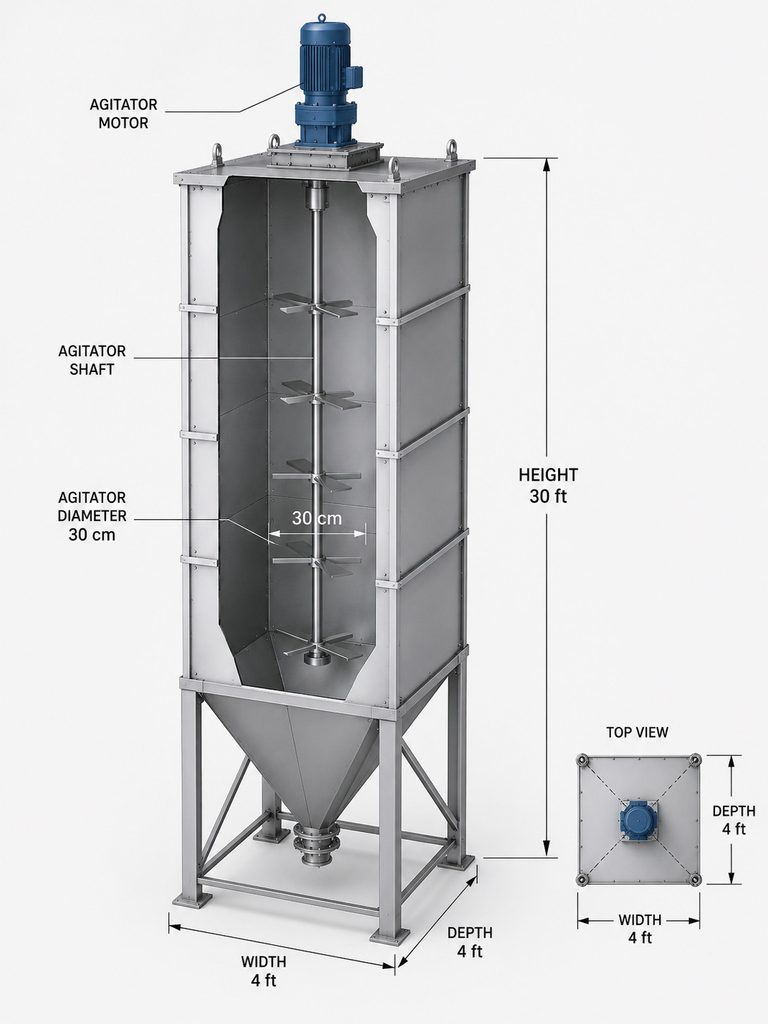
Compared with large silos, small silos have shorter measuring distances, but that does not necessarily make level measurement easier. In fact, because the silo diameter is small and the wall is close to the measuring axis, internal objects such as filling pipes, reinforcement ribs, brackets, conical hopper walls, and falling material streams can easily interfere with the radar signal.
For powders, granules, and other bulk solids, additional factors such as dust, low dielectric constant, sloped material surfaces, buildup, and filling impact must also be considered.
For this reason, the key to level measurement in a small silo is not simply a long measuring range. What matters more is beam focusing, target recognition, and the ability to process complex echoes.
The JWrada-34 radar level meter uses 80GHz FMCW millimeter-wave technology. With its narrow beam, non-contact measurement principle, and advanced echo processing, it is suitable for continuous level measurement of powders, granules, and other bulk solids, especially in dusty and complex small-silo applications.
Why Is Level Measurement in Small Silos More Difficult Than It Looks?
When selecting a level instrument for a small silo, many users first focus on measuring range.
For example, if a silo is only 3, 5, or 8 meters high, it may appear that an ultrasonic level meter, a lower-frequency radar, or even a mechanical level switch would be sufficient.
However, measuring range is only one factor.
The real challenges usually come from silo diameter, filling method, material characteristics, and internal structures.
Consider a small powder silo that is only 5 meters high and 1.5 meters in diameter. If there is an offset filling pipe at the top and reinforcement structures along the wall, the actual space available for radar measurement is very limited.
If the radar beam is too wide, it may illuminate the silo wall, filling pipe, or other metal structures at the same time, creating multiple reflected signals.
If the instrument cannot correctly identify these echoes, the result may be unstable readings, false levels, sudden jumps, or temporary loss of echo.
In addition, bulk solids do not usually form a flat surface.
Granular materials often create a conical pile due to their angle of repose, while powders may form sloped or uneven surfaces depending on the filling position and airflow.
As filling and discharge continue, the highest and lowest points of the material surface also change.
Therefore, the real challenge in small-silo radar measurement is how to keep the measuring beam away from the silo wall and internal structures while accurately identifying the constantly changing material surface.
Why Is 80GHz Radar Well Suited for Small Silos?
The JWrada-34 uses 80GHz high-frequency millimeter-wave radar technology.
Compared with lower-frequency radar systems, high-frequency millimeter-wave radar can generate a much narrower and more focused beam.
In a large and open vessel, a slightly wider beam may not cause major problems. However, in a small silo, narrow beam focusing becomes much more important.
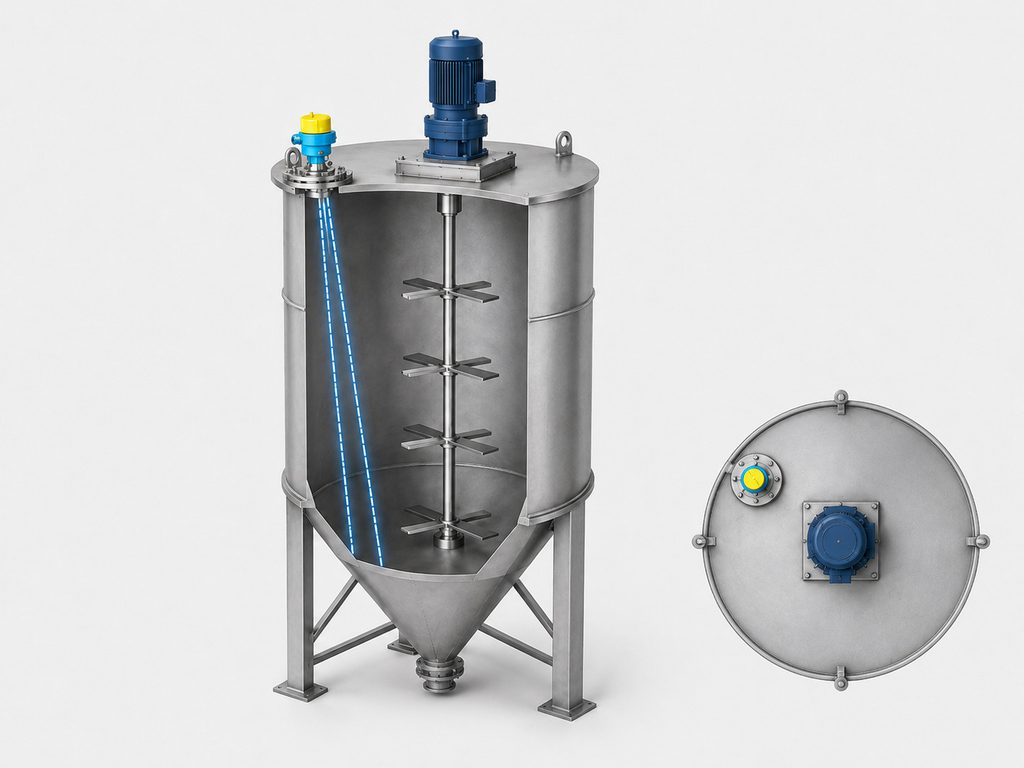
A concentrated radar beam reduces the possibility of the signal hitting the silo wall, brackets, reinforcement ribs, filling devices, or other nearby structures.
For example, when a radar is mounted on the top of a small cylindrical silo, a wide beam gradually expands as the measuring distance increases. This makes it easier for the beam to reach the surrounding wall.
A narrow beam, on the other hand, keeps more radar energy focused on the material surface, making the true material echo easier to identify.
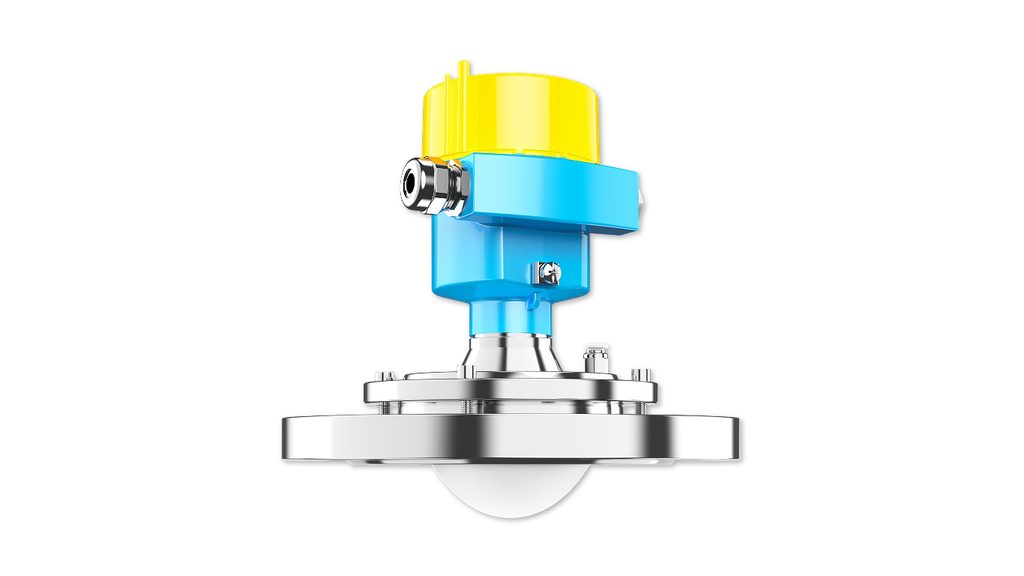
The JWrada-34 operates at 80GHz and uses a large-aperture lens antenna. Its narrow beam angle and concentrated energy make it suitable for powder, granule, and dusty bulk-solid applications.
For small silos, the main advantage is not the ability to measure extremely long distances. The greater value lies in obtaining a clearer and more focused echo within a confined space.
Why Does Dust Affect Traditional Level Measurement?
Small powder silos are widely used for materials such as cement, lime powder, fly ash, mineral powder, flour, starch, plastic powder, animal feed ingredients, and various industrial additives.
During filling, these materials can generate large amounts of suspended dust.
Because the internal space of a small silo is limited, airflow disturbances and dust concentrations can become more intense during material filling.
In pneumatic conveying applications, changing air pressure and strong airflow may create additional measurement challenges.
Ultrasonic instruments rely on sound waves, which can be affected by dust, gas conditions, temperature changes, and airflow.
Contact-type probes or mechanical devices may suffer from buildup, abrasion, and direct impact from falling materials.
Radar level meters use electromagnetic waves and do not require the sensor to contact the material.
This makes radar particularly suitable for small silos where reducing mechanical wear and buildup-related maintenance is important.
The JWrada-34 is designed for applications involving dust, low-dielectric powders, and solid granules.
Its echo processing capability helps distinguish weak or unwanted reflections from the true material surface, improving measurement stability in dusty environments.
Non-Contact Measurement for Frequently Filled and Emptied Silos
Many small silos are used as buffer vessels within production lines.
As a result, they may be filled and emptied much more frequently than large storage silos.
For example, raw material bins in an automated batching system may be refilled and discharged every few minutes.
Buffer hoppers on packaging lines may also operate continuously under dynamic filling conditions.
If a level instrument depends on direct contact with the material, repeated abrasion, pulling forces, and impact from granules can eventually cause mechanical wear.
The JWrada-34 is installed at the top of the silo and transmits an 80GHz frequency-modulated continuous-wave radar signal toward the material surface.
When the electromagnetic wave reaches the material, part of the signal is reflected back to the antenna.
The instrument analyzes the frequency difference between the transmitted and received signals to calculate the distance from the antenna to the material surface. The actual material level is then determined based on the silo height.
Throughout the entire measurement process, the antenna does not need to enter the material.
This means continuous level measurement can be maintained during filling, storage, and discharge while avoiding direct mechanical wear caused by contact with bulk solids.
How Does the JWrada-34 Handle Sloped and Uneven Material Surfaces?
One of the major differences between bulk solids and liquids is that solid material surfaces are rarely flat.
When granular material enters a silo from the top, it usually forms a conical pile.
Powders may also form uneven or sloped surfaces depending on airflow and filling position.
In a small silo, such local variations can have a greater impact on the measured result.
For this reason, the radar installation position should not be selected simply according to the geometric center of the silo.
The filling point, discharge outlet, material flow pattern, internal structure, and expected surface shape should all be considered.
The JWrada-34 can be equipped with an adjustable universal flange, allowing the measuring direction to be optimized according to the actual material surface.
For silos with offset filling or consistently sloped material surfaces, the antenna can be aimed toward a more representative area.
This is especially important in small silos because a change of only a few centimeters in the measurement position may correspond to a significantly different material level.
Selecting the correct measuring area is often more important than simply choosing an instrument with higher specifications.
Installation Considerations for JWrada-34 in Small Silos
Even a high-performance radar may produce unstable results if it is installed incorrectly.
First, the instrument should not be installed directly above the filling inlet.
When material is continuously falling from the filling point, the radar may detect the falling stream instead of the actual surface.
Heavy dust and direct material impact can also negatively affect long-term measurement stability.
A better approach is to place the radar away from the main filling stream and aim it toward a relatively stable material surface.
Second, the distance from the silo wall must be considered.
Because the diameter of a small silo is limited, the radar should not be installed too close to the wall.
The silo diameter, installation height, and radar beam angle should be evaluated to ensure that the measuring path does not significantly intersect with the wall.
The measuring beam should also avoid internal beams, reinforcement ribs, filling pipes, brackets, and other metal structures that may create strong reflections.
If such obstacles cannot be completely avoided, echo analysis can be performed during commissioning in both empty and filled conditions.
Fixed false echoes can then be identified and suppressed, helping the radar maintain stable tracking of the actual material surface.
Why Is Intelligent Echo Processing Important in Small Silos?
In large silos, internal structures may be complicated, but the walls are often relatively far from the radar.
Small silos are different.
Because of the limited diameter, many internal structures may be only a few tens of centimeters away from the main measuring axis.
As a result, the radar antenna may receive multiple echoes.
These may include the true material surface, wall reflections, mounting nozzle reflections, reinforcement ribs, filling pipes, and even secondary or multiple reflections.
Therefore, successful small-silo level measurement depends not only on radar hardware but also on echo-processing algorithms.
The JWrada-34 uses intelligent echo learning and signal processing to identify false echoes from fixed structures and continuously track the actual material surface.
This capability helps reduce reading fluctuations caused by fixed obstacles inside the silo.
Can the JWrada-34 Measure Low-Dielectric Powders?
Different materials reflect radar signals with different strengths.
In general, materials with a lower dielectric constant produce weaker reflected signals.
This means plastic pellets, lightweight powders, and certain additives can be more difficult to measure than water or high-dielectric liquids.
This is one reason why even a small silo with a measuring distance of only a few meters may still require a high-performance radar level meter.
The JWrada-34 is suitable for low-dielectric powders and solid granules.
Its 80GHz operating frequency, concentrated beam energy, and advanced signal processing help extract useful echoes from complex background reflections.
For this reason, the instrument can be considered for applications such as plastic pellet bins, lightweight powder silos, additive hoppers, and other low-reflectivity bulk-solid vessels.
The instrument should not be selected purely according to silo height.
The dielectric properties of the material should also be evaluated.
Antenna Purging for High-Dust Small Silos
Some small silos may be physically compact but operate under extremely dusty conditions.
If filling occurs frequently, dust can gradually accumulate around the silo roof and radar antenna.
When the material is hygroscopic or sticky, this buildup can become even more severe.
The JWrada-34 can be configured with an antenna purging structure.
Clean compressed air can be used to assist in keeping the antenna area free from heavy dust deposits.
For applications involving cement powder, mineral powder, lime, fly ash, and other dusty materials, the need for purging should be evaluated based on dust concentration, material adhesion, and maintenance intervals.
Not every small silo requires air purging.
However, in continuous processes with heavy dust or sticky deposits, a purging function can help reduce the frequency of manual antenna cleaning.
What Types of Small Silos Are Suitable for JWrada-34?
From an application perspective, the JWrada-34 is especially suitable for small silos that are compact in size but challenging in measurement conditions.
Typical applications include small silos for cement, mineral powder, fly ash, and lime; plastic pellets and resin granules; feed ingredients and additives; food powders and granular raw materials; and chemical powders, granules, and intermediate process materials.
In automated batching systems, small silos often need to provide continuous level information to a PLC or DCS instead of simply detecting whether the bin is full or empty.
A continuous radar level meter converts changes in material level into a continuous process signal, providing data for replenishment, batching, inventory monitoring, and process interlocking.
The JWrada-34 supports 4–20mA/HART and RS485/Modbus communication options and can also support wireless commissioning.
This allows the instrument to be integrated into different industrial automation systems.
Does a Small Silo Really Need a Radar with a 150-Meter Range?
This is a common misunderstanding during instrument selection.
The JWrada-34 has a maximum measuring range of up to 150 meters according to current product specifications.
However, using it on a 5-meter or 10-meter silo does not mean that the small silo requires such a long measuring range.
For small silos, the more important advantages are the narrow beam, target identification capability, and ability to handle complex process conditions.
A radar should not be selected simply by choosing a maximum measuring range that is close to the actual silo height.
A small fly ash silo only 4 meters high may be more difficult to measure than a 20-meter-high liquid vessel if it has heavy dust, frequent filling, complex internal structures, and an uneven material surface.
The correct selection approach is to evaluate the material and process conditions first and the measuring range second.
The Value of Bluetooth Commissioning for Small Silos
Small silos are often installed in groups.
On batching lines, building material plants, and food processing systems, one platform may contain dozens of silos or hoppers.
If every radar requires the cover to be opened or a dedicated programming device to be connected, commissioning and maintenance can become inconvenient.
The JWrada-34 supports Bluetooth wireless commissioning, allowing parameters, device status, and echo curves to be viewed through a mobile terminal.
For small silos installed at high elevations, on narrow platforms, or in dusty industrial areas, wireless commissioning can reduce the need for operators to access the instrument directly.
When level fluctuations occur, maintenance personnel can inspect the echo curve to determine whether the issue comes from actual material movement, a fixed obstruction, or the installation position.
This can significantly improve troubleshooting efficiency.
Continuous Level Measurement Provides More Information Than High and Low Level Switches
Many traditional small silos use only high-level and low-level switches.
This arrangement can indicate when a silo is nearly full or close to empty, but it cannot show the continuous level trend.
As industrial automation develops, more production systems need to know exactly how much material remains instead of simply whether material is present.
Continuous radar level data can be used to monitor material consumption, plan replenishment, detect abnormal discharge, and optimize production scheduling.
For example, if a batching buffer silo shows the material level gradually falling from 80% to 40% and then 20%, the control system can arrange replenishment in advance instead of waiting for a low-level switch to activate.
For applications with higher process safety requirements, a continuous radar level meter can also be combined with independent high-level and low-level switches.
The radar provides continuous measurement, while independent switches provide overflow protection or empty-bin interlocking.
This arrangement offers both continuous process data and an independent safety layer.
What Factors Should Be Considered When Selecting a Radar Level Meter for a Small Silo?
Before determining whether the JWrada-34 is suitable for a specific application, several process conditions should be evaluated.
These include silo height and diameter, maximum and minimum level, material type, particle size, dielectric characteristics, dust concentration, filling position, discharge method, internal structures, ambient temperature, process temperature, pressure, and explosion protection requirements.
For small silos, silo diameter and internal structures are especially important.
Simply providing a silo height of 5 meters is not enough for reliable instrument selection.
It is also necessary to know whether the 5-meter silo is 3 meters in diameter or only 800 millimeters wide, whether there is a filling pipe at the top, how far the radar will be installed from the wall, and what shape the material surface is expected to form.
Only by considering these conditions together with the radar beam path can a suitable installation position be selected.
For very narrow vessels, the available process connection and mounting space should also be checked in advance to ensure that the JWrada-34 lens antenna and flange can be properly installed.
What Is the Main Value of JWrada-34 in Small-Silo Applications?
The real advantage of using the JWrada-34 in a small silo is not simply that a long-range radar can measure a short vessel.
Its value lies in providing stable, continuous level data in confined and challenging spaces.
The 80GHz millimeter-wave technology produces a narrow beam that helps avoid nearby silo walls and internal structures.
Non-contact measurement reduces mechanical wear from powders and granules.
Intelligent echo processing helps minimize interference from fixed structures and irregular material surfaces.
Wireless commissioning simplifies installation, setup, and maintenance, especially when multiple silos are installed together.
For low-dielectric powders, granules, dusty materials, and small silos with complex internal structures, these capabilities are often more important than maximum measuring distance alone.
Recommended Commissioning Procedure After Installation
After the radar is installed, commissioning should not end after simply entering the silo height and configuring the 4–20mA output range.
A more reliable approach is to first observe the complete echo curve when the silo is empty or at a low level.
This helps identify possible interference from walls, filling pipes, nozzles, and fixed structures.
The target echo should then be observed during actual filling.
If the material surface is significantly sloped, the adjustable flange can be used to redirect the radar toward a more stable and representative area.
Measurement should also be verified near the high-level condition.
This ensures that the maximum operating level does not enter an unsuitable near-field area and confirms that the radar does not mistakenly track the falling material stream during filling.
After testing the typical operating conditions of empty silo, filling, normal storage, and discharge, damping time, output range, and false echo suppression parameters can be optimized if necessary.
This commissioning process can significantly improve long-term measurement stability.
Is the JWrada-34 Radar Level Meter Suitable for Small Silos?
The answer depends on the actual process conditions.
For a clean, structurally simple small silo containing a highly reflective material, a simpler level instrument may also be able to meet the measurement requirement.
However, if the silo has heavy dust, a narrow diameter, multiple internal structures, low-dielectric powders, sloped material surfaces, frequent filling and discharge, or integration requirements with an automated control system, the application becomes a genuine level-measurement challenge.
This is where 80GHz radar technology can provide clear advantages.
With 80GHz FMCW millimeter-wave measurement, narrow-beam focusing, intelligent echo processing, non-contact operation, and adjustable measuring direction, the JWrada-34 can more effectively identify the actual material surface within the limited space of a small silo.
It can provide continuous level data for small powder silos, granular material bins, buffer hoppers, and automated batching vessels.
Conclusion
Although small silos have short measuring distances, their narrow dimensions, nearby walls, dense internal structures, and rapidly changing material surfaces make them one of the more challenging level-measurement applications in industrial production.
When selecting a radar level meter for a small silo, the decision should not be based on measuring range alone.
Beam angle, material dielectric properties, dust concentration, filling method, material surface shape, available installation space, and echo-processing capability should all be considered.
For small silos containing powders, granules, low-dielectric materials, or materials generating heavy dust, the JWrada-34 radar level meter combines 80GHz high-frequency millimeter-wave technology with non-contact measurement and intelligent echo processing.
Its narrow radar beam helps reduce interference from silo walls and fixed structures, while advanced echo identification supports stable tracking of the actual material surface.
With proper instrument selection, correct installation, and commissioning based on real process conditions, continuous radar level data can be used for inventory monitoring, automatic replenishment, high- and low-level alarms, equipment interlocking, and production scheduling.
This allows a small silo to become more than a simple storage vessel. It can become an intelligent, continuously monitored part of the automated production process.