1. Project Background: Higher Level-Safety Requirements in Medical Alcohol Production
A manufacturer of medical disinfectants produces ethanol-based disinfectant solutions, medical alcohol, and related hygiene products. Its production line includes ethanol receiving, purified-water metering, alcohol dilution and blending, circulation mixing, intermediate storage, filtration, filling, and finished-product holding processes.
Stable level detection is required throughout the production process, particularly in ethanol raw-material tanks, medical alcohol blending vessels, intermediate storage tanks, and filling buffer tanks.
An excessively high level can cause alcohol overflow, material loss, contamination of the production area, and an increase in the concentration of flammable vapor. An excessively low level can cause transfer pumps to run dry, introduce air into process piping, destabilize filtration, or interrupt filling operations.
Ethanol is a flammable liquid. Its vapor can form a combustible or explosive atmosphere when mixed with air within a certain concentration range. Level instruments used in medical alcohol production must therefore provide reliable switching while meeting the applicable electrical-safety, explosion-protection, and process-interlocking requirements.

Medical alcohol is also subject to demanding hygiene and product-quality controls. Instruments that come into contact with the process liquid should minimize dead spaces, residual-liquid accumulation, rough surfaces, and other structures that may make cleaning more difficult or increase the risk of cross-contamination.
To improve tank safety, the manufacturer installed Ring-11 tuning fork level switches at critical points on the production line. The switches are used for high-level, high-high-level, low-level, and low-low-level detection.
2. Problems with the Original Level-Detection System
Before the upgrade, some tanks used mechanical float switches for point-level detection, while others relied only on continuous level transmitters.
As production volumes increased, several limitations of the original arrangement became increasingly apparent.
2.1 Lack of Independent Protection
A continuous level transmitter can display the real-time level in a tank and provide a control signal for normal operation. However, relying on a single continuous signal for overfill protection provides limited redundancy.
Incorrect configuration, echo interference, electrical faults, signal drift, communication failures, or control-system problems may prevent the continuous transmitter from providing reliable protection.
The manufacturer therefore required an independent point-level switch. When the liquid reached a predefined position, the switch had to generate a direct switching signal for alarms, inlet-valve closure, or transfer-pump shutdown.
2.2 Risk of Mechanical Float Jamming
A mechanical float switch operates through the movement of a float and related mechanical components.
After long-term operation, deformation, contamination, wear, deposits, or physical obstruction may interfere with float movement and reduce switching reliability.
Although medical alcohol is generally a clean and free-flowing liquid, blending vessels may contain circulation flow, inlet turbulence, bubbles, and surface movement. The manufacturer wanted a level-detection method without a moving float to reduce the risks of mechanical jamming and frequent maintenance.
2.3 Limited Installation Space
Some intermediate vessels and filling buffer tanks are relatively small. Their top connections are already occupied by inlet pipes, vent lines, cleaning ports, continuous level transmitters, agitators, and other equipment.
The remaining installation space for point-level switches is limited.
A long probe or extended fork may interfere with internal pipes, spray-cleaning devices, agitators, or other vessel components. It may also be unsuitable for small-diameter piping and compact process equipment.
2.4 Explosion-Protection Requirements
Ethanol vapor may create a hazardous atmosphere in storage, blending, and transfer areas.
A standard non-explosion-proof level switch may not be suitable for these locations. The explosion-protection method, output circuit, cable entry, enclosure, grounding, and installation arrangement must match the hazardous-area classification and electrical design of the site.
2.5 Hygienic Cleaning Requirements
The production line handles products with different alcohol concentrations and undergoes periodic cleaning.
The wetted parts of the level switch should have smooth surfaces, suitable materials, and an easy-to-remove process connection. Thread gaps, rough surfaces, long cavities, and structural dead zones should be minimized to simplify inspection and sanitation.
3. Why a Tuning Fork Level Switch Was Selected
After comparing float, capacitance, optical, and vibration-based technologies, the project team selected tuning fork level switches as independent point-level protection devices for the critical tanks.
A tuning fork level switch is a point-level instrument. It does not continuously measure how much liquid remains in a vessel. Instead, it determines whether liquid is present or absent at a fixed installation point.
Piezoelectric elements inside the instrument drive the fork at a specific mechanical resonance frequency.
When the fork is not covered by liquid, it vibrates at its normal frequency. When the liquid rises and covers the fork, the surrounding medium applies a damping force and changes the vibration frequency.
The electronic unit detects this frequency change and converts it into a relay, two-wire, NAMUR, NPN, or PNP switching signal.
This operating principle provides several advantages for medical alcohol production.
First, the switch does not rely on the movement of a float and contains no mechanical switching element that must rise and fall with the liquid.
Second, point-level detection does not require complicated calibration based on tank geometry. The switch changes state when the liquid reaches the installed fork position.
Third, vibration-based detection can remain stable in the presence of moderate surface movement, small bubbles, and normal equipment vibration.
Finally, a tuning fork level switch can operate as an independent protection layer in addition to a continuous level transmitter. Its signal can directly participate in high-high-level interlocking, low-low-level pump shutdown, and local audible or visual alarms.
4. Reasons for Selecting the Ring-11 Tuning Fork Level Switch
Medical alcohol production involves flammable media, hygienic requirements, relatively low liquid density, and limited installation space. The project therefore focused on the following characteristics.
4.1 Detection of Low-Density Liquids
The density of ethanol and ethanol-water mixtures is lower than that of water.
If the minimum detectable density of a level switch is too high, the switch may have insufficient sensitivity or unstable operation in alcohol applications.
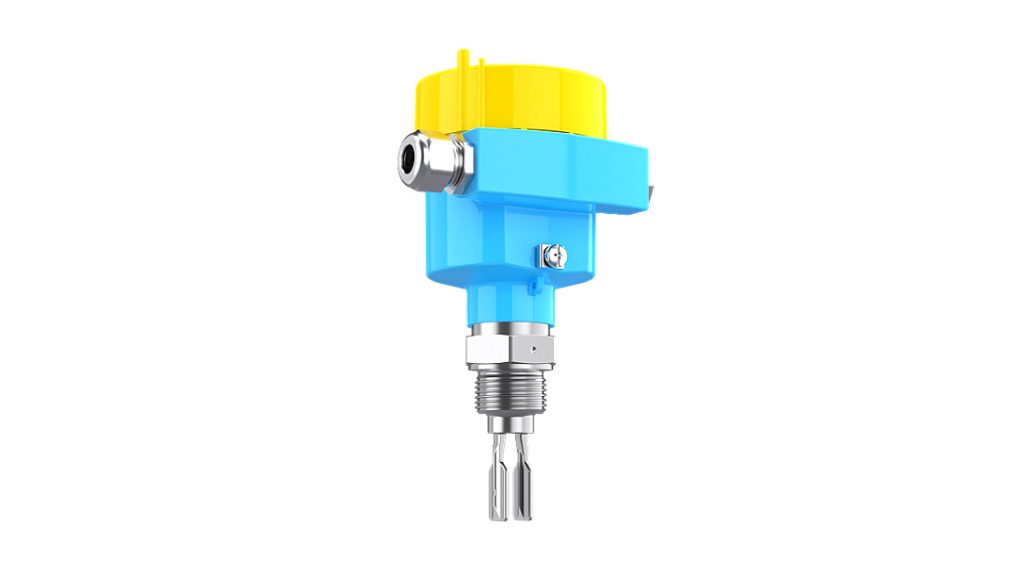
The precision-tuned Ring-11 can detect liquids with a density as low as 0.5 g/cm³. This range covers common ethanol products and medical alcohol solutions.
The low-density capability allows the same product series to be used for raw ethanol, diluted alcohol, blending solutions, and finished-product buffer tanks. It also reduces the need to readjust switch sensitivity when production changes between different alcohol concentrations.
4.2 Compact 40 mm Fork
The Ring-11 has a compact fork length of only 40 mm.
It can therefore be installed on small tanks, short nozzles, narrow pipes, and process equipment with limited internal space.
Compared with a long sensing fork, the short-fork design reduces the insertion depth and lowers the risk of interference with cleaning devices, agitators, inlet pipes, and other internal components.
This feature was particularly valuable for the filling buffer tanks. These vessels had limited capacity and densely arranged top connections. The short fork allowed installation without major modification of the original tank structure.
4.3 Hygienic Process Connection
A hygienic clamp-connection version was selected for the medical alcohol production line.
The wetted surface can achieve a roughness of Ra < 0.5 μm, while the fork and principal wetted components can be manufactured from 316L stainless steel.
The hygienic clamp connection facilitates removal, inspection, cleaning, and seal replacement. Its smooth wetted surfaces also help reduce the risk of liquid remaining on rough or difficult-to-clean areas.
Hygienic suitability should not be determined from surface roughness alone. Seal material, process connection design, cleaning-agent compatibility, cleaning temperature, installation orientation, and the manufacturer’s cleaning-validation procedures must also be considered.
4.4 Explosion-Proof and Functional-Safety Options
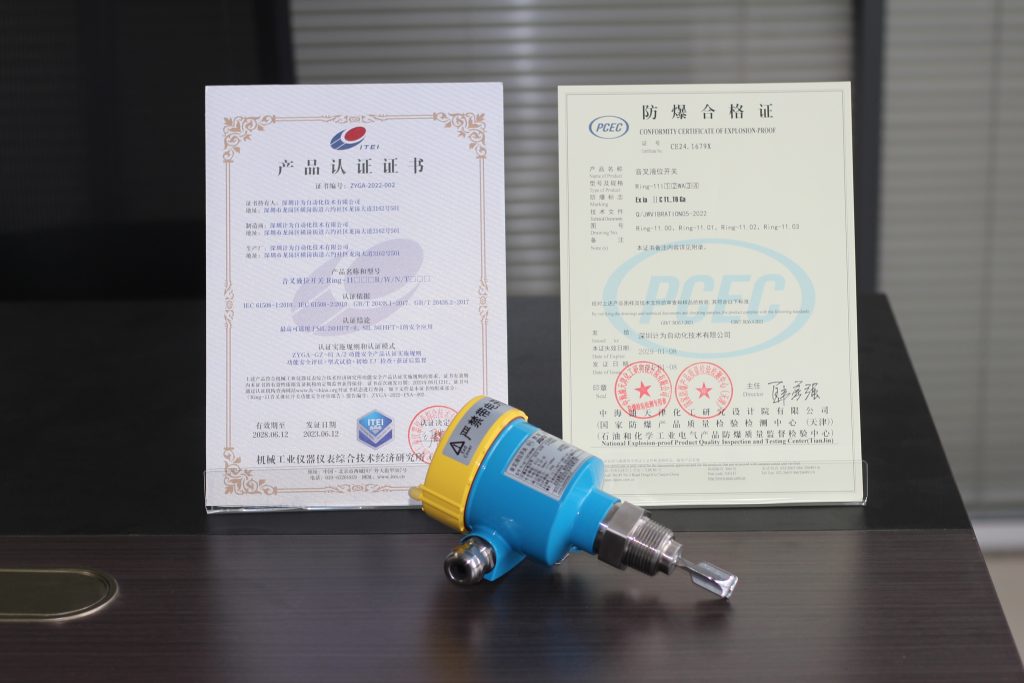
Because ethanol vapor may create a hazardous atmosphere, the project selected an appropriate intrinsically safe or flameproof configuration based on the hazardous-area classification.
The Ring-11 is available with explosion-protection options such as Ex ia intrinsic safety and Ex db flameproof protection. Configurations suitable for SIL 2 with HFT = 0 and SIL 3 with HFT = 1 functional-safety applications are also available.
For standard high-level alarms, relay or transistor outputs may be selected according to the control system.
A NAMUR output can be used where an intrinsically safe circuit and isolating barrier are required. A two-wire output may be suitable for applications that require simplified field wiring.
An explosion-proof certificate does not mean that every configuration is automatically suitable for every hazardous area.
The complete explosion-protection marking, gas group, temperature class, ambient-temperature range, process temperature, cable entry, enclosure type, wiring method, and safety-barrier parameters must be verified before installation.
4.5 Resistance to Foam, Bubbles, and Vibration
Alcohol and purified water are introduced into blending vessels and mixed through circulation or agitation. These processes may generate bubbles, surface turbulence, and limited foam.
The Ring-11 detects level through changes in fork vibration frequency. It can therefore provide stable point-level switching in the presence of moderate bubbles, foam, and mechanical vibration.
However, the switch should still be installed away from direct high-velocity inlet flow.
Resistance to process interference cannot compensate for an incorrect installation position.
5. Level-Control Arrangement for the Medical Alcohol Production Line
Based on the production process, Ring-11 tuning fork level switches were installed on four types of critical equipment.
5.1 High-High-Level Protection for the Ethanol Storage Tank
Raw ethanol is transferred into the storage tank from a road tanker or process transfer line.
The existing continuous level transmitter remains responsible for normal level indication, inventory monitoring, and routine inlet control.
A Ring-11 switch is installed near the maximum permissible filling level as an independent high-high-level protection device.
When the ethanol reaches the tuning fork, the switch immediately sends a signal to the PLC or safety-interlock circuit. The control system then performs the following actions:
- Stops the unloading or transfer pump;
- Closes the ethanol inlet valve;
- Activates the local audible and visual alarm;
- Displays a high-high-level alarm in the control room;
- Records the alarm time and equipment status.
This combination of continuous level measurement and independent point-level protection reduces the possibility that a single instrument fault could lead directly to tank overfilling.
5.2 High-Level Interlock for the Alcohol Blending Tank
In the blending vessel, ethanol and purified water are introduced according to the production formula and mixed to the required concentration.
Because the two liquids may be added in separate stages, a metering-valve fault, incorrect batch setting, or delayed manual response could cause the liquid to exceed the vessel’s safe operating level.
A Ring-11 switch is installed at the high-level position.
When the liquid reaches this point, the control system blocks further addition of ethanol and purified water and stops the associated transfer pumps.
The tuning fork switch only confirms whether the liquid has reached the installed level. It does not measure alcohol concentration.
Final ethanol concentration must still be verified using an online density meter, another concentration-analysis instrument, or laboratory testing. The level-switch signal must not be used as evidence that the alcohol concentration meets the product specification.
5.3 High- and Low-Level Control in the Intermediate Tank
Before filtration, blended medical alcohol may be temporarily stored in an intermediate vessel.
Two independent Ring-11 switches are installed on this tank.
The upper switch provides a high-level alarm and stops upstream transfer. The lower switch provides low-level protection.
When the liquid falls below the lower detection point, the system stops the downstream transfer pump to prevent prolonged dry running.
This high- and low-point arrangement keeps the intermediate vessel within a defined operating window and provides process buffering between upstream blending and downstream filtration.
Even if the continuous level signal drifts or becomes unavailable, the point-level switches can still provide basic overfill and dry-run protection.
5.4 Low-Level Protection in the Filling Buffer Tank
Filling equipment requires a relatively stable inlet pressure and continuous liquid supply.
If the buffer-tank level becomes too low, the filling pump may draw in air, causing filling-volume variation, bubbles in the piping, unstable operation, or filling-line shutdown.
A Ring-11 switch is installed at the low-level position of the buffer tank.
When the fork changes from the covered state to the uncovered state, the system issues a refill request.
If the liquid continues to fall to the low-low protection condition, the filling pump or the entire filling line is stopped.
The 40 mm short fork is particularly suitable for a compact filling buffer vessel with limited internal space and small process connections.
6. Installation Requirements
The performance of a tuning fork level switch depends not only on its technical specifications but also on its installation position and construction quality.
6.1 Keep the Fork Away from Inlet Flow
The fork should not be installed directly opposite the ethanol or purified-water inlet.
Continuous impact from a high-velocity liquid stream can cause signal fluctuations and unnecessary mechanical stress.
For side mounting, the fork surfaces should be aligned parallel to the main direction of liquid flow to reduce resistance and turbulence around the sensing element.
6.2 Determine the Alarm Height Correctly
The high-level installation point should not simply be placed as close as possible to the tank roof.
The design must allow sufficient safety space for continued inflow caused by liquid momentum, valve-closing time, pump stopping time, material remaining in the pipeline, foam, and process uncertainty.
The low-level switch should be positioned above the pump suction connection and the minimum safe operating level.
After a low-level alarm or shutdown signal is generated, sufficient liquid should remain to maintain an appropriate seal and allow the pump to stop safely.
6.3 Install Hygienic Seals Correctly
Before installing the clamp connection, the seal should be checked for compatibility with ethanol, product additives, cleaning agents, and process temperature.
The gasket must not be twisted, damaged, incorrectly seated, or used beyond its recommended service life.
After installation, the connection should be inspected for leakage, gaps, uneven clamping, and areas that may be difficult to clean.
6.4 Complete Wiring According to Explosion-Proof Requirements
Hazardous-area installation must use suitable cable glands, grounding methods, seals, barriers, and explosion-protected accessories.
When an intrinsically safe output is selected, the associated isolating barrier must comply with the required circuit parameters.
When a flameproof enclosure is used, maintenance personnel must not damage flame paths or replace cable-entry components with unapproved parts.
The Ring-11 can be supplied with relay, two-wire, NAMUR, NPN, or PNP outputs.
The output should be selected according to the PLC input module, safety-circuit design, power supply, cable distance, and hazardous-area requirements rather than wiring convenience alone.
7. Commissioning and Interlock Testing
After installation, the project team tested the switches using actual liquid immersion and removal.
Holding the fork by hand, covering it with a solid object, or using another unsuitable method may not accurately reproduce the instrument’s response to a liquid.
The commissioning procedure included the following steps.
First, with the fork uncovered, the team confirmed the indicator status and output-contact condition.
Second, liquid was slowly introduced into the tank or a suitable test vessel until the fork was fully immersed. The switching output was then checked.
Third, the liquid level was lowered to confirm that the instrument returned to its normal uncovered state after the fork emerged from the liquid.
Finally, the complete PLC interlock sequence was simulated. The team verified inlet-valve closure, pump shutdown, alarm indication, event recording, and status feedback.
The nominal switching delay of the Ring-11 is approximately 0.5 seconds when the fork becomes covered and approximately 1 second when it becomes uncovered.
The PLC program included appropriate interlock delays and signal confirmation to prevent repeated actions caused by momentary valve movement, liquid sloshing, or electrical signal disturbance.
High-high-level and low-low-level protection were designed using a fail-safe philosophy.
A loss of power, broken cable, or abnormal instrument condition should drive the process toward a predefined safe state rather than continue allowing filling or pumping.
8. Benefits of the Completed Solution
After Ring-11 tuning fork level switches were installed, the medical alcohol production line gained a combined protection structure consisting of continuous level measurement and independent point-level switching.
8.1 Improved Overfill Protection
The ethanol storage and blending tanks gained independent high-high-level interlocks.
When the liquid reaches a hazardous position, the system can stop filling before alcohol overflows, helping reduce material loss, surface contamination, and the release of flammable vapor.
8.2 Better Pump Protection
Low-level signals from the intermediate and filling buffer tanks can stop transfer and filling pumps before prolonged dry running occurs.
This helps reduce air intake, unstable flow, pump wear, pipeline bubbles, and interruption of the filling process.
8.3 Hygienic Process Integration
The hygienic clamp connection, 316L wetted parts, and Ra < 0.5 μm surface finish make the instrument suitable for equipment that requires regular removal, inspection, and cleaning.
8.4 Easier Automation Integration
Multiple output options allow the switch to connect to a PLC, DCS, independent alarm circuit, safety barrier, or safety-control system.
A single switching signal can be used for a control-room alarm and can also participate in valve, pump, and filling-line interlocking.
8.5 Reduced Routine Maintenance
The tuning fork design contains no moving float and does not require continuous-range calibration.
Routine maintenance mainly involves checking the fork for deposits or physical damage, confirming that electrical connections remain secure, inspecting the hygienic seal, and testing the complete interlock function.
9. Recommended Maintenance Practices
Although medical alcohol is generally a clean liquid, the tuning fork switch should still be included in the plant’s preventive-maintenance program.
During each scheduled shutdown, the fork should be inspected for product residue, mechanical damage, scratches, collision marks, or deformation.
Hard tools should not be used to strike or scrape the fork because they may damage the polished surface or alter the mechanical characteristics of the sensing element.
The hygienic clamp, gasket, and wetted connection should be checked regularly.
Any seal that has swollen, hardened, cracked, lost elasticity, or reached the end of its recommended service life should be replaced.
The enclosure, cable entry, grounding terminal, and external wiring should also be inspected to ensure that maintenance work has not compromised the ingress-protection or explosion-protection integrity.
High-high-level and low-low-level interlocks should undergo periodic proof testing in accordance with the plant’s safety-management procedures.
The test should not stop at confirming that the level switch changes state. It should verify the complete safety-action chain, including:
- Level-switch output;
- PLC or safety-system input;
- Control-room alarm;
- Local alarm;
- Valve closure;
- Pump shutdown;
- Filling-equipment response;
- Event recording.
If the process medium, ethanol concentration, cleaning method, process temperature, installation orientation, or tank structure changes, the material compatibility and selection conditions should be reviewed again.
10. Selection Guide for Medical Alcohol Level Switches
When selecting a tuning fork level switch for medical alcohol production, the following factors should be reviewed.
| Selection Item | Recommended Consideration |
|---|---|
| Process medium | Anhydrous ethanol, ethanol-water mixture, or disinfectant containing additives |
| Minimum liquid density | Must be below the actual liquid density with a suitable operating margin |
| Wetted material | Confirm compatibility with ethanol, additives, and cleaning chemicals |
| Surface finish | Hygienic applications should consider roughness and structural dead zones |
| Process connection | A hygienic clamp connection simplifies removal and cleaning |
| Explosion protection | Select intrinsic safety or flameproof protection according to area classification |
| Output signal | Relay, two-wire, NAMUR, NPN, or PNP |
| Installation method | Confirm side mounting, top mounting, insertion length, and nozzle dimensions |
| Fail-safe logic | Define high-level, low-level, power-loss, and cable-fault states |
| Interlocked equipment | Inlet valves, transfer pumps, alarms, and filling equipment |
The Ring-11 can detect liquids with a density as low as 0.5 g/cm³, uses a compact 40 mm fork, offers hygienic surfaces with a roughness of Ra < 0.5 μm, and supports multiple output and explosion-protection configurations.
These characteristics make it suitable for point-level detection in medical alcohol storage, blending, transfer, filtration, and filling processes.
11. Frequently Asked Questions
11.1 Can the Ring-11 Measure the Continuous Level of Medical Alcohol?
No.
The Ring-11 is a point-level switch. It determines whether liquid is present or absent at a fixed position.
A radar level transmitter, weighing system, or another continuous level instrument is required when the tank level must be displayed continuously.
11.2 Can a Tuning Fork Level Switch Measure Alcohol Concentration?
No.
A tuning fork level switch detects whether the fork is covered by liquid. It does not determine ethanol concentration.
Alcohol concentration should be measured using density, refractive-index, near-infrared, laboratory, or other appropriate analytical methods.
11.3 Can Foam Cause a False Alarm?
A tuning fork level switch generally performs well in the presence of bubbles and moderate foam.
However, foam characteristics vary significantly.
If a process produces persistent, dense, or conductive foam, a practical media test should be performed to determine whether the switch responds to the foam or to the actual liquid.
11.4 Must Medical Alcohol Tanks Use Explosion-Proof Level Switches?
The requirement depends on alcohol concentration, ventilation, equipment structure, and hazardous-area classification.
When the installation point is classified as an explosive-gas hazardous area, the switch, wiring, cable glands, barriers, and accessories must comply with the applicable explosion-protection requirements.
11.5 Why Is a Continuous Level Transmitter Still Needed?
A continuous level transmitter is used for process monitoring, inventory management, batch control, and normal operating control.
A tuning fork level switch is used for critical point alarms and safety interlocks.
The two instruments perform different functions. Using them together improves the reliability and independence of the level-protection system.
12. Conclusion
Level detection in medical alcohol production affects more than material measurement and production continuity. It directly influences ethanol-tank overfill prevention, transfer-pump protection, filling stability, hygienic operation, and hazardous-area safety.
The Ring-11 tuning fork level switch uses vibration-frequency detection and offers a compact 40 mm fork, reliable low-density liquid detection, hygienic clamp connections, multiple output options, and intrinsically safe or flameproof configurations.
It is suitable for high- and low-level detection in ethanol raw-material tanks, medical alcohol blending tanks, intermediate storage vessels, and filling buffer tanks.
In practical applications, instrument selection, explosion-protection design, hygienic connection, mounting position, output signal, and PLC interlock logic should be considered as one complete system.
Only when the switch is correctly matched to the process conditions, installed in accordance with applicable requirements, and periodically function-tested can it provide effective overfill prevention, dry-run protection, and long-term production safety.