1. Why Does the Marine Industry Need Reliable Radar Level Meters?
With the rapid development of smart ports, intelligent shipping, cross-sea transportation projects, marine ranching, offshore wind power, and marine environmental monitoring, the marine industry has increasingly high requirements for liquid level, water level, and material level measurement. Whether it is tide level monitoring at ports and terminals, seawater level monitoring for cross-sea bridges, liquid level measurement in ship fuel tanks, ballast water tanks, and freshwater tanks, or storage tank monitoring on offshore platforms, stable, continuous, and accurate level data is essential.
Marine environments are very different from ordinary industrial sites. Offshore and coastal areas are exposed to high salt mist, high humidity, strong winds, waves, tidal changes, ultraviolet radiation, equipment vibration, and complex electromagnetic conditions for long periods. Traditional contact-type level instruments are easily affected by seawater corrosion, marine organism attachment, probe contamination, mechanical wear, and difficult maintenance. These problems may lead to measurement drift, unstable signals, or even equipment failure. For long-term unattended marine monitoring stations, frequent maintenance not only increases operating costs but also brings higher safety risks for field personnel.
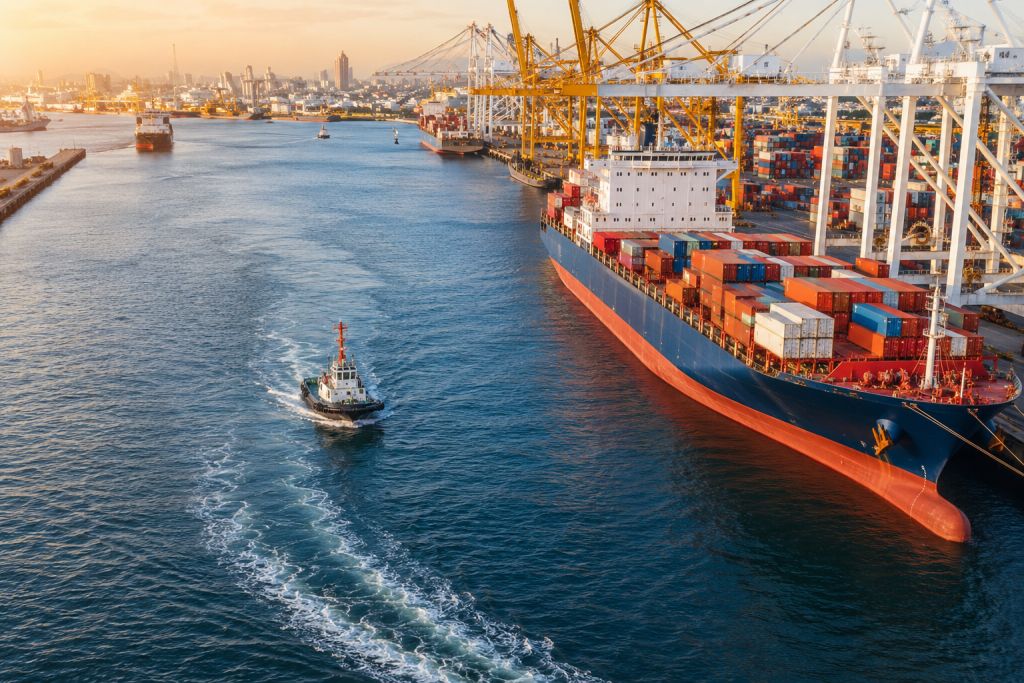
Radar level meters have become an important choice for liquid level and water level measurement in the marine industry due to their non-contact measurement, high accuracy, high reliability, and low maintenance requirements. In particular, 80GHz high-frequency radar level meters feature a narrower beam angle, more concentrated energy, and stronger anti-interference capability, making them suitable for stable measurement in conditions involving fluctuating sea surfaces, limited installation space, and complex structural environments.
2. Working Principle of Radar Level Meters
A radar level meter usually emits high-frequency electromagnetic waves toward the measured liquid surface through an antenna. When the electromagnetic waves reach the liquid surface, reflected echoes are generated. The instrument receives the echoes and calculates the distance from the radar antenna to the liquid surface based on the signal travel time or frequency difference. The liquid level or water level is then calculated according to the installation height.
Compared with contact-type measurement methods such as float level meters, pressure level transmitters, and submersible water level sensors, radar level meters do not need to come into direct contact with seawater, oil, or chemical liquids. This effectively reduces the influence of corrosion, scaling, adhesion, contamination, and mechanical wear. Radar level meters can be selected and installed according to different site conditions for various media, including seawater, rainwater, wastewater, fuel oil, lubricating oil, ballast water, and fire water.
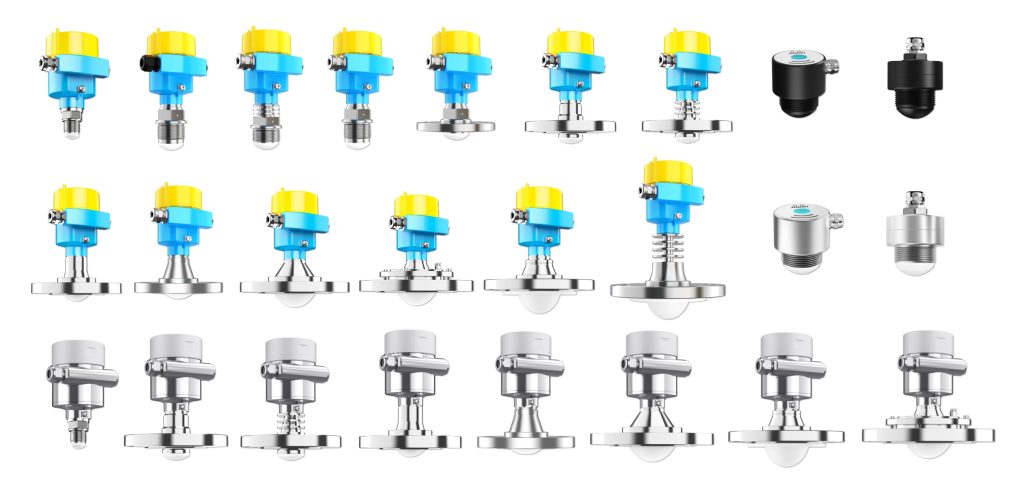
Jiwei Automations radar level meters adopt 80GHz high-frequency radar technology and integrate intelligent echo learning, adaptive algorithms, false echo identification, multi-layer echo separation, and dynamic target tracking. These functions enable the instrument to continuously output stable and reliable level data under complex operating conditions. Such technical features are highly suitable for the marine industry’s requirements for safety, stability, and long-term operation.
3. Main Applications of Radar Level Meters in the Marine Industry
3.1 Seawater Level Monitoring
Seawater level monitoring is one of the typical applications of radar level meters in the marine industry. Coastal areas, cross-sea bridges, ports, terminals, breakwaters, seawalls, sluice gates, and marine observation stations all need real-time monitoring of sea level changes. Tides, typhoons, storm surges, and heavy rainfall can cause rapid water level fluctuations. Without continuous and reliable monitoring data, shipping dispatch, disaster warning, and infrastructure safety management may be affected.
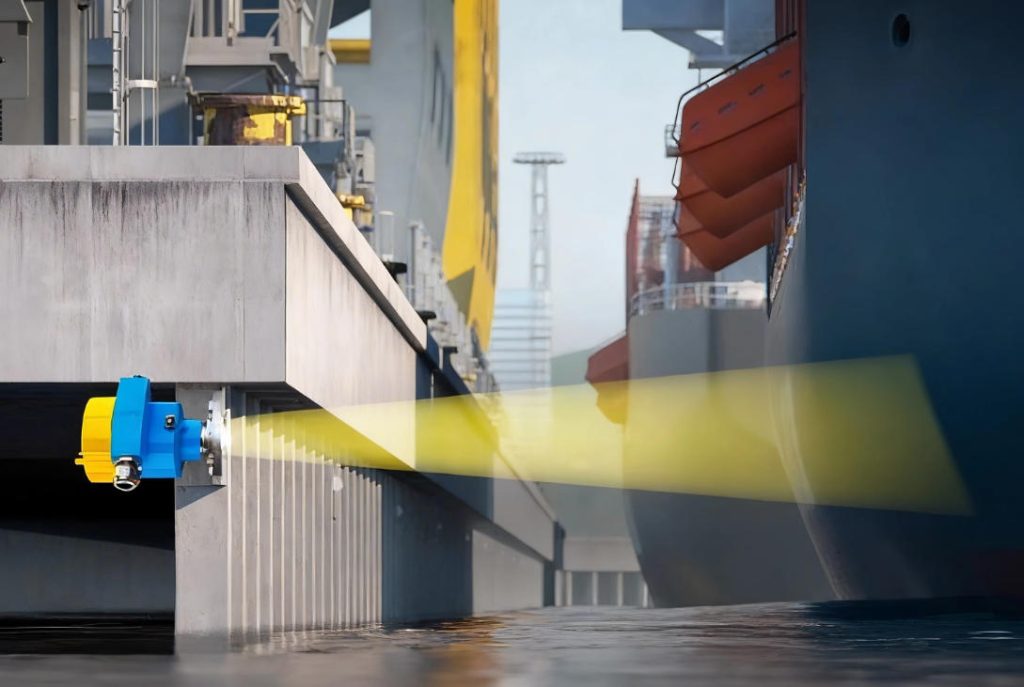
Radar level meters can be installed on bridge guardrails, terminal platforms, monitoring brackets, or shore-based monitoring stations, with the sensor directed toward the sea surface for non-contact measurement. Since the instrument does not come into contact with seawater, it can avoid seawater corrosion and marine organism attachment. For seawater level monitoring systems that require long-term online operation, radar level meters can significantly reduce maintenance frequency and improve data continuity.
In cross-sea bridge applications, radar level meters can provide real-time water level data for bridge operation and maintenance, disaster prevention, meteorological warning, and intelligent transportation systems. By connecting to PLC, SCADA, DCS, or smart management platforms, operators can remotely view water level trends and build long-term historical databases, providing a basis for safety assessment and emergency decision-making.
3.2 Tide Level Monitoring at Ports and Terminals
Ports and terminals are among the most demanding marine scenarios for level measurement. Vessel berthing, loading and unloading operations, channel navigation, terminal dispatching, and flood and tide control all require accurate tide and water level data. Traditional manual observation or contact-type water level meters require higher maintenance in port environments with high salt mist, high humidity, and wave impact, while radar water level meters can provide all-weather automatic monitoring.
Radar level meters are flexible to install and can be mounted on brackets, guardrails, or platforms according to terminal structures. 80GHz high-frequency radar has a small beam angle, which helps reduce interference from surrounding steel structures, fenders, cables, vessels, and terminal facilities, thereby improving measurement stability. For modern smart ports, radar level meters are not only measuring devices but also important data entry points for digital port management systems.
3.3 Liquid Level Measurement on Ships
In the shipbuilding and marine transportation industry, fuel tanks, diesel tanks, lubricating oil tanks, freshwater tanks, wastewater tanks, ballast water tanks, and chemical storage tanks all require liquid level monitoring. During ship operation, factors such as rolling, vibration, temperature changes, and liquid surface fluctuation are common, so level instruments must have strong anti-interference capability and long-term stability.
Radar level meters use non-contact measurement, reducing the influence of medium corrosion and adhesion on the instrument. For fuel oil and lubricating oil, radar level meters can reduce the failure risk caused by mechanical moving parts. For ballast water and wastewater, they can reduce scaling, contamination, and maintenance difficulty. Through 4-20mA, HART, RS485/Modbus, and other signal outputs, radar level meters can be connected to ship automation systems for centralized monitoring and alarm linkage.
In ship tank level management, accurate level data contributes to fuel management, load balance, safe operation, and overflow protection. Compared with manual gauging or traditional mechanical instruments, radar level meters are more suitable for the automation, digitalization, and safety requirements of modern vessels.
3.4 Storage Tank Monitoring on Offshore Engineering Platforms
Offshore platforms, marine engineering vessels, offshore wind power operation and maintenance platforms, and marine energy facilities are usually equipped with fuel tanks, freshwater tanks, wastewater tanks, chemical dosing tanks, fire water tanks, and process liquid storage tanks. These sites have extremely high requirements for equipment reliability. Inaccurate level measurement may affect production operation, environmental discharge, and safety management.
Radar level meters are suitable for high-humidity, high-salt-mist, strong-wind, and vibrating environments. They can provide continuous level measurement from the top of storage tanks. Some radar level meters are designed with high-protection housings to withstand harsh outdoor environments. For offshore platforms with limited space, compact radar level meters are easier to install and can reduce the impact on tank structures and maintenance passages.
3.5 Marine Environmental Protection and Wastewater Treatment
Coastal wastewater treatment stations, ship wastewater collection systems, port rainwater and wastewater pumping stations, and marine environmental monitoring stations also require level monitoring for water pools, collection wells, chemical dosing tanks, wastewater tanks, and discharge systems. Wastewater environments often contain foam, odors, corrosive gases, and contaminants, which can easily pollute or damage contact-type instruments.
Radar level meters do not contact the medium and are less affected by wastewater contamination and corrosion. They are suitable for level measurement in open water pools, pumping stations, open channels, and storage tanks. By setting high and low level alarms, the system can realize automatic pump start-stop control, overflow prevention, and remote warning, improving the operating efficiency of port environmental protection facilities.
4. Core Advantages of Radar Level Meters in the Marine Industry
4.1 Non-Contact Measurement to Avoid Seawater Corrosion
Seawater has a high salt content and is highly corrosive to metal components. Traditional contact-type level instruments are immersed in seawater for long periods and are prone to corrosion, aging, and attachment. Radar level meters are installed above the liquid surface and use electromagnetic waves for measurement without contacting seawater or the measured medium. This fundamentally reduces the impact of corrosion and contamination.
4.2 High-Accuracy Measurement for Dynamic Water Level Monitoring
Marine water levels are affected by tides, waves, air pressure, and currents, and the liquid surface is often in a dynamic state. High-frequency radar level meters have strong signal processing capability. They can identify real liquid surface echoes and filter short-term fluctuations through algorithms, making the output data more stable. For tide level monitoring, bridge water level monitoring, and port dispatching, high-accuracy and continuous level data is critical.
4.3 Strong Anti-Interference Capability for Complex Marine Environments
Marine sites usually include steel structures, guardrails, brackets, vessels, bridge piers, waves, and vibration interference. 80GHz radar level meters feature a small beam angle and concentrated signals, making it easier to avoid interference from surrounding structures and obtain stable echoes in limited installation spaces. Intelligent echo processing technology can also identify false echoes and improve measurement reliability under complex conditions.
4.4 Flexible Installation for Space-Limited Sites
Ports, ships, bridges, and offshore platforms often have limited installation space. Compact radar level meters can be installed with threaded connections, brackets, or flanges, requiring minimal site modification. For bridge guardrails, maintenance passages, terminal edges, and small tanks, compact design can reduce installation difficulty and improve engineering adaptability.
4.5 Low Maintenance to Reduce Long-Term Operating Costs
Marine monitoring points are often widely distributed, and field maintenance costs are high. Since radar level meters have no mechanical moving parts, no contact with the medium, and little wear, their maintenance requirements are significantly lower than those of contact-type instruments. For high-altitude bridges, port edges, offshore platforms, and other difficult-to-maintain sites, low maintenance can reduce manual inspection frequency, lower operating costs, and reduce safety risks.
4.6 Support for Remote Monitoring and Intelligent Management
The modern marine industry is moving toward digitalization and intelligence. Radar level meters can be connected to automation control systems through 4-20mA, HART, RS485/Modbus, and other communication methods. They can also support wireless commissioning, remote monitoring, and cloud-based management, enabling centralized data acquisition, remote diagnosis, and alarm linkage. This advantage is especially important for smart ports, smart bridges, and smart ocean systems.
5. Jiwei Radar Level Meters Provide Reliable Measurement Solutions for the Marine Industry
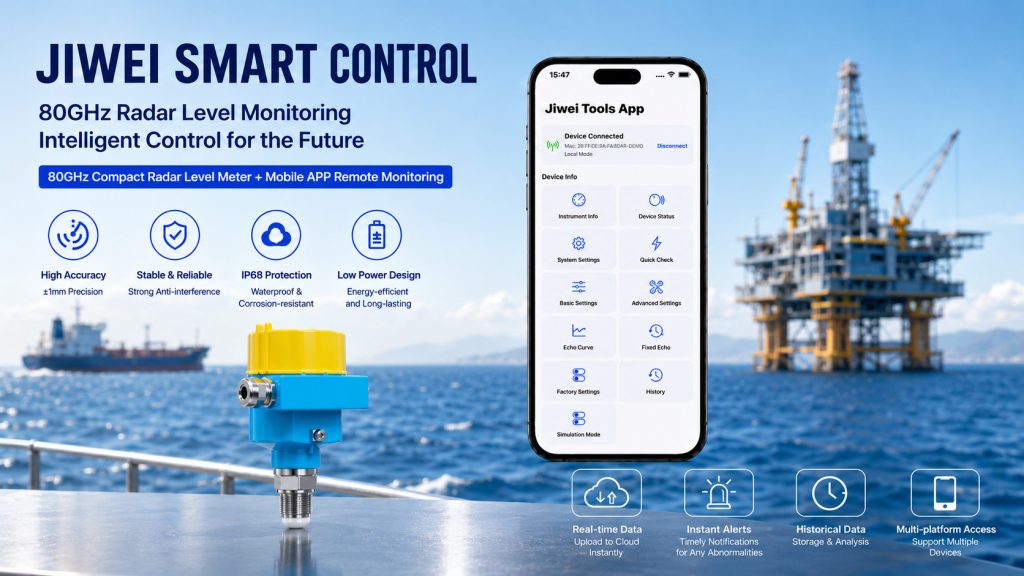
Jiwei Automations has long focused on the research, development, and application of level measurement instruments. Its radar level meter products are widely used in hydrology and water affairs, industrial storage tanks, energy, environmental protection, and other scenarios. For the marine industry, Jiwei radar level meters can be applied to seawater level monitoring, port and terminal tide level monitoring, cross-sea bridge water level monitoring, ship tank level measurement, offshore platform tank monitoring, and environmental water treatment systems.
Jiwei JWrada series radar level meters adopt 80GHz high-frequency radar technology and feature non-contact measurement, high accuracy, small beam angle, easy installation, simple commissioning, and stable operation. Some products support Bluetooth wireless commissioning, allowing field personnel to set parameters, view echoes, and perform fault diagnosis through mobile tools. This reduces the need to open the instrument cover and shortens working time at heights. Intelligent echo algorithms help the instrument adapt to waves, structural interference, and complex liquid surface changes, providing stable and reliable level data for the marine industry.
In seawater monitoring projects, radar level meters can operate for long periods under the challenges of high salt mist, high humidity, strong ultraviolet radiation, and harsh weather. Non-contact measurement avoids seawater corrosion and marine organism attachment. Compact structure facilitates installation on bridges, terminals, and shore-based monitoring points, while remote data access supports centralized management of marine monitoring systems.
6. Key Factors When Selecting Radar Level Meters for the Marine Industry
When selecting radar level meters for marine applications, users should consider actual operating conditions and pay attention to the following factors. First, confirm the measuring distance and installation height, and select the appropriate range. Second, check the instrument’s protection rating and weather resistance to ensure suitability for high-salt-mist, high-humidity, and outdoor environments. Third, evaluate whether there are bridge structures, guardrails, steel components, waves, or vessel interference at the site, and prioritize high-frequency radar products with small beam angles and strong echo processing capability. Fourth, confirm whether the signal output method matches the site control system, such as 4-20mA, HART, or RS485/Modbus. Fifth, consider installation methods and later maintenance convenience. For high-altitude, coastal, and unattended scenarios, products with convenient commissioning and low maintenance requirements are preferred.
For hydrological and seawater level monitoring applications, compact, low-power radar water level meters with remote monitoring capability can be selected. For ship and offshore platform storage tanks, selection should be based on medium characteristics, tank structure, temperature and pressure, installation space, and protection requirements. For ports, terminals, and cross-sea bridges, anti-wave performance, anti-interference capability, and long-term operational stability should be key considerations.
7. Conclusion
The marine industry has complex operating environments and higher requirements for level measurement equipment. Radar level meters, with their advantages of non-contact measurement, high accuracy, corrosion resistance, anti-interference performance, flexible installation, low maintenance, and remote monitoring, are playing an increasingly important role in seawater level monitoring, ports and terminals, cross-sea bridges, ship tanks, offshore engineering platforms, and environmental water treatment.
As smart ocean, smart port, and digital marine infrastructure continue to develop, stable and reliable level data will become an important foundation for safe operation, risk warning, and intelligent decision-making. Jiwei Automations radar level meters, integrating 80GHz high-frequency radar technology, intelligent echo processing, and convenient commissioning methods, can provide more efficient, reliable, and low-maintenance liquid level and water level measurement solutions for marine industry users.