In detergent manufacturing, storage tanks and transfer systems are widely used throughout the production process, from storing surfactants, additives, and other raw materials to mixing, blending, and finished-product storage. To maintain continuous production and ensure equipment safety, reliable high- and low-level detection is essential.
A high-level switch is typically used for overfill prevention, while a low-level switch can provide low-level alarms and help protect transfer pumps against dry running.
However, detergent level detection can be more challenging than measuring ordinary water-based liquids. Laundry detergents, cleaning agents, and concentrated detergent products may have relatively high viscosity. They can also generate significant foam and entrained air during filling, agitation, and circulation.
If a level switch is highly sensitive to foam, buildup, or surface turbulence, false alarms and unstable switching signals may occur.
For these applications, the Ring-11 tuning fork level switch, which detects point level based on changes in vibration frequency, provides a practical solution for high-level alarms, overfill prevention, low-level detection, and pump protection in detergent tanks.
Challenges of Level Detection in Detergent Storage Tanks
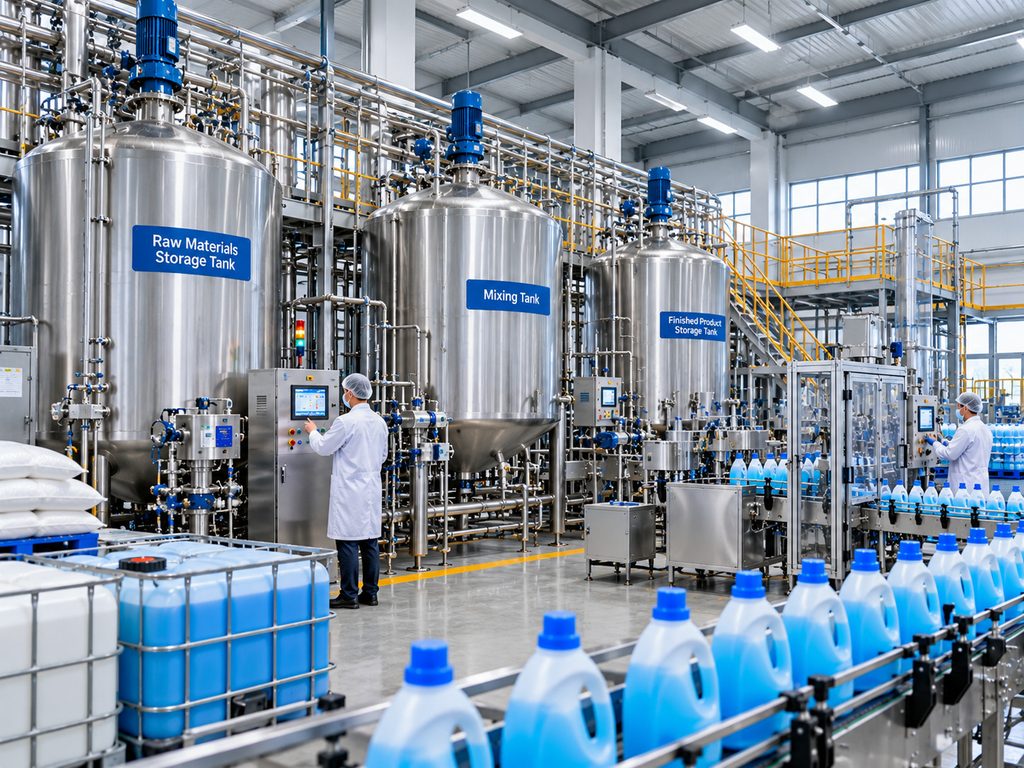
Consider a typical household and industrial detergent production line equipped with raw-material tanks, blending tanks, and finished-product storage tanks.
After formulation and mixing, the detergent is transferred by pump to a storage tank before being sent to a filling line or the next production stage.
To prevent tank overfilling during product transfer, an independent high-level switch is installed near the upper section of the tank. At the same time, a low-level detection point may be required near the bottom of the tank. When the liquid level drops below this point, the switch can trigger an alarm or stop the transfer pump to prevent dry running.
Several characteristics of detergents make reliable point-level detection more demanding.
The first challenge is foam.
Detergents contain surfactants, and significant foam can be generated during filling, agitation, and circulation. For some measurement technologies that depend heavily on electrical properties or buoyancy, foam may complicate the distinction between the actual liquid level and the foam layer.
The second challenge is viscosity.
Some concentrated detergents have relatively poor fluidity and may leave deposits on the sensing element. If the level switch is installed incorrectly, long-term buildup can affect reliable operation.
The third challenge is surface turbulence.
During filling and agitation, the actual liquid surface is rarely completely stable. A level detection device with insufficient resistance to process disturbances may repeatedly switch between states, causing unstable signals and potentially interfering with PLC control logic.
For these reasons, the primary requirement in many detergent storage applications is not continuous level measurement. Instead, the system needs to reliably determine whether liquid is present or absent at a specific point and transmit that status to the control system.
Solution: Ring-11 Tuning Fork Level Switch for High and Low Level Detection
Considering the tendency of detergents to foam and their potentially high viscosity, the Ring-11 vibrating fork level switch can be used as a point-level detection device in detergent storage tanks.
The Ring-11 operates according to the vibration principle.
A piezoelectric element drives the fork into vibration. When the vibrating fork is in air, it oscillates at its characteristic resonant frequency. When the detergent rises and covers the fork, the resonant frequency changes significantly. The electronics detect this frequency change and convert it into a switching signal.
An important advantage of this measurement principle is that detection is based on the change in vibration characteristics rather than solely on the liquid’s conductivity, dielectric constant, or buoyancy.
As a result, the Ring-11 offers strong resistance to interference from foam, bubbles, viscous liquids, and process vibration, making it suitable for many detergent applications.
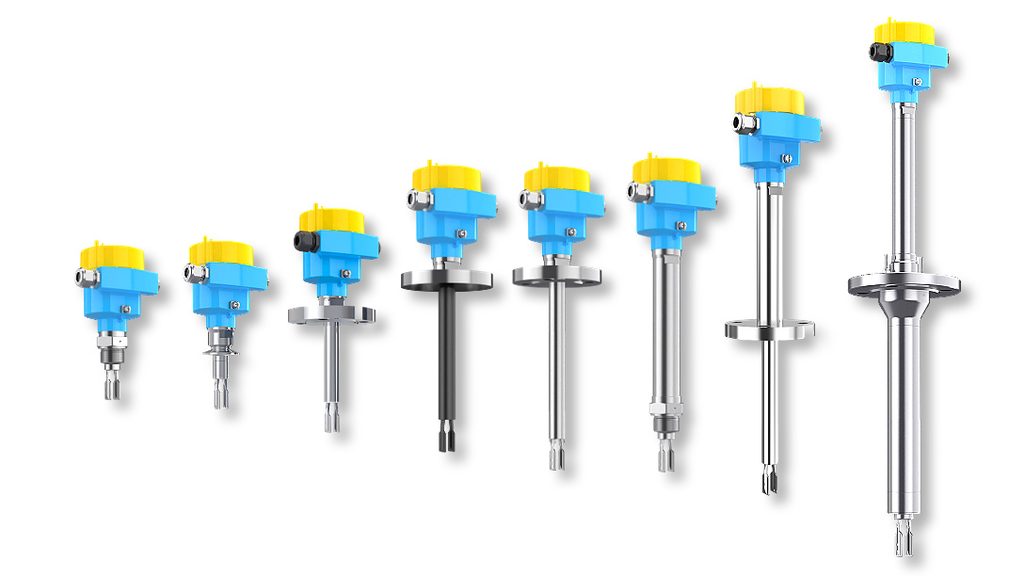
The Ring-11 features a compact 40 mm fork length, allowing installation on tank walls, tank tops, and certain pipelines where installation space is limited.
It can detect liquids with densities as low as 0.5 g/cm³, providing a broad application range for common detergents, cleaning solutions, and other liquid products.
High-Level Overfill Protection for Detergent Tanks
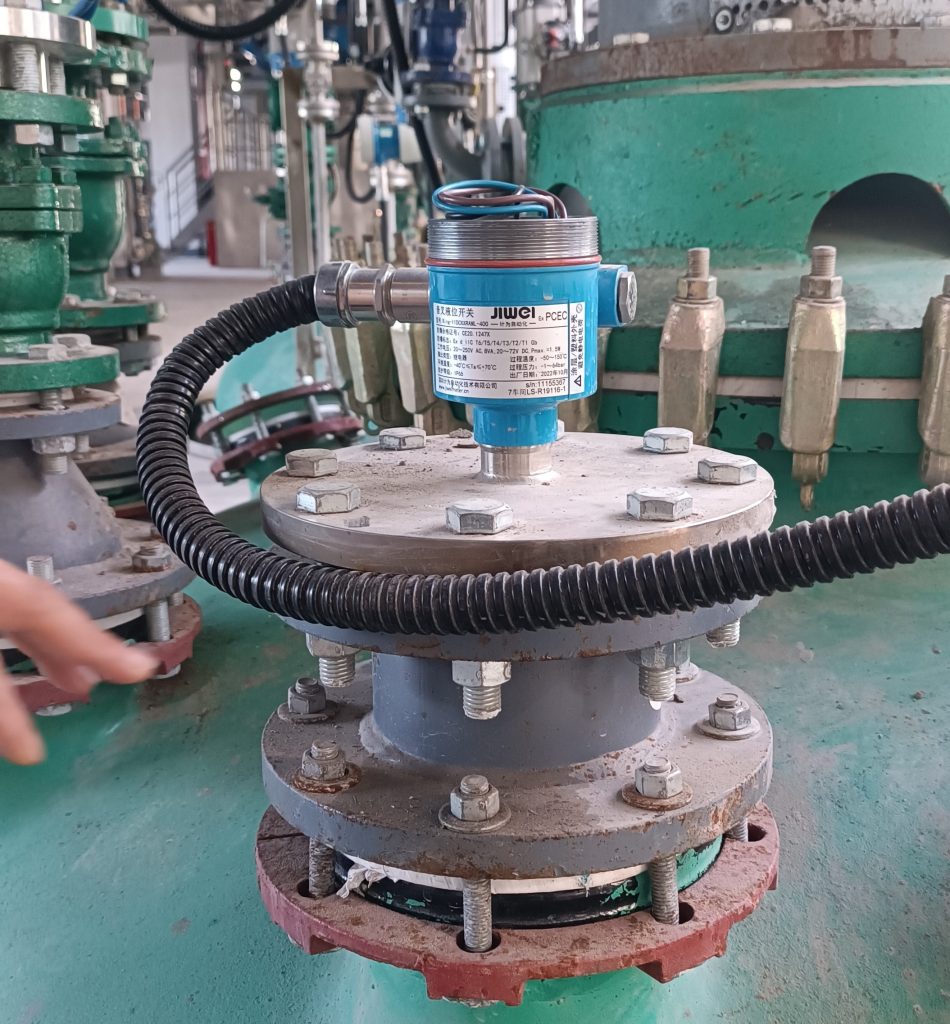
For overfill protection, a Ring-11 tuning fork level switch can be installed near the maximum permitted liquid level of the detergent storage tank and configured for high-level detection.
During normal production, the liquid level remains below the switch.
As the tank is filled and the detergent reaches the vibrating fork, the resonant frequency changes. The electronics detect this change and immediately generate a switching signal.
This signal can be connected to a PLC, DCS, alarm system, or interlock circuit. Depending on the process control strategy, the high-level signal can be used to activate an audible or visual alarm, close an inlet valve, or stop the filling pump.
Compared with relying only on the displayed value of a continuous level transmitter, an independent point-level switch provides a clearly defined limit detection point.
In highly automated detergent production facilities, this independent high-level switch can therefore serve as an important field instrument in the tank overfill protection system.
Low-Level Detection and Pump Dry-Run Protection
In addition to high-level detection, the Ring-11 can be installed near the lower section of a detergent storage tank for low-level alarms and pump dry-run protection.
When sufficient detergent remains inside the tank, the vibrating fork is covered by the liquid.
As detergent continues to be transferred out of the tank, the liquid level eventually falls below the fork. The resulting change in vibration condition is detected by the electronics, and the level switch generates the corresponding output signal.
After receiving the low-level signal, the control system can issue a refill warning or stop the transfer pump according to the programmed control logic.
This arrangement is particularly suitable for detergent raw-material tanks, finished-product tanks, intermediate storage vessels, and pump protection applications.
By using separate high- and low-level detection points, the system can provide protection against both overfilling and excessive emptying, creating a more complete tank level control strategy.
Why Is the Ring-11 Suitable for Detergent Level Detection?
Selecting a level switch for detergent applications requires more than simply considering the measuring range. Foam, viscosity, installation space, wetted materials, process temperature, and control system compatibility must all be evaluated.
The Ring-11 can detect liquids with densities as low as 0.5 g/cm³.
For liquids with a density of 1 g/cm³, the applicable viscosity range can reach 0.1 to 10,000 mPa·s, enabling the switch to handle a wide variety of liquid applications.
Its vibration-based measurement principle also provides strong resistance to interference caused by foam, bubbles, viscous liquids, and process vibration. These characteristics correspond well with the typical operating conditions found in detergent manufacturing and storage.
Material compatibility is another important consideration.
Depending on the specific configuration, the process connection and vibrating fork can be manufactured from 316L stainless steel, Hastelloy C-22, or materials with ECTFE or PFA coatings.
If the detergent formulation contains strong acids, alkalis, or other corrosive ingredients, the wetted material should be selected according to the chemical composition, concentration, temperature, and material compatibility requirements. A configuration suitable for ordinary water-based liquids should not automatically be assumed to be suitable for highly corrosive detergent formulations.
The Ring-11 is also available with different output options, including relay, two-wire, NAMUR, and transistor outputs, allowing integration with PLCs, DCS systems, safety barriers, and other control equipment.
Installation Guidelines for Detergent Applications
For viscous and foaming liquids such as detergents, correct installation is just as important as selecting the appropriate instrument.
For high-viscosity products, a vertical installation should be considered where appropriate to help reduce material buildup on the vibrating fork.
The orientation of the fork should also take the direction of liquid movement into account. Proper orientation can reduce resistance to the process flow and minimize the possibility of product accumulation around the sensing element.
The level switch should also be installed away from the tank inlet whenever possible.
When detergent enters a storage tank at relatively high velocity, the incoming stream can directly impact the vibrating fork while simultaneously generating significant foam and surface turbulence. Installing the level switch directly in this area may result in unstable switching behavior and unnecessary mechanical stress.
For high-level detection, the mounting height should be determined according to several factors, including the tank’s maximum allowable operating level, alarm response time, filling rate, and the amount of residual product that may continue flowing through the pipeline after the filling pump or inlet valve has been stopped.
Therefore, the high-level switch should not simply be installed as close to the tank roof as possible.
Similarly, the low-level switch position should be determined according to the pump suction point, tank-bottom geometry, and minimum safe operating level.
For highly concentrated detergents that tend to adhere to surfaces, the condition of the vibrating fork should also be checked as part of the normal maintenance schedule. If significant deposits are present, the fork should be cleaned to maintain reliable vibration characteristics.
Application Benefits
In detergent storage applications, the purpose of the Ring-11 is not necessarily to replace every continuous level transmitter. Instead, it provides a clear and reliable switching signal at critical level points.
At the high-level position, the switch can help prevent excessive filling and tank overflow.
At the low-level position, it can provide a low-level alarm and help protect transfer pumps against dry running.
Within an automated process control system, the Ring-11 can also be integrated with inlet valves, transfer pumps, audible and visual alarms, PLCs, and DCS systems to create automatic interlock functions.
For detergent applications where foam is frequently present, the vibration-based detection principle helps reduce the influence of foam, bubbles, and variations in the electrical properties of the liquid on point-level detection.
The compact 40 mm vibrating fork also reduces installation space requirements, allowing the switch to be used not only on storage tanks but also in certain pipelines and compact process vessels.
However, every level switch should be selected according to the actual process conditions.
Detergent formulations can vary considerably. Before selecting a specific configuration, users should confirm important process parameters such as liquid density, viscosity, temperature, pressure, corrosiveness, hazardous-area requirements, process connection, and required electrical output.
Frequently Asked Questions
1. Can a vibrating fork level switch be used when detergent produces a lot of foam?
Yes. The Ring-11 detects liquid level through changes in the vibration characteristics of the fork and offers strong resistance to interference from foam and bubbles.
However, the actual application should still take foam density, product buildup, and installation position into consideration. In particular, the switch should generally not be installed directly in the tank inlet area, where foam and turbulence are most severe.
2. How should the level switch be installed for highly viscous laundry detergent?
For viscous liquids that tend to adhere to surfaces, an installation orientation that allows the product to drain naturally from the fork is recommended. Vertical installation should be considered where suitable to minimize buildup.
The sensing fork should also be inspected periodically to ensure that long-term product accumulation does not affect its operation.
3. Can one Ring-11 detect both high and low liquid levels?
A point-level switch detects the liquid condition at one defined installation position.
If a storage tank requires both high-level overfill protection and low-level pump protection, separate level switches are normally installed at the corresponding high and low positions. Each switch can then be configured according to the required high- or low-level operating mode.
4. How should the Ring-11 be selected for corrosive detergents?
The chemical composition, concentration, process temperature, and pressure of the detergent should first be confirmed.
The appropriate wetted materials can then be selected according to chemical compatibility requirements. In addition to 316L stainless steel, Ring-11 configurations may include Hastelloy C-22 or ECTFE/PFA-coated options.
For strongly corrosive applications, final material selection should always be based on the actual chemical compatibility of the process medium.
Conclusion
Detergent tank level detection may appear straightforward, but foam, bubbles, viscosity, product buildup, and surface turbulence can all make reliable detection more difficult.
In automated filling, transfer, and continuous production systems, a stable high- or low-level switching signal can play an important role in overfill prevention, equipment protection, and production continuity.
The Ring-11 tuning fork level switch detects liquid level through changes in vibration frequency. With its compact 40 mm fork, ability to detect liquids with densities as low as 0.5 g/cm³, and resistance to interference from foam, bubbles, and viscous media, it is well suited to point-level detection in detergent raw-material tanks, blending tanks, finished-product storage tanks, and related process applications.
With appropriate instrument selection, correct installation, and integration with a PLC or DCS, the Ring-11 can support high-level overfill protection, low-level alarms, and pump dry-run protection, providing a reliable point-level control solution for detergent manufacturing and storage processes.