1. What Exactly Is a Radar Level Meter?
In industrial production, “level” refers to the position of the material surface inside a vessel, storage tank, silo, pool, reactor, or open channel. It may be the liquid level of a fluid, or the solid level of powders, granules, slurries, lumps, and other semi-fluid materials. A radar level meter is an industrial instrument that uses radar electromagnetic waves to measure the height of these materials.
Simply put, a radar level meter is like installing a “microwave eye” on a storage tank. It is usually mounted on the top of a tank, silo, or pool and emits electromagnetic waves downward. When the waves reach the liquid surface or material surface, they are reflected back. The instrument receives the echo signal, analyzes the signal changes, calculates the distance, and then determines the current position of the material.
Radar level meters are known by many names, such as radar level transmitters, radar liquid level meters, radar solid level meters, radar water level meters, microwave level meters, FMCW radar level transmitters, and high-frequency radar level meters. Strictly speaking, a radar liquid level meter is mainly used for liquid measurement, while a radar solid level meter is mainly used for powders, granules, and bulk solids. The term radar level meter is broader and can cover liquids, solids, slurries, and complex media.
As industrial automation continues to develop, radar level meters have been widely used in chemical, petroleum and petrochemical, pharmaceutical, food and beverage, water treatment, environmental protection, power, metallurgy, mining, cement, grain storage, and many other industries. They help operators monitor liquid and material levels in real time and can also participate in automatic feeding, pump and valve control, inventory management, process interlocking, and safety alarms. They are an important type of instrument in modern industrial level measurement.
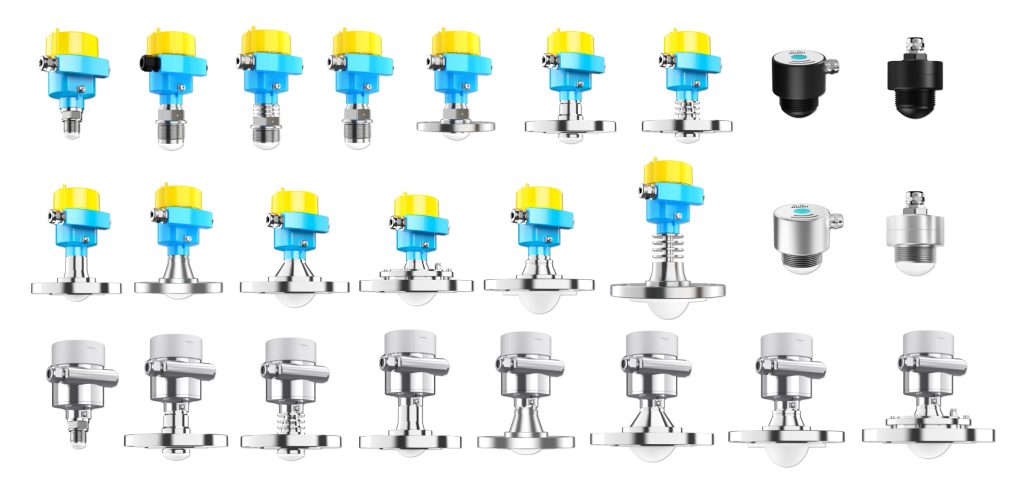
2. Working Principle of a Radar Level Meter: Using Echoes to Determine Level
The core principle of a radar level meter is not difficult to understand. The antenna emits a microwave signal toward the measured medium. When the signal reaches the liquid or material surface, it is reflected back. Since electromagnetic waves travel at nearly the speed of light, the instrument can calculate the distance from the antenna to the material surface by analyzing the time difference or frequency difference between the transmitted signal and the received echo. Once the vessel height is known, the level height can be calculated by subtracting this distance from the total vessel height.
A simple formula can help explain it:
Level Height = Total Vessel Height – Distance from Radar to Material Surface
There are two common radar measurement technologies used in industrial applications: pulse radar and FMCW radar.
Pulse radar emits short pulse signals and calculates distance by measuring the time it takes for the electromagnetic wave to travel to the surface and return. Its principle is straightforward, it has been used for a long time, and it is suitable for many conventional applications.
FMCW radar, or Frequency Modulated Continuous Wave radar, emits electromagnetic waves with continuously changing frequency. It calculates distance by analyzing the frequency difference between the echo signal and the current transmitted signal. Because this frequency difference can be analyzed very precisely, FMCW radar generally provides higher resolution and measurement accuracy, making it more suitable for continuous level measurement under complex working conditions.
In recent years, 80GHz FMCW radar level meters have become increasingly popular. The term 80GHz means that the radar operates in the high-frequency millimeter-wave range. The higher the frequency, the shorter the wavelength, allowing the antenna to be smaller and the beam angle to be narrower. A narrower beam angle means more concentrated radar energy, making it easier to avoid interference from tank walls, support structures, ladders, agitators, heating coils, and other internal obstacles.
This is why 80GHz radar level meters are often used in small tanks, narrow tanks, tall silos, complex vessels, and long-distance measurement applications. Compared with lower-frequency radar, 80GHz radar usually offers better focusing capability, higher resolution, and stronger anti-interference performance.
3. Why Are Radar Level Meters Becoming More Popular?
1. Non-Contact Measurement Reduces Corrosion, Adhesion, and Wear
One of the biggest advantages of a radar level meter is non-contact measurement. The instrument is usually installed on the top of the vessel, and the sensor does not need to remain inserted into the medium for long periods. As a result, it is less affected by strong acids, strong alkalis, organic solvents, highly viscous liquids, dust, particle abrasion, and other harsh factors.
For corrosive liquids, crystallizing media, sticky materials, wastewater, sludge, powders, and granules, non-contact measurement can significantly reduce the risk of corrosion, material buildup, clogging, or wear. For industries such as food, pharmaceuticals, and beverages, non-contact measurement also reduces the risk of material contamination and supports cleaner production and better hygiene management.
2. Less Affected by Temperature, Pressure, Steam, and Dust
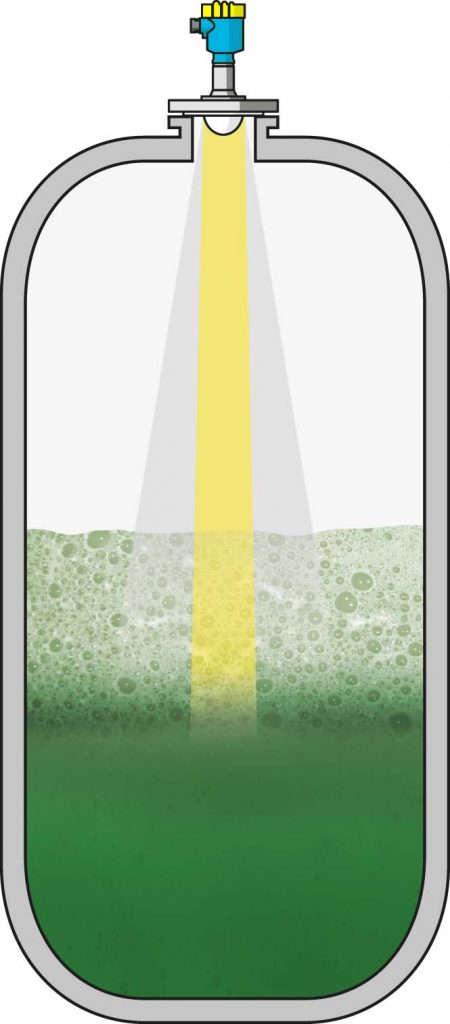
Ultrasonic level meters rely on sound wave propagation, and sound waves can be affected by temperature, pressure, airflow, steam, dust, and changes in gas composition. Radar level meters use electromagnetic waves and do not rely on air as the propagation medium. Therefore, they usually provide better stability in environments with steam, mist, dust, vacuum, significant temperature changes, or complex gas conditions.
For example, in chemical reactors, temperature and pressure may change frequently; in powder silos, dust concentration can be very high during feeding; in wastewater tanks, foam and vapor may exist on the surface; and in oil storage tanks, the medium may be volatile. These conditions are not friendly to many conventional measuring instruments, but radar level meters can often maintain reliable continuous measurement.
3. High Accuracy for Continuous Automation Control
In modern factories, level measurement is not just about “getting a rough idea.” It may be directly involved in automation control. For example, a high storage tank level may trigger an alarm, a low silo level may start automatic feeding, a reactor level change may affect batching ratio, and a water tank level may control pump station start and stop.
Therefore, the accuracy, stability, and response speed of level measurement instruments are very important. 80GHz FMCW radar level meters usually provide high measurement accuracy and are suitable for continuous liquid level measurement, inventory management, process control, and safety interlocking. Compared with manual observation or simple switch alarms, continuous radar level meters provide real-time, stable, and traceable data.
4. Intelligent Algorithms Improve Adaptability to Complex Conditions
Industrial sites are rarely ideal. Inside a tank, there may be agitators, heating coils, supports, ladders, inlet nozzles, stilling wells, bypass pipes, and other structures. There may also be foam, dust, steam, buildup, inclined material surfaces, and multiple reflections. Traditional instruments may mistake false echoes for the real liquid surface, leading to value fluctuations, inaccurate measurement, or echo loss.
Modern radar level meters often use intelligent algorithms such as echo curve analysis, false echo suppression, multi-echo identification, dynamic target tracking, and empty-tank spectrum learning. In simple terms, the instrument does not merely “see an echo”; it also determines which echo is most likely to be the true material surface, thereby improving measurement reliability in complex field conditions.
5. Low Maintenance and Better Long-Term Cost Performance
Radar level meters generally have no mechanical moving parts and do not require floats, pulleys, steel tapes, or similar structures. Therefore, mechanical wear is low and maintenance requirements are reduced. In high-temperature, high-pressure, toxic, hazardous, flammable, explosive, or dusty environments, reducing manual maintenance frequency also means improved safety and lower downtime costs.
Although the purchase price of a radar level meter may be higher than that of some traditional instruments, from a long-term perspective, it often provides better value in terms of stability, maintenance cost, downtime risk, and automation benefits.
4. Where Are 80GHz Radar Level Meters Suitable?
Radar level meters have a wide range of applications, especially in working conditions where traditional instruments are difficult to use, unstable, or inconvenient to maintain.
1. Chemical Storage Tanks and Reactor Level Measurement
In the chemical industry, radar level meters can be used for acid and alkali storage tanks, solvent tanks, resin tanks, reactors, intermediate tanks, metering tanks, and buffer tanks. Chemical media often have corrosive, volatile, toxic, adhesive, or flammable and explosive characteristics, requiring high standards for instrument material and measurement stability.
Radar level transmitters use non-contact measurement and do not need direct contact with the medium, helping reduce corrosion, adhesion, and leakage risks. For conditions involving steam, foam, temperature changes, or pressure changes, 80GHz radar level meters can also provide strong anti-interference performance.
2. Petroleum and Petrochemical Storage and Transportation Systems
In the petroleum and petrochemical industries, radar level meters are commonly used for crude oil, refined oil, fuel oil, diesel, gasoline, lubricating oil, coal tar, crude benzene, solvents, oil-water separation tanks, and other storage and transportation applications. Oil storage tanks usually require high safety, stability, and continuous monitoring. Some areas also have explosion-proof requirements.
Radar level meters can be installed on the top of tanks for continuous measurement, reducing the need for tank opening inspections and manual gauging. For large storage tanks, a radar level meter with the appropriate range and accuracy can also provide real-time data for inventory management, process control, and safety alarms.
3. Silos in Power, Metallurgy, Cement, and Mining Industries
Solid level measurement has always been a challenge in industrial sites. Materials such as fly ash, coal powder, mineral powder, limestone powder, cement, clinker, plastic pellets, grain, and feed often create problems such as heavy dust, uneven material surfaces, weak reflection, strong feeding impact, and severe buildup inside silos.
The narrow beam advantage of 80GHz radar level meters is very useful in these applications. It allows the radar beam to focus more precisely on the target material surface, reducing interference from silo walls, support structures, and inlet nozzles. For tall silos or highly dusty vessels, air purging, dust-resistant antennas, and adjustable flanges can also be used to improve long-term measurement stability.
4. Water Treatment, Environmental Protection, and Municipal Water Level Monitoring
In water treatment and environmental protection, radar water level meters can be used in rivers, lakes, reservoirs, open channels, pump stations, wastewater tanks, regulating tanks, sedimentation tanks, stormwater wells, sluices, and urban flooding monitoring systems. Compared with contact-type water level meters, radar water level meters are installed above the water surface and are less affected by wastewater, floating debris, sediment, or corrosive gases.
In open channels or river monitoring applications, radar water level meters can provide non-contact continuous water level monitoring, making them suitable for unattended operation, remote monitoring, and smart water management systems. For small-range pools, wastewater stations, and pump rooms, compact 80GHz radar water level meters are also becoming an important alternative to ultrasonic level meters.
5. Food, Pharmaceutical, and Fine Chemical Industries
Food, pharmaceutical, and fine chemical industries usually require hygiene, cleanliness, stability, and traceability. Radar level meters use non-contact measurement, reducing the risk of medium contamination. They are suitable for raw material tanks, batching tanks, fermentation tanks, storage tanks, and powder silos.
For applications involving CIP cleaning, steam sterilization, temperature changes, foam, or adhesion, users should select the appropriate antenna structure, process connection, and sealing material. With proper selection, radar level meters can provide continuous and stable level monitoring while meeting hygiene requirements.
5. How to Select a Radar Level Meter
Selecting a radar level meter should not be based only on price or measuring range. Proper selection should consider the medium, vessel, process conditions, safety requirements, communication methods, and installation conditions.
1. Consider Medium Type and Dielectric Constant
Different media reflect radar waves differently. In general, the higher the dielectric constant, the stronger the radar echo and the easier the measurement. The lower the dielectric constant, the weaker the radar echo, and the higher the requirements for instrument sensitivity, antenna structure, and algorithm capability.
Water, acid and alkali solutions, and wastewater are usually easier to measure. Oils, solvents, plastic pellets, and powders with low dielectric constants are relatively more difficult. For low-dielectric media, it is recommended to choose high-frequency radar, a suitable antenna form, and stronger echo processing capability.
2. Consider Measuring Range and Vessel Height
Measuring range is one of the basic parameters in radar level meter selection. Small pools, small tanks, and conventional liquid level applications can use short-range models. Large storage tanks, tall silos, mining bins, and cement silos require long-range radar level meters.
When selecting, users should not only consider vessel height, but also installation position, blind zone, maximum level, minimum level, surface fluctuation, and safety margin. For example, if a vessel height is 10 meters, it does not necessarily mean that a 10-meter range instrument is enough. A certain margin is usually recommended.
3. Consider Temperature, Pressure, and Process Environment
Process temperature and pressure affect instrument structure, seals, antenna materials, and process connection. Selection is relatively simple for normal temperature and pressure conditions. However, for high temperature, high pressure, steam, vacuum, corrosion, condensation, and similar conditions, selection should be more cautious.
For example, high-temperature steam environments require attention to antenna condensation and seal temperature resistance. Strongly corrosive media require corrosion-resistant antennas or isolation structures. High-pressure vessels require process connections that meet the pressure rating. Severe dust conditions may require air purging structures or dust-resistant designs.
4. Consider Foam, Dust, Agitation, and Internal Obstacles
Foam, dust, agitators, supports, heating coils, and feeding streams can all affect radar echoes. During selection, users should understand the internal tank structure and operating conditions in advance. Drawings or photos should be provided when necessary.
If there are many internal obstacles, an 80GHz radar level meter with a smaller beam angle is preferred. If dust is heavy, a product with an air purging structure can be considered. If the material surface is obviously inclined, an adjustable flange can be used to adjust the angle. If the foam is thick, it is necessary to evaluate whether the radar wave can penetrate the foam and obtain an effective echo.
5. Consider Explosion-Proof, Protection, and Safety Requirements
In petroleum, chemical, coal chemical, pharmaceutical, and dusty silo applications, explosion-proof rating is very important. During selection, users should confirm whether the site is a gas hazardous area or a dust hazardous area and choose a radar level meter that meets the corresponding explosion-proof requirements.
At the same time, the protection rating of the instrument should also be considered. Outdoor installation, humid environments, washdown environments, and dusty environments all require a higher protection rating. In areas with frequent thunderstorms, grounding, lightning protection, and surge protection should also be considered.
6. Consider Output Signals and Communication Methods
Traditional radar level meters commonly provide 4-20mA analog output and may also support HART communication. Modern intelligent radar level meters may also support RS485, Modbus, Bluetooth commissioning, wireless communication, remote diagnosis, and cloud-based management.
If the instrument needs to be connected to a PLC, DCS, or SCADA system, users should confirm the signal type, power supply, communication protocol, and wiring requirements in advance. If measurement points are scattered, located at height, or inconvenient for manual commissioning, radar level meters with Bluetooth commissioning or remote diagnosis can be more convenient.
6. Installation Precautions for Radar Level Meters
Even a high-quality radar level meter can be affected if the installation position is unreasonable. The core installation principle is to make the radar wave strike the true material surface as vertically as possible, while minimizing interference from tank walls, supports, agitators, feeding streams, and nozzle edges.
1. Avoid the Feed Inlet
A radar level meter should not be installed directly above the feed inlet. If the radar wave hits the falling material stream directly, the instrument may measure the feeding stream instead of the true liquid or material surface, resulting in data fluctuations or misjudgment.
The correct approach is to keep the installation point away from the feed stream influence area while ensuring that the radar beam can cover a stable material surface.
2. Keep a Proper Distance from the Tank Wall
A radar level meter should maintain a proper distance from the vessel wall to avoid the beam hitting the wall or weld seams and creating interference echoes. In general, the installation point should not be too close to the tank wall, nor should it be mounted at the exact center of the tank top, especially for domed or spherical tanks, because the center position may cause multiple reflections.
The actual installation distance should be determined based on tank diameter, measuring range, beam angle, and internal structures.
3. Avoid Agitators, Coils, and Supports
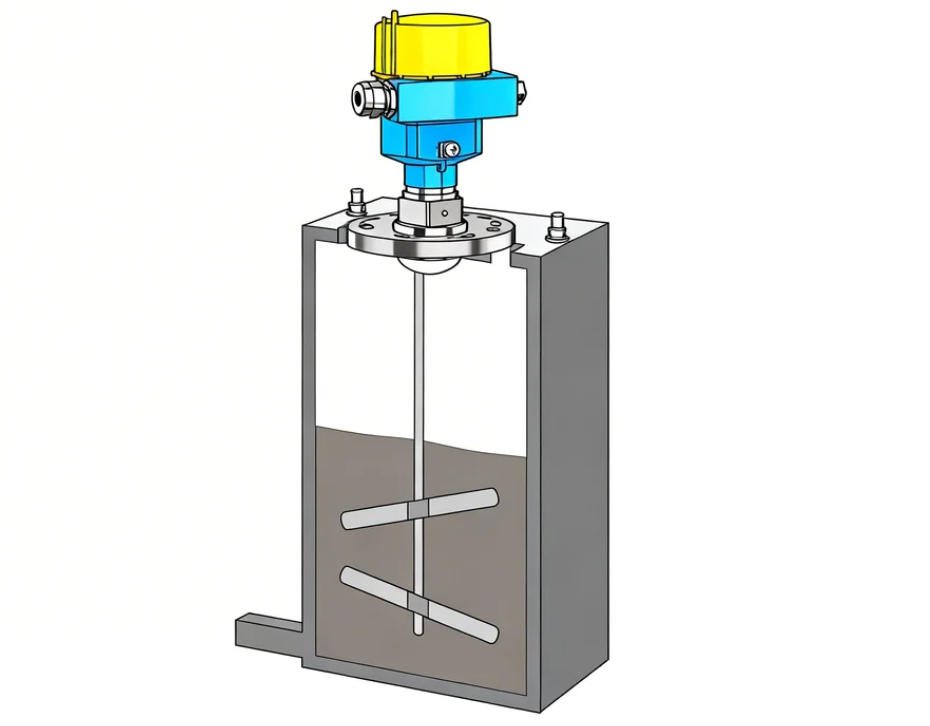
If there are agitators, heating coils, support beams, ladders, or other metal structures inside the tank, the radar level meter should be installed away from these obstacles as much as possible. Metal structures create strong reflections and can easily generate false echoes. If they cannot be avoided, measurement can be improved by adjusting the installation position, setting false echo suppression, reducing beam angle, or using a stilling well.
4. Pay Attention to Nozzle Height and Diameter
Many radar level meters are installed on flange nozzles. If the nozzle is too high, too narrow, or has a rough inner wall, radar waves may reflect inside the nozzle and affect the true echo. During installation, the nozzle should ideally be short and wide, with a smooth inner wall and no burrs or weld beads at the bottom.
If a long nozzle must be used, the appropriate antenna size and installation method should be selected according to the instrument instructions, and on-site commissioning may be required.
5. Consider Material Surface Angle in Solid Silos
Powders and granules often form a conical surface in silos rather than a perfectly horizontal plane. When installing a radar level meter for solid materials, the feed point, discharge outlet, angle of repose, and silo structure should be considered. If necessary, an adjustable flange can be used to adjust the instrument angle so that the radar beam points toward an effective reflection area.
6. Provide Proper Protection for Outdoor Installation
In outdoor water level, silo, and storage tank applications, instruments are exposed to sunlight, rain, low temperatures, high temperatures, and lightning for long periods. During installation, protection against rain, sun exposure, lightning, grounding issues, and cable sealing should be properly handled. Cable entries must be tightened to prevent moisture from entering the instrument.
7. Radar Level Meter vs. Ultrasonic Level Meter: Which One Should You Choose?
Many users wonder: which is better, a radar level meter or an ultrasonic level meter? The answer is not absolute. It depends on the application.
If the site is a simple water tank with normal temperature, normal pressure, no steam, no dust, no foam, a stable liquid surface, and a limited budget, an ultrasonic level meter can still offer good cost performance. For simple applications such as clean water tanks, fire water tanks, and open water channels, ultrasonic level meters can meet basic measurement needs.
However, if the site involves steam, foam, dust, temperature changes, vacuum, strong airflow, strong corrosion, agitation, long-distance measurement, or safety interlocking, a radar level meter is usually a more reliable choice.
A simple comparison is as follows:
Ultrasonic level meters rely on sound wave propagation and are easily affected by temperature, airflow, steam, dust, and foam. Radar level meters rely on electromagnetic waves and have stronger anti-interference capability.
Ultrasonic level meters are usually suitable for short-distance, simple liquid, and budget-sensitive applications. Radar level meters are more suitable for complex working conditions, high accuracy, long-distance measurement, automation control, and critical measurement points.
Ultrasonic level meters are relatively low in price, but their long-term stability is more affected by the environment. Radar level meters require a higher initial investment, but they offer low maintenance, wider applicability, and stronger long-term value.
In other words, ultrasonic level meters are more like an “economical solution,” while radar level meters are more like a “stable solution.” If the measurement point is only for auxiliary observation and occasional fluctuation is acceptable, ultrasonic may be considered. If the measurement point is related to production safety, automatic control, inventory measurement, or downtime risk, a radar level meter is more worth the investment.
8. Common Faults and Troubleshooting Ideas for Radar Level Meters
1. No Echo or Weak Signal
No echo is usually related to weak medium reflection, improper installation angle, antenna contamination, incorrect range setting, or obstruction of the radar wave by obstacles. During troubleshooting, parameters should be checked first, followed by installation position and antenna surface condition. If the medium has a low dielectric constant, a more suitable antenna or high-frequency radar solution should be considered.
2. Fluctuating Measurement Values
Value fluctuation usually indicates that the instrument is switching between the true echo and false echoes. Common causes include agitator interference, feeding stream impact, internal tank structure reflections, foam changes, or surface movement. The problem can be improved by adjusting the installation position, avoiding interference sources, enabling false echo suppression, and optimizing filtering parameters.
3. Large Measurement Deviation
Large deviation may be caused by incorrect tank height settings, incorrect zero and span settings, inconsistent installation reference points, nozzle interference, or inaccurate field calibration. In this case, tank height, installation height, output range, and actual level reference should be verified again.
4. Antenna Condensation or Material Buildup
In high-humidity, steam, dusty, or sticky media environments, condensation, dust accumulation, oil stains, or material buildup may occur on the antenna surface, causing echo attenuation. The antenna should be cleaned regularly according to site conditions. If necessary, anti-condensation structures, air purging structures, or more suitable antenna materials should be selected.
5. Communication Abnormalities
If 4-20mA, HART, RS485, or Modbus communication is abnormal, users should check supply voltage, wiring polarity, shielding and grounding, communication address, baud rate, terminal resistance, and system parameter settings. For explosion-proof applications, users should also confirm whether the safety barrier, isolator, and power supply loop are compatible.
9. Daily Maintenance Recommendations for Radar Level Meters
Although radar level meters require relatively little maintenance, this does not mean they require no maintenance at all. Reasonable routine inspections can extend instrument service life and improve measurement stability.
First, regularly check the instrument housing, cable entry, seals, and cables to ensure there is no water ingress, corrosion, looseness, or damage. For outdoor installation, special attention should be paid to rainwater backflow and cable sealing.
Second, regularly check whether there is dust, crystallization, oil contamination, condensation, or material buildup on the antenna surface. If the antenna is seriously contaminated, it should be cleaned under shutdown or safe operating conditions.
Third, regularly check the echo curve and historical data. If the measurement value frequently fluctuates, signal strength decreases, or abnormal alarms occur, the cause should be analyzed in time to prevent small problems from developing into shutdown failures.
Finally, when process conditions change, instrument parameters should be re-evaluated. For example, medium replacement, tank modification, addition of an agitator, change of feeding method, or increase in temperature and pressure may affect radar echoes and require recommissioning or parameter optimization.
10. Frequently Asked Questions
1. Can a Radar Level Meter Measure Solid Level?
Yes. A radar level meter can measure not only liquids, but also powders, granules, and bulk solids. However, solid level measurement often involves dust, inclined surfaces, low dielectric constants, and feeding impact. Therefore, it is recommended to choose an 80GHz high-frequency radar level meter with a narrow beam angle, sufficient range, and strong algorithm capability.
2. Is a Radar Level Meter Affected by Foam?
Light foam usually has little effect on radar measurement. However, thick foam, low-dielectric foam, or obvious surface fluctuation may weaken the echo. Selection should consider medium properties, foam thickness, antenna type, and algorithm capability.
3. Does a Radar Level Meter Require Maintenance?
Yes, but maintenance requirements are usually low. Radar level meters have no moving parts, and non-contact measurement reduces wear and corrosion risks. However, in high-dust, condensation, buildup, corrosive, or outdoor environments, it is still recommended to regularly check the antenna, seals, wiring, and echo status.
4. Is an 80GHz Radar Level Meter Always Better Than a 26GHz Radar Level Meter?
Not necessarily. The advantages of an 80GHz radar level meter include narrow beam angle, concentrated energy, and high resolution. It is suitable for complex tanks, small vessels, precision measurement, and certain solid level applications. However, the final choice still depends on the medium, range, dust concentration, installation conditions, and budget. For some simple applications, lower-frequency radar can also meet the requirements.
5. Can a Radar Level Meter Be Used in Vacuum?
Yes. Radar level meters use electromagnetic waves for measurement, and electromagnetic waves can propagate in vacuum. Therefore, radar level meters are suitable for vacuum vessels or applications with changing gas environments.
6. What Output Signals Are Available for Radar Level Meters?
Common outputs include 4-20mA, HART, RS485, and Modbus. Some intelligent radar level meters also support Bluetooth commissioning, wireless communication, remote diagnosis, and data platform integration. During selection, the output method should be determined according to the requirements of PLC, DCS, SCADA, or remote monitoring systems.
7. What Parameters Are Needed for Radar Level Meter Selection?
It is recommended to provide the medium name, dielectric constant or material properties, liquid/powder/granule type, vessel height, measuring range, process temperature, process pressure, whether steam/foam/dust/agitation exists, internal tank structure, installation nozzle size, explosion-proof requirements, output signal, and communication protocol.
Conclusion: Choosing a Radar Level Meter Means Choosing a Stable and Reliable Level Measurement Solution
Radar level meters are becoming increasingly common in industrial automation because they solve many problems that traditional instruments struggle to handle reliably over the long term, such as corrosion, adhesion, dust, steam, foam, high temperature, high pressure, complex tank structures, and long-distance measurement. In particular, 80GHz FMCW radar level meters, with their narrow beam angle, high resolution, non-contact measurement, intelligent echo algorithms, and convenient commissioning, are becoming an important choice for continuous liquid and solid level measurement.
For users, selecting a radar level meter should not be only about asking “how much does one unit cost?” More importantly, it should focus on whether the measurement point can remain stable over the long term, reduce downtime, and lower maintenance costs. From small-range water level measurement to chemical storage tanks, petrochemical explosion-proof zones, dusty silos, high-temperature and high-pressure vessels, and corrosive media, different types of radar level meters now cover a wide range of industrial level measurement scenarios.
As long as selection is accurate, installation is standardized, and commissioning is properly completed, a radar level meter can become a stable, reliable, and intelligent part of on-site level measurement, continuously supporting production safety, process control, and digital management with reliable data.