As the biomass energy industry continues to expand, wood pellets are increasingly used in industrial boilers, district heating systems, biomass power generation plants, and clean-fuel applications. Their popularity is largely due to their renewable raw materials, stable combustion performance, and convenient storage and transportation.
A typical wood pellet production line includes raw material crushing, screening, drying, pelletizing, cooling, and packaging. Among these stages, drying has a direct impact on raw material moisture content, pellet forming quality, production efficiency, and energy consumption.
Reliable high- and low-level detection in the buffer silo upstream of the dryer is therefore essential for maintaining continuous feeding and safe system operation.
Sawdust, wood powder, and fine wood chips are low-density bulk solids that can generate significant dust and easily adhere to equipment surfaces. Conventional level detection instruments may be affected by dust accumulation, moisture changes, material bridging, and impact from falling material. These conditions can lead to false alarms, delayed switching, or complete detection failure.
A vibrating rod level switch provides a practical solution for these applications. By detecting changes in probe vibration, it can provide stable high-level alarms, low-level material shortage detection, and interlock signals for conveyors, feeders, and drying equipment.
1. Why Is Reliable Level Detection Necessary Before the Dryer?
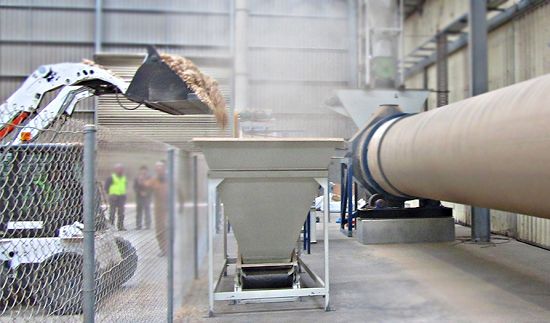
In a wood pellet production line, crushed and screened raw material is usually transferred into a buffer silo before entering the dryer through a screw conveyor, belt conveyor, rotary valve, or another feeding device.
The buffer silo temporarily stores material while balancing the production capacity of the upstream crushing section and the downstream drying section.
Without reliable level signals, the system may experience overfilling, blockage, unstable feeding, or material shortages.
Risks Caused by High-Level Detection Failure
When a high-level switch fails to respond in time, material can continue accumulating inside the silo. This may result in:
- Blockage at the feeding inlet
- Overloading of conveying equipment
- Material overflowing from the top of the silo
- Feeder jamming or shutdown
- Interruption of the drying process
- Increased mechanical load on the silo structure
In severe cases, accumulated material may place excessive pressure on internal components, conveyor systems, or silo walls, increasing the risk of equipment damage and production accidents.
A reliable high-level switch provides an early warning before the silo becomes completely full. Its output can also be used to stop upstream conveyors or feeding equipment automatically.
Risks Caused by Low-Level Detection Failure
An unreliable low-level signal may allow the dryer to operate with insufficient or intermittent feed.
Unstable material flow can change the heat distribution inside the drying system and lead to fluctuations in the moisture content of the discharged material.
If the moisture content remains too high, the raw material may not pelletize properly. The finished pellets can become loose, weak, or prone to breakage.
If the material becomes excessively dry, dust generation may increase and energy may be wasted.
For this reason, wood chip and sawdust buffer silos are often equipped with both high- and low-level switches.
The high-level switch helps prevent overfilling and blockage, while the low-level switch confirms whether enough material is available for continuous feeding.
These signals can be integrated with the feeder, conveyor, fan, dryer, or programmable logic controller to support automatic startup, shutdown, material shortage protection, and overfill prevention.
2. Main Challenges in Sawdust and Wood Chip Level Detection
2.1 Low Bulk Density
Fine sawdust, wood powder, and dry wood chips are lightweight and loosely packed. Their bulk density can vary significantly depending on:
- Wood species
- Particle size
- Moisture content
- Degree of compaction
- Storage time
- Processing conditions Wood Pellet
A level switch that requires strong mechanical resistance or heavy material pressure may not respond reliably when covered by lightweight wood powder.
This problem is especially important in low-level applications, where the amount of material surrounding the probe may be limited.
When selecting an instrument, users should therefore consider the minimum detectable material density rather than simply confirming that the device is suitable for general granular solids.
2.2 Heavy Dust and Material Adhesion
Crushing, conveying, screening, and drying operations generate large quantities of fine wood dust.
This dust can gradually accumulate on the sensing probe. Under humid conditions, it may form a thicker adhesive layer.
For instruments that rely on capacitance or changes in dielectric constant, buildup on the probe may cause signal drift. In some cases, the instrument may continue indicating the presence of material even after the actual material level has dropped below the probe.
Frequent manual cleaning increases maintenance costs and may require production shutdowns.
A suitable level switch should therefore tolerate a reasonable degree of dust buildup without generating false alarms. Wood Pellet
2.3 Changes in Moisture Content and Dielectric Properties
The moisture content of sawdust entering a dryer is rarely constant.
Seasonal changes, storage conditions, wood species, weather exposure, and raw material sources can all affect moisture content.
These changes can also alter the dielectric properties of the material.
Detection technologies that are highly dependent on dielectric constant may require repeated sensitivity adjustments when the raw material changes.
If the sensitivity is not configured correctly, the instrument may switch too early, too late, or not at all.
A vibrating rod level switch is less dependent on dielectric properties because it detects changes in mechanical vibration rather than changes in electrical capacitance.
2.4 Falling Material Impact and Mechanical Vibration
During silo filling, sawdust and larger wood particles may fall directly onto the sensing probe.
At the same time, motors, fans, screw conveyors, vibrators, and other rotating equipment can transmit mechanical vibration through the silo wall.
The level switch must be mechanically strong enough to withstand falling material while also distinguishing between changes in its own vibration and vibration generated by surrounding machinery.
Poor installation or an unsuitable mounting position can increase the risk of false switching or probe damage.
2.5 Elevated Process Temperatures
A standard sawdust buffer silo may operate at a moderate temperature. However, measurement points close to a hot-air duct, dryer inlet, or hot material outlet may be exposed to much higher temperatures.
Instrument selection must distinguish between process temperature and ambient temperature.
Process temperature refers to the temperature experienced by the probe and process connection.
Ambient temperature refers to the air temperature around the electronic housing.
Selecting an instrument based only on room temperature may underestimate the actual thermal load on the sensing element and connection.
Excessive process temperature can reduce service life, damage internal components, or cause unstable operation.
3. How Does a Vibrating Rod Level Switch Work?
A vibrating rod level switch is a point-level detection device designed for powders, granules, and other bulk solids.
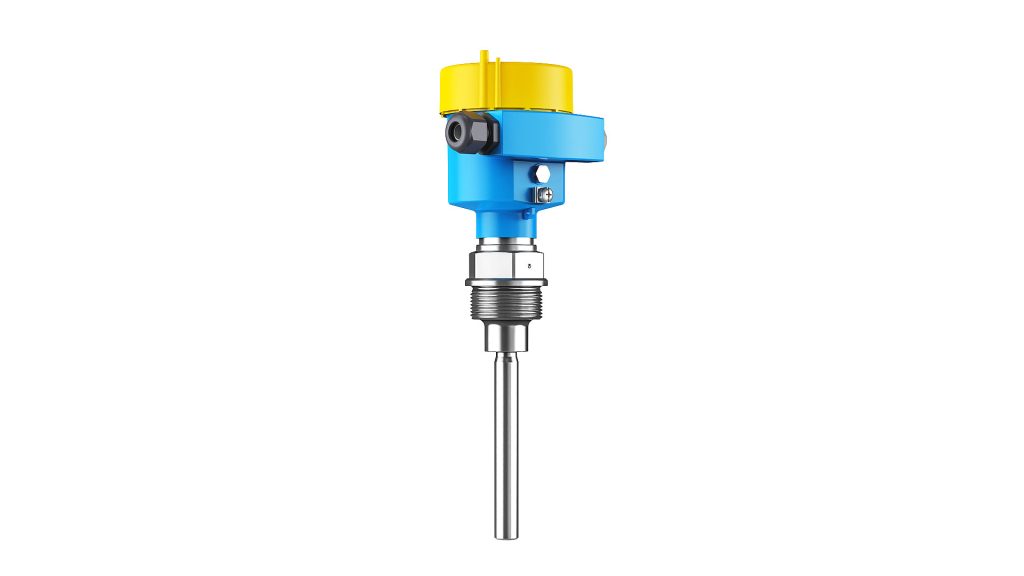
Under normal conditions, the sensing rod is driven by a piezoelectric element and vibrates at a fixed resonant frequency.
When sawdust, wood powder, wood chips, or biomass particles cover the sensing rod, the surrounding material dampens the vibration.
This causes the vibration amplitude, frequency, or resonance condition to change.
The electronic unit detects this change and switches the output signal.
When the material level falls below the probe, the sensing rod returns to its normal vibration state and the output resets.
Because this operating principle is based mainly on mechanical vibration, the instrument does not need to calculate level according to the dielectric constant of the material.
As a result, changes in wood species, moisture content, or raw material composition generally have less influence on the switching point than they may have on some capacitance-based devices.
For low-density and dusty materials, a properly selected vibrating rod level switch can provide reliable:
- High-level overfill protection
- Low-level material shortage alarms
- Conveyor interlocks
- Feeder control
- Dryer protection
- Process shutdown signals
4. Operating Principle of the Tube-11 Vibrating Rod Level Switch
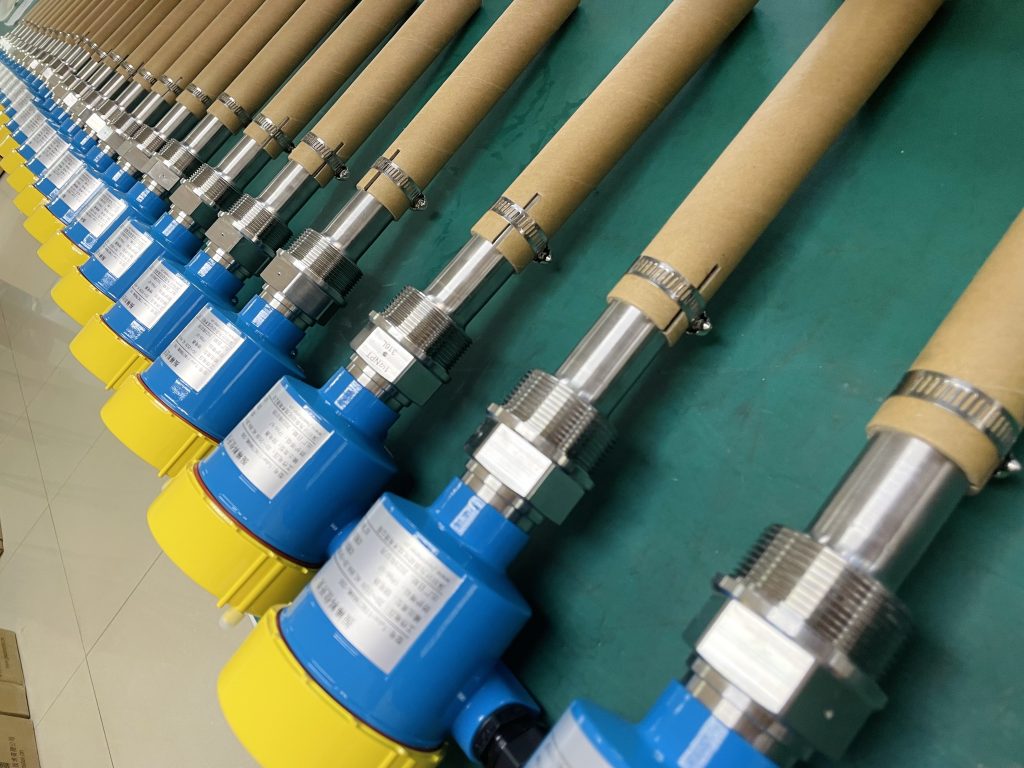
The Tube-11 vibrating rod level switch uses a dual-tube vibration structure consisting of an inner tube and an outer tube.
The resonant frequencies of the two vibration components are adjusted so that they maintain a stable resonant condition when the probe is free of material.
When the outer tube comes into contact with sawdust or another bulk solid, its vibration amplitude and resonant frequency change.
The original resonance condition is disrupted.
The electronic circuit analyzes the signal from the piezoelectric sensing element and then produces the corresponding switching output.
According to the product specifications, the Tube-11 series is suitable for powders and granular solids with a minimum detectable material density as low as 0.02 g/cm³.
This makes it suitable for lightweight materials such as:
- Sawdust
- Fine wood powder
- Biomass fibers
- Straw
- Activated carbon
- Fly ash
- PVC granules
- Lightweight industrial powders
- Other low-density bulk solids
5. Main Advantages of the Tube-11 in Sawdust Silos
5.1 High Sensitivity for Lightweight Materials
Sawdust, straw, wood powder, and certain biomass materials have relatively low bulk densities.
Mechanical level switches that depend on strong material pressure may not always respond reliably in these applications.
The Tube-11 is designed for low-density material detection and can provide sufficient sensitivity for low-level monitoring in sawdust buffer silos.
This helps reduce the risk of the switch failing to respond when surrounded by lightweight material.
5.2 Independent of Dielectric Constant
The vibrating rod operating principle is based on changes in probe resonance rather than changes in dielectric constant.
When wood species, moisture content, or raw material batches change, the instrument generally does not require frequent recalibration.
This can reduce commissioning time and simplify maintenance.
It is particularly useful in wood pellet plants that process raw materials from multiple suppliers or operate with significant seasonal moisture variation.
5.3 Compact Probe Design
The standard Tube-11 probe has a length of 125 mm and a diameter of 16 mm.
Its compact sensing element presents a relatively small surface area to falling material, helping reduce the mechanical force applied to the probe.
However, a compact probe should not be treated as a substitute for correct installation.
Where material drops from a significant height, where the feeding rate is high, or where large wood fragments may be present, the switch should still be mounted away from the main material stream.
A protective shield may also be required.
5.4 Resistance to Moderate Material Buildup
A thin coating of wood dust on the sensing element does not necessarily cause immediate false switching.
The dual-tube vibration design provides a degree of tolerance to material adhesion.
Within reasonable limits, the probe can continue operating even when dust is present on its surface.
However, no contact level switch should remain permanently buried under heavily compacted material or thick hardened deposits.
If wet sawdust frequently forms solid buildup, bridging, or caking, the plant should also address the underlying process conditions.
Possible improvements may include:
- Optimizing silo geometry
- Improving material flow
- Reducing moisture accumulation
- Installing flow aids
- Adding air purging or mechanical cleaning
- Adjusting the mounting position
5.5 Multiple Temperature Versions
Different areas of a wood pellet production line can operate at very different temperatures.
A standard-temperature model may be suitable for ordinary buffer silos.
A high-temperature version may be required near a dryer, hot-air duct, or heated process vessel.
For more extreme process temperatures, an air-cooled or water-cooled version may be necessary.
According to the product specifications:
- The standard model can withstand process temperatures up to 150°C
- The high-temperature model can withstand temperatures up to 250°C
- The ultra-high-temperature model with cooling can withstand temperatures up to 400°C
The final model should be selected according to the highest expected process temperature, heat radiation, operating duration, and an appropriate safety margin.
5.6 Explosion-Proof Options
Wood dust is combustible.
When fine dust reaches a sufficient concentration in an enclosed space and is exposed to an ignition source, a dust explosion may occur.
If the installation area is classified as a hazardous dust environment, the level switch must have the appropriate explosion-protection certification.
Cable glands, seals, grounding, enclosure installation, and wiring must also comply with the relevant hazardous-area requirements.
The Tube-11 series is available in standard and explosion-proof configurations.
Depending on the control system, users may select a relay output or a two-wire switching signal.
5.7 No Frequent Product Calibration
After installation, a vibrating rod level switch generally requires only verification of:
- Wiring
- Switching direction
- Fail-safe mode
- Output logic
- Control system response
It normally does not require separate calibration for every batch of sawdust.
This can be valuable in wood pellet plants where raw material sources and moisture levels change frequently.
Reduced calibration requirements help shorten commissioning time and lower the maintenance burden on plant personnel.
6. How to Select a Level Switch for a Wood Pellet Production Line
Step 1: Define the Detection Function
The first step is to determine exactly what the switch needs to do.
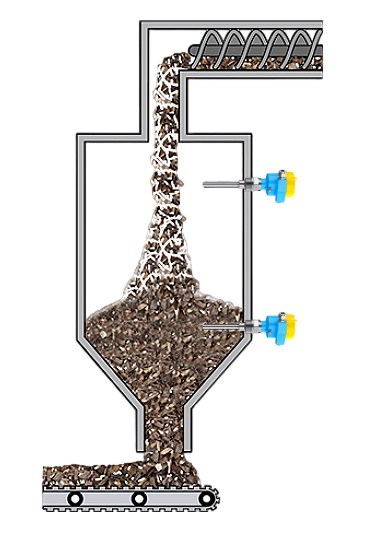
For overfill prevention only, a high-level switch can be installed near the upper section of the silo.
For dryer feed protection, a low-level switch should be installed near the lower section.
For automatic filling, feeding control, and material shortage protection, a high- and low-level configuration is normally recommended.
In safety-critical systems, an additional independent high-high-level switch may be installed as a separate emergency protection device.
Step 2: Confirm the Material Properties
Before selecting a model, collect information about:
- Minimum and maximum bulk density
- Average and maximum particle size
- Normal moisture content
- Maximum moisture content
- Tendency to bridge
- Tendency to cake or adhere
- Presence of bark or large wood pieces
- Material flow pattern
- Filling rate
- Discharge rate
For lightweight wood powder, minimum detectable density is a critical selection parameter.
For material containing larger wood fragments, mechanical strength and impact protection should also be considered.
Step 3: Verify the Process Temperature
Confirm the normal and maximum temperature at the actual probe location.
Also consider heat accumulation after shutdown and heat radiation from nearby equipment.
When the measurement point is close to a hot-air inlet, dryer, furnace, or heated duct, the electronic housing may require additional thermal isolation.
A high-temperature extension, cooling structure, or remote electronics arrangement may be necessary.
Step 4: Select the Process Connection
The process connection should be selected according to:
- Silo wall thickness
- Threaded or flanged connection requirements
- Existing mounting nozzles
- Insulation thickness
- Maintenance access
- Required insertion length
If the silo wall is thin, a reinforcing plate or mounting socket may be required to prevent deformation caused by vibration or mechanical stress.
The instrument should also remain accessible for inspection and removal.
Avoid mounting it behind fixed piping, platforms, insulation, or structural supports.
Step 5: Select the Output and Power Supply
The output must be compatible with the plant control system.
Relay output is suitable when a direct switching contact is required.
A two-wire output may be preferred for certain control loops or existing wiring systems.
Users should also define the required fail-safe mode for high-level and low-level applications.
In the event of power failure, cable breakage, or instrument malfunction, the control system should move into a predetermined safe condition.
Step 6: Check Explosion Protection and Enclosure Requirements
Areas with heavy wood dust may require an explosion-proof model, depending on the hazardous-area classification.
Outdoor, wet, or washdown environments also require an appropriate enclosure protection rating.
The Tube-11 specifications include IP66/IP67 protection, while the probe and process connection can be manufactured from materials such as 316L stainless steel.
Material compatibility, corrosion resistance, and cleaning requirements should be verified before final selection.
7. Correct Installation of a Vibrating Rod Level Switch
Correct installation is essential for stable sawdust level detection.
Even a properly selected instrument may switch too early, fail to detect material, or suffer mechanical damage if mounted in the wrong location.
Avoid Direct Installation Under the Inlet
The switch should not be installed directly in the center of the incoming material stream.
Continuous impact from falling sawdust can damage the probe.
It may also cause premature switching before the actual bulk material level reaches the intended alarm point.
A high-level switch should be installed away from the main filling stream and clear of internal supports, reinforcing ribs, and structural components.
Angle the Probe Downward for Side Mounting
When a vibrating rod switch is mounted horizontally from the side of a silo, material may collect around the base of the probe.
A slight downward angle helps material slide away and reduces buildup.
For horizontal side mounting, an angle of approximately 20 degrees may be used where permitted by the installation design.
Use a Protective Shield When Necessary
In applications with a high material drop, rapid filling, or large wood fragments, a protective shield can be installed above the sensing probe.
The shield should divert falling material to both sides of the probe without creating a new dead zone or accumulation point.
Its dimensions and shape should be selected according to:
- Material density
- Particle size
- Drop height
- Flow direction
- Filling speed
A poorly designed shield may create additional buildup, so it should not completely enclose the probe.
Avoid Bridging and Empty Cavities
Sawdust can form bridges, rat holes, funnel flow, and irregular voids inside a silo.
If a low-level switch is installed inside a cavity beneath a material bridge, it may indicate an empty condition even though a large quantity of material remains in the silo.
The mounting position should therefore be selected with reference to:
- Silo cone angle
- Outlet design
- Flow pattern
- Internal friction
- Known bridging locations
- Actual discharge behavior
Site observation during operation is often useful when determining the most representative measurement point.
Perform Empty and Material-Covered Tests
After installation, test the instrument under both empty and covered conditions.
Confirm that:
- The switch changes state reliably
- The output direction is correct
- High- and low-level logic matches the control design
- PLC interlocks operate correctly
- Alarm signals are received
- Feeder and conveyor responses are correct
- Power-loss behavior matches the fail-safe requirement
Cable entries must be properly sealed to prevent dust, moisture, and condensation from entering the housing.
Explosion-proof models must be installed according to the relevant certification and hazardous-area installation rules.
8. Vibrating Rod, Capacitance, Rotary Paddle, or Radar: Which Is Best?
Vibrating Rod Level Switch
A vibrating rod level switch is well suited for high- and low-point detection in sawdust, wood powder, and other low-density bulk solids.
Its main advantages include:
- Limited dependence on dielectric constant
- Simple commissioning
- Good sensitivity for lightweight material
- Compact sensing element
- Suitability for alarm and interlock functions
However, it provides only a point-level signal and does not display the continuous material level.
Capacitance Level Switch
A capacitance level switch has a relatively simple structure and can be used for many powders and granular materials.
However, when sawdust moisture content changes significantly or the probe experiences heavy buildup, sensitivity settings may require more careful adjustment.
Plants with frequently changing raw materials should evaluate whether changes in dielectric constant and coating thickness may affect switching stability.
Rotary Paddle Level Switch
A rotary paddle level switch is easy to understand and widely used for powders and granules.
However, it contains moving mechanical parts.
In extremely lightweight wood powder, the available resistance may not always be sufficient to stop the rotating paddle.
Applications with strong impact, high maintenance demands, or limited installation space should carefully consider motor torque, paddle size, shaft strength, and access for service.
Radar Level Transmitter
A radar level transmitter is suitable for continuous level measurement.
It can provide real-time information about:
- Material height
- Remaining inventory
- Filling trends
- Consumption rate
- Refill requirements
In important wood chip or sawdust silos, a combined solution may be used.
A radar transmitter provides continuous inventory monitoring and process control, while a separate vibrating rod switch acts as an independent high-level shutdown device.
This arrangement improves redundancy and provides a separate protection layer.
No single measurement principle is ideal for every application.
The correct choice depends on:
- Required measurement function
- Material density
- Moisture content
- Particle size
- Process temperature
- Dust concentration
- Mounting conditions
- Safety requirements
- Maintenance strategy
For sawdust buffer silos that require only reliable high- and low-level signals, a vibrating rod level switch often provides a practical balance of sensitivity, compact size, and ease of commissioning.
9. Frequently Asked Questions
Can a Vibrating Rod Level Switch Detect Fine Wood Powder and Sawdust?
Yes.
The minimum bulk density of the material must be higher than the minimum detectable density specified for the instrument.
The probe should also be installed away from direct impact zones, bridging cavities, and areas where material does not flow past the sensing point.
Will Sawdust Buildup on the Probe Cause False Alarms?
A light coating of dust can normally be tolerated when the instrument has sufficient buildup resistance.
However, thick deposits of wet, compacted, or hardened sawdust may change the vibration condition and cause incorrect switching.
Correct mounting, improved material flow, and periodic inspection can reduce the risk of severe buildup.
Can a Standard-Temperature Model Be Used in a Hot Drying System?
The instrument should not be selected only according to the temperature outside the silo.
The actual maximum process temperature at the probe and process connection must be confirmed.
A suitable safety margin should also be included.
When the process temperature exceeds the limit of a standard model, a high-temperature or cooled version should be selected.
Does a Sawdust Silo Need a Continuous Level Transmitter or a Point-Level Switch?
A point-level switch is normally sufficient for overfill protection or material shortage alarms.
A continuous level transmitter is more suitable when the plant needs to:
- Display real-time material level
- Calculate inventory
- Control blending
- Predict refill times
- Monitor material consumption
- Optimize production planning
Using a continuous level transmitter together with an independent point-level switch can provide both process visibility and safety protection.
How Many Level Switches Should Be Installed in a Sawdust Buffer Silo?
A typical control arrangement includes one high-level switch and one low-level switch.
The high-level signal can stop the incoming conveyor or feeder.
The low-level signal can start refilling, warn the operator, or protect the dryer from running without material.
For critical applications, an independent high-high-level switch may be added as an emergency shutdown device separate from the normal process control system.
Conclusion
Level detection in a wood pellet drying process may appear to be a simple high- or low-level measurement task.
In practice, it directly affects feeding continuity, dryer efficiency, product moisture content, equipment protection, and overall production safety.
Low density, heavy dust, moisture variation, material adhesion, bridging, mechanical impact, and elevated temperature can all make sawdust level detection difficult.
A vibrating rod level switch detects changes in the resonance condition of its sensing element.
This reduces the influence of changing dielectric properties and makes the technology suitable for many wood-processing and biomass applications.
The Tube-11 vibrating rod level switch offers options for low-density material detection, elevated temperatures, explosion-proof areas, compact installation, and different output requirements.
It can be applied to:
- Sawdust
- Wood powder
- Wood chips
- Straw
- Biomass pellets
- Activated carbon
- Lightweight powders
- Other granular and powdered bulk solids
For a successful installation, users should evaluate material density, particle size, moisture content, maximum process temperature, mounting position, hazardous-area classification, and control-system compatibility.
Correct selection, installation, functional testing, and interlock verification are essential for building a stable and reliable level detection system for wood pellet production.