In the production of vaccines, injections, biologics, APIs, and pharmaceutical excipients, level data is not only used to show how much material remains in a tank. It also directly participates in batching, feeding, stirring, transferring, cleaning, and batch management. Once level measurement fluctuates, drifts, or is interrupted, it may lead to inaccurate material ratios, pump dry running, material overflow, batch delays, or even production line shutdowns.
At the same time, pharmaceutical production is characterized by high cleanliness requirements, strict batch traceability, frequent equipment cleaning, and increasing automation. Traditional float, magnetic flap, or immersed probe level instruments may be affected by adhesion, corrosion, scaling, and mechanical wear in certain applications. As a result, non-contact radar level measurement has gradually become an important technical choice for pharmaceutical companies upgrading their level monitoring systems.
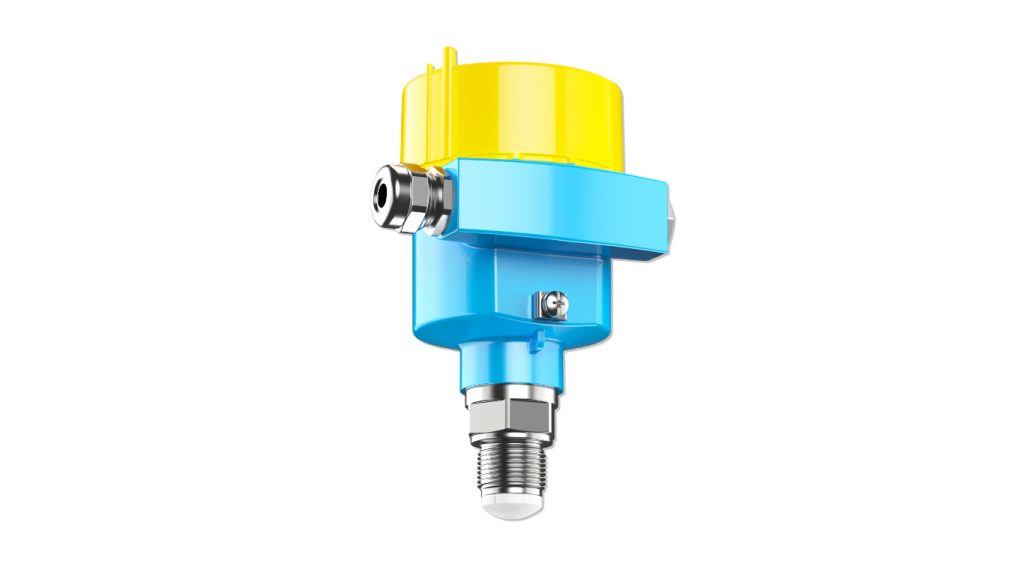
The Jiwei JWrada-31 radar level meter is based on 80GHz FMCW frequency-modulated continuous wave technology and is mainly designed for continuous liquid level measurement. It can be applied to mixing tanks, reactors, intermediate storage tanks, process water tanks, and some pharmaceutical utility vessels. Its value lies in providing more continuous, stable, and easily integrated level data for pharmaceutical production through non-contact measurement, intelligent echo processing, and digital communication.
1. Challenges of Level Measurement in the Pharmaceutical Industry
The measurement environment of pharmaceutical vessels is usually more complex than that of ordinary room-temperature water tanks. The same mixing tank may go through multiple stages such as feeding, heating, stirring, holding, transferring, and cleaning during production. The liquid surface inside the tank may be affected by foam, steam, vortexes, and changes in medium viscosity.
First, stirring devices can easily create fluctuating liquid surfaces. If a level instrument cannot distinguish the real liquid surface echo from interference echoes generated by agitators, tank walls, or coils, the output value may fluctuate.
Second, some pharmaceutical liquids may generate foam during mixing, fermentation, or high-speed feeding. Foam structure, thickness, and moisture content may change continuously, which can weaken or alter the measurement signal. Therefore, it should not be assumed that any radar instrument can completely ignore foam.
Third, heating, sterilization, and cleaning processes may generate steam or condensation. The instrument must adapt to changing process conditions while also preventing long-term condensation or buildup on the probe surface from affecting measurement.
In addition, pharmaceutical companies usually need to connect level signals to PLC, DCS, or SCADA systems to achieve pump and valve interlocking, level alarms, trend recording, and batch tracking. This means that a level instrument should not only “measure accurately,” but also provide stable output, fault diagnosis, and convenient commissioning.
2. Working Principle of the JWrada-31 Radar Level Meter
The JWrada-31 emits 80GHz frequency-modulated continuous electromagnetic waves toward the medium surface through its antenna. When the signal reaches the liquid surface, a reflected echo is generated. The instrument mixes the transmitted signal with the received echo and then calculates the distance between the antenna and the liquid surface through spectral analysis. By combining this distance with the tank height and configured parameters, the actual level is calculated.
Unlike measurement methods that rely on float movement or probes immersed in the medium, radar level meters do not require the measuring element to remain immersed in pharmaceutical liquids. This helps reduce measurement problems caused by mechanical jamming, medium adhesion, and wear of moving parts.
It should be noted that “non-contact measurement” does not mean the entire instrument is completely isolated from the process environment. The antenna, process connection, and sealing components may still come into contact with steam, condensate, or cleaning media inside the tank. Therefore, suitable materials and connection structures must be selected according to the corrosiveness of the pharmaceutical liquid, cleaning method, and hygienic requirements.
3. Why 80GHz Radar Technology Is Suitable for Pharmaceutical Vessels
The JWrada-31 adopts 80GHz high-frequency radar technology. Combined with a compact antenna structure, it can concentrate radar energy within a relatively narrow area. For pharmaceutical vessels with limited top installation space and internal structures such as agitator shafts, coils, spray balls, or support components, a more focused measuring beam helps avoid some fixed obstacles.
In small mixing tanks, laboratory tanks, skid-mounted equipment, and retrofit projects, the tank top is often already equipped with temperature, pressure, cleaning, and venting devices, leaving limited available connections. The compact design and small-size process connection of the JWrada-31 can reduce installation space requirements and provide convenience for upgrading existing equipment.
However, high-frequency radar does not mean that no commissioning is required after installation. If the antenna faces the feed inlet, agitator shaft, or tank wall welds, false echoes may still occur. In practical applications, the measuring range should be configured according to the tank structure, and measurement results should be optimized through echo learning, false echo suppression, and dynamic tracking.
4. Typical Applications of JWrada-31 in the Pharmaceutical Industry
4.1 Level Measurement in Mixing Tanks
Mixing tanks are used for raw material dissolution, concentration adjustment, and batch preparation. Accurate level data helps control the amount of water, solvent, and stock solution added, while also supporting stirring, material transfer, and batch completion judgment.
The JWrada-31 uses non-contact measurement and does not rely on float movement or probes immersed in liquid, which helps reduce the influence of adhesion and mechanical jamming. After the level signal is connected to the control system, it can participate in feed valve shutoff, transfer pump start-stop control, high-level alarms, and low-level protection.
For mixing processes that generate foam, echo testing should be performed under real material conditions. Installation position, foam thickness, stirring speed, and the dielectric properties of the medium all affect the final measurement performance. Project suitability should not be judged based only on laboratory clean water testing.
4.2 Reactor Level Monitoring
Pharmaceutical reactors may contain agitator blades, baffles, jackets, coils, and cleaning devices, making them typical complex vessels. The liquid surface may also fluctuate due to heating, reaction, and feeding.
The intelligent echo processing function of the JWrada-31 can be used to identify interference signals generated by fixed obstacles and track valid liquid surface echoes. During installation, the instrument should be positioned away from agitator shafts, baffles, and feed streams as much as possible. If necessary, the best installation point can be determined based on the on-site echo curve.
Reactor selection should not be based only on measuring range. Maximum temperature, maximum pressure, vacuum conditions, sealing materials, and process connections must also be checked. If the site is located in a hazardous area, a model with the corresponding explosion-proof certification should be selected instead of using a standard non-explosion-proof configuration.
4.3 Intermediate Storage Tanks and Transfer Tanks
Intermediate storage tanks are used to store liquids waiting for filtration, filling, or transfer to the next process. Continuous level data helps production personnel monitor material balance, avoid overflow caused by upstream feeding, and prevent downstream pumps from operating at low levels.
After the signal is connected to an automation system through 4–20mA, HART, or Modbus, operators can view tank levels, historical trends, and alarm status from the control room, reducing dependence on manual inspection.
4.4 Process Water and Pharmaceutical Utilities
After process conditions are confirmed, the JWrada-31 can also be used in some cleaning water tanks, condensate tanks, recovery water tanks, dosing tanks, and wastewater treatment vessels. Stable level data helps optimize pump and valve control, prevent tank overflow, and provide basic data for water consumption and recovery efficiency analysis.
However, for purified water, water for injection, or other high-hygiene systems, special attention must be paid to process connections, material certificates, surface quality, sealing structure, drainability, and validation documents. It should not be assumed that the instrument meets specific pharmaceutical system requirements simply because it is “non-contact” or “made of stainless steel.”
5. Key Value of JWrada-31 for Pharmaceutical Production
Reducing Maintenance Issues Caused by Contact Components
Radar measurement does not rely on mechanical moving parts such as floats or connecting rods, which can reduce the risk of mechanical wear and jamming. For media that easily adhere, crystallize, or form deposits, non-contact measurement can also reduce the cleaning burden caused by sensors being directly immersed in the material.
However, radar level meters are not completely maintenance-free. Antenna condensation, surface buildup, cable sealing, and process connections should still be included in preventive maintenance plans.
Supporting Continuous Automation Control
Continuous level signals can participate in batching control, pump and valve interlocking, high and low level alarms, and material transfer. Compared with level switches that provide only one switching point, radar level meters can output complete level change trends, providing more data for process optimization and abnormality analysis.
Convenient Wireless Commissioning and Fault Diagnosis
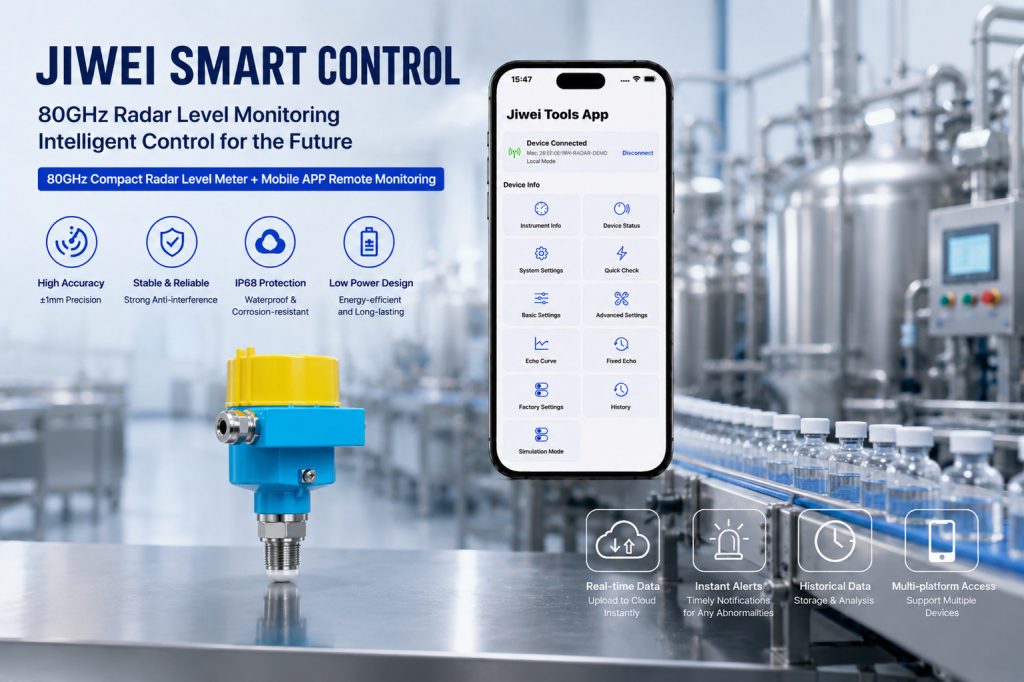
The JWrada-31 is equipped with Bluetooth communication and can be used with the Jiwei intelligent control WeChat mini program or related applications for parameter setting, status viewing, and on-site commissioning. When the instrument is installed at height, in equipment-dense areas, or in locations where frequent opening is inconvenient, wireless commissioning can reduce operation difficulty.
Through echo curves and diagnostic information, maintenance personnel can determine whether abnormalities are caused by liquid surface changes, fixed obstacles, antenna buildup, or parameter settings, thereby shortening troubleshooting time.
Easy Integration with DCS and SCADA Systems
Depending on the configuration, the JWrada-31 can provide 4–20mA/HART or RS485/Modbus signals and can be connected to PLC, DCS, and SCADA systems. Companies can use this to establish real-time display, trend recording, alarm management, and equipment status monitoring.
In a GMP environment, data integration does not automatically mean compliance with electronic record or data integrity requirements. The system still needs to be designed and validated as a whole, taking into account user permissions, time synchronization, audit trails, backups, and change management.
6. Application Reference for JWrada-31 in Pharmaceutical Production Scenarios
In pharmaceutical production, level measurement usually runs through multiple stages, including mixing, reaction, temporary storage, material transfer, cleaning, and utilities. The JWrada-31 radar level meter can be applied to batching tanks, reactors, intermediate storage tanks, process water tanks, and some auxiliary vessels according to different tank structures and process conditions, providing continuous and real-time level data for production sites.
In mixing tank applications, level data can be used for water addition, material feeding, and transfer process control, helping operators understand batch material changes and reduce errors caused by manual inspection and experience-based judgment. For mixing processes with agitators, proper installation position selection and echo commissioning can help reduce the influence of agitator shafts, tank walls, and liquid surface fluctuations on measurement results.
In reactor applications, the level measurement environment is usually more complex. The tank may contain agitator blades, baffles, coils, steam, foam, or temperature variations. The JWrada-31 adopts non-contact measurement, so the measuring component does not need to remain immersed in pharmaceutical liquids for long periods. This can reduce maintenance issues caused by medium adhesion, corrosion, and mechanical wear. Through intelligent echo processing and on-site parameter optimization, the instrument can better identify valid liquid surface signals and provide data support for reaction process monitoring, feeding control, and safety interlocking.
In intermediate storage tanks and transfer tanks, continuous level signals can help companies monitor material inventory, transfer progress, and coordination between upstream and downstream processes. When the level signal is connected to PLC, DCS, or SCADA systems, operators can view real-time level, alarm status, and historical trends from the control room, improving production management visibility.
In addition, the JWrada-31 can also be selected for cleaning water tanks, recovery water tanks, condensate tanks, dosing tanks, and some wastewater treatment vessels according to actual site conditions. Stable level data helps realize automatic pump and valve control, high and low level alarms, overflow prevention, and low-level pump shutdown protection, supporting energy saving, consumption reduction, and safe equipment operation in pharmaceutical plants.
It should be noted that pharmaceutical materials vary greatly in dielectric constant, viscosity, foam condition, corrosiveness, and cleaning method. The same installation and parameter scheme should not be applied mechanically to all applications. Before formal selection, tank dimensions, connection position, process temperature, pressure conditions, explosion-proof requirements, hygienic grade, and control system interface should be comprehensively evaluated. If necessary, on-site testing should be conducted to verify measurement stability.
7. How to Correctly Select JWrada-31 for Pharmaceutical Projects
When selecting a model, it is recommended to provide the supplier with the following information:
First, vessel height, diameter, tank top shape, connection size, and available installation position.
Second, pharmaceutical liquid name, dielectric properties, viscosity, corrosiveness, and whether it is prone to foam, crystallization, or adhesion.
Third, normal and extreme process temperature, pressure, and vacuum conditions.
Fourth, whether there are agitator shafts, baffles, coils, spray balls, or high-speed feed inlets inside the tank.
Fifth, required process connection, antenna material, sealing material, and cleaning method.
Sixth, whether the site is located in a hazardous area and the required explosion-proof rating.
Seventh, which signal type the control system requires, such as 4–20mA, HART, RS485, or Modbus.
Eighth, whether the project requires material certificates, calibration documents, inspection reports, software version records, and other validation documents.
Different pages and documents on the Jiwei official website may contain different configuration parameters for the JWrada-31. Therefore, measuring range, pressure, temperature, beam angle, protection rating, and process connection should not be quoted separately from the specific product version. The project should be based on the supplier’s latest selection sheet, technical agreement, factory documents, and product nameplate.
8. Installation and Commissioning Considerations for JWrada-31
The measurement performance of a radar level meter depends largely on installation.
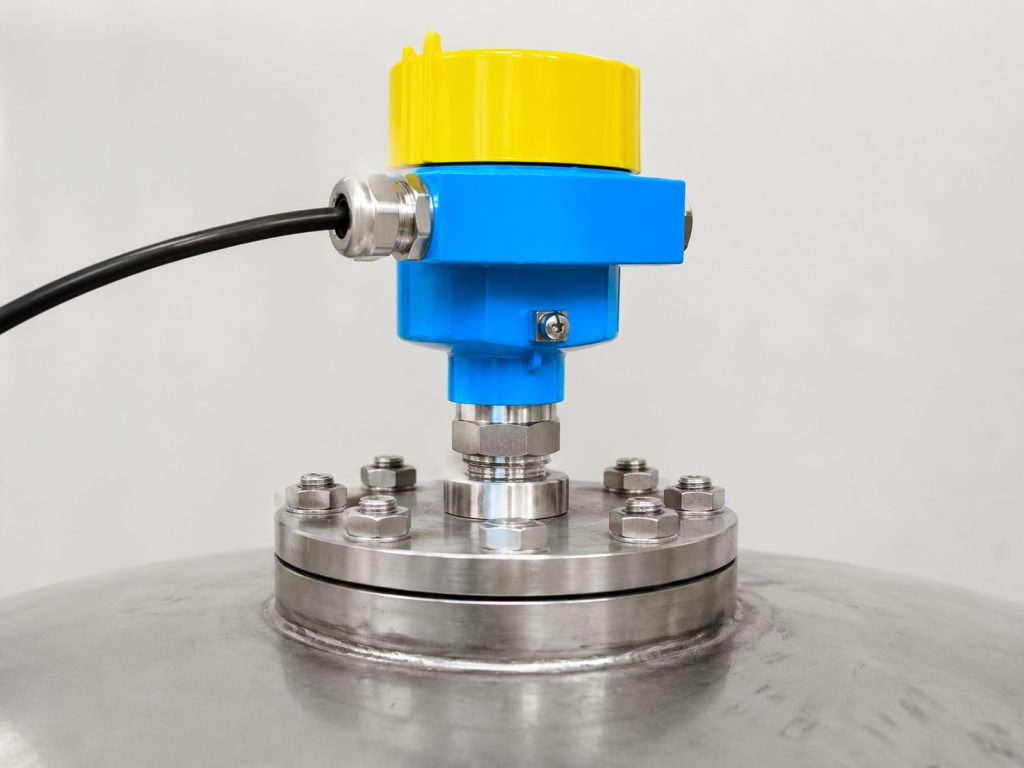
The instrument should not be installed directly above the feed stream, otherwise the radar may measure the feed stream instead of the actual liquid surface. For vessels with agitators, the instrument should be installed away from the agitator shaft and blades as much as possible, and there should be no obvious obstacles within the main antenna beam.
The installation position should also maintain a reasonable distance from the tank wall. For domed tanks or vessels with complex internal structures, positions that may cause multiple reflections should be avoided. The antenna should point vertically toward the liquid surface as much as possible, and the mounting nozzle should not be too long or too narrow to avoid additional echoes.
During commissioning, echo curves should be recorded separately under empty tank, low level, normal level, and stirring operation conditions. False echo learning and range setting should then be performed. After commissioning is completed, the measurement results should also be verified using manual level measurement, weighing data, or other reliable references.
9. Does JWrada-31 Meet GMP Requirements?
GMP is a systematic standard covering facilities, equipment, personnel, documentation, production, and quality management. It cannot be achieved by a single instrument alone. Therefore, a more accurate statement is that a properly configured JWrada-31 can support clean production and process control in pharmaceutical companies through non-contact measurement, cleanable structure, and automated data output.
Whether it is suitable for a specific GMP project must be evaluated together with antenna and sealing materials, surface treatment, process connection, cleaning and sterilization methods, drainability design, calibration documents, change control, and validation plans.
In sterile, high-purity, or direct-contact critical pharmaceutical liquid applications, the quality, process, equipment, and automation departments should jointly participate in model selection. Compliance judgments should not be made based only on promotional materials.
10. Conclusion
With 80GHz FMCW technology, non-contact continuous measurement, intelligent echo processing, Bluetooth commissioning, and multiple signal outputs, the JWrada-31 radar level meter provides a digital level measurement solution for pharmaceutical mixing tanks, reactors, and intermediate storage tanks.
Its advantage is not simply replacing a traditional level instrument, but helping companies obtain more continuous level data and use this data for batching control, pump and valve interlocking, alarm management, trend analysis, and equipment maintenance.
For pharmaceutical companies, the key to stable measurement lies in correct model selection, proper installation, real-process testing, and standardized validation. Only when the instrument configuration is fully matched with medium properties, tank structure, hygienic requirements, hazardous area classification, and the control system can the JWrada-31 fully contribute to production continuity, quality control, and automated management.
Frequently Asked Questions
Can the JWrada-31 measure pharmaceutical liquids with foam?
Radar technology can adapt to some foam conditions, but the actual performance depends on foam thickness, density, moisture content, and duration. It is recommended to provide real process information and confirm performance through echo testing.
Can the JWrada-31 be installed in hazardous areas?
The standard JWrada-31 is positioned for non-explosion-proof areas. If flammable gas or dust risks exist, the hazardous area should be reassessed and a model with the corresponding explosion-proof certification should be selected.
Can the JWrada-31 be connected to a pharmaceutical plant SCADA system?
Depending on the specific configuration, 4–20mA/HART or RS485/Modbus signals can be selected and connected to PLC, DCS, or SCADA systems to realize level display, alarms, and trend recording.
Is a radar level meter completely maintenance-free?
No. Non-contact measurement can reduce mechanical wear and the cleaning work required for immersed sensors, but antenna buildup, condensation, cable sealing, process connections, and measurement trends still need to be checked regularly.