JWrada®-34 Radar Level Meter Enables High-Accuracy Level Monitoring for Rapeseed Oil Storage
In edible oil production, the storage of rapeseed oil has a direct impact on product quality, inventory control, and production continuity. As the food-processing industry continues to adopt higher levels of automation, more companies are replacing traditional float level gauges, magnetic level gauges, and differential-pressure level transmitters with non-contact radar level meters to achieve more stable, accurate, and reliable liquid level measurement.
The JWrada®-34 radar level meter from Jiwei adopts 80 GHz millimeter-wave radar technology and an independently developed intelligent echo-processing algorithm. It delivers excellent performance in a wide range of challenging level measurement applications.
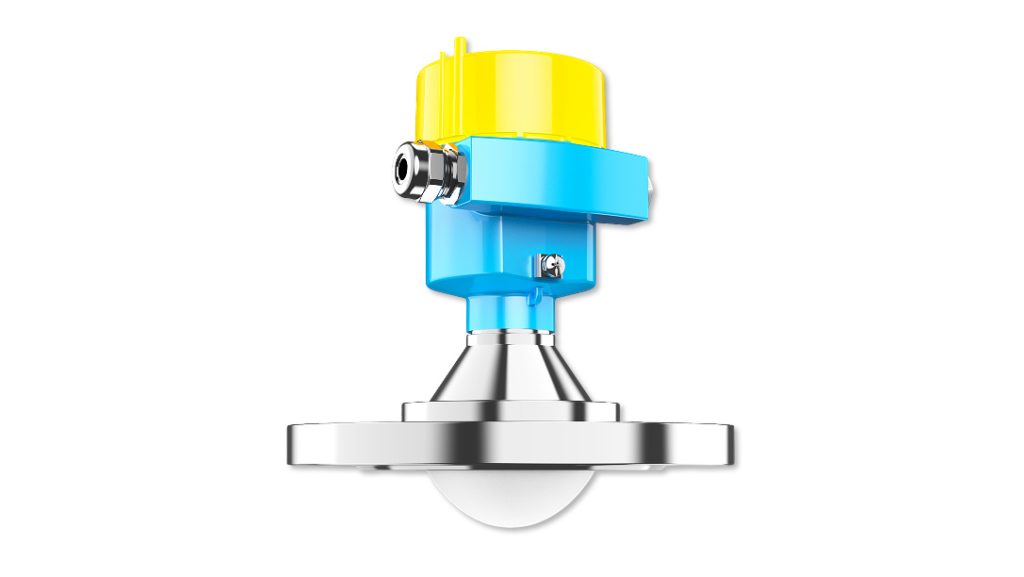
For rapeseed oil storage tanks, the instrument offers high accuracy, strong resistance to interference, and low maintenance requirements. It is therefore well suited to the digital and intelligent management needs of modern grain and edible oil processing enterprises.
Challenges in Rapeseed Oil Level Measurement
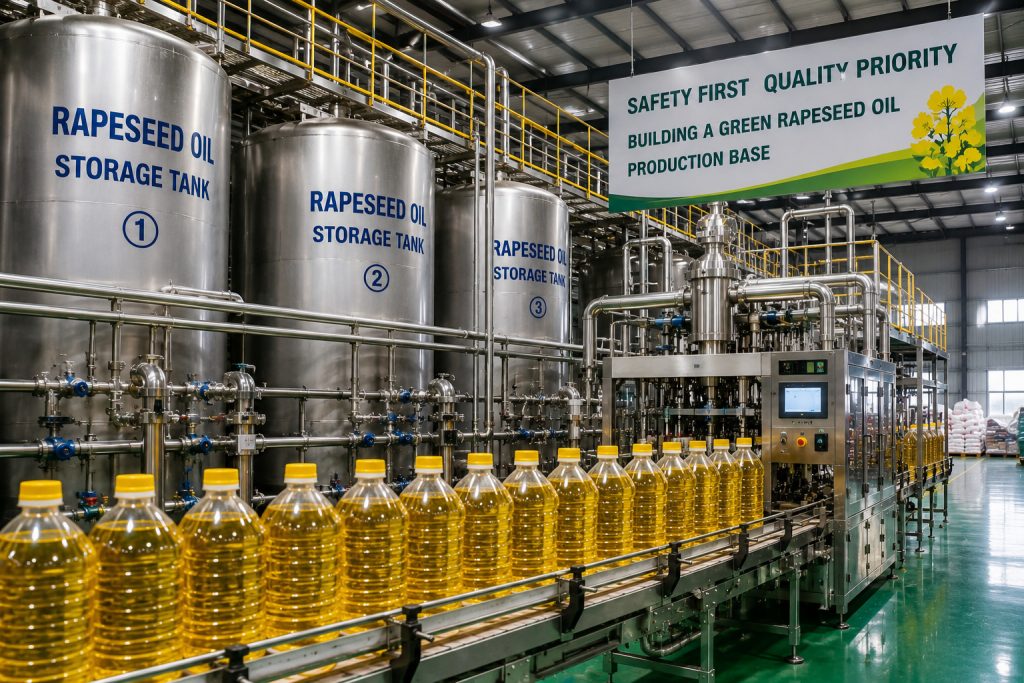
Rapeseed oil is widely used in edible oil processing, food manufacturing, and grain and oil storage. It is commonly stored in large vertical or horizontal tanks.
Because these tanks often operate with continuous filling and discharge, the liquid level measurement system must remain accurate and stable under changing process conditions.
The main measurement challenges include the following.
1. Fluctuating Oil Surfaces
During filling and discharge, the oil surface may fluctuate continuously. Traditional contact-type level instruments can be affected by liquid movement, which may cause unstable readings or signal fluctuations.
2. Oil Mist and Vapor
Although rapeseed oil has relatively low volatility, oil mist or vapor may still form in the upper section of the tank during heated storage or winter insulation.
These conditions may interfere with conventional ultrasonic level meters or lower-frequency radar instruments.
3. Complex Internal Tank Structures
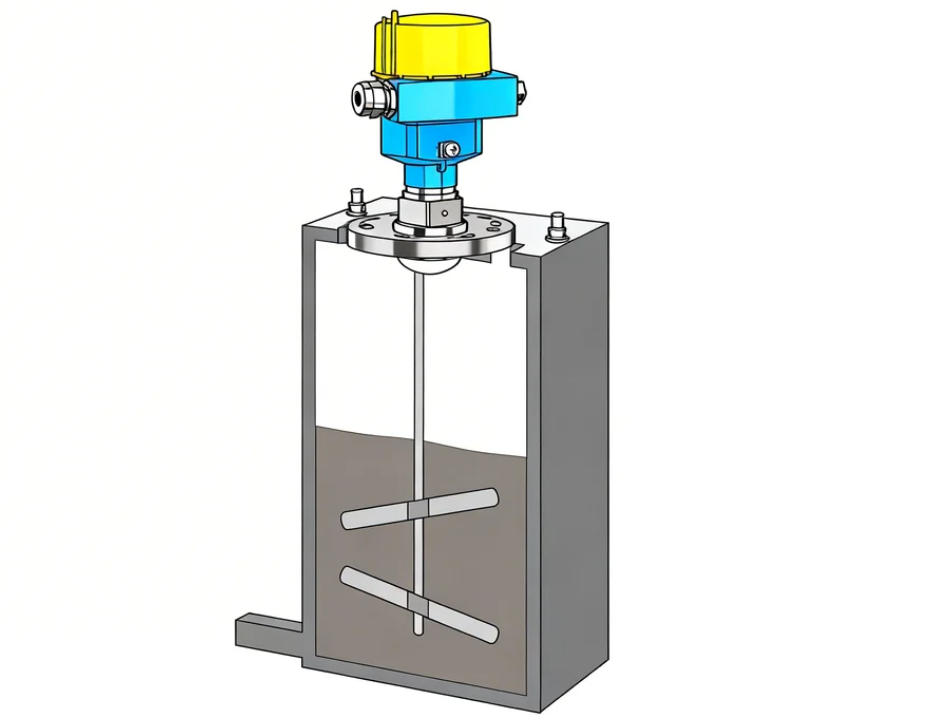
Some storage tanks contain agitators, heating coils, reinforcing structures, ladders, support beams, or manholes.
These internal components may generate false echoes, making it more difficult for the level instrument to identify the true oil surface.
4. Increasing Demands for Inventory Management
Modern grain and edible oil enterprises are increasingly integrating MES, DCS, or SCADA systems into their production facilities.
These systems require stable and reliable real-time level data for inventory calculation, automatic replenishment, production planning, and process scheduling.
For these reasons, a high-accuracy radar level meter with strong interference resistance is an ideal choice for rapeseed oil storage tank measurement.
JWrada®-34 Radar Level Measurement Solution
To meet the requirements of rapeseed oil level measurement, the JWrada®-34 uses 80 GHz high-frequency millimeter-wave radar technology to provide continuous, non-contact liquid level monitoring.
Compared with conventional 26 GHz radar instruments, an 80 GHz radar level meter provides a narrower beam angle, more concentrated signal energy, and clearer echo signals.
Even when a storage tank contains multiple internal structures, the instrument can identify the actual oil surface more effectively.
Narrow Beam Angle Improves Measurement Reliability
The JWrada®-34 is equipped with a high-performance lens antenna that produces a narrow and highly focused radar beam.
In rapeseed oil tanks containing agitators, ladders, heating coils, or other obstacles, the radar beam can be directed away from interfering structures.
This helps reduce false echoes and improves measurement accuracy and long-term stability.
Intelligent Echo Processing Improves Interference Resistance
Jiwei’s independently developed intelligent echo-learning algorithm enables the radar level meter to identify and track the true liquid level signal automatically.
Its signal-processing capabilities include:
- Automatic false-echo suppression
- Separation of multiple echo signals
- Dynamic target tracking
- Intelligent echo recognition
Even when oil mist, vapor, foam, or internal tank structures are present, the instrument can maintain a stable output and reduce sudden fluctuations in the displayed liquid level.
Non-Contact Measurement Supports Hygiene and Safety
Rapeseed oil is a food-grade raw material, so hygiene and product cleanliness are important considerations.
The JWrada®-34 uses non-contact measurement technology. Its antenna does not need to touch the process medium, reducing the risk of oil contamination and eliminating mechanical wear caused by direct contact.
Compared with contact-type instruments such as float level gauges, the radar level meter offers several advantages:
- No mechanical moving parts
- No risk of float blockage or sticking
- Reduced maintenance requirements
- Longer service life
- Lower long-term operating costs
These features make the instrument suitable for continuous operation in food and edible oil production facilities.
Bluetooth Wireless Commissioning Improves Installation Efficiency
Traditional level instruments often require engineers to open the housing before adjusting parameters.
This process may be inconvenient and time-consuming, particularly when the instrument is installed on top of a tall storage tank.
The JWrada®-34 is equipped with a Bluetooth 5.0 module and supports HART communication. Through Jiwei’s intelligent control application, engineers can configure parameters, check operating conditions, and commission the instrument wirelessly.
Without repeatedly opening the instrument enclosure, on-site engineers can perform tasks such as:
- Empty-tank calibration
- Full-tank configuration
- Echo-curve viewing
- Parameter adjustment
- Fault diagnosis
- Operating-status monitoring
This functionality can simplify commissioning, reduce high-level working time, and shorten the overall project start-up period.
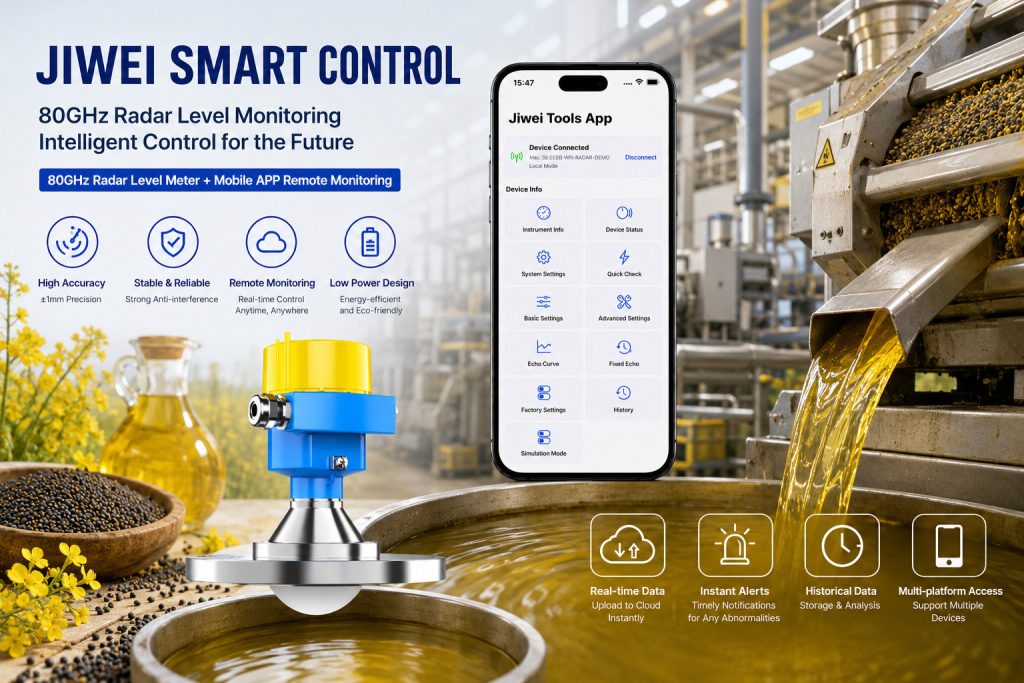
Typical Application Case
A large grain and edible oil processing enterprise operates several storage tanks for crude rapeseed oil, intermediate oil, and finished edible oil.
The company previously used traditional liquid level measurement instruments. During long-term operation, several problems were identified:
- Large fluctuations in displayed level values
- Occasional false high-level alarms
- Significant errors in tank inventory calculations
- Frequent maintenance requirements
- Limited integration with the plant control system
As part of an automation upgrade, the company installed JWrada®-34 radar level meters on its rapeseed oil storage tanks.
After commissioning, the instruments delivered stable and continuous level measurement.
Even during filling and discharge, when the oil surface fluctuated, the displayed values remained steady. Internal tank structures did not create significant measurement interference, and the instruments communicated reliably with the DCS.
The new system also enabled real-time inventory monitoring and reduced routine maintenance work.
By obtaining more accurate storage tank level data, the enterprise was able to improve raw material purchasing, production scheduling, inventory management, and overall operating efficiency.
Key Advantages of the JWrada®-34 Radar Level Meter
As a new-generation 80 GHz radar level meter from Jiwei, the JWrada®-34 offers the following advantages:
- 80 GHz millimeter-wave radar technology for a narrow beam angle and high measurement accuracy
- Maximum measuring range of up to 150 meters, making it suitable for large storage tanks and silos
- Intelligent echo-learning algorithm for suppressing interference caused by vapor, foam, oil mist, and complex internal structures
- HART communication protocol support for integration with different process automation systems
- Built-in Bluetooth wireless commissioning for easier installation, configuration, and maintenance
- Explosion-proof design options for use in demanding industrial environments
- Non-contact measurement with no moving mechanical parts
- Stable long-term operation with reduced maintenance requirements
- Lower total cost of ownership throughout the instrument’s service life
Application Value in the Edible Oil Industry
As the grain and edible oil industry moves toward intelligent manufacturing, liquid level measurement is no longer limited to basic process monitoring.
Accurate level data has become an essential source of information for digital inventory management, automatic production control, operational planning, and enterprise-level decision-making.
With its 80 GHz millimeter-wave radar technology, intelligent echo-processing algorithm, wireless commissioning capability, and high reliability, the JWrada®-34 provides a stable and accurate level measurement solution for rapeseed oil storage tanks.
It can be used in large grain and oil processing enterprises, edible oil production facilities, food-processing plants, and other oil storage applications.
By providing real-time liquid level monitoring and more accurate inventory information, the JWrada®-34 radar level meter can help companies improve production efficiency, optimize storage management, reduce maintenance costs, and increase the overall level of plant automation.