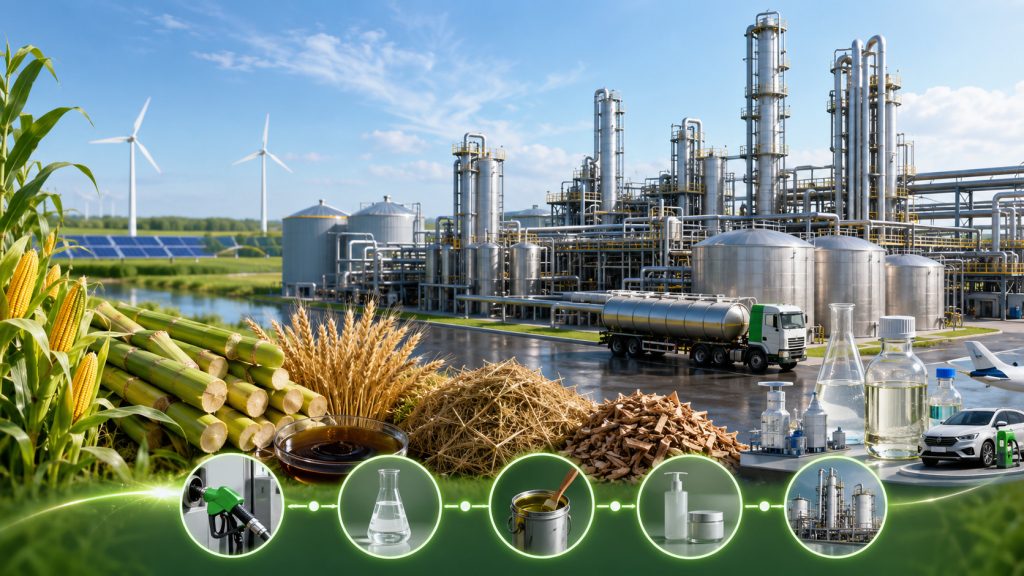
As the global energy industry moves toward lower-carbon production, bioethanol is increasingly used in fuel blending, chemical manufacturing, industrial solvents, and sustainable fuel supply chains.
Whether bioethanol is produced from corn, wheat, sugarcane, molasses, straw, forestry residues, or other cellulosic materials, stable fermentation and distillation control is essential for improving ethanol yield, reducing energy consumption, and maintaining consistent product quality.
In a bioethanol plant, process variables such as temperature, pH, sugar concentration, feed flow, fermentation activity, and distillation conditions often receive the most attention. However, level measurement is equally important throughout the production process.
The level inside a fermentation tank affects batch volume, available headspace, foam control, mixing performance, heat transfer, and feed or discharge interlocks. Level signals from mash buffer tanks, distillation feed tanks, condensate vessels, and finished ethanol storage tanks are also critical for maintaining continuous operation, preventing overfilling, protecting pumps against dry running, and managing inventory.
These applications can be difficult because the process may involve foam, vapor, condensation, agitators, heating or cooling coils, suspended solids, and changing media properties.
Traditional contact level instruments may experience buildup, corrosion, blockage, mechanical wear, or frequent maintenance.
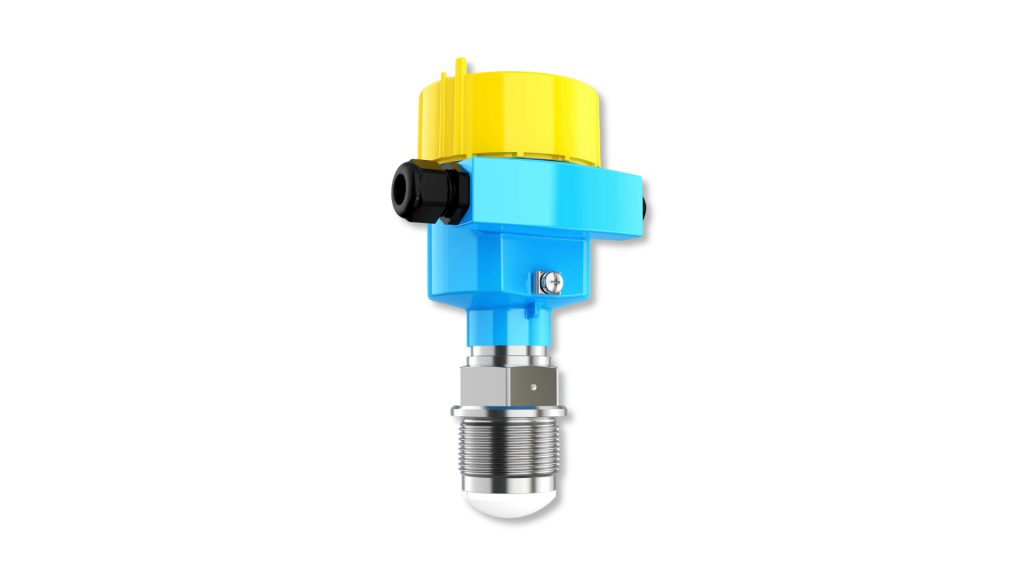
The JWrada-32 radar level meter uses 80 GHz frequency-modulated continuous-wave technology to provide continuous, non-contact level measurement for fermentation tanks, intermediate process vessels, and ethanol storage applications.
1. Overview of the Bioethanol Production Process
Bioethanol plants use different raw materials and equipment configurations, but the overall production process normally includes raw material preparation, saccharification or hydrolysis, fermentation, distillation, dehydration, and final product storage.
1.1 Raw Material Preparation and Saccharification
Sugar-rich feedstocks such as sugarcane juice and molasses can usually enter the fermentation stage after suitable preparation.
Starch-based materials such as corn and wheat must first be milled, mixed with water, cooked, and treated with enzymes. These steps convert starch into fermentable sugars.
Cellulosic feedstocks such as straw, agricultural residues, and forestry materials require more complex pretreatment and hydrolysis. The purpose is to break down the lignocellulosic structure and release sugars that can be converted into ethanol.
During this stage, slurry tanks, saccharification vessels, and hydrolysate buffer tanks must maintain stable levels. Reliable level measurement helps ensure that raw materials, water, enzymes, and other additives are introduced in the correct proportions.
1.2 Fermentation
The prepared sugar-containing mash is transferred into fermentation tanks, where yeast, nutrients, and other process additives are introduced.
The yeast converts fermentable sugars into ethanol and carbon dioxide. During this process, temperature, pH, nutrient supply, fermentation time, and yeast activity must be carefully controlled.
Operators must also monitor foam formation, carbon dioxide release, and changes in liquid level.
If a fermentation tank is overfilled, foam may enter the vent system, foam separator, or safety equipment. If the liquid level is too low, mixing, cooling, and batch yield may be affected.
1.3 Distillation and Dehydration
After fermentation, the mash is transferred to the distillation system.
Heat and vapor-liquid separation are used to separate ethanol from water, solids, and other components.
Distillation columns, reboilers, reflux drums, condensate vessels, and intermediate storage tanks must operate together as a coordinated system.
Large level fluctuations in one buffer vessel may cause unstable feed flow, pump dry running, irregular reflux, or disturbances inside the distillation column.
Following distillation, the ethanol normally undergoes additional dehydration to reach the required product concentration. It is then transferred to finished-product storage tanks before shipment, blending, or further processing.
2. Why Level Measurement Matters in Fermentation Control
Fermentation tank level is not simply an inventory measurement.
It provides important information about filling, reaction conditions, foam space, mixing, and discharge performance.
Controlling the Effective Filling Volume
If identical fermentation tanks are filled to different levels, the sugar concentration, yeast dosage, heat-transfer load, and final ethanol output may vary between batches.
A continuous level signal can be integrated into the batch filling sequence so that mash, nutrients, process water, and additives are introduced according to the required recipe.
This helps reduce filling errors caused by manual observation or timing-based control.
Maintaining Sufficient Foam Space
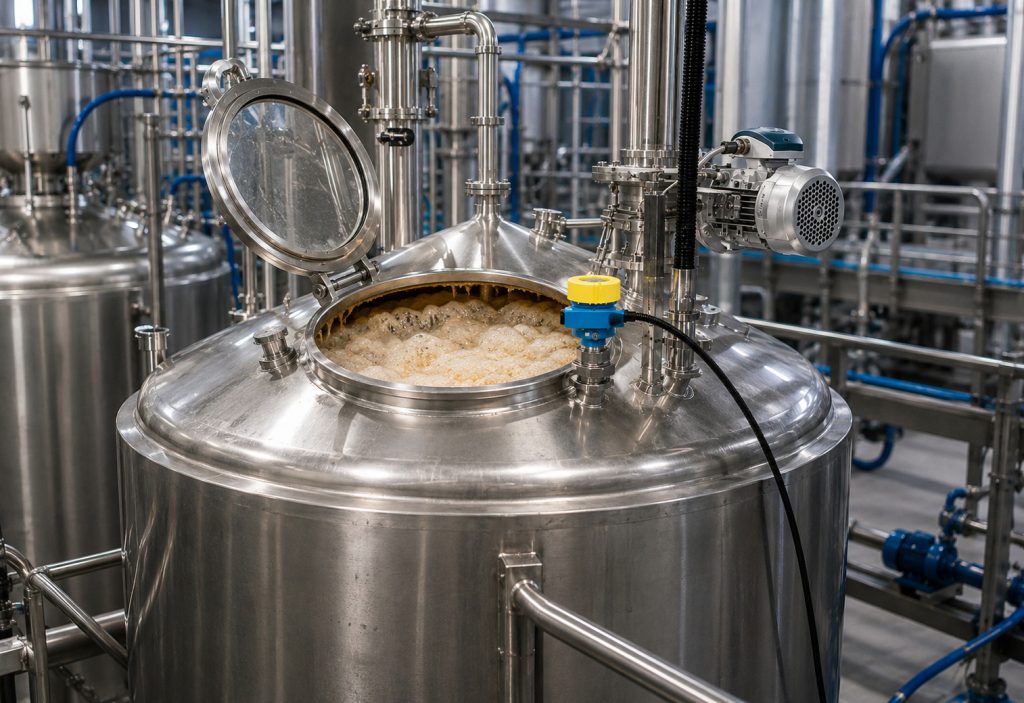
Fermentation continuously releases carbon dioxide and may generate large quantities of foam.
If the liquid level is too high, there may not be enough free space above the liquid surface. Foam can then enter vent pipes, gas-handling equipment, foam-control systems, or safety devices.
Accurate liquid level information helps operators maintain sufficient headspace and determine when antifoam dosing or other foam-control measures may be required.
A radar level transmitter normally measures the surface that produces the strongest and most stable reflection.
Light, dry foam may allow part of the radar signal to pass through to the actual liquid surface. Dense, wet foam may generate a separate reflection or weaken the liquid-surface echo.
During commissioning, the echo curve should therefore be checked to confirm whether the transmitter is tracking the true liquid surface or the upper foam layer.
Maintaining Stable Mixing and Heat Transfer
Fermentation vessels often contain agitators, cooling coils, or external jackets.
If the level becomes too low, part of the heat-transfer surface may no longer be covered by liquid, and agitator loading may change.
If the level becomes too high, the risk of foam carryover and contamination of upper vessel areas increases.
Connecting the level signal to the inlet valve, discharge pump, and batch control program helps keep the process within the intended operating range.
Detecting Abnormal Filling or Discharge
If an inlet valve is open but the level does not rise as expected, the system may have a blocked pipe, failed pump, closed valve, or faulty instrument.
If the level continues to fall after all discharge equipment has stopped, operators may need to check for valve leakage, siphoning, pipeline drainage, or vessel leakage.
A continuous level trend can reveal these abnormalities earlier than a high- or low-level point switch alone.
3. Main Challenges in Bioethanol Fermentation Level Measurement
3.1 Constantly Changing Foam Conditions
The thickness, moisture content, and structure of fermentation foam change with yeast activity, temperature, sugar concentration, gas release, and antifoam dosing.
Loose, relatively dry foam may allow radar signals to reach the true liquid surface.
Dense foam with a high liquid content may produce a strong reflection of its own.
Because foam conditions change throughout the batch, the echo position and signal strength may also vary.
Radar selection for fermentation tanks should therefore consider more than measurement range. The expected foam thickness, foam duration, process stage, and required measurement target should all be evaluated.
3.2 False Echoes from Agitators and Internal Structures
A fermentation tank may contain an agitator shaft, impeller blades, cooling coils, spray pipes, feed pipes, baffles, and structural supports.
These metal components reflect radar signals.
If the beam is too wide or the mounting position is poorly selected, the transmitter may receive strong reflections from fixed internal structures and have difficulty identifying the true liquid surface.
High-frequency radar provides a narrower beam, making it easier to avoid internal obstructions.
However, correct mounting and false-echo mapping are still necessary.
3.3 Vapor and Condensation
Saccharification liquid, fermentation mash, distillation feed, and condensate vessels may contain water vapor, volatile gases, or condensation.
If heavy condensation or sticky buildup forms on the antenna, the quality of the radar signal may decrease.
The transmitter should be positioned away from direct spray or severe condensation zones.
Antenna materials, sealing materials, and process connections must also be selected according to the operating temperature, chemical conditions, and cleaning requirements.
3.4 Changes in Density and Composition
During fermentation, sugar is gradually converted into ethanol and carbon dioxide.
As a result, the density, viscosity, suspended-solids concentration, and dielectric properties of the liquid change throughout the process.
Hydrostatic level instruments can be affected by density changes because they calculate liquid height from measured pressure.
Non-contact radar measures the distance between the antenna and the liquid surface using electromagnetic waves. It does not require a density value to calculate level.
This makes radar particularly suitable for fermentation processes in which product composition changes continuously.
3.5 Cleaning and Hygiene Requirements
Bioethanol process vessels may be cleaned using water, alkaline solutions, steam, or other cleaning procedures.
Contact probes, floats, guide rods, and mechanical components can create additional buildup points and may require frequent removal or cleaning.
A radar level transmitter is mounted at the top of the tank and normally does not extend into the liquid.
This can reduce direct contact with sticky mash, fibers, solids, and fermentation residues.
For processes with defined hygienic requirements, users must still verify the antenna design, surface finish, gasket material, and process connection against the applicable project standards.
3.6 Explosion-Protection Requirements
Areas around downstream fermentation equipment, distillation systems, dehydration units, and finished-product tanks may contain ethanol vapor.
Ethanol is flammable, and the required instrument certification depends on the hazardous-area classification, vapor concentration, ventilation, and plant design.
Users must verify the explosion-protection method, gas group, temperature class, cable sealing, grounding, and installation requirements.
A general-purpose instrument should not be selected for a hazardous area based only on its normal process specifications.
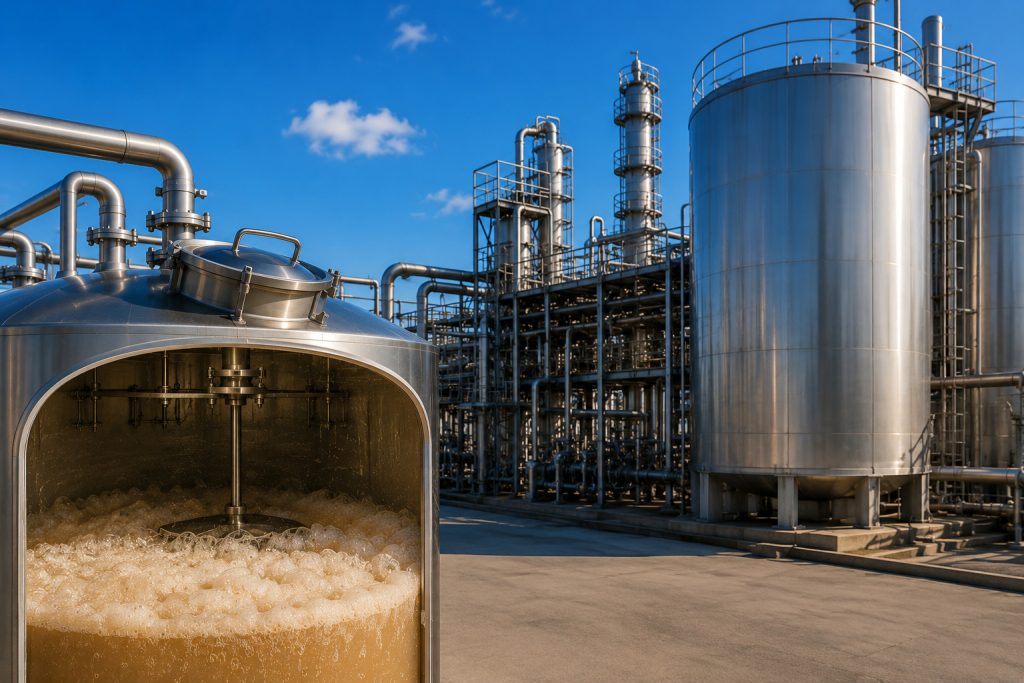
4. How the JWrada-32 Radar Level Transmitter Works
The JWrada-32 uses 80 GHz FMCW radar technology.
Its antenna continuously transmits a millimeter-wave signal whose frequency changes linearly over time.
When the signal reaches the liquid surface, part of it is reflected back to the antenna.
A frequency difference is created between the transmitted signal and the received echo.
The electronic unit analyzes this difference to calculate the distance from the antenna to the material surface.
The transmitter then converts this distance into a level value using the configured vessel height, zero point, and measurement range.
FMCW radar collects continuous frequency information and can distinguish reflections originating from different distances.
The JWrada-32 incorporates intelligent echo-processing functions that help identify and suppress fixed reflections from tank walls, pipes, supports, agitators, and other internal structures.
The system then dynamically tracks the valid product-surface echo.
5. Why Use the JWrada-32 for Bioethanol Level Measurement?
5.1 Narrow 80 GHz Beam for Complex Vessels
Fermentation and buffer tanks often contain multiple internal structures.
The 80 GHz operating frequency and compact lens antenna allow the JWrada-32 to produce a concentrated measurement beam.
A narrow beam can be directed through the available space between an agitator shaft, cooling coils, feed pipes, and other internal components.
This helps reduce interference from the vessel structure.
A narrow beam does not eliminate the need for proper installation.
The mounting point must still be selected according to the tank diameter, measurement height, beam angle, and internal arrangement.
5.2 Non-Contact Measurement Reduces Buildup Problems
The JWrada-32 transmits radar signals from the top of the vessel toward the liquid surface.
The sensing element does not normally need to be immersed in fermentation mash or ethanol.
Compared with floats, rods, or pressure impulse lines, a non-contact design helps reduce problems caused by sticky mash, fibers, suspended solids, deposits, and blockage.
This can lower maintenance requirements in vessels that require frequent cleaning.
5.3 Direct Measurement Independent of Liquid Density
Fermentation liquid density changes as sugar is consumed and ethanol is produced.
A hydrostatic instrument using a fixed density value may show additional measurement error as the process composition changes.
Radar measures the physical distance to the liquid surface, so changes in density do not directly affect the level calculation.
5.4 Measurement Range and Accuracy for Multiple Vessel Sizes
The JWrada-32 offers a maximum measurement range of 60 meters and a stated accuracy of up to ±1 millimeter.
This allows it to cover many fermentation tanks, mash vessels, intermediate tanks, and large ethanol storage tanks.
Actual measurement performance depends on several factors, including:
- Product reflectivity
- Foam conditions
- Antenna contamination
- Vessel geometry
- Internal obstructions
- Installation position
- Parameter configuration
Final performance should therefore be assessed according to real process conditions rather than laboratory accuracy alone.
5.5 Multiple Output Options
The JWrada-32 supports output options such as 4–20 mA/HART and RS485/Modbus.
A 4–20 mA signal can be connected to a conventional PLC or DCS analog input.
HART communication can be used for configuration, diagnostics, and device information.
RS485/Modbus is suitable for digital data collection and multi-device communication networks.
The output should be selected according to the plant control architecture, wiring distance, power supply, and communication standard.
5.6 Bluetooth Commissioning
Fermentation tanks and ethanol storage tanks are often installed on elevated platforms or in areas with restricted access.
Traditional commissioning may require technicians to open the instrument housing and operate local keys or displays.
The JWrada-32 includes Bluetooth communication and can be configured through the Jiwei intelligent control application or mini program.
Users can adjust parameters, view echo curves, and check instrument status wirelessly.
This can reduce repeated housing opening and make it easier to inspect the echo profile, change the measuring range, or identify the position of false echoes.
When mobile devices are used in hazardous areas, plant rules governing electronic equipment and hazardous-area work must still be followed.
5.7 Multiple Explosion-Proof Configurations
The JWrada-32 is available with configurations for gas flameproof protection, gas intrinsic safety, and combustible-dust environments.
Bioethanol applications mainly require evaluation of explosive gas risks caused by ethanol vapor.
The final certification must match the hazardous-zone classification, gas group, and temperature class defined by the project designer or plant owner.
6. Typical JWrada-32 Measurement Points in Bioethanol Plants
Fermentation Tanks
Fermentation tanks are one of the most representative applications for the JWrada-32.
The transmitter is mounted on the tank roof and aimed through a clear path between the agitator shaft, coils, and feed pipes.
It continuously monitors the base liquid surface.
The level signal can be used to:
- Control batch filling volume
- Prevent excessive filling
- Provide data for foam-space management
- Confirm completion of tank discharge
- Support batch records and trend analysis
- Work with an independent high-high-level switch
- Detect abnormal filling or discharge rates
When foam is thick or variable, echo curves should be reviewed during different fermentation stages.
The measured target should be verified against the actual tank condition.
For safety-critical overfill protection, an independent point-level switch is normally recommended rather than relying solely on one continuous level transmitter.
Saccharification Liquid and Fermentation Mash Buffer Tanks
Saccharification liquid buffer tanks balance upstream raw material preparation with downstream fermentation.
Fermented mash buffer tanks coordinate fermentation discharge with the distillation feed system.
Unstable levels in these vessels can cause pumps to start and stop frequently, interrupt distillation feed, or force upstream equipment to wait.
Continuous level measurement allows pump speed and transfer flow to be controlled according to the available tank capacity.
Distillation Feed Tanks
A distillation system normally requires a continuous and stable feed.
A low liquid level can cause a feed pump to run dry, while a high level may cause overflow or interrupt the upstream fermentation discharge sequence.
The JWrada-32 output can be used by the control system to regulate the feed pump, switch to a standby pump, and generate high- or low-level alarms.
Reflux Drums and Condensate Vessels
Condensed liquid from the top of a distillation column normally enters a reflux drum.
Part of the liquid is returned to the column, while the remainder continues to the next process stage.
Changes in reflux-drum level can affect pump operation and the vapor-liquid balance inside the distillation column.
These vessels may contain vapor, condensation, and changing temperatures.
Before selecting the JWrada-32, users should verify the process temperature, pressure, antenna material, available nozzle size, and installation clearance.
Finished Ethanol Storage Tanks
Finished ethanol storage tanks require inventory monitoring, loading control, overfill prevention, and abnormal loss detection.
A radar level transmitter provides continuous measurement without mechanical moving parts or direct immersion in the ethanol.
In these applications, explosion protection, process sealing, grounding, and static-electricity control are especially important.
For custody transfer or high-accuracy tank gauging, the complete system must also consider tank calibration, temperature compensation, volume tables, and applicable metering regulations.
A standard process level transmitter should not automatically be treated as a complete certified tank-gauging system.
7. Installation Guidelines for Fermentation-Tank Radar
Avoid the Tank Center and Agitator Shaft
The radar transmitter should not be mounted directly above the agitator shaft.
The rotating shaft and impeller blades can produce strong reflections and may periodically enter the measurement beam.
A suitable location should provide a clear view of the liquid surface while remaining away from major internal structures.
Maintain a Suitable Distance from the Tank Wall
If the instrument is mounted too close to the tank wall, welds, reinforcement rings, buildup, and the wall itself may generate interference echoes.
The mounting distance should be determined according to tank diameter, measurement height, and beam angle.
The instrument should also be positioned away from feed inlets and cleaning nozzles.
Aim the Antenna Vertically at the Liquid Surface
If the transmitter is installed at an angle, the main beam may be directed away from the intended measurement area.
This reduces the strength of the true liquid-surface echo.
For conical roofs, domed tanks, or angled nozzles, an adjustment flange or suitable mounting structure should be used to point the antenna as vertically as possible toward the liquid surface.
Avoid Direct Feed and Cleaning Spray
Incoming liquid, antifoam spray, or CIP nozzles should not continuously strike the antenna.
Direct spray may create a persistent liquid film, contamination, or unstable reflections.
Before installation, the location and direction of all inlets and cleaning nozzles should be reviewed.
Perform False-Echo Mapping
When the tank is empty or at a known low level, false-echo mapping can be used to record reflections from fixed internal structures.
The mapping range must not accidentally include positions where the real liquid surface will later appear.
After setup, the echo curve should be checked at low, medium, and high levels to confirm that the transmitter continues tracking the correct target.
Configure an Appropriate Damping Time
Agitation and foam can cause short-term movement of the measured surface.
If damping is too low, the output may fluctuate excessively.
If damping is too high, the signal may respond too slowly to actual filling or emptying.
The damping time should be selected according to the vessel size, expected surface movement, and control objective.
Inventory indication may use a relatively stable output, while critical high-level protection should be provided by a separate device with a clearly defined response.
8. Control-System Interlock Recommendations
The JWrada-32 can provide continuous level data to a PLC or DCS.
A fermentation-tank control strategy may include the following functions:
- Close the raw material inlet valve when the filling setpoint is reached
- Stop additional dosing when the level approaches the upper limit
- Stop the discharge pump when the level reaches the low limit
- Generate an alarm when the rate of level change is abnormal
- Block automatic filling if the level signal is invalid
- Initiate an independent emergency shutdown when a high-high-level switch operates
In buffer tanks and distillation feed tanks, the continuous level signal can also regulate pump speed and reduce frequent starting and stopping.
A continuous level transmitter is suitable for process control, monitoring, and trend analysis.
A point-level switch is better suited to independent high- or low-level protection.
Combining the two technologies normally provides greater reliability than depending on a single instrument.
9. Operational Benefits of the JWrada-32
More Consistent Batch Filling
Using continuous level measurement for batch filling helps fermentation tanks maintain similar working volumes.
This provides a more consistent basis for controlling sugar concentration, nutrient dosage, yeast loading, and fermentation time.
Less Manual Inspection
Operators can view tank level, trends, and alarms from the control room without repeatedly climbing to the vessel roof.
Bluetooth commissioning also allows technicians to inspect device status and echo information from a more convenient position.
Reduced Maintenance Compared with Contact Instruments
Because the radar antenna is not continuously immersed in the process liquid, it avoids floats, guide rods, or probes becoming covered by mash, fibers, or deposits.
This can reduce cleaning and mechanical maintenance.
Improved Coordination Between Process Stages
Continuous level signals from buffer and feed tanks can be used to regulate transfer capacity.
This helps balance material flow between fermentation, distillation, dehydration, and storage.
Support for Digital Production Management
HART or Modbus communication can transmit real-time level, device status, and diagnostic information to the plant control system.
Historical trends can then be used to analyze:
- Batch filling consistency
- Fermentation discharge times
- Tank turnover
- Inventory changes
- Unusual filling or emptying behavior
These data provide a useful foundation for process improvement and production planning.
10. Frequently Asked Questions
Can the JWrada-32 Measure Fermentation Foam Thickness Directly?
The primary function of the JWrada-32 is to measure a liquid or material surface continuously.
Whether foam produces a stable echo depends on its thickness, moisture content, bubble structure, and dielectric properties.
In some applications, the radar signal may penetrate loose foam and measure the liquid below.
In other applications, it may detect the foam surface.
The intended measurement target should be defined before commissioning and verified through echo-curve analysis and site testing.
Can Radar Be Used in a Fermentation Tank with an Agitator?
Yes, but the mounting location is critical.
The narrow beam of an 80 GHz radar should be directed away from the agitator shaft, impeller blades, coils, and feed pipes.
False-echo mapping should also be performed.
If the tank contains many internal components, vessel drawings should be reviewed before selecting the mounting position.
Is Radar Affected by Changes in Fermentation-Liquid Density?
Radar calculates level from the electromagnetic-wave travel distance to the liquid surface.
It does not rely on hydrostatic pressure, so density changes do not directly create a level error.
However, foam, heavy antenna buildup, and changes in reflectivity may still affect echo quality.
Does a Finished Ethanol Tank Require an Explosion-Proof Radar?
The need for an explosion-proof model is determined by the hazardous-area classification.
Because ethanol is flammable, storage and distillation areas must be carefully evaluated for explosive gas conditions.
The selected transmitter must match the required explosion-protection marking, zone classification, gas group, temperature class, and electrical installation rules.
Can a Radar Level Transmitter Replace a High-Level Switch?
A continuous radar transmitter can provide a software-based high-level alarm.
However, critical overfill protection and emergency feed shutdown normally benefit from an independent point-level switch.
This provides a separate protection layer if the continuous transmitter, control system, or communication circuit fails.
Conclusion
Stable bioethanol production depends not only on temperature, pH, sugar concentration, and distillation conditions, but also on reliable level measurement.
Fermentation foam, agitators, changing liquid properties, process vapor, buffer-tank fluctuations, and hazardous ethanol-storage conditions all create demanding measurement requirements.
The JWrada-32 radar level transmitter uses 80 GHz FMCW technology and provides a narrow beam, non-contact measurement, intelligent echo processing, multiple communication outputs, Bluetooth commissioning, and explosion-proof configuration options.
It can be applied to:
- Fermentation tanks
- Saccharification liquid tanks
- Fermentation mash buffer tanks
- Distillation feed tanks
- Reflux drums
- Condensate vessels
- Intermediate ethanol tanks
- Finished ethanol storage tanks
For reliable operation, the transmitter must be selected according to the vessel structure, foam conditions, temperature, pressure, media reflectivity, internal obstructions, nozzle arrangement, and hazardous-area classification.
Correct mounting, false-echo mapping, parameter configuration, and verification at multiple liquid levels are essential.
By combining JWrada-32 continuous level measurement with independent high- and low-level switches, as well as temperature, pressure, flow, and analytical instruments, bioethanol plants can build a more complete process-monitoring system.
This integrated approach supports stable fermentation, consistent distillation feed, reduced unplanned shutdowns, improved inventory visibility, and more effective digital production management.