
In industrial automation, a magnetic switch is a sensing device that uses changes in a magnetic field to perform switching operations. It is widely used in liquid level monitoring, position detection, equipment interlocking, and automatic control systems. Thanks to its simple structure, high reliability, long service life, and non-contact operation, magnetic switches have become indispensable components in industries such as oil and gas, petrochemicals, power generation, water treatment, pharmaceuticals, and food processing.
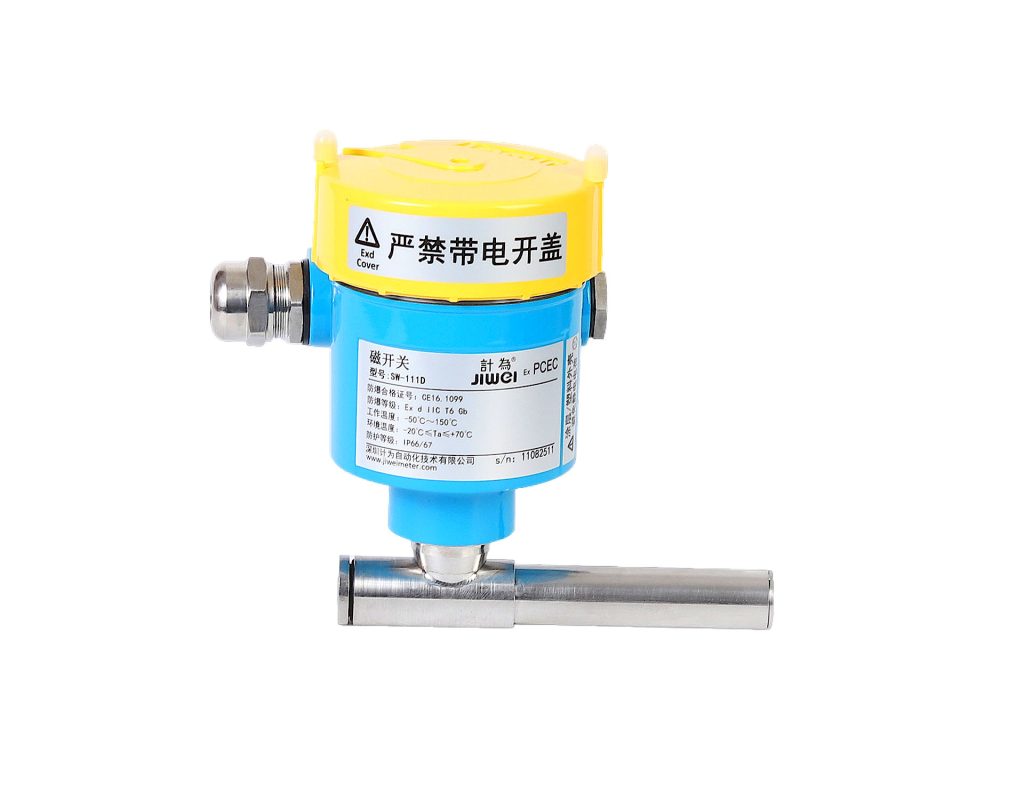
As industrial automation continues to advance, manufacturers demand higher levels of safety and reliability. Consequently, high-performance, explosion-proof, and long-life magnetic switches have become the preferred choice for modern industrial applications.
So, what exactly is a magnetic switch? How does it work? And how do you select the right model for your application? This article provides a comprehensive overview.
What Is a Magnetic Switch?
A magnetic switch is an electrical switching device that operates through the presence or absence of a magnetic field. When a permanent magnet approaches the switch, the magnetic field actuates an internal sensing element—typically a reed switch or a magnetic sensor—causing the electrical contacts to open or close and generate an output signal.
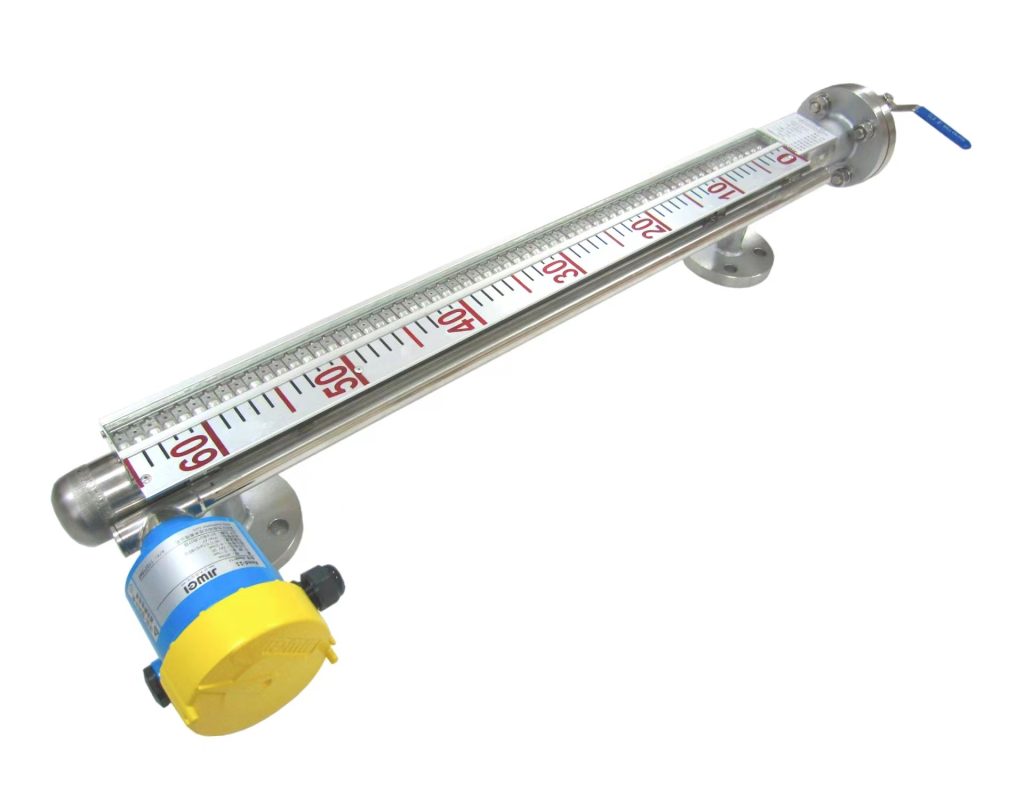
In industrial liquid level measurement, magnetic switches are commonly installed alongside magnetic level gauges, float level gauges, and magnetic float level transmitters. As the liquid level rises or falls, the magnetic float moves accordingly. When the float reaches the position of the magnetic switch, the magnetic field activates the switch, enabling functions such as high- or low-level alarms, pump protection, valve control, and process automation.
Compared with continuous level measurement devices, magnetic switches are primarily designed for point level detection, making them an economical, reliable, and easy-to-maintain solution.
How Does a Magnetic Switch Work?
The most common magnetic switch relies on a reed switch as its sensing element.
A reed switch consists of two ferromagnetic metal reeds hermetically sealed inside a glass tube. Under normal conditions, the contacts remain separated and the circuit stays open.
When a permanent magnet approaches, the reeds become magnetized and attract each other, causing the contacts to close and complete the circuit. Once the magnet moves away, the magnetic field disappears, the reeds separate, and the circuit opens again.
Since the switching action is achieved without mechanical linkage, magnetic switches offer several advantages:
- Fast response time
- Excellent repeatability
- Long electrical life
- Extremely low power consumption
- Hermetically sealed contacts
- Resistance to dust and moisture
These characteristics make reed-switch-based magnetic switches one of the most reliable solutions for industrial level control.
Types of Magnetic Switches
Depending on their sensing technology and application, magnetic switches can be categorized into several types.
1. Reed Magnetic Switch
The reed magnetic switch is the most widely used type in industrial automation.
It utilizes a reed switch as the core sensing element and is extensively applied in magnetic level gauges, float level switches, and other level monitoring systems.
2. Hall Effect Magnetic Switch
Hall effect magnetic switches detect magnetic fields using semiconductor Hall sensors instead of mechanical contacts.
They offer fast response, high switching frequency, and excellent durability. However, they require an external power supply and are generally more expensive than reed switches.
3. Explosion-Proof Magnetic Switch
Explosion-proof magnetic switches are specifically designed for hazardous environments where flammable gases or combustible dust may be present.
These switches typically comply with intrinsic safety or explosion-proof standards, making them suitable for chemical plants, refineries, oil terminals, and natural gas facilities.
4. Liquid Level Magnetic Switch
Liquid level magnetic switches are mounted externally on magnetic level gauges or float chambers. They detect the movement of the magnetic float and provide high- or low-level switching signals for process control.
Advantages of Magnetic Switches
Compared with traditional mechanical limit switches and contact-based sensing devices, magnetic switches offer several important advantages.
High Reliability
With minimal moving parts and magnetic actuation, magnetic switches provide stable performance and low failure rates.
Easy Installation
The switch is mounted externally without contacting the process medium, simplifying installation and maintenance.
Excellent Environmental Resistance
Magnetic switches can operate reliably in harsh industrial environments, including high temperatures, high pressures, corrosive media, and dusty conditions.
Long Service Life
High-quality reed switches are capable of millions of switching cycles, significantly reducing maintenance costs.
Low Maintenance Requirements
Routine maintenance is generally limited to checking mounting positions and electrical connections.
Industrial Applications of Magnetic Switches
Magnetic switches are widely used in virtually every industry requiring liquid level or position detection, including:
- Petrochemical storage tanks
- Boiler feedwater systems in power plants
- Water and wastewater treatment facilities
- Food and beverage processing tanks
- Pharmaceutical production equipment
- LNG storage and transportation systems
- Marine ballast water systems
- Environmental protection equipment
In magnetic level gauges, magnetic switches are commonly used for high-level, low-level, and overfill alarms. They can also be connected directly to PLCs, DCS systems, and other industrial controllers for automated process control.
How to Select the Right Magnetic Switch
Selecting the appropriate magnetic switch requires careful consideration of the application environment and process requirements.
1. Hazardous Area Requirements
If the installation site contains flammable gases or combustible dust, an explosion-proof or intrinsically safe magnetic switch should be selected.
2. Operating Temperature
Ensure that the switch’s temperature rating matches the process conditions, especially in high-temperature applications.
3. Output Type
Choose the appropriate output configuration—normally open (NO), normally closed (NC), or changeover contacts—according to the control system requirements.
4. Contact Rating
When switching inductive loads such as solenoid valves or contactors, verify that the contact rating is sufficient to ensure long-term reliability.
5. Protection Rating
For outdoor or harsh industrial environments, products with IP66 or IP67 protection are recommended to ensure reliable operation under dust and water exposure.
Installation Considerations
Proper installation is essential for reliable performance.
The following recommendations should be followed:
- Align the magnetic switch with the travel path of the magnetic float.
- Secure the switch firmly to prevent vibration-induced movement.
- Keep the switch away from strong external magnetic fields generated by motors or transformers.
- Follow the manufacturer’s wiring instructions carefully.
- Periodically inspect the mounting hardware and electrical connections.
Correct installation helps maximize both measurement accuracy and service life.
Why High-Reliability Magnetic Switches Matter
As industrial processes become increasingly automated, even a single false alarm or switching failure can lead to production downtime, material loss, or safety hazards.
For this reason, many manufacturers prioritize long-term reliability over initial purchase cost.
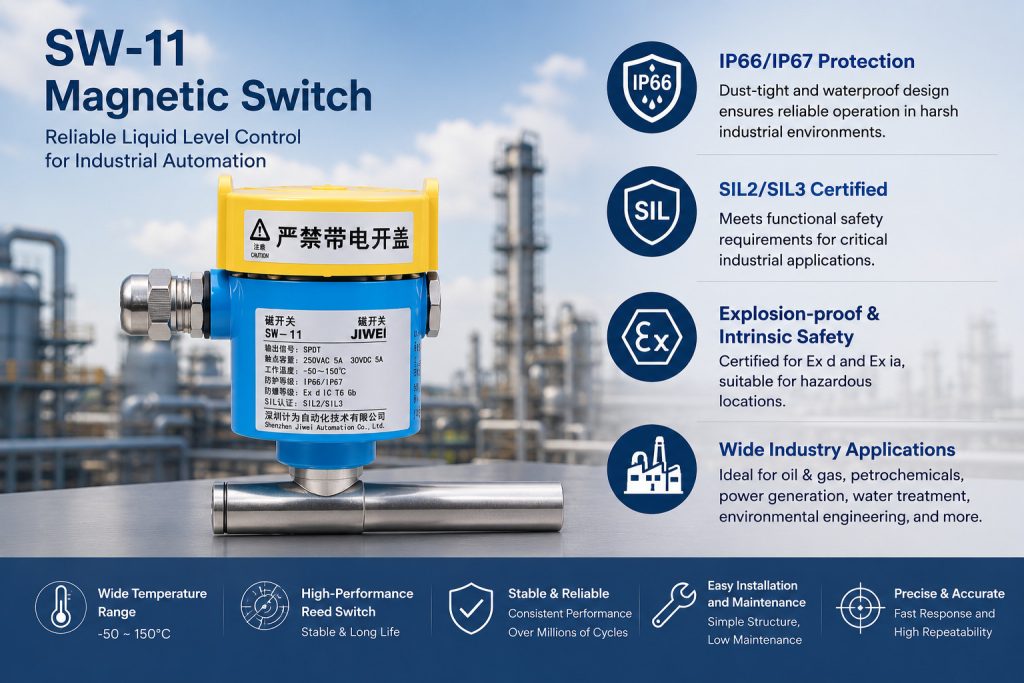
Jiwei’s SW-11 Magnetic Switch is designed specifically for demanding industrial liquid level applications. It features an imported high-power reed switch, providing higher contact capacity, greater switching stability, and extended service life. The product also incorporates a 304 stainless steel protection tube and a large aluminum terminal housing, making installation and maintenance easier while improving corrosion resistance.
In addition, the SW-11 offers IP66/IP67 ingress protection, making it suitable for harsh industrial environments. It has also obtained SIL2/SIL3 functional safety certification as well as explosion-proof and intrinsically safe certifications, allowing it to be used safely in industries such as oil and gas, petrochemicals, power generation, and environmental engineering. These features make it an ideal companion for magnetic level gauges in critical level control applications.
Future Trends in Magnetic Switch Technology
As Industry 4.0 and intelligent manufacturing continue to evolve, magnetic switches are also becoming smarter and more reliable.
Future developments are expected to focus on:
- Higher functional safety certifications
- Enhanced explosion-proof performance
- Wider operating temperature and pressure ranges
- Longer electrical and mechanical service life
- Better integration with intelligent monitoring and predictive maintenance systems
Industrial users are increasingly selecting certified, high-quality magnetic switches to improve operational safety, reduce maintenance costs, and maximize equipment availability.
Conclusion
Although a magnetic switch is only a small component within an automation system, it plays a critical role in liquid level control, equipment protection, and process safety. Whether installed on magnetic level gauges, float level gauges, or other industrial level control systems, a reliable magnetic switch significantly improves system stability while minimizing maintenance and downtime.
When selecting a magnetic switch, engineers should consider factors such as process medium, operating environment, explosion-proof requirements, output configuration, contact capacity, and certification standards. For critical industries including oil and gas, chemicals, power generation, and environmental protection, choosing a magnetic switch certified to SIL and relevant explosion-proof standards provides greater operational reliability and long-term safety.
Frequently Asked Questions (FAQ)
1. What is the difference between a magnetic switch and a proximity switch?
A magnetic switch is activated by a magnetic field, while a proximity switch detects objects using inductive, capacitive, ultrasonic, or other sensing technologies. They are designed for different applications.
2. Can a magnetic switch only be used with magnetic level gauges?
No. Magnetic switches can also be used with float level gauges, magnetic float chambers, and other equipment incorporating moving permanent magnets.
3. Can magnetic switches operate in high-temperature environments?
Yes. High-temperature models are available for demanding industrial processes, provided their temperature ratings meet the application requirements.
4. Which industries commonly use explosion-proof magnetic switches?
Explosion-proof magnetic switches are widely used in oil and gas, petrochemical, chemical processing, pharmaceutical manufacturing, and fuel storage facilities.
5. Do magnetic switches require regular maintenance?
Magnetic switches require very little maintenance. Periodic inspection of the mounting position, wiring, and switching performance is generally sufficient to ensure reliable long-term operation.