1. Project Background: Why Reliable Level Measurement Matters in Beer Production
In beer brewing, level measurement is required throughout multiple critical processes, including mashing, boiling, fermentation, storage, filtration, filling, and CIP cleaning. Whether in fermentation tanks, bright beer tanks, buffer tanks, wort tanks, or pre-filling storage tanks, level data directly affects feeding control, discharge rhythm, pump start-stop protection, overflow alarms, batch management, and product quality stability.
Beer tank level measurement is not simply about knowing “how much beer is inside the tank.” In actual production, level signals are closely linked to process control, safety interlocks, automation systems, and quality traceability. If beer tank level measurement is inaccurate, it may lead to excessive feeding, tank overflow, pump dry running, unstable filling, increased batch loss, and even risks to food hygiene and production continuity.
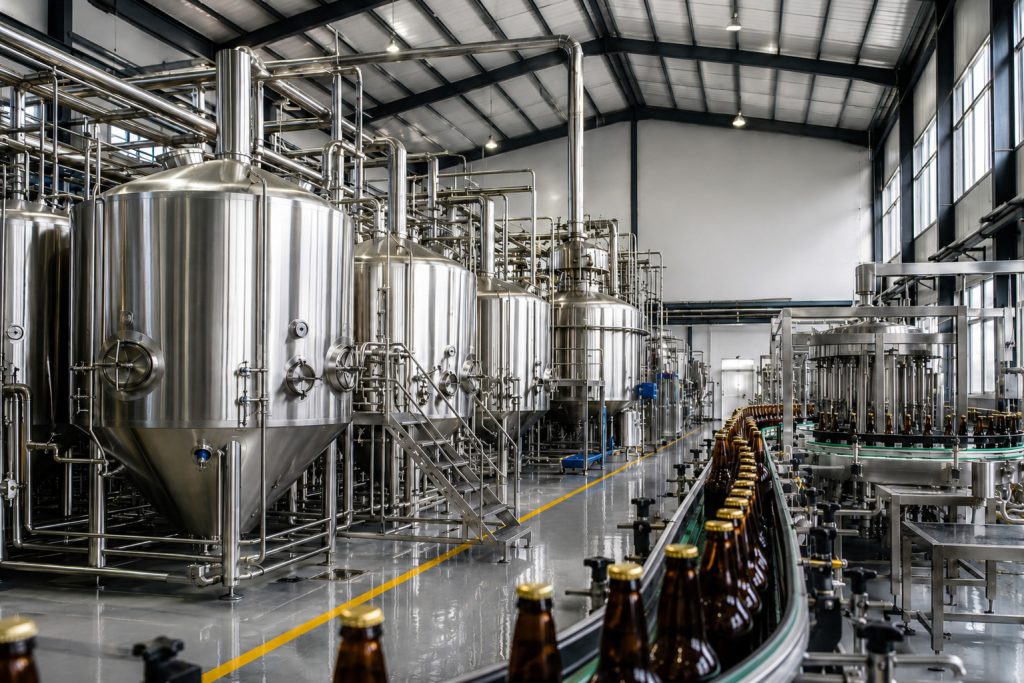
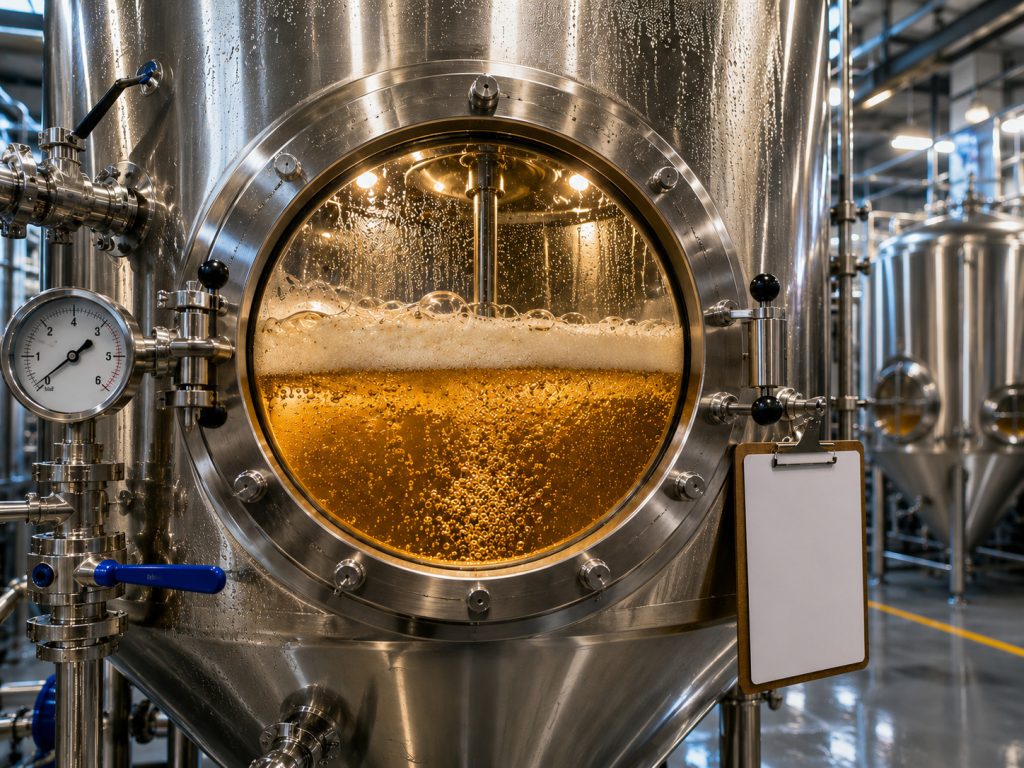
Compared with ordinary liquid storage tanks, beer tank level measurement involves more complex operating conditions. Beer tends to generate a large amount of foam during fermentation, agitation, transfer, and filling. CO₂ bubbles, steam, condensation, and liquid surface fluctuations inside the tank can interfere with traditional level instruments. In addition, temperature, pressure, density, and viscosity may vary during different process stages. Conventional differential pressure level meters, float level meters, or capacitance level meters may suffer from reading drift, false alarms, frequent maintenance, or cleaning difficulties under high-foam, high-humidity, and variable-media conditions.
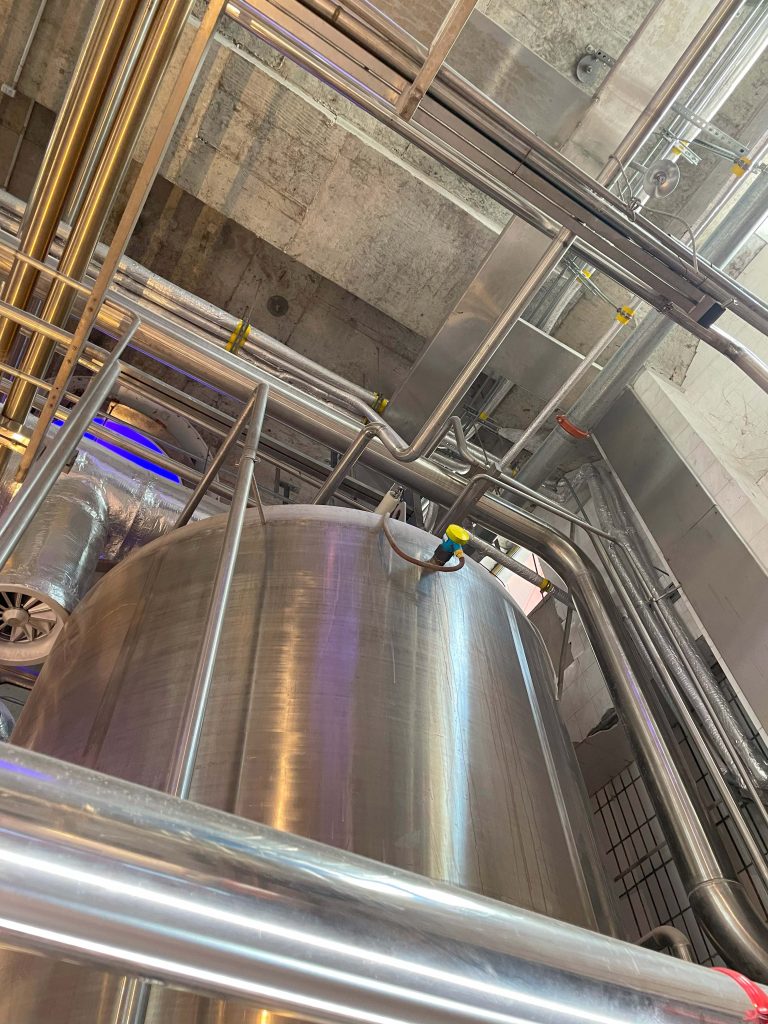
To address these pain points, including heavy foam, high humidity, agitation interference, strict food hygiene requirements, and strong automation needs, Jiwei Automations provides a combined application solution using the Ring-11 tuning fork level switch and the JWrada® radar level meter. In this solution, Ring-11 is used for high and low point level alarms and interlock protection, while JWrada® is used for continuous level measurement and data recording. Together, they form a complete level measurement solution based on “point level control + continuous monitoring.”
2. Site Conditions and Technical Challenges of Beer Tank Level Measurement
In this application case, the measured object is a beer tank, and the measured medium is beer. Typical measurement conditions include a maximum measuring range of approximately 5 m, process temperatures generally ranging from +3°C to +120°C, and process pressure of approximately 0 to +5 bar. The main challenges include heavy foam, humid environments, and agitation interference.
First, foam is one of the most typical interference factors in beer tank level measurement. During fermentation, beer releases CO₂, easily forming a foam layer above the liquid surface. Foam also changes continuously during agitation, transfer, and filling. Some traditional level meters may mistakenly identify foam as the real liquid surface, resulting in false level readings. Some point level switches may also be affected by foam, liquid adhesion, or bubble attachment, causing false switching.
Second, beer tanks are often exposed to high humidity and condensation. Temperature differences between the inside and outside of the tank, cleaning processes, and humid production environments all place high demands on instrument sealing, electronic stability, and long-term operating reliability. If the level instrument is not sufficiently resistant to moisture, signal fluctuations, fault alarms, or increased maintenance costs may occur.
Third, beer media conditions are not constant. Wort, fermented liquid, mature beer, and cleaning solutions differ in density, viscosity, temperature, foam state, and dielectric constant. Level instruments must adapt to media changes at different production stages without requiring frequent recalibration.
Fourth, beer production belongs to the food and beverage industry, where hygiene and safety requirements are strict. Parts of the instrument in contact with the medium should minimize contamination, material buildup, and cleaning dead zones. Continuous level measurement instruments should also reduce scaling, corrosion, and maintenance risks caused by contact measurement as much as possible.
Fifth, modern breweries commonly use PLC, DCS, SCADA, or MES systems for centralized management. A beer tank level meter must not only perform field measurement but also output stable signals for alarms, interlocks, trend recording, remote monitoring, and production scheduling. Therefore, instrument selection should consider not only measurement accuracy but also automation compatibility, commissioning convenience, and long-term maintenance efficiency.
3. Solution Overview: Ring-11 + JWrada® Dual-Layer Level Measurement Architecture
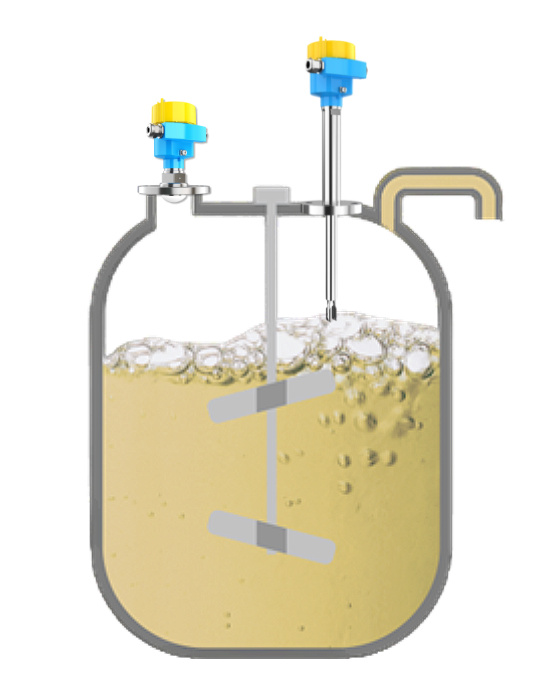
To address the above operating conditions, Jiwei Automations adopts a combined solution consisting of the Ring-11 tuning fork level switch and the JWrada® radar level meter. The beer tank level measurement system is divided into two layers.
The first layer is point level safety control. Ring-11 tuning fork level switches are installed at the high level, low level, or high-high level positions of the beer tank to provide upper and lower limit alarms and interlock protection. When the liquid level reaches the set point, Ring-11 outputs a switch signal. The control system can then activate feed valves, discharge pumps, alarm devices, or emergency shutdown logic to prevent tank overflow, pump dry running, and abnormal production risks.
The second layer is continuous level monitoring. The JWrada® radar level meter is installed on the top of the beer tank. It continuously collects level data through non-contact radar measurement and transmits real-time level information to the PLC, DCS, or host system. Operators can view level curves in the control room, monitor tank inventory, analyze process changes, and optimize feeding, discharge, and filling rhythms based on level data.
The advantage of this combined solution is that Ring-11 answers the question “Has the critical level point been reached?” while JWrada® answers the question “What is the current level?” The former provides a safety boundary, while the latter provides continuous process data. Working together, they enable both safety interlock capability and process visualization for beer tank level measurement.
4. Application Advantages of Ring-11 Tuning Fork Level Switch in Beer Tank High and Low Level Alarms
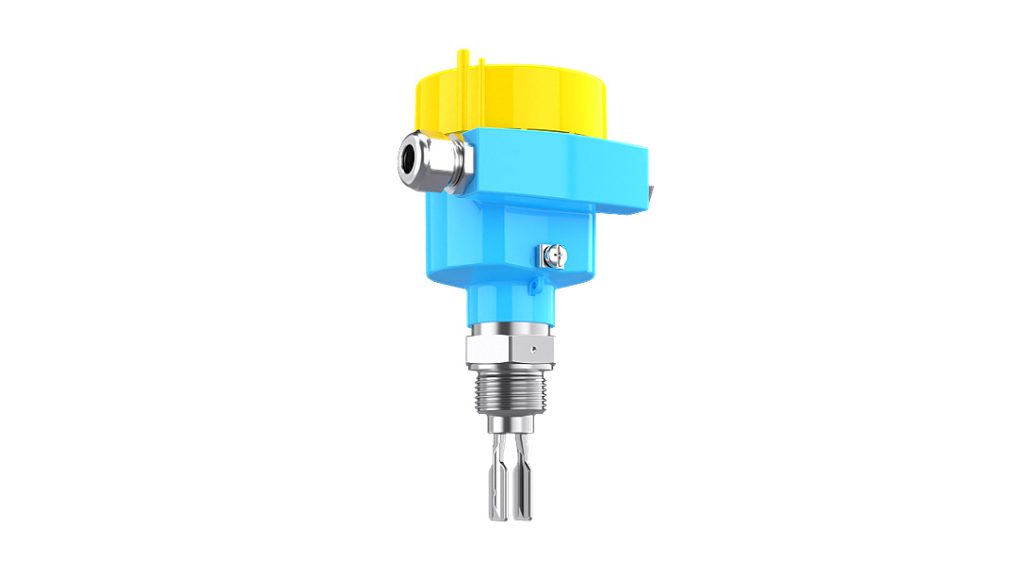
The Ring-11 tuning fork level switch is an important device for point level control in beer tanks. It is suitable for high level alarms, low level protection, high-high level interlocks, empty tank detection in filling buffer tanks, and CIP cleaning liquid level control. Its working principle is based on detecting the change in vibration frequency of the tuning fork in air and liquid. When beer contacts the fork, the vibration frequency changes, and the instrument detects this change to output a reliable switch signal.
4.1 High-Reliability Design for Complex Brewery Environments
Ring-11 is based on frequency change detection and does not depend on the color, transparency, conductivity, or optical properties of the medium. Whether there is vibration, foam, bubbles, or changes in medium density, viscosity, and temperature, Ring-11 can maintain stable measurement. For beer fermentation tanks and storage tanks, the reliability of the level switch is directly related to overflow protection and pump safety. Therefore, Ring-11 is especially suitable for critical alarm points and safety interlock points.
4.2 Food-Grade Hygienic Design for Brewery Requirements
Beer production has extremely high hygiene and safety requirements. Ring-11 can be equipped with a clamp-type process connection, which is convenient for installation, removal, and cleaning. Its material and surface finish meet food-grade application requirements, helping reduce contamination, material buildup, and hygienic dead zones. For beer, wort, fermented liquid, and cleaning solutions, the food-grade design better ensures a clean, safe, and stable production process.
4.3 40 mm Ultra-Short Fork for Narrow Installation Spaces
Not every measuring point in a brewery has sufficient installation space. Some measuring points are located on tank sidewalls, bottom outlets, pump inlet pipelines, filling buffer tanks, or CIP systems, where installation space is limited. Traditional long-fork level switches may be difficult to install. The Ring-11 fork is only 40 mm long, making it suitable for narrow spaces inside pipelines or storage tanks and enabling reliable level detection in complex equipment structures.
4.4 Reliable Measurement of Low-Density Liquids
The density of beer and related fermentation liquids may vary at different process stages. The precisely tuned fork of Ring-11 can measure liquids with a density as low as 0.5 g/cm³, meeting the level monitoring requirements of beer, wort, fermentation liquid, cleaning liquid, and other low-density liquids. This feature helps reduce false switching caused by changes in medium characteristics and improves the stability of beer tank high and low level alarms.
4.5 Strong Anti-Interference Capability to Reduce False Alarms from Foam and Agitation
Foam, bubbles, agitation, vibration, and viscous liquids inside beer tanks can all affect the stability of level switches. Ring-11 uses tuning fork vibration detection, allowing it to maintain reliable response under foam, bubbles, agitation, and vibration. For critical points such as high level overflow prevention, low level pump protection, and high-high level interlocking, strong anti-interference capability effectively reduces false alarms and unnecessary shutdowns.
4.6 High-Temperature Resistance for Special Process Sections
During beer production and CIP cleaning, some process sections may involve high-temperature media or high-temperature cleaning conditions. Ring-11 can withstand process temperatures up to 400°C, meeting the level measurement requirements of special high-temperature process sections. For breweries, this means one product series can cover a wider range of measuring points, making model selection and spare parts management easier.
4.7 Multiple Signal Outputs for Flexible Automation Integration
Ring-11 supports multiple signal output options, including relay, two-wire, NAMUR, and transistor outputs. It can be flexibly configured according to the on-site PLC, DCS, alarm system, or interlock system. For new brewery automation lines, it can be directly integrated into the control system. For upgrades of existing tank farms, it can also be compatible with the original control architecture, enabling automated high and low level alarm upgrades.
4.8 Authoritative Certifications for High-Safety Applications
Ring-11 has obtained certifications such as SIL2/3, 3C, CE, and EAC, and supports intrinsic safety and explosion-proof capabilities. It can meet high safety standards such as gas and dust dual explosion-proof requirements. Brewery sites may involve CO₂, alcohol vapor, cleaning chemicals, or special hazardous areas. Therefore, a certified level switch is more suitable for long-term stable operation.
With Ring-11, the high and low point control of beer tank levels can be accurate and reliable. Even in the presence of foam, agitation, vibration, or liquid viscosity changes, it can reduce false operations and provide fundamental safety protection for beer production.
5. Application of JWrada® Radar Level Meter in Continuous Beer Tank Level Monitoring
For beer production processes that require continuous level monitoring, data recording, and automatic scheduling, the JWrada® radar level meter provides a high-precision, non-contact level measurement solution. Unlike point level switches, a radar level meter can output the real-time level height, allowing operators and control systems to continuously understand changes inside the tank.
5.1 80 GHz FMCW Radar Technology for High-Precision Level Measurement
The JWrada® radar level meter adopts 80 GHz FMCW radar technology, offering high accuracy, a high signal-to-noise ratio, and a narrow beam angle. The narrow beam design concentrates radar energy, helping avoid interference from tank walls, reinforcing ribs, spray balls, agitators, and other internal structures. Under complex conditions such as foam and liquid surface fluctuations in beer tanks, JWrada® can still capture the true liquid surface stably and provide continuous, reliable data for production control.
5.2 Non-Contact Measurement to Reduce Contamination and Maintenance Risks
The JWrada® radar probe does not need to contact the beer liquid, avoiding common problems of contact-type instruments such as scaling, corrosion, material adhesion, and wear under high temperature or high pressure. For the food and beverage industry, non-contact measurement also reduces contamination risks and lowers cleaning and maintenance workload. Especially in beer tank areas requiring frequent CIP cleaning, non-contact radar level meters offer clear advantages in hygiene and maintenance convenience.
5.3 Intelligent Echo Algorithm for Foam, Steam, and Agitation Interference
The challenge of continuous beer tank level measurement lies in the complexity of the echo environment. Foam layers, steam, condensation, liquid surface fluctuations, and internal structures may all generate interference echoes. JWrada® uses a self-developed echo algorithm that supports false echo identification, multi-layer echo separation, and dynamic target tracking. It can continuously lock onto the real liquid surface under complex operating conditions. For fermentation tanks, bright beer tanks, and filling buffer tanks where the liquid surface changes frequently, this capability greatly improves level data stability.
5.4 High-Temperature Resistance and Explosion-Proof Capability for Special Process Areas
The JWrada® radar level meter can be used in high-temperature environments and supports gas and dust dual explosion-proof certification. It meets application requirements in special process areas, cleaning areas, or areas with high safety requirements in beer production. In tank-top environments with high humidity, steam, temperature differences, and condensation, the instrument can still maintain stable operation, providing safety assurance for continuous beer tank level measurement.
5.5 Bluetooth Smart Commissioning to Improve Multi-Tank Project Efficiency
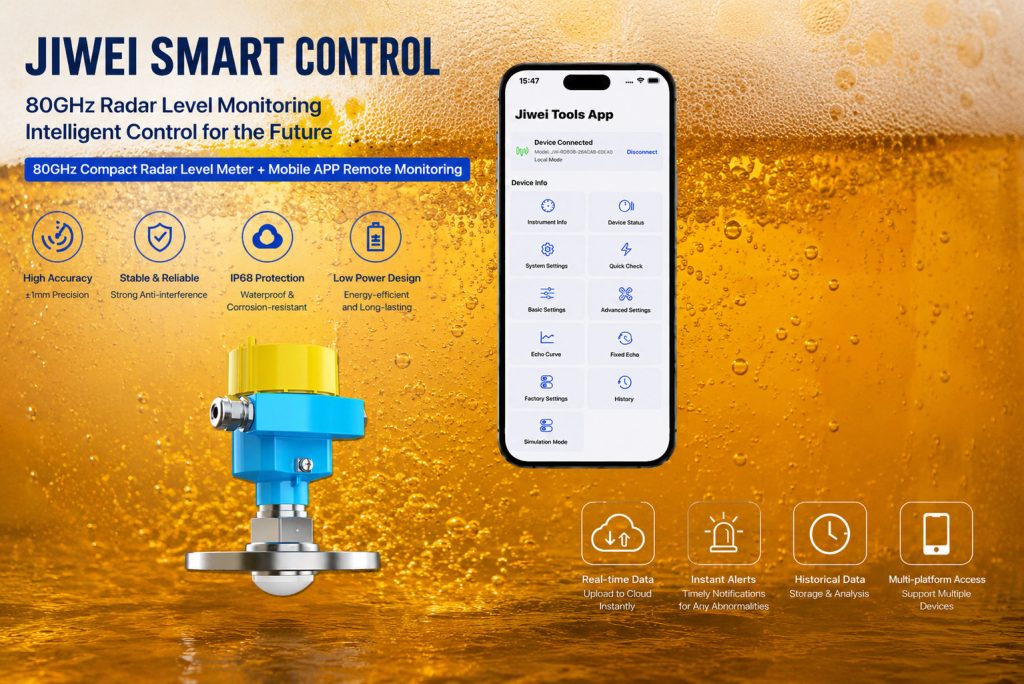
JWrada® integrates a Bluetooth module and can be wirelessly commissioned, configured, and monitored through the “Jiwei Smart Control®” APP. Field engineers do not need to frequently climb or open instrument covers. They can complete range setting, echo viewing, parameter adjustment, and status diagnosis from a safe position. For multiple beer tanks with the same specifications, parameters can also be copied to multiple devices, reducing repetitive commissioning and greatly improving project installation efficiency.
5.6 LCD Display and Physical Buttons for Flexible Field Operation
JWrada® provides an LCD display and physical buttons, allowing field personnel to directly view the current level and instrument status and manually adjust parameters. At the same time, the Bluetooth APP can synchronize the current level and support more function settings and software upgrades. The combination of field operation and mobile commissioning makes JWrada® more suitable for breweries with multiple tank areas, multiple measuring points, and centralized maintenance management.
5.7 Alternative to Traditional Level Measurement Methods and Imported Brands
In many brewery retrofit projects, traditional pressure-type, float-type, or imported radar level meters may involve high maintenance costs, long delivery cycles, and slow field service response. With high precision, non-contact measurement, intelligent echo processing, and convenient commissioning, JWrada® radar level meter can serve as a localized solution for continuous beer tank level measurement. It helps enterprises reduce procurement and operation costs while improving local service efficiency.
In continuous beer tank level measurement, JWrada® can quickly and stably collect level data. Even under high foam, high humidity, high temperature, and strong disturbance conditions, it can provide reliable data support for brewing process optimization, tank inventory management, and automation control.
6. System Value of the Combined Ring-11 and JWrada® Application
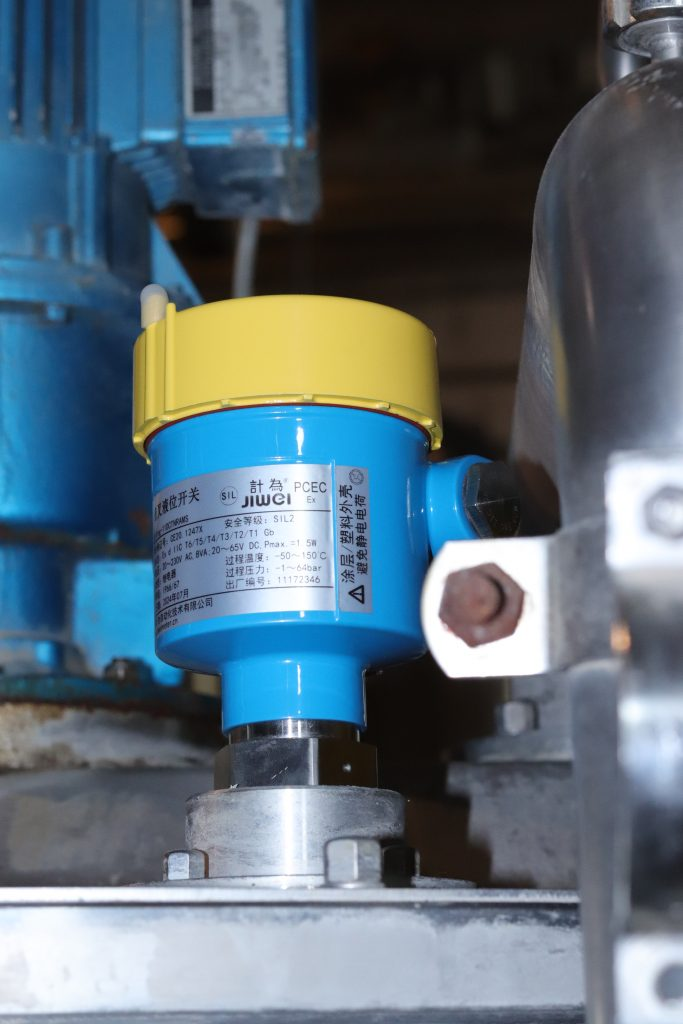
The greatest value of combining the Ring-11 tuning fork level switch with the JWrada® radar level meter lies in the complementary relationship between “safety boundary control” and “continuous process monitoring.”
Ring-11 is responsible for high and low point safety control. When the beer tank level reaches the upper or lower limit, the system can trigger alarms or perform interlock actions in time, preventing excessive feeding, tank overflow, pump dry running, and abnormal shutdowns.
JWrada® is responsible for continuous level data acquisition. Through real-time level curves, the control system can monitor beer level changes inside the tank and optimize feeding, discharge, fermentation, storage, and filling rhythms.
When used together, breweries can not only know “what the current level is,” but also obtain independent and reliable switch protection at critical risk points. This combined solution is safer than using only a continuous level meter and more valuable in terms of data than using only a level switch.
In an automation system, the switch signal from Ring-11 can be used for alarms and interlocks, while the continuous signal from JWrada® can be used for trend recording, level display, inventory statistics, and process analysis. By connecting with PLC, DCS, SCADA, or MES systems, enterprises can achieve centralized management of beer tank level information, reduce manual inspection, and improve abnormal condition response speed.
7. Typical Installation and Commissioning Recommendations
The JWrada® radar level meter should be installed at a suitable position on the top of the beer tank. It should avoid feed inlets, spray balls, agitators, reinforcing ribs, and other strong interference structures as much as possible. During installation, the radar beam should be directed vertically toward the liquid surface to avoid tilted mounting or obstruction by internal tank components. During commissioning, range, empty tank height, output range, and echo parameters can be set through the LCD, physical buttons, or Bluetooth APP. False echo suppression can also be configured according to site conditions.
The Ring-11 tuning fork level switch should be installed at the actual level height where alarm or control is required. The high level switch should leave enough safety margin to prevent overflow caused by liquid inertia. The low level switch should be set according to the pump inlet height, residual liquid in the pipeline, and the minimum allowable process level. During installation, the fork should avoid direct impact from strong inflow, while ensuring that the fork can be fully immersed in or completely separated from the liquid to obtain clear and stable switching actions.
Before system commissioning, single-instrument testing and interlock testing should both be completed. First, verify whether the continuous level indication from JWrada® matches the actual liquid level. Then test whether the high and low point actions of Ring-11 are accurate. Finally, verify the alarm, pump start-stop, valve interlock, and data recording logic in the PLC or DCS to ensure that the entire beer tank level measurement system is safe and reliable.
8. Application Results and Customer Value
After the solution is put into operation, beer tank level measurement is upgraded from traditional manual inspection and single-instrument monitoring to an automated system combining continuous level data acquisition with critical point protection.
In terms of production safety, Ring-11 can identify high and low level states in time, reducing the risks of tank overflow, empty tank operation, and pump dry running, while lowering the probability of abnormal shutdowns.
In terms of measurement accuracy, JWrada® provides stable and continuous level data. Even when foam, moisture, temperature fluctuations, and agitation are present, it maintains good measurement reliability.
In terms of food hygiene, the food-grade process connection of Ring-11 and the non-contact measurement of JWrada® jointly reduce contamination, material buildup, and cleaning dead zone risks, making the solution more suitable for hygienic beer production requirements.
In terms of maintenance cost, both instruments offer strong anti-interference capability. Ring-11 has a compact structure and reliable response, while JWrada® uses non-contact measurement with low maintenance requirements. Its Bluetooth smart commissioning function also reduces field commissioning time and improves implementation efficiency for multi-tank projects.
In terms of management value, continuous level data connected to the control system can be used for production planning, batch traceability, inventory management, process optimization, and energy consumption analysis. This provides foundational data support for brewery digitalization and intelligent brewing.
9. Conclusion: A Highly Reliable Solution for Beer Tank Level Measurement
Beer tank level measurement may seem simple, but in practice it faces multiple challenges, including thick foam, many bubbles, high humidity, temperature changes, obvious agitation interference, strict hygiene requirements, and complex automation integration. A single level instrument often cannot simultaneously meet the needs of high and low point safety control and continuous level monitoring.
The combined solution of Jiwei Automations Ring-11 tuning fork level switch and JWrada® radar level meter provides a complete, reliable, hygienic, and intelligent level measurement solution for beer production conditions. Ring-11 offers stable protection for beer tank high and low level alarms and safety interlocks through high reliability, food-grade design, a 40 mm ultra-short fork, low-density liquid detection capability, strong anti-interference performance, high-temperature resistance, multiple output options, and authoritative certifications. JWrada® provides reliable data for continuous beer tank level measurement through 80 GHz FMCW radar technology, non-contact measurement, intelligent echo algorithms, high-precision continuous monitoring, Bluetooth smart commissioning, and flexible operation.
When used together, the two instruments complement each other by combining point level safety control with continuous level monitoring. This not only safeguards beer production but also improves level data transparency and automation capability. For breweries, this solution can solve level measurement problems under high foam, high humidity, and complex process conditions, while reducing maintenance costs, improving production efficiency, ensuring food hygiene safety, and laying a solid foundation for intelligent brewing and digital factory construction.
For breweries planning to upgrade level measurement in fermentation tanks, bright beer tanks, buffer tanks, filling storage tanks, or CIP systems, the combined Ring-11 tuning fork level switch and JWrada® radar level meter solution is an excellent choice that balances safety, accuracy, hygiene, and automation scalability.