
In wastewater treatment systems, level measurement may seem like a basic process parameter, but it directly affects influent regulation, chemical dosing, wastewater storage, sludge treatment, pump station interlocking and safety alarms. If the liquid level is measured inaccurately, it may cause frequent pump starts and stops, unstable chemical dosing, pump dry running, tank overflow, corrosion leakage or even environmental compliance risks. Therefore, selecting a stable, reliable and easy-to-maintain level instrument is essential for the safe and automated operation of wastewater treatment plants.
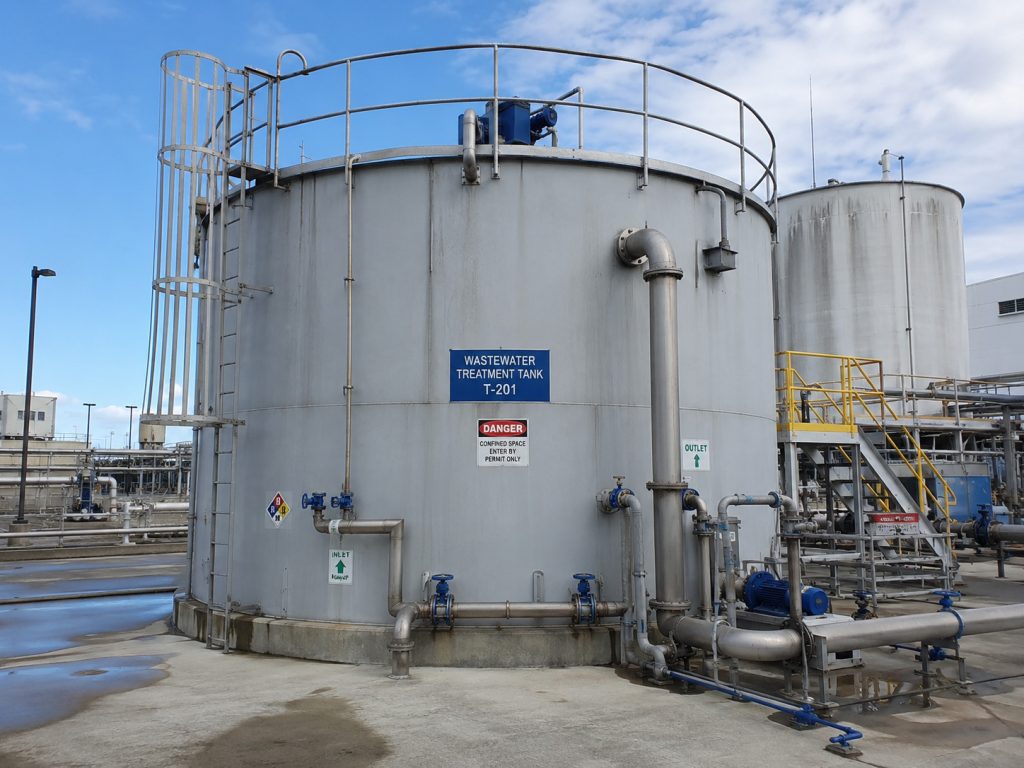
A magnetic level indicator is a commonly used on-site direct-reading level measurement instrument. It features intuitive display, no power supply required for local indication, simple structure, high reliability, and optional remote transmission and alarm functions. In the wastewater treatment industry, magnetic level indicators are especially suitable for wastewater tanks, acid and alkali storage tanks, flocculant tanks, sludge conditioning chemical tanks, regeneration liquid tanks and some enclosed water treatment vessels.
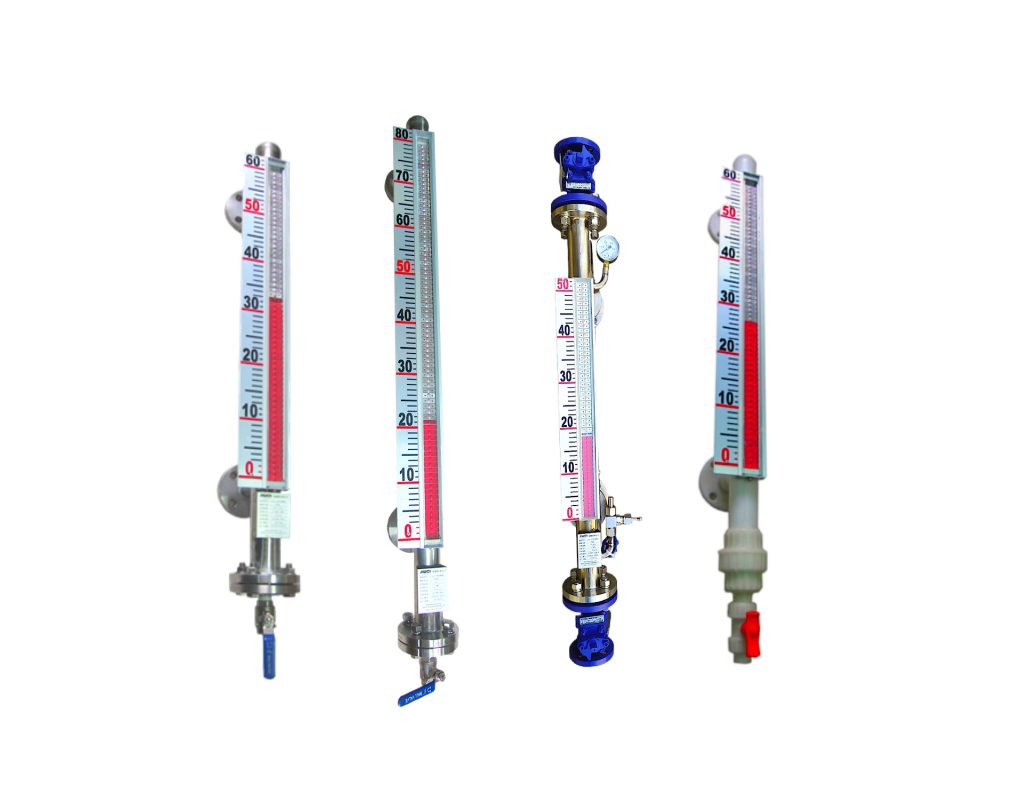
The Flap-11 series magnetic level indicators include anti-corrosion, plastic, lined and remote-transmission configurations. With optional magnetic switches and reed-chain transmitters, they can meet various requirements in wastewater treatment applications, including corrosion resistance, remote monitoring and safety interlocking.
1. Why Reliable Level Measurement Is Important in Wastewater Treatment
A typical wastewater treatment plant includes grid chambers, equalization tanks, sedimentation tanks, biochemical tanks, sludge tanks, chemical dosing systems, reclaimed water systems and discharge systems. Different process units require different types of level measurement. Open tanks are often more suitable for radar level meters or ultrasonic level meters, while enclosed tanks, pressure vessels, acid and alkali tanks and wastewater storage tanks are often suitable for magnetic level indicators.
In actual operation, wastewater treatment media are often complex. They may be corrosive, contain impurities, foam or suspended solids, and the site environment is usually humid and harsh. Traditional glass tube level gauges may have limitations in terms of protection, impact resistance and safety. Some electronic level instruments are suitable for remote monitoring, but in highly corrosive or humid environments, they may face higher maintenance pressure.
A magnetic level indicator uses magnetic coupling between the float and the flaps to display the liquid level. Operators can directly observe the red-white boundary on the indicator panel to determine the liquid level in the tank. When equipped with magnetic switches or remote transmitters, the level signal can be connected to PLC, DCS or a central control system to realize high and low level alarms, pump start-stop control and continuous level monitoring.
2. Working Principle of a Magnetic Level Indicator
A magnetic level indicator usually consists of a chamber, magnetic float, flap indicator, scale, process connection and optional magnetic switches or remote transmitters. Its working principle is based on the communicating vessel principle and magnetic coupling principle.
After the level indicator is connected to the vessel through flanges or other process connections, the liquid level inside the chamber remains the same as the liquid level inside the vessel. As the liquid level rises or falls, the magnetic float inside the chamber moves up and down accordingly. The permanent magnet inside the float drives the external flaps to rotate through magnetic coupling.
The two sides of the flaps are usually marked with different colors, commonly red and white. When the level rises, the flaps turn from white to red. When the level falls, the flaps turn from red to white. The boundary between red and white indicates the actual liquid level. Since the display unit is isolated from the measured medium, the reading is clear and safe. Local level indication can be achieved without power supply, making magnetic level indicators highly practical for tank level measurement in wastewater treatment plants.
3. Typical Applications of Magnetic Level Indicators in Wastewater Treatment
3.1 Level Measurement for Wastewater Tanks and Intermediate Water Tanks
Wastewater treatment systems often include wastewater collection tanks, intermediate water tanks and buffer tanks. These tanks are used for flow regulation and process connection. If the level is too high, overflow may occur. If the level is too low, pumps may run dry.
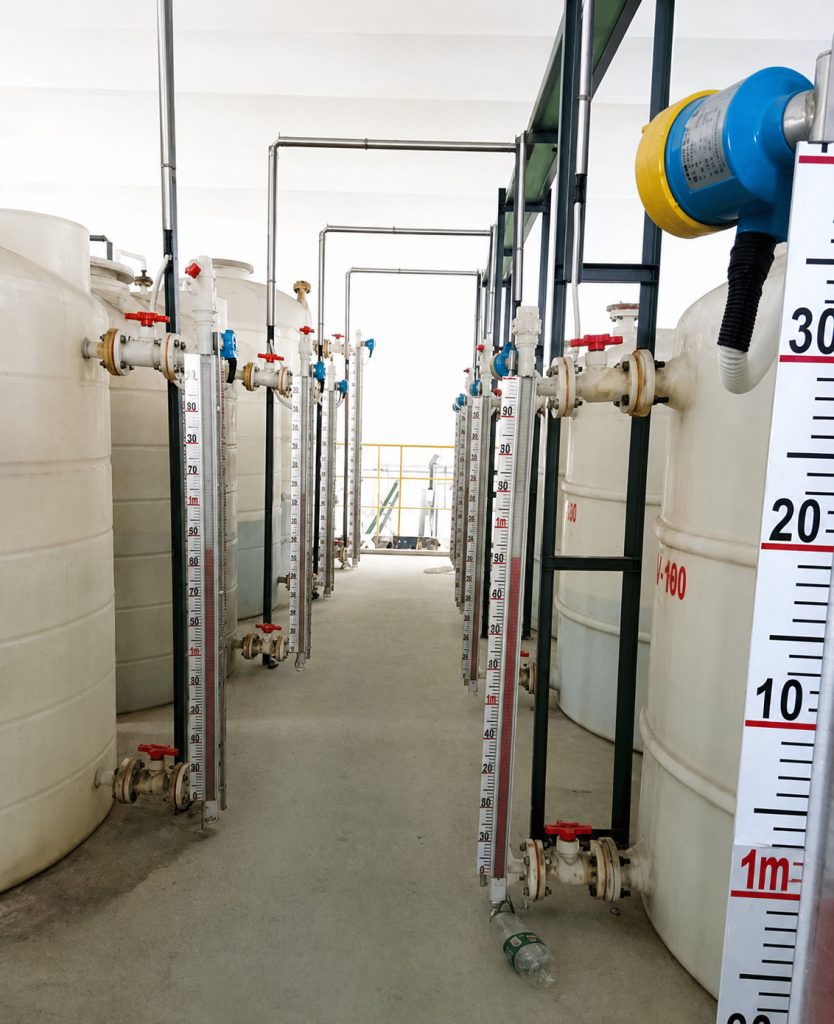
A magnetic level indicator can be installed on the side of the tank to provide continuous on-site level display. When equipped with a remote transmitter, it can output a 4–20mA signal to the control system, allowing operators in the central control room to monitor level changes in real time.
For wastewater tanks in wastewater treatment systems, Jiwei Flap-11C plastic magnetic level indicator is a suitable option. It is made of PP material and is applicable to wastewater treatment, power plant chemical water treatment and printing and dyeing industries. It has good corrosion resistance and lightweight construction, making it suitable for low-pressure corrosive liquid applications.
3.2 Level Measurement for Acid and Alkali Chemical Tanks
Wastewater treatment often uses chemicals such as acid, alkali, PAC, PAM, sodium hypochlorite, hydrochloric acid and sodium hydroxide. The level monitoring of chemical storage tanks directly affects the continuity and effectiveness of dosing. For corrosive acid and alkali media, the compatibility and corrosion resistance of wetted materials must be carefully considered.
When the medium is compatible with PP material and the pressure and temperature conditions are suitable, a PP plastic magnetic level indicator can be selected. For more strongly corrosive media, or where higher requirements for permeability resistance and sealing are needed, a lined magnetic level indicator is recommended.
For example, Jiwei Flap-11Px lined magnetic level indicator is available with F4/PTFE or F46/FEP lined chambers and is designed for highly corrosive liquid measurement. It is suitable for chemical, water treatment and related industries. For strong acid and alkali tanks in wastewater treatment plants, this type of lined anti-corrosion solution can reduce the risk of corrosion to the metal body.
3.3 Sludge Treatment and Conditioning Chemical Systems
During sludge thickening, dewatering and conditioning, media such as flocculants, lime slurry and conditioning agents may be used. Some of these media have certain viscosity or sedimentation characteristics. Therefore, when selecting a magnetic level indicator, factors such as medium viscosity, density, crystallization tendency and solid particle content should be considered.
The chamber of the magnetic level indicator should remain unobstructed to prevent the float from being stuck by solid impurities. For media that tend to settle, a drain structure should be provided, and regular cleaning and maintenance should be planned.
In these applications, magnetic level indicators are more suitable for relatively clean and flowable chemical tanks or auxiliary liquid tanks where impurities are not likely to block the chamber. If the medium contains a large amount of suspended solids, severe foam or highly fluctuating open-tank levels, radar level meters, ultrasonic level meters or other non-contact instruments should be considered.
3.4 Regeneration Liquid, Cleaning Liquid and Chemical Water Treatment Systems
Many wastewater treatment plants and industrial wastewater stations are equipped with reverse osmosis, ion exchange, membrane treatment or chemical cleaning systems. These systems may involve hydrochloric acid, alkali solution, regeneration liquid or cleaning liquid.
Magnetic level indicators can provide direct level indication for these storage tanks. With magnetic switches, they can also provide high and low level alarms to prevent tank overflow or chemical shortage.
According to Jiwei’s official product information, Flap-11C plastic magnetic level indicator is suitable for power plant chemical water treatment, wastewater treatment and printing and dyeing applications. Its lightweight design is easy to install, and its PP material improves corrosion resistance. It is suitable for low-pressure, strongly corrosive liquid conditions. For corrosive chemical storage tanks commonly found in water treatment systems, this type of product offers strong practical value.
4. Advantages of Magnetic Level Indicators in Wastewater Treatment
4.1 Intuitive On-Site Display for Easy Inspection
Routine inspection is common in wastewater treatment plants. Operators need to quickly determine whether the tank level is within a normal range. Magnetic level indicators use red and white flaps for indication, making the level position clear and easy to read.
Jiwei Flap-11 series products use a widened display panel design, providing a wider viewing angle and longer visible distance. The scale and numbers are also clearer, which is convenient for operators to observe from a distance.
4.2 Local Indication Without Power Supply
The local display of a magnetic level indicator is achieved through the float and magnetic flaps, so no external power supply is required for on-site indication. This is especially practical in wastewater treatment sites that are humid, corrosive, difficult to wire or require mechanical local indication.
Even if the remote transmission system or central control system fails, operators can still read the liquid level directly from the local indicator.
4.3 Connection to Automation Control Systems
As wastewater treatment plants become increasingly automated, liquid level signals are often connected to PLC or DCS systems. A magnetic level indicator can be equipped with magnetic switches for high and low level alarms, or with a reed-chain remote transmitter to output a 4–20mA continuous signal.
This enables remote level transmission, pump start-stop control, valve interlocking and central control monitoring. For unattended or lightly staffed wastewater treatment stations, remote transmission can significantly improve operational efficiency and safety.
4.4 Flexible Anti-Corrosion Solutions
The composition of chemicals and wastewater in treatment plants varies greatly. A single material cannot cover all working conditions. Jiwei Flap-11 series magnetic level indicators include standard, economical, plastic and lined models.
PP plastic models are suitable for low-pressure strongly corrosive liquids, while F4/PTFE and F46/FEP lined models are suitable for more aggressive media. Users can select the appropriate model according to medium composition, temperature, pressure, density, viscosity and installation conditions.
4.5 Relatively Easy Maintenance
Magnetic level indicators have a relatively simple structure. Maintenance mainly focuses on preventing chamber blockage, float jamming, flap disorder and sealing leakage. By installing valves between the level indicator and the vessel, the medium can be isolated during cleaning or maintenance, reducing the impact on plant operation.
For continuously operating wastewater treatment plants, easy inspection and maintenance are important advantages.
5. Key Parameters for Selecting a Magnetic Level Indicator in Wastewater Treatment
5.1 Medium Corrosiveness
For ordinary domestic wastewater or mildly corrosive wastewater, stainless steel or economical magnetic level indicators can be selected according to pressure, temperature and material compatibility. For acids, alkalis, saline water, sodium hypochlorite and other corrosive chemicals, PP plastic or PTFE/FEP lined magnetic level indicators should be considered first.
5.2 Medium Density and Viscosity
A magnetic level indicator relies on the float floating on the liquid surface. Therefore, the medium density must meet the float design requirements. Taking Jiwei Flap-11C plastic magnetic level indicator as an example, its applicable liquid density range is 0.45–2g/cm³, and the viscosity requirement is ≤200cp.
If the medium density is too low or viscosity is too high, detailed process parameters should be provided to the manufacturer in advance so that a suitable float can be selected.
5.3 Measuring Range and Installation Method
Wastewater treatment tanks vary greatly in height. The measuring range should be determined according to the center-to-center distance of the upper and lower process connections, actual measuring requirements and safe operating level.
Jiwei Flap-11C has a single-section measuring range of 200–4000mm, while multi-section structures can reach 20m or more. For long measuring ranges, segmented manufacturing, transportation, installation, support fixation and remote transmission cable connection should all be considered.
5.4 Temperature and Pressure
Plastic magnetic level indicators are suitable for low-pressure, normal-temperature or medium-low-temperature corrosive media. For example, Jiwei Flap-11C has a process pressure range of -0.1–0.6MPa and a process temperature range of -20–80°C.
For higher pressure or higher temperature conditions, metal, lined or customized magnetic level indicators should be selected.
5.5 Remote Transmission and Alarm Requirements
If only local inspection is required, a basic magnetic level indicator is sufficient. If the level needs to be connected to a central control system, a remote transmitter should be added. If high level, low level, pump protection or overflow alarms are required, magnetic switches should be configured.
For wastewater treatment plants, it is recommended to integrate key tank levels into the automation system to improve operational safety.
6. Installation and Maintenance Precautions
The installation quality of a magnetic level indicator directly affects measurement stability. During installation in wastewater treatment sites, the following points should be noted.
First, shut-off valves should be installed between the level indicator and the vessel to facilitate cleaning, drainage and maintenance. Second, ferromagnetic materials should be kept away from the chamber, and iron clamps should not be used, as they may affect the magnetic coupling system. Third, during commissioning, the upper valve should be opened first, and then the lower valve should be opened slowly to allow the medium to enter the chamber smoothly. This helps prevent the float from rising too quickly and causing flap disorder.
Fourth, for media containing solid impurities or sediment, the chamber should be cleaned regularly to prevent the float from being blocked. Fifth, for products equipped with remote transmitters, magnetic switches or electric tracing devices, reliable grounding and correct wiring should be completed according to explosion-proof, waterproof and electrical safety requirements.
In wastewater treatment applications, some media contain sand, suspended solids or crystallized substances. After long-term operation, deposits may accumulate at the bottom of the chamber or near the connection pipes. Therefore, drain valves, flushing ports, maintenance valves and bypass structures should be considered during the design stage, and a regular maintenance schedule should be established according to the water quality.
7. Combined Use with Other Level Instruments
In wastewater treatment plants, magnetic level indicators are not the only choice for all applications. For open equalization tanks, sedimentation tanks, channels, wells or applications with strong level fluctuations and heavy foam, radar level meters or ultrasonic level meters may be more suitable.
For enclosed tanks, acid and alkali storage tanks, wastewater storage tanks and vessels requiring local direct reading, magnetic level indicators have clear advantages.
A reasonable solution is often a combination of different instruments. Key storage tanks can use magnetic level indicators for local indication and remote control. Open tanks can use radar or ultrasonic level meters for non-contact measurement. Pump stations and chemical dosing systems can use high and low level switches for interlocking protection. This approach makes full use of the advantages of different instruments and improves the reliability of the overall wastewater treatment system.
8. Why Jiwei Flap-11 Series Is Worth Considering for Wastewater Treatment Projects
Based on Jiwei’s official product information, the Flap-11 series magnetic level indicators include standard, economical, plastic and lined models. Different chamber materials can be selected according to the chemical properties of the medium, and suitable floats can be matched according to the liquid density to achieve better measurement performance.
The series can also be equipped with SW-11 magnetic switches, SW-21 compact magnetic switches, Reed-11/Reed-21S reed-chain remote transmitters and other accessories to realize automatic level control and remote operation.
For wastewater treatment projects, Flap-11C plastic magnetic level indicator is suitable for level measurement in wastewater tanks. Its PP material, corrosion resistance and lightweight structure are beneficial for site installation. Flap-11Px lined magnetic level indicator is more suitable for strongly corrosive liquids and can be used in water treatment, chemical and storage applications.
When selecting a model, users should provide the manufacturer with medium name, density, viscosity, temperature, pressure, measuring range, installation method, flange standard, explosion-proof requirements, remote transmission requirements and alarm requirements. This allows the manufacturer to provide a more accurate product solution.
9. Conclusion
The value of magnetic level indicators in wastewater treatment lies mainly in their intuitive local display, reliable operation, flexible anti-corrosion options, easy maintenance and remote transmission capability. For wastewater tanks, acid and alkali chemical tanks, regeneration liquid tanks, intermediate water tanks and some enclosed water treatment vessels, selecting the right material and structure can effectively improve level monitoring stability and operational safety.
With the continuous upgrade of wastewater treatment automation, level instruments are no longer simple reading devices. They have become important components of process control, safety interlocking and operation management. Through proper selection, standard installation and regular maintenance, magnetic level indicators can help wastewater treatment plants reduce level misjudgment, lower equipment failure risks and improve operating efficiency.
For applications requiring corrosion resistance, remote transmission and local indication, Jiwei Flap-11 series magnetic level indicators can be an important choice for wastewater treatment level measurement solutions.