As smart water management, urban flood control, environmental governance, and industrial automation continue to advance, level data is evolving from a simple on-site reading into an essential source of information for process control, risk warning, and operational decision-making.
Applications such as rivers, reservoirs, open channels, detention basins, wastewater tanks, and chemical storage vessels have very different operating conditions. Users therefore expect more than an instrument that can simply detect a liquid surface. They increasingly require long-term measurement stability, strong environmental adaptability, efficient commissioning, convenient maintenance, and seamless integration with digital monitoring systems.
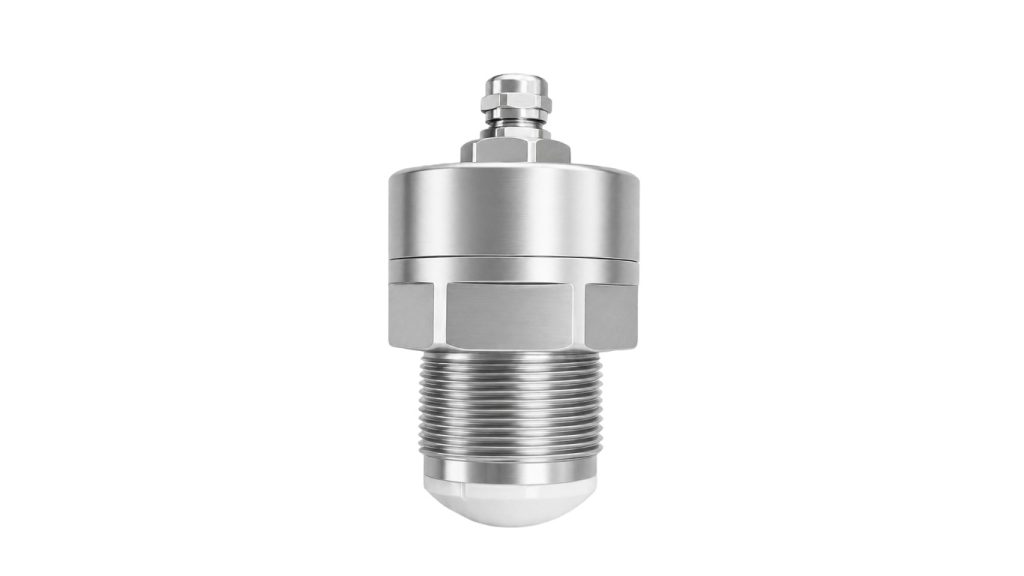
Against this background, the JWrada-23 radar sensor has been introduced as a new solution for hydrological monitoring, municipal water management, drainage systems, and general industrial level measurement. Combining 80 GHz frequency-modulated continuous-wave technology, intelligent echo-processing algorithms, and wireless maintenance capabilities, the new instrument provides a practical balance between measurement performance, installation flexibility, and cost efficiency.
Designed for Continuous Level Monitoring with an Effective Balance of Accuracy, Range, and Cost
The JWrada-23 is a compact and economical radar sensor developed for continuous level measurement. Its design combines a small physical footprint, convenient installation, reliable performance, and intelligent instrument management.
The sensor offers a maximum liquid-level measuring range of 30 meters, accuracy of up to ±1 mm, and a beam angle of only 6 degrees. These specifications make it suitable not only for relatively long-range water-level applications such as rivers, channels, and reservoirs, but also for storage tanks, open pools, and simple short-range bulk-solid measurement applications.
The narrow radar beam helps minimize reflections from vessel walls, support structures, pipelines, and surrounding construction features. This improves target identification and measurement stability, especially in installations where space is limited or where obstacles are located close to the measuring path.
For projects involving restricted mounting positions, complicated internal structures, or long measuring distances, the JWrada-23 allows users to achieve a practical balance between measurement performance and overall project cost.
80 GHz FMCW Technology Enables Accurate Non-Contact Measurement
The JWrada-23 uses 80 GHz frequency-modulated continuous-wave radar technology. During operation, the instrument transmits high-frequency electromagnetic waves whose frequency changes continuously over time. These waves are reflected by the surface of the measured liquid or material and received by the radar antenna.
The instrument mixes the transmitted signal with the returning echo to generate an intermediate-frequency signal. Fast Fourier transform analysis is then used to process the signal spectrum, calculate the distance between the antenna and the material surface, and determine the real-time level.
Because the measurement is non-contact, the sensing element does not need to come into direct contact with the measured medium. This helps reduce the effects of corrosion, material buildup, adhesion, and mechanical wear.
For wastewater, acidic or alkaline liquids, chemical agents, and other media that are difficult or undesirable to access regularly, non-contact radar measurement can also reduce routine cleaning and maintenance requirements.
High-frequency 80 GHz radar technology provides a concentrated beam with strong directivity. Compared with measurement technologies that produce a wider beam, the JWrada-23 can focus more precisely on the target surface and reduce interference caused by surrounding obstacles.
This is particularly valuable in open channels, narrow access points, tank-top installations, pump wells, and structures containing internal components that could otherwise create unwanted reflections.
Intelligent Echo Processing Adapts to Changing Process Conditions
Level-measurement environments do not always remain stable or ideal. Internal supports, pipelines, mixers, ladders, water-surface movement, and nearby structures can all produce reflected signals.
Without effective signal processing, an instrument may have difficulty distinguishing the real liquid surface from interference echoes. This can result in unstable readings, sudden value changes, inaccurate measurements, or temporary loss of the target signal.
To address false echoes, multiple reflection targets, and changing process conditions, the JWrada-23 uses an intelligent adaptive echo-learning algorithm. The instrument supports false-echo identification, multilayer echo separation, and dynamic target tracking.
Based on changes in the installation environment, the system continuously optimizes the way it evaluates and selects returning radar signals.
When the water surface fluctuates, fixed obstacles are present inside a vessel, or surrounding structures generate unwanted reflections, the system can more effectively distinguish the real level from non-target echoes. This helps the instrument maintain stable and continuous measurement output.
Intelligent signal processing also reduces excessive dependence on the experience of individual commissioning engineers, making initial setup and long-term operation more convenient.
316L Stainless Steel Construction for Outdoor and Corrosive Environments
The JWrada-23 features a 316L stainless steel housing and an antenna-lens design incorporating 316L stainless steel and PTFE materials. This combination provides mechanical strength while improving resistance to moisture and corrosion.
The sensor supports process pressures from -0.1 to 3 MPa. Its process-temperature, ambient-temperature, and storage-temperature ranges extend from -40°C to 80°C.
With an IP66/IP68 protection rating at 0.2 bar, the instrument is designed to withstand demanding outdoor conditions, humid environments, rain exposure, and selected corrosive applications.
These characteristics make the JWrada-23 suitable for long-term operation in water infrastructure, municipal drainage networks, industrial facilities, and exposed outdoor monitoring stations.
In applications such as rivers, reservoirs, sluice gates, open pools, and urban flood-risk locations, level instruments may be continuously exposed to temperature fluctuations, rainfall, humidity, and condensation.
The corrosion-resistant metal construction and high enclosure-protection rating help reduce the impact of external conditions on the internal electronics, supporting a longer and more stable operating life.
Bluetooth Wireless Commissioning Improves Maintenance Efficiency
Traditional level instruments often require technicians to approach the device directly when configuring parameters, reviewing operating conditions, or diagnosing faults.
When the instrument is installed at height, beside a pool, over a well, along a riverbank, or in a confined area, this approach can be inefficient and may make maintenance work more difficult.
The JWrada-23 includes Bluetooth communication, allowing routine configuration and operating-status checks to be completed wirelessly through a mobile device.
Technicians do not need to open the instrument housing repeatedly or remain close to a difficult installation point for extended periods. Common parameter adjustments, echo-curve checks, and instrument-status reviews can be performed from a more convenient location.
When combined with a cloud-based data network, the sensor can also support remote commissioning, software updates, and operating-status monitoring. These capabilities provide a more flexible maintenance approach for distributed monitoring points, unattended stations, and projects involving centralized management of multiple instruments.
Water-level and drainage-monitoring devices are often distributed across large geographic areas. Wireless commissioning and remote management can reduce the frequency of site visits, shorten parameter-adjustment and troubleshooting times, and move level-monitoring systems from conventional on-site maintenance toward remote digital operation.
HART and Modbus Communication Simplify System Integration
The JWrada-23 is available in both two-wire and four-wire configurations.
The two-wire version supports a 12–30 V DC power supply and 4–20 mA/HART output. The four-wire version can use RS-485/Modbus communication.
These options enable convenient integration with programmable logic controllers, distributed control systems, remote terminal units, supervisory control and data acquisition platforms, and a wide range of water-management monitoring systems.
For conventional industrial projects, the 4–20 mA output provides broad compatibility with existing control infrastructure and can reduce the complexity of system upgrades.
For digitalization projects, HART and Modbus communication allow additional process and instrument-status information to be transmitted, supporting the transition from isolated measurement points to networked equipment management.
Multiple communication options also allow the JWrada-23 to accommodate different project architectures. Whether the application is an independent water-level monitoring station, a pump-station control system, or a centralized chemical-process platform, users can select an appropriate communication method based on the power supply, transmission distance, and automation-system requirements.
Supporting Water-Level Monitoring in Rivers, Reservoirs, and Open Channels
In hydrological and water-management applications, the JWrada-23 can be used to monitor water levels in rivers, lakes, reservoirs, open channels, sluice gates, and irrigation or drainage channels.
Such monitoring points are often widely distributed and located in exposed environments. Instruments may be affected by rainfall, humidity, temperature variation, fluctuating water surfaces, sediment, and floating debris.
Non-contact radar measurement does not require mechanical floats or submerged sensing components. This helps reduce maintenance problems caused by floating-material entanglement, sediment accumulation, and continuous exposure to water.
The instrument can be mounted above the water surface for continuous measurement, making inspection, servicing, and replacement more convenient.
With its 30-meter measuring range, 6-degree beam angle, and remote communication capabilities, the JWrada-23 can provide continuous data for hydrological data collection, reservoir management, sluice-gate control, and flood-prevention decision-making.
When connected to telemetry terminals, data-acquisition systems, and centralized monitoring platforms, it enables operators to follow water-level trends more effectively and improve the efficiency of water-resource management and emergency response.
Improving Urban Drainage and Flood-Warning Systems
Urban drainage infrastructure is undergoing rapid digital transformation. Rainwater tanks, detention basins, pumping-station sumps, underground drainage networks, and flood-prone urban areas require continuous and accurate water-level data.
These measurements help operators evaluate drainage-network loading, available storage capacity, pumping requirements, and the risk of surface flooding.
The JWrada-23 can be installed in rainwater tanks, detention facilities, drainage networks, and urban flood-warning systems. By continuously tracking changes in water level, operators can assess remaining storage capacity, drainage performance, and pump-station operating requirements.
The collected data can support drainage scheduling, equipment coordination, and early-warning procedures.
When the water level reaches a predetermined threshold, the monitoring system can use programmed control logic to start pumps, adjust gates, or issue warning notifications.
Reliable level data therefore affects not only the operation of an individual instrument, but also the overall efficiency and responsiveness of the urban drainage network.
For projects requiring a large number of monitoring points, the compact structure, convenient installation, and economical positioning of the JWrada-23 can help reduce the cost of constructing and maintaining the monitoring network.
This makes it easier to expand digital coverage across important drainage nodes and urban flood-risk locations.
A Non-Contact Measurement Solution for Wastewater Treatment
Wastewater-treatment environments often contain high humidity, vapor, foam, odors, and contaminants. These conditions can make level measurement more difficult.
Some contact-based sensors may experience material buildup, corrosion, or mechanical blockage after prolonged immersion in wastewater, increasing the frequency of cleaning and maintenance.
The JWrada-23 uses non-contact measurement, preventing the sensor from being continuously immersed in the liquid. This helps reduce the influence of contamination and buildup on instrument performance.
Its intelligent echo-processing capabilities provide a reliable measurement foundation for wastewater tanks, equalization basins, combined stormwater and sewage facilities, and open treatment structures.
By continuously measuring inlet and outlet levels and tracking changes in available tank capacity, wastewater operators can gain a clearer understanding of treatment loads and process conditions.
The data can then support pump control, process scheduling, equipment coordination, and abnormal-condition warnings.
Suitable for Chemical Tanks and Corrosive Liquids
In addition to water-management applications, the JWrada-23 can be used for level measurement in acid and alkali tanks, chemical storage vessels, reagent tanks, general industrial tanks, and open pools.
The combination of 316L stainless steel construction and PTFE-related materials improves the instrument’s suitability for humid and corrosive environments. Its non-contact measuring principle also reduces the risks associated with direct exposure to the process medium.
For projects that require an effective balance of cost, accuracy, installation flexibility, and intelligent communication, the JWrada-23 can serve as an upgrade option for selected applications previously using ultrasonic level instruments.
In reagent tanks and acid or alkali storage vessels, level data is often closely connected with dosing control, material replenishment, inventory management, and safety interlocks.
Stable and continuous measurement can help reduce the risk of tank overfilling, dry operation, insufficient supply, or interruptions in the feeding process.
A New Upgrade Option for Traditional Ultrasonic Level Measurement
Unlike ultrasonic instruments, 80 GHz radar level measurement does not depend on the propagation of sound through air.
As a result, radar measurement can reduce the impact of temperature gradients, airflow, and certain vapor conditions that may affect the speed and stability of an ultrasonic signal.
High-frequency radar also produces a more concentrated beam with stronger target directivity. In narrow spaces or locations containing surrounding structures, this makes it easier to focus on the actual liquid surface.
With its compact construction, convenient installation, and non-contact measurement method, the JWrada-23 is particularly suitable for wastewater, corrosive liquids, and demanding outdoor environments.
It can provide an upgrade or replacement option for selected traditional ultrasonic level-measurement applications.
However, instrument selection should always consider the properties of the measured medium, installation position, process temperature and pressure, surrounding obstacles, required measuring range, and communication requirements.
Accurate operating-condition information and appropriate parameter configuration are essential to ensure that the radar sensor matches the needs of the application.
Compact Installation Design for New and Retrofit Projects
The JWrada-23 uses a G1½ threaded connection with a retaining nut. It can be mounted directly through a threaded process connection or installed through a support bracket.
Its compact structure makes it suitable for both new monitoring points and retrofit projects where installation space may be limited.
During installation, the instrument should be positioned away from water inlets, material filling points, strongly disturbed areas, and significant obstacles. The radar beam should have a clear path toward the measured surface.
For open rivers, channels, and pools, the mounting height and direction should be determined according to the highest and lowest expected water levels and the location of surrounding structures.
Selecting the correct installation position, completing the initial parameter configuration, and performing false-echo learning when necessary can further improve the benefits of the narrow radar beam and intelligent echo-processing algorithm.
These steps help maintain long-term measurement accuracy and stability.
Advancing Level Monitoring Toward Intelligent and Remote Operation
The introduction of the JWrada-23 reflects the broader development of level-measurement technology toward higher operating frequencies, smarter signal processing, wireless communication, and remote instrument management.
The sensor provides more than a continuous level value. It brings together measurement, commissioning, diagnostics, communication, and remote maintenance in a single instrument platform.
For water-management operators, environmental-engineering companies, system integrators, and industrial users, this combination can help shorten project-commissioning times, reduce the workload associated with on-site inspection, and improve the timeliness and usability of level data.
From rivers and reservoirs to urban drainage networks, and from wastewater-treatment facilities to chemical storage tanks, the range of level-monitoring applications continues to expand.
With 80 GHz FMCW technology, a 30-meter measuring range, ±1 mm accuracy, a 6-degree beam angle, 316L stainless steel construction, and multiple intelligent communication options, the JWrada-23 provides a level-monitoring solution that combines performance, reliability, flexibility, and cost efficiency.
As smart water infrastructure, digital factories, and unattended monitoring stations continue to develop, radar sensors featuring non-contact measurement, intelligent algorithms, and remote maintenance capabilities will play an increasingly important role in process automation, environmental management, and public-infrastructure monitoring.