As industrial internet and Industrial Internet of Things (IIoT) technologies continue to evolve, industrial level measurement is expanding beyond conventional wired data transmission toward wireless communication, remote monitoring, and intelligent maintenance.
To address challenges such as complex cabling, widely distributed measuring points, inconvenient instrument commissioning, and high maintenance costs, Shenzhen Jiwei Automations Ltd. (“Jiwei”) is actively advancing research into the application of 4G wireless communication technology in industrial level instruments.
The company is exploring flexible wireless access and remote management solutions for radar level meters as well as tuning fork, vibrating rod, RF admittance, and rotary paddle level switches.
80 GHz Radar Level Meter Provides a Foundation for Wireless Upgrades
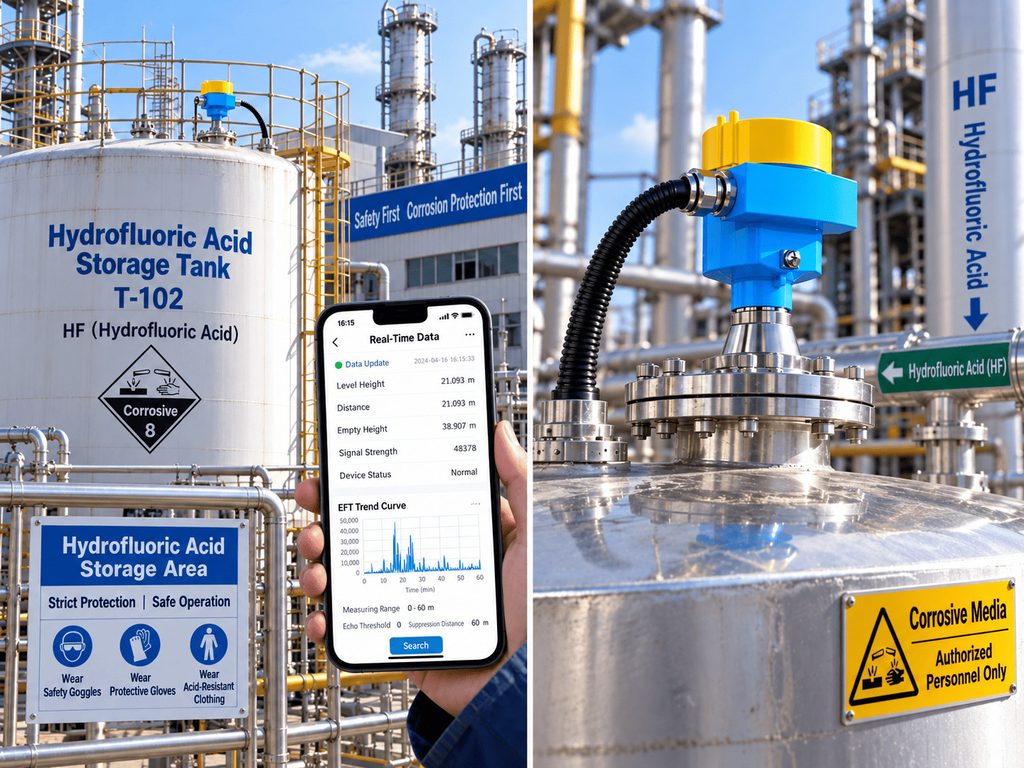
Jiwei’s independently developed JWrada intelligent radar level meter uses 80 GHz Frequency Modulated Continuous Wave (FMCW) technology for non-contact continuous level measurement of liquids, powders, and granular materials.
Combined with advanced echo signal processing algorithms, the instrument is capable of identifying measurement echoes under different media characteristics, installation structures, and operating conditions, providing continuous level data for storage tanks, silos, and other industrial applications.
For intelligent commissioning, the JWrada® radar level meter already supports Bluetooth-based wireless parameter configuration, echo curve viewing, and device diagnostics.
Using Jiwei’s “Jiwei Smart Control” software and mobile-based tools, engineers can review instrument operating information and perform parameter configuration, echo analysis, and preliminary troubleshooting without having to directly access the instrument in every case.
For instruments installed on tall storage tanks, elevated silos, or in potentially hazardous measuring environments, wireless commissioning can reduce unnecessary climbing and on-site operations, helping improve commissioning efficiency while lowering personnel exposure to operational risks.
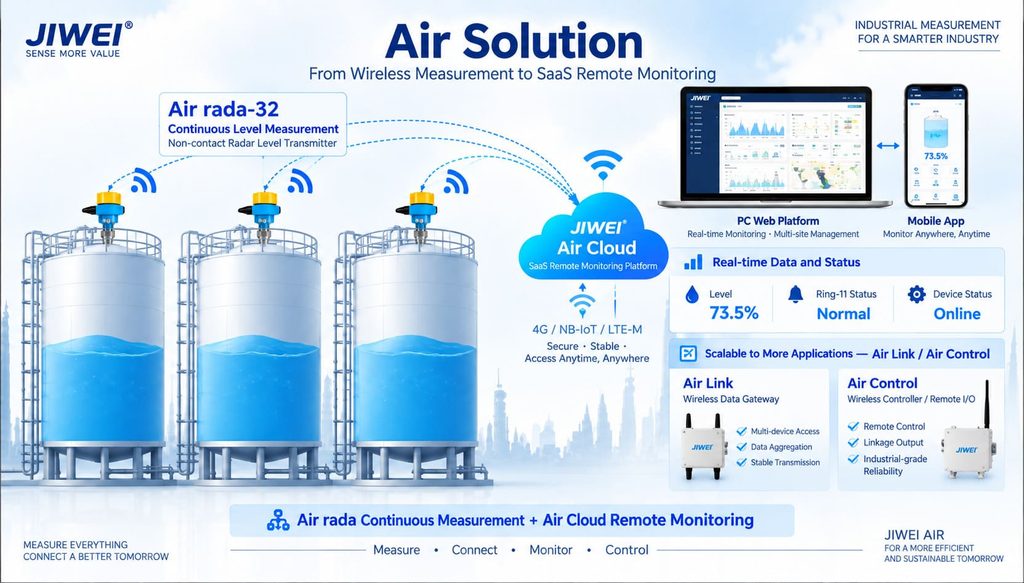
Building on these capabilities, Jiwei is further exploring the integration of 4G wireless communication with radar level measurement.
For instruments that are already installed and operating in the field, an external 4G industrial gateway can be connected through compatible communication interfaces. Measurement data can then be transmitted to a remote monitoring platform, enabling wireless upgrades for existing instrumentation.
For newly developed products, Jiwei is also studying the integration of 4G communication modules directly into the instrument, allowing level data and device status information to be uploaded over mobile communication networks.
These two approaches are designed for different requirements: one focuses on upgrading installed instruments, while the other supports the development of a new generation of wireless-enabled level measuring devices.
The appropriate solution can be selected according to power supply conditions, communication interfaces, mobile network coverage, and overall project cost.
Bringing Level Switches onto 4G Wireless Networks
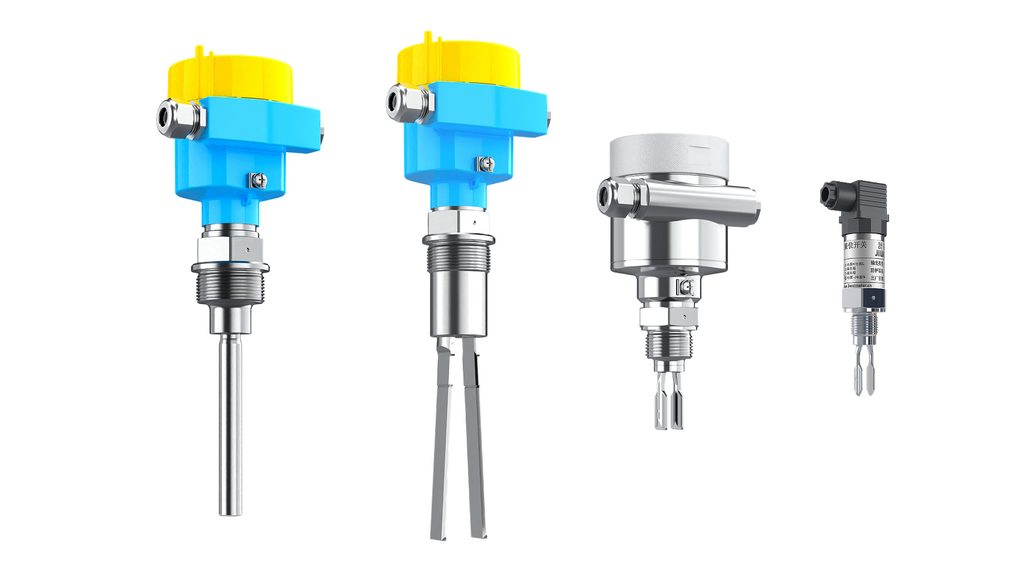
In addition to radar level meters, Jiwei is extending its 4G wireless communication research to tuning fork level switches, vibrating rod level switches, RF admittance level switches, and rotary paddle level switches.
For conventional instruments with relay or switching outputs, digital input modules or multi-channel 4G industrial gateways can be used to collect high-level and low-level status signals, full-silo alarms, material shortage warnings, and other switching information.
These signals can then be transmitted through mobile communication networks to a remote monitoring platform.
For facilities with tanks, silos, water reservoirs, and other equipment distributed across large areas, 4G wireless connectivity enables multiple independent measuring points to be monitored through a centralized platform, giving operators easier access to real-time level status information.
For intelligent instruments equipped with digital communication capabilities, device status data and remote diagnostic functions may also be extended according to the available communication interface and protocol.
By connecting radar level meters and level switches within the same monitoring architecture, users can obtain both continuous level measurements and point-level alarm information.
This combination allows continuous liquid or solid level monitoring to work alongside high-level, low-level, and limit-level detection, providing a more complete view of process conditions.
Reducing Long-Distance Cabling and Improving Deployment Flexibility
Traditional industrial level instruments are commonly connected to PLC, DCS, or other control systems using 4–20 mA, HART, RS485, or similar wired communication methods.
In projects where measuring points are concentrated and communication distances are relatively short, wired communication remains a mature and reliable choice.
However, in large tank farms, outdoor storage yards, wastewater treatment facilities, and other projects with widely distributed measuring points, communication cable installation may require cable trays, conduits, junction facilities, and extensive construction work.
These requirements can increase both project installation costs and long-term maintenance workloads.
With 4G wireless communication, part of the instrument data can be transmitted through mobile networks, reducing the need for long-distance communication cabling and associated construction.
For existing facilities, adding a 4G industrial gateway can enable remote data acquisition from installed instruments without requiring a complete redesign of the original control system.
This can reduce the implementation difficulty associated with adding new measuring points or upgrading older systems.
Wireless communication is particularly useful in large tank farms, outdoor silos, wastewater treatment plants, pumping stations, and remote monitoring locations, where cable installation may be difficult or costly.
It is important to note, however, that 4G wireless communication mainly replaces part of the data transmission infrastructure. It does not eliminate the need for power.
Instruments, gateways, and related auxiliary devices still require reliable power supplies according to actual site conditions.
For critical safety interlocks, emergency shutdown systems, and other safety-related circuits, appropriate independent and reliable protective measures should be retained in accordance with applicable safety requirements.
Network service fees, wireless communication hardware, remote platform maintenance, and mobile network coverage should also be included in the overall project cost assessment.
Therefore, the economic value of a 4G wireless level measurement solution should be evaluated based on the number of measuring points, communication distances, construction conditions, network availability, and long-term maintenance requirements.
Its primary benefits lie in reducing part of the cabling investment, improving installation flexibility, and decreasing some on-site inspection and maintenance work.
Remote Diagnostics Improve Radar Level Meter Maintenance Efficiency
During long-term operation, industrial radar level meters may be affected by installation structures, changes in material properties, false echoes, dust, foam, or variations in process conditions.
As a result, parameter verification, echo analysis, and device diagnostics may be required to maintain stable measurement performance.
The JWrada radar level meter’s existing Bluetooth commissioning and diagnostic capabilities provide a technical foundation for further development of remote maintenance functions.
Once 4G communication is integrated with a remote management platform, engineers can obtain measurement data, device status information, and relevant diagnostic data over the network.
This information can be used to remotely analyze abnormal measurements and help identify potential causes before an on-site service visit is arranged.
When device interfaces, network conditions, authorization mechanisms, and cybersecurity requirements are satisfied, remote parameter verification and adjustment may also be implemented.
This can reduce the number of field visits required for routine configuration and troubleshooting.
For remote factories, distributed storage tanks, hazardous measurement environments, and overseas projects, remote diagnostics can help shorten response times and improve the efficiency of technical support while reducing the need for personnel to enter high-risk locations.
At the same time, remote parameter changes and maintenance operations require appropriate cybersecurity controls.
Measures such as identity authentication, permission management, operation logging, and data protection should be incorporated to prevent unauthorized access and maintain safe, stable instrument operation.
Expanding Applications in Petrochemical, Environmental, Mining, and Storage Industries
4G wireless level measurement technology is particularly suitable for industrial facilities where measuring points are widely distributed, cabling is difficult, or centralized monitoring is required.
In the petrochemical industry, it can be used for liquid level data acquisition from distributed storage tanks as well as high-level and low-level alarm monitoring.
In environmental protection and water treatment applications, wireless level monitoring can provide remote liquid level information from wastewater tanks, pumping stations, reservoirs, and other facilities.
In mining, building materials, and cement production, level data and alarm signals from multiple silos can be uploaded to a centralized platform to support material supply management and production scheduling.
In grain storage applications, centralized monitoring of multiple silos can help operators track stored material levels and improve routine inspection and inventory management.
For remote measuring points where fixed communication infrastructure is unavailable, wireless level monitoring may also be combined with low-power design, solar power supply, and periodic data transmission technologies to explore more independent deployment options.
As industrial IoT platforms become more widely adopted, accumulated liquid and solid level data can also support historical trend analysis, abnormal-condition alerts, inventory monitoring, and equipment operation management.
This allows level measurement data to become part of a broader industrial information and asset management system.
Advancing the Practical Application of 4G Wireless Level Measurement
Applying 4G wireless communication to industrial instrumentation involves more than simply transmitting measurement data over a mobile network.
A successful solution must balance measurement reliability, communication stability, power consumption, cybersecurity, and on-site safety requirements.
During product development and engineering implementation, the influence of wireless communication modules on instrument measurement performance should be fully evaluated.
Testing should also cover power consumption, electromagnetic compatibility, network coverage, connection recovery after communication interruptions, communication stability, and data security.
For hazardous environments such as petrochemical and chemical processing facilities, the equipment must also comply with applicable explosion protection and industrial safety requirements.
Looking ahead, Jiwei will continue to build on its existing JWrada radar level meters, level switches, and intelligent commissioning technologies to advance the application of 4G wireless communication in industrial level measurement.
The company will further explore instrument connectivity, wireless data transmission, remote monitoring, and equipment maintenance solutions designed around real industrial operating requirements.
As wireless data transmission and remote maintenance technologies become increasingly integrated, industrial level instruments are expected to gain greater flexibility in deployment, monitoring, and lifecycle management.
Jiwei will continue to develop practical, stable, and safety-oriented wireless level measurement solutions, providing industrial users with additional options for reducing part of their engineering and maintenance costs while improving instrument management efficiency.