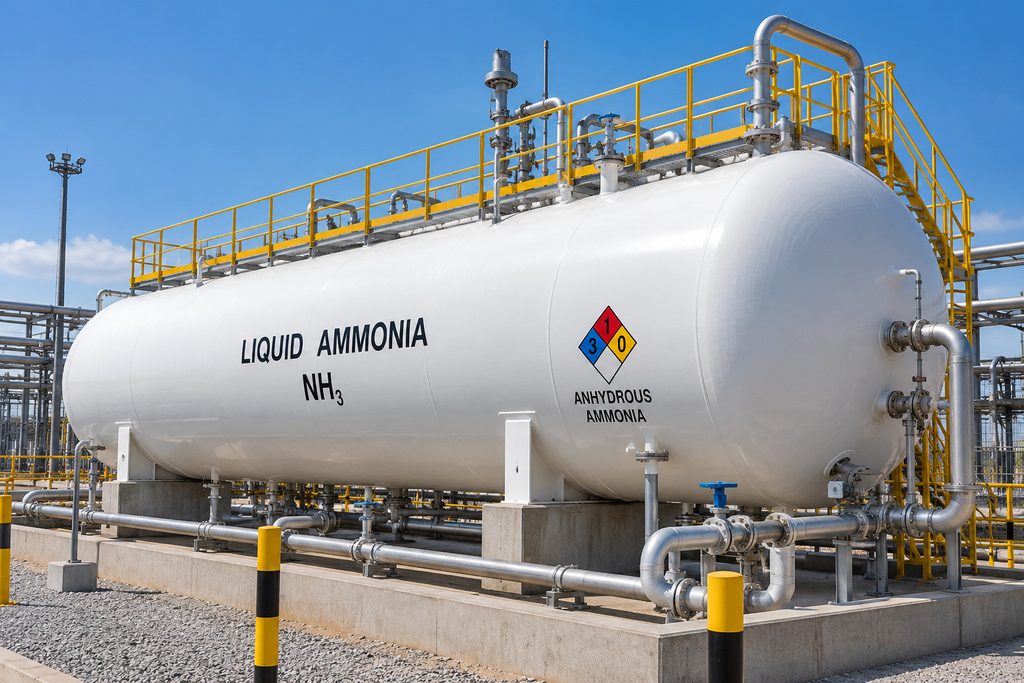
Liquid ammonia is widely used in chemical processing, fertilizer production, industrial refrigeration, energy, and environmental applications. Because ammonia is volatile and toxic, reliable tank level measurement is important not only for inventory management and process control, but also for preventing overfilling, leakage, and safety incidents during storage and transfer.
Compared with measuring water in an atmospheric tank, measuring the level of liquid ammonia is considerably more challenging. Tank pressure, temperature variations, liquid-vapor equilibrium, vapor-space conditions, and instrument installation can all affect measurement performance.
For this reason, selecting a level instrument for a liquid ammonia storage tank should not be based solely on nominal accuracy. Long-term stability, process compatibility, safety, maintainability, and reliability under changing operating conditions are equally important.
1. Why Is Liquid Ammonia Tank Level Difficult to Measure?
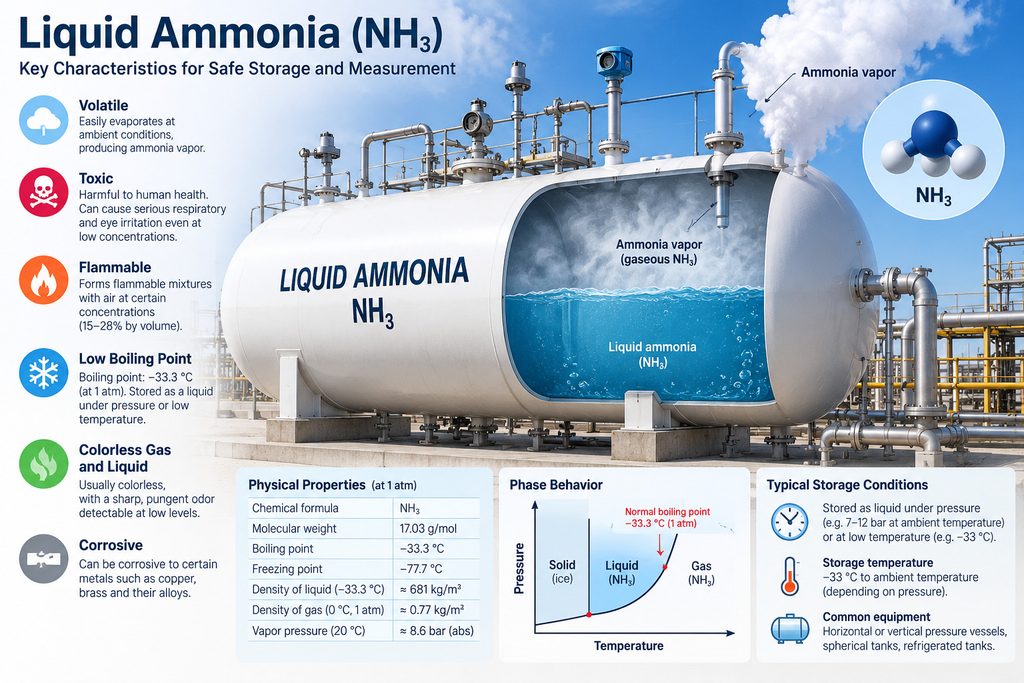
Liquid ammonia is commonly stored either under pressure or at reduced temperatures. Under many operating conditions, both liquid ammonia and ammonia vapor are present inside the tank, and the equilibrium between these two phases changes with temperature, pressure, filling, and withdrawal.
As a result, the level instrument is not operating in a completely stable measurement environment.
During rapid filling or unloading, for example, both tank pressure and liquid level may change simultaneously. Changes in ambient or process temperature can also influence ammonia density and liquid-vapor equilibrium.
If the selected measurement technology is sensitive to vapor conditions, density, pressure, or temperature, the instrument may experience fluctuating readings, zero-point drift, or increased measurement uncertainty.
The main challenge, therefore, is not simply obtaining a level reading. It is obtaining a stable, reliable, and safe level measurement over the full range of expected operating conditions.
2. Challenge 1: Vapor-Space Conditions Can Affect Measurement
The space above the liquid surface in an ammonia tank contains ammonia vapor. The properties of this vapor can change as tank pressure and temperature vary.
This is particularly important for measurement technologies that depend on wave propagation through the vapor space.
An ultrasonic level transmitter, for example, determines level by measuring the travel time of an acoustic signal between the sensor and the liquid surface. However, the speed of sound is affected by gas composition, temperature, and other vapor properties.
Changes in the vapor space of an ammonia tank can therefore introduce measurement errors. In some industrial applications, guided wave radar has been used to replace ultrasonic measurement where ammonia vapor conditions made reliable ultrasonic measurement difficult.
Radar technology does not depend on the speed of sound, but this does not mean that every radar transmitter can automatically be applied to every ammonia tank.
For anhydrous ammonia and other demanding applications, the effect of the vapor space on microwave propagation should still be evaluated. Storage pressure, measurement distance, antenna design, radar frequency, and the dielectric properties of the process medium should all be considered.
Therefore, the statement that “radar is non-contact, so it will work on any ammonia tank” is an oversimplification.
3. Challenge 2: Liquid Ammonia Density Changes with Temperature
The density of liquid ammonia is not constant. It varies with temperature, which is particularly important when using differential pressure (DP) level measurement.
A DP level transmitter indirectly calculates liquid level from the hydrostatic pressure generated by the liquid column.
In simplified form:
Hydrostatic Pressure = Liquid Density × Gravity × Liquid Height
If the transmitter is calibrated using a fixed liquid density while the actual ammonia temperature changes significantly, the difference between the assumed density and actual density can be converted directly into a level measurement error.
For a closed pressurized tank, vapor pressure compensation must also be considered, along with impulse lines, seals, condensation, and transmitter installation.
When using differential pressure for liquid ammonia level measurement, engineers should therefore evaluate the expected operating temperature range, ammonia density variation, pressure compensation, tapping-point arrangement, impulse piping, and ambient temperature conditions.
This is one reason why a DP level transmitter may perform well during commissioning but later show a deviation from another level instrument as process conditions change.
4. Challenge 3: Vaporization and Liquid-Vapor Changes Can Cause Unstable Readings
Liquid ammonia is highly volatile.
During rapid filling, withdrawal, depressurization, or other process changes, local flashing, bubbles, turbulence, and liquid-surface movement may occur. These conditions can cause temporary fluctuations in the measured level.
If the level transmitter responds too quickly, the control system may display a continuously fluctuating level trend. On the other hand, excessive damping may hide genuine rapid changes in tank level.
Reliable ammonia level measurement therefore involves more than choosing the correct sensor.
Instrument configuration may also include:
- Echo recognition
- False-echo suppression
- Signal filtering
- Damping time
- Threshold settings
- Abnormal signal handling
A stable level signal should not simply be an artificially smoothed signal. The objective is to achieve the appropriate balance between measurement stability and response speed for the application.
5. Challenge 4: Safety Requirements Are Much Higher Than for Ordinary Tanks
For water or wastewater applications, a level instrument failure may primarily result in inaccurate process control.
For liquid ammonia, however, the consequences can be much more serious because ammonia presents significant toxicity and leakage hazards. Instrument selection must therefore consider process containment and tank integrity in addition to measurement performance.
Important considerations include:
- Reliability of process connections and seals
- Pressure rating
- Temperature rating
- Wetted material compatibility
- Hazardous-area certification
- Potential leak points
- Maintenance requirements
- Whether maintenance requires opening the tank
From a process-safety perspective, minimizing unnecessary tank penetrations and potential leakage points can be beneficial.
The ability to perform diagnostics and certain maintenance activities without frequently opening the tank is therefore an important consideration when selecting an ammonia tank level transmitter.
If an instrument is also used as part of a high-high level or overfill protection system, the design should consider applicable regulations, plant safety standards, and Safety Instrumented System (SIS) requirements.
Depending on the risk assessment and applicable standards, an independent high-level switch or separate measurement loop may be required rather than relying solely on a single continuous level transmitter connected to the DCS.
6. Challenge 5: Internal Tank Structures Can Create Measurement Interference
Many level measurement problems are caused not by poor instrument performance, but by improper installation.
A liquid ammonia tank may contain internal pipes, support structures, manways, reinforcement members, inlet pipes, or other metallic components.
For non-contact radar level measurement, these structures may create unwanted reflections or false echoes.
If the radar transmitter is installed directly above or close to the filling inlet, the incoming liquid stream and surface turbulence may also interfere with measurement stability.
For guided wave radar, engineers need to consider the distance between the probe and surrounding structures. Tank height, available installation space, probe configuration, and mechanical loads should also be evaluated.
For this reason, level instrument selection and installation design should be considered together.
Selecting an instrument simply because the process medium is “liquid ammonia,” without reviewing the tank drawing, process conditions, nozzle arrangement, and internal structures, is a common engineering mistake.
7. Which Level Instrument Is Suitable for a Liquid Ammonia Tank?
Common technologies used for liquid ammonia tank level measurement include non-contact radar, guided wave radar, differential pressure transmitters, and magnetic level gauges.
Non-Contact Radar Level Transmitter
Non-contact radar has the advantage of measuring without direct contact with the liquid. It has few mechanical moving parts and generally requires relatively little maintenance.
However, for liquid ammonia applications, engineers should evaluate tank pressure, measurement distance, vapor-space conditions, antenna design, nozzle configuration, and internal tank structures.
The decision should not be based only on radar frequency.
Guided Wave Radar Level Transmitter
Guided wave radar sends microwave pulses along a probe or cable, creating a more defined propagation path.
This technology is used in some anhydrous ammonia storage applications where vapor-space conditions make other measurement methods more difficult.
However, probe length, process connection, mechanical installation, surrounding structures, and operating pressure must all be considered during selection.
Differential Pressure Level Transmitter
Differential pressure measurement is a mature and widely used technology.
Its main challenge in ammonia applications is that the measurement is influenced by liquid density. Temperature-dependent density changes, vapor pressure, impulse lines, remote seals, and installation conditions must therefore be evaluated carefully.
For applications with significant process variations, temperature or density compensation may need to be considered.
Magnetic Level Gauge
A magnetic level gauge provides direct local indication and can also be combined with a transmitter for remote monitoring.
However, bypass chambers, valves, flanges, and seals introduce additional process connections. Because ammonia applications require careful control of potential leakage points, material compatibility, connection design, and long-term sealing reliability should receive particular attention.
There is therefore no single “best level transmitter” for every liquid ammonia storage tank. The correct solution depends on the tank design, operating pressure, temperature, measurement range, safety requirements, and installation conditions.
8. What Information Is Required Before Selecting an Ammonia Level Transmitter?
Before selecting a level measurement system, the following process information should normally be confirmed:
- Tank type and dimensions
- Minimum and maximum operating temperatures
- Normal operating pressure
- Maximum or design pressure
- Level measurement range
- Process connection size
- Nozzle location and length
- Internal tank structures
- Inlet and outlet locations
- Hazardous-area classification
- Available installation positions
- Required measurement accuracy
- Continuous measurement or point-level detection
- Local indication requirements
- Output signal and communication protocol
For large ammonia storage tanks, critical process vessels, or applications involving safety interlocks, additional information may be required, including redundancy strategy, SIL requirements, independent overfill protection, diagnostic requirements, and maintenance procedures.
In other words, the first step in selecting an ammonia tank level transmitter is not choosing a brand or model. It is establishing a complete set of process conditions.
9. Frequently Asked Questions About Liquid Ammonia Level Measurement
Can a radar level transmitter be used for liquid ammonia?
Yes. Radar is one of the technologies used for ammonia tank level measurement. However, the appropriate radar configuration should be selected according to the type of ammonia, tank pressure, measurement distance, vapor-space conditions, nozzle arrangement, and internal tank structure.
For certain demanding applications, guided wave radar may also be considered.
Why does an ammonia tank level reading fluctuate?
Possible causes include liquid-surface turbulence during filling or withdrawal, vapor-liquid changes, false echoes, unsuitable installation locations, incorrect instrument configuration, and rapid changes in process pressure or temperature.
Instrument diagnostic data and historical level trends should be analyzed before concluding that the transmitter itself has failed.
Can an ultrasonic level transmitter be used for an ammonia tank?
It requires careful evaluation.
Ultrasonic measurement depends on the propagation of sound through the vapor space. Because changes in gas composition, temperature, and other vapor conditions can affect the speed of sound, ammonia vapor may introduce measurement errors.
For applications requiring high measurement reliability, the actual pressure, temperature, vapor composition, and operating conditions should be evaluated before selecting ultrasonic technology.
Which is better for liquid ammonia: radar or differential pressure?
Both technologies can be used, but they are affected by different factors.
Radar applications require careful evaluation of vapor-space conditions, microwave propagation, echoes, nozzle geometry, and installation.
Differential pressure measurement requires particular attention to ammonia density changes, vapor pressure, impulse piping, and temperature effects.
The appropriate technology should therefore be selected according to the actual tank and process conditions rather than simply comparing the nominal accuracy specifications of the instruments.
Is guided wave radar suitable for anhydrous ammonia?
Guided wave radar can be suitable for certain anhydrous ammonia applications because the microwave signal travels along a defined probe.
However, operating pressure, temperature, probe configuration, tank geometry, process connection, and surrounding structures should all be evaluated before final selection.
Conclusion
The most difficult part of liquid ammonia tank level measurement is not simply determining whether the instrument can detect the liquid surface.
The real challenge is whether the instrument can provide stable, reliable, and safe level data while temperature, pressure, vapor conditions, liquid density, and operating conditions continuously change.
A successful ammonia tank level measurement system should therefore address three fundamental questions.
First, is the measurement principle suitable for liquid ammonia and the expected process conditions?
Second, how will tank geometry, internal structures, vapor conditions, temperature, pressure, and filling operations affect the measurement?
Third, what happens if the instrument fails, requires maintenance, or is used as part of an overfill protection system?
By evaluating the process medium, tank design, operating conditions, installation arrangement, and measurement technology as an integrated system, engineers can significantly improve the long-term reliability and safety of liquid ammonia tank level measurement.