
In microwave communications, radar testing, wireless measurements, and electromagnetic compatibility laboratories, you may often see an antenna shaped like a flared horn. This is known as a horn antenna.
Thanks to its simple structure, stable gain, good directivity, relatively wide operating bandwidth, and high power-handling capability, the horn antenna has become one of the most widely used antenna types in microwave and millimeter-wave systems.
So, how does a horn antenna work? What types of horn antennas are available? How are antenna gain and physical dimensions related? And where are horn antennas commonly used?
This article provides a comprehensive introduction to the working principle, types, characteristics, key parameters, advantages, and applications of horn antennas.
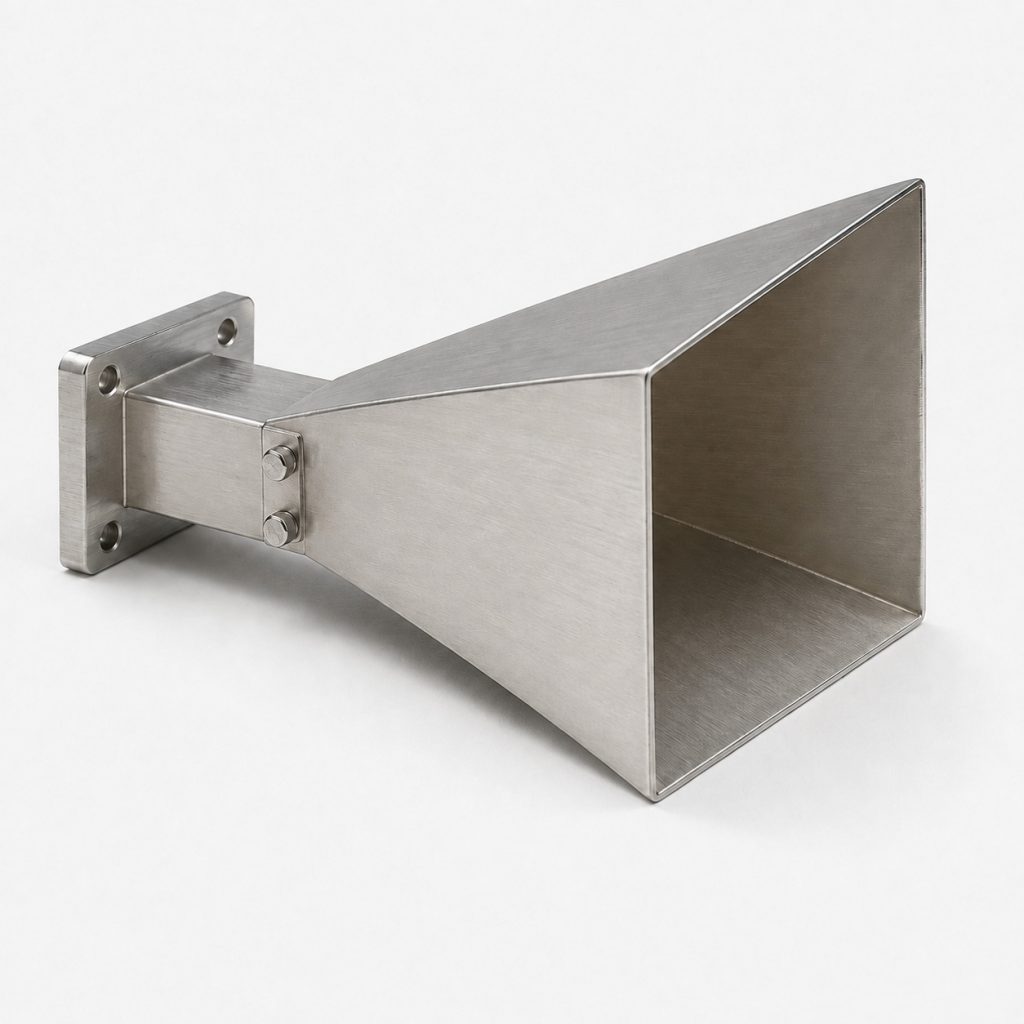
1. What Is a Horn Antenna?
A horn antenna is an aperture antenna formed by gradually flaring the end of a waveguide. In simple terms, it can be considered an expanded rectangular or circular waveguide designed to allow electromagnetic waves to transition smoothly from the waveguide into free space.
If electromagnetic waves are radiated directly from the relatively small opening of a waveguide, the abrupt transition between the waveguide and free space may cause significant impedance mismatch and signal reflection. This can reduce radiation efficiency.
The flared horn structure provides a gradual transition between the waveguide and free space.
As electromagnetic waves travel through the expanding section, the impedance changes more gradually, helping reduce reflections and allowing more electromagnetic energy to be radiated efficiently.
Therefore, a horn antenna primarily solves two important problems.
First, it improves the transition of electromagnetic energy from the waveguide into free space.
Second, it increases the effective radiating aperture, improving antenna directivity and gain.
Although the structure of a horn antenna is relatively simple, these characteristics make it highly effective and widely used in microwave engineering.
2. How Does a Horn Antenna Work?
To understand the working principle of a horn antenna, it is useful to first understand waveguides.
At microwave frequencies, conventional transmission lines may experience increasing losses and other limitations. As a result, rectangular or circular waveguides are commonly used to carry high-frequency electromagnetic energy.
When an electromagnetic wave travels along a waveguide and reaches the horn section, the cross-sectional dimensions gradually increase.
As the waveguide expands, the electromagnetic field distribution also changes.
At the aperture of the horn antenna, electromagnetic energy is radiated into free space. Because the aperture has a relatively large physical area, the electromagnetic waves emitted from different parts of the aperture combine in space.
In the forward direction, these waves largely reinforce each other, creating a strong main beam.
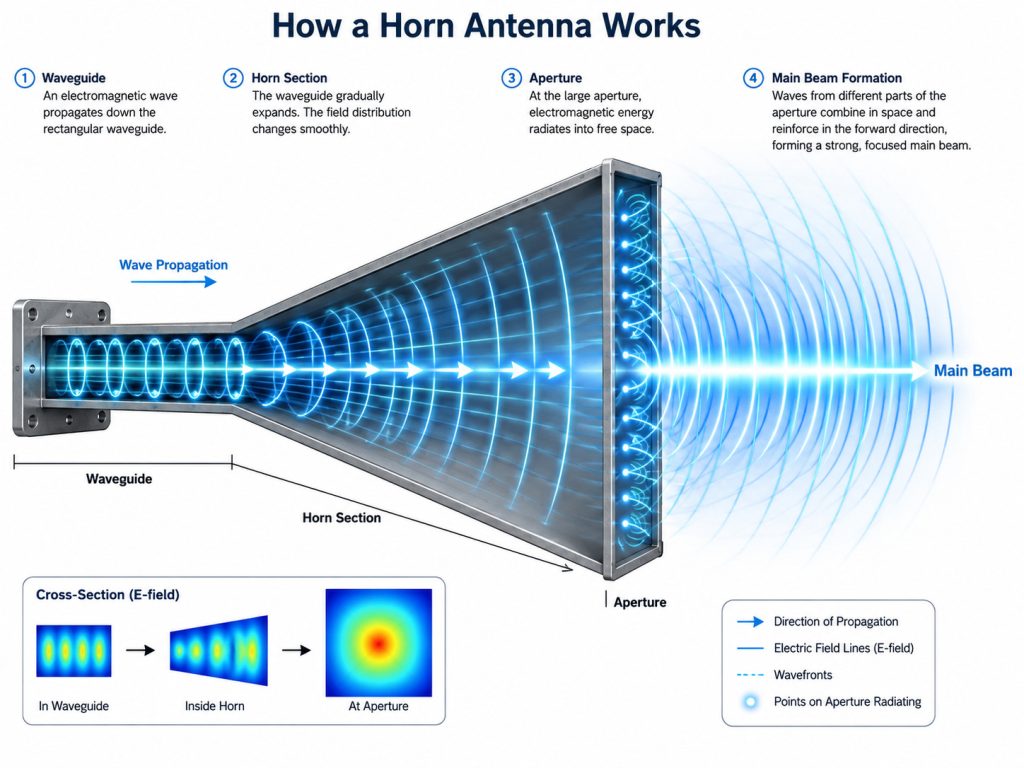
In other directions, the radiated fields are generally weaker.
This produces the directional radiation pattern associated with a horn antenna.
Unlike an omnidirectional antenna that distributes energy over a wide area, a directional horn antenna concentrates much of its radiated energy toward a specific direction.
As a result, a horn antenna can achieve higher effective radiation intensity in the desired direction without actually generating additional power.
The receiving process works in reverse.
Electromagnetic waves arriving from a particular direction enter the horn aperture and are gradually coupled into the waveguide before being transmitted to the receiving equipment.
Therefore, horn antennas can be used for both transmitting and receiving RF and microwave signals.
3. Common Types of Horn Antennas
Horn antennas can be classified according to their geometry and the way the waveguide expands.
E-Plane Horn Antenna
An E-plane horn antenna is flared mainly in the plane corresponding to the electric field.
The dimension in the other plane remains relatively unchanged.
This configuration improves beam characteristics primarily in one direction and is often used for educational experiments, microwave research, and specialized RF applications.
H-Plane Horn Antenna
An H-plane horn antenna is similar to an E-plane horn, but the flare occurs in the plane associated with the magnetic field.
Because the aperture is expanded in only one plane, the radiation patterns in the E-plane and H-plane can be significantly different.
Pyramidal Horn Antenna
The pyramidal horn antenna is one of the most common types of rectangular horn antennas.
It expands in both the E-plane and H-plane directions, creating a rectangular aperture.
Because the horn is flared in two dimensions, a pyramidal horn can provide improved directivity and gain in both planes.
Pyramidal horn antennas are widely used in microwave measurement systems, radar applications, communication systems, antenna testing, and research laboratories.
Conical Horn Antenna
A conical horn antenna is generally formed by gradually expanding a circular waveguide.
Its aperture is circular rather than rectangular.
Because of its rotationally symmetric geometry, a conical horn can provide relatively symmetrical radiation characteristics and is often used in systems requiring specific polarization or beam properties.
Double-Ridged Horn Antenna
The double-ridged horn antenna is one of the most important types of broadband horn antennas.
It incorporates two ridges inside the horn and waveguide structure. These ridges modify the electromagnetic field distribution and can lower the cutoff frequency of certain propagation modes.
As a result, double-ridged horn antennas can achieve significantly wider bandwidth than many conventional horn antennas.
They are widely used in:
- EMC testing
- EMI measurements
- Broadband RF testing
- Antenna measurements
- Wireless research
- Electromagnetic laboratories
For applications requiring operation across a very wide frequency range, the double-ridged horn antenna is often a practical choice.
4. Key Horn Antenna Parameters
When selecting a horn antenna, physical appearance alone is not enough. Several important technical specifications should be considered.
Operating Frequency
The frequency range specifies the frequencies over which the horn antenna can operate effectively.
Traditional standard gain horns are typically designed for a specific waveguide frequency band, while broadband horn antennas can cover much wider frequency ranges.
The frequency range of the antenna should always include the frequencies used by the measurement, communication, or radar system.
Horn Antenna Gain
Horn antenna gain is one of the most important specifications.
In general, when other conditions are similar, a larger effective aperture provides higher directivity and potentially higher gain.
It is important to understand that antenna gain does not mean that the antenna creates additional electromagnetic energy.
Instead, a higher-gain antenna concentrates more of the available energy in a particular direction.
Therefore, a high-gain horn antenna generally produces a narrower main beam and is well suited for long-distance communication, directional measurements, radar systems, and antenna testing.
VSWR
Voltage Standing Wave Ratio (VSWR) is commonly used to evaluate impedance matching between the antenna and the RF system.
If the impedance match is poor, part of the input energy is reflected back toward the transmitter.
This reduces the amount of energy actually radiated by the antenna and may also create problems in high-power RF systems.
A low and stable VSWR generally indicates good impedance matching across the specified operating frequency range.
Beamwidth
The beamwidth of a horn antenna describes the angular width of its main radiation beam.
A high-gain horn antenna usually has a narrower beamwidth, while an antenna with a wider beam can cover a larger angular area.
However, higher gain is not always better.
The appropriate gain and beamwidth should be selected according to the measurement distance, target size, required coverage, and overall system configuration.
Polarization
Horn antennas may support different polarization types depending on their design and feed configuration.
Common options include linear polarization, dual linear polarization, and circular polarization.
When two antennas are used together, their polarization orientation should be properly aligned.
A polarization mismatch between transmitting and receiving antennas can introduce additional signal loss and significantly affect measurement accuracy.
5. Why Do Horn Antennas Have High Gain?
The relatively high gain of a horn antenna is mainly related to its large effective aperture and directional radiation characteristics.
Antenna gain is closely associated with the effective aperture, operating wavelength, and aperture efficiency.
In general, when the aperture becomes electrically larger compared with the wavelength, the antenna can produce a narrower beam and higher directivity.
This also explains why horn antenna size varies significantly with operating frequency.
At lower frequencies, wavelengths are longer, so the horn antenna usually needs to be physically larger to achieve a given gain.
At millimeter-wave frequencies, wavelengths are much shorter.
Therefore, even a physically small antenna may have a relatively large electrical aperture compared with the wavelength and can still provide substantial gain.
This is why compact high-gain horn antennas are commonly used in millimeter-wave radar, 5G testing, satellite communications, 6G research, and terahertz measurement systems.

6. Advantages of Horn Antennas
Horn antennas are widely used because they provide several practical advantages.
One major benefit is their relatively simple structure.
Many horn antennas can be connected directly to standard waveguide systems without requiring a complicated feed network.
Another advantage is their stable gain and predictable radiation pattern.
Standard gain horn antennas, in particular, can be accurately characterized and calibrated, making them useful as reference antennas in measurement systems.
Horn antennas can also provide high power-handling capability.
Because many horn antennas are based on metallic waveguide structures, they are often more suitable for high-power microwave applications than some compact printed antenna designs.
Other common advantages include:
- High radiation efficiency
- Low transmission loss
- Good directivity
- Stable electrical performance
- Relatively low VSWR
- Good mechanical reliability
- Easy integration with waveguide systems
- Suitable operation at microwave and millimeter-wave frequencies
Special designs such as double-ridged, exponentially tapered, and broadband horns can further increase the available operating bandwidth.
7. Applications of Horn Antennas
Horn antennas are used in a wide variety of RF, microwave, and millimeter-wave applications.
Antenna Testing and Measurement
One of the most common applications is antenna measurement.
A calibrated standard gain horn antenna can be used as a reference antenna to measure the gain, radiation pattern, polarization characteristics, and performance of another antenna under test.
Horn antennas are therefore common equipment in anechoic chambers and antenna measurement laboratories.
EMC and EMI Testing
Broadband horn antennas, particularly double-ridged horn antennas, are widely used for electromagnetic compatibility (EMC) and electromagnetic interference (EMI) measurements.
Depending on the test system and frequency range, they may be used for radiated emissions measurements or radiated immunity testing.
Radar Systems
Horn antennas are commonly found in radar applications.
A horn may be used directly as a transmitting or receiving antenna, or it may serve as a feed antenna for a larger reflector system.
Their high directivity and stable radiation characteristics make horn antennas particularly useful in microwave and millimeter-wave radar systems.
Satellite and Microwave Communications
Horn antennas are also widely used as feeds for parabolic reflector antennas in satellite communication and microwave communication systems.
The horn illuminates the reflector, which then produces a much narrower and higher-gain beam.
Millimeter-Wave and 5G Testing
As wireless systems move toward higher frequencies, horn antennas have become increasingly important in 5G millimeter-wave testing.
They can be used for channel measurements, over-the-air testing, device characterization, propagation studies, and wireless research.
Automotive Radar
Modern automotive radar systems commonly operate in millimeter-wave frequency bands.
Horn antennas are frequently used in laboratories to test radar modules, measure antennas, evaluate propagation performance, and characterize radar components.
They are also widely used in 6G research, remote sensing, terahertz studies, RF laboratories, microwave education, and scientific measurement systems.
8. Horn Antenna vs. Other Antenna Types
Compared with common dipole antennas, whip antennas, or PCB antennas, horn antennas are designed for different priorities.
Compact communication devices such as smartphones, IoT equipment, and Wi-Fi routers usually require small antennas and relatively broad coverage.
For these applications, compact omnidirectional or wide-beam antennas may be more appropriate.
Horn antennas, on the other hand, place greater emphasis on:
- Directivity
- Antenna gain
- Low loss
- Power handling
- Predictable radiation characteristics
- Accurate calibration
This explains why horn antennas are rarely seen in ordinary consumer devices but are commonly found in microwave laboratories, radar test systems, satellite ground equipment, and antenna measurement facilities.
Neither design is universally better.
The correct antenna depends on the specific application.
9. How to Choose a Horn Antenna
When selecting a horn antenna, the first step is usually to determine the required operating frequency range.
Once the frequency range is established, gain and beamwidth can be selected according to the application.
For laboratory calibration, antenna gain measurements, or narrowband microwave tests, a standard gain horn antenna may be suitable.
For wideband EMC, EMI, or general RF measurement applications, a double-ridged horn antenna or another broadband horn design may be a better choice.
Other specifications that should be considered include:
- Frequency range
- Gain
- Half-power beamwidth
- VSWR
- Polarization
- Waveguide size
- RF connector type
- Power-handling capability
- Aperture dimensions
- Antenna dimensions and weight
- Calibration requirements
For far-field antenna measurements, the required measurement distance should also be calculated based on the antenna dimensions and operating wavelength.
If the antenna is placed too close to the device under test, the measurement may occur in the near-field or transition region rather than the intended far-field region, affecting accuracy.
For millimeter-wave applications, additional attention should be paid to machining accuracy, alignment, waveguide interfaces, connector loss, and installation tolerances, because small mechanical errors can have a greater electrical impact as wavelength decreases.
10. Conclusion
A horn antenna is a classic and highly practical directional microwave antenna.
By gradually expanding a waveguide, the horn creates a smoother transition between the guided electromagnetic wave and free space. At the same time, its enlarged aperture produces a directional radiation pattern and relatively high antenna gain.
Thanks to its high gain, low loss, good directivity, high power capability, stable performance, and predictable radiation characteristics, the horn antenna is widely used in microwave communications, radar systems, antenna testing, EMC measurements, millimeter-wave systems, and scientific research.
As technologies such as 5G millimeter-wave communications, automotive radar, satellite internet, 6G, and terahertz systems continue to develop, operating frequencies are moving higher.
Although the horn antenna is one of the oldest microwave antenna structures, its reliable and predictable performance means it continues to play an important role in modern RF, microwave, and millimeter-wave engineering.