
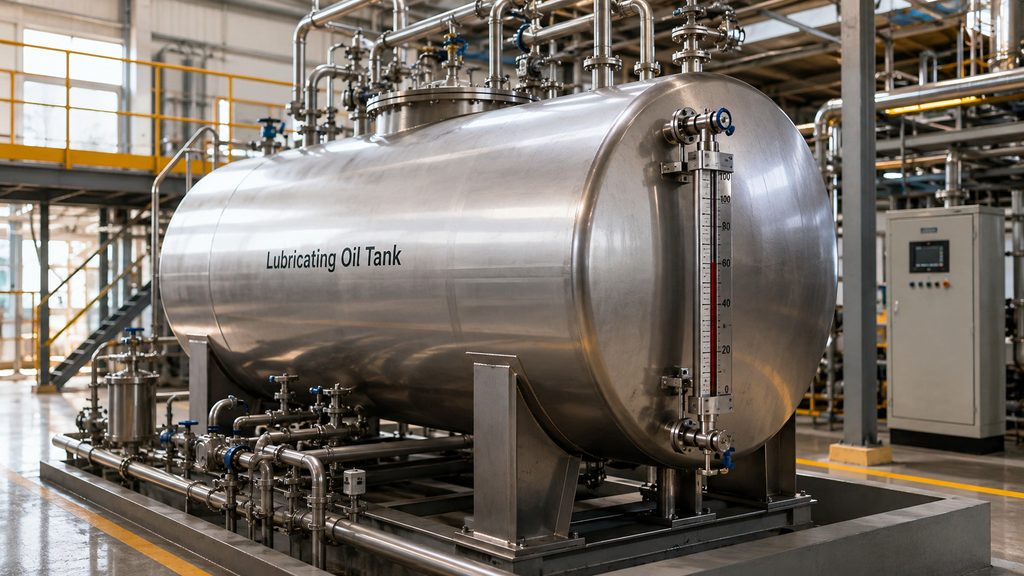
Lubricating oil storage tanks are widely used in machinery manufacturing, power generation, metallurgy, petrochemical plants, cement production, and centralized lubrication systems. These tanks play an important role in oil storage, buffering, and continuous oil supply.
The liquid level inside a lubricating oil tank directly affects the stability and reliability of the lubrication system. If the level is too low, the oil supply system may experience suction loss, pressure fluctuations, or even interruption. If the level is too high, overflow may occur during refilling, resulting in oil loss, contamination, and additional maintenance work.
For this reason, reliable liquid level monitoring is essential for the safe operation of lubricating oil storage tanks.
Among the many types of liquid level instruments available, the magnetic level indicator is widely used because of its clear local indication, simple mechanical structure, ability to operate without power for local display, and compatibility with remote transmitters and level alarm switches.
This article explains how magnetic level indicators are used in lubricating oil storage tanks, including their working principle, advantages, selection criteria, installation requirements, remote monitoring options, troubleshooting, and maintenance recommendations.
1. Why Is Reliable Level Monitoring Important for Lubricating Oil Storage Tanks?
Lubricating oil tanks are commonly used as storage and buffer vessels within lubrication systems. Stable tank level is important because both excessively high and excessively low oil levels can create operating risks.
When the liquid level becomes too low, the oil pump may begin to draw air. This can cause unstable discharge pressure, reduced oil supply, or interruption of lubrication.
For bearings, gearboxes, hydraulic equipment, compressors, turbines, and other rotating machinery, insufficient lubrication may result in higher operating temperatures, increased friction, abnormal wear, and equipment failure.
A high liquid level can also create problems.
If oil continues to enter the storage tank after the maximum operating level has been reached, the tank may overflow. Lubricating oil spills can contaminate floors and equipment, increase housekeeping requirements, create slip hazards, and cause unnecessary material loss.
A practical lubricating oil tank level monitoring system should therefore address three basic requirements:
- Operators should be able to visually check the liquid level at the tank.
- The control system should be able to monitor the liquid level remotely.
- High-level and low-level conditions should be capable of triggering alarms or control actions.
A properly configured magnetic level indicator can meet all three requirements.
2. How Does a Magnetic Level Indicator Work in a Lubricating Oil Tank?
A magnetic level indicator operates mainly according to the principle of communicating vessels and magnetic coupling.
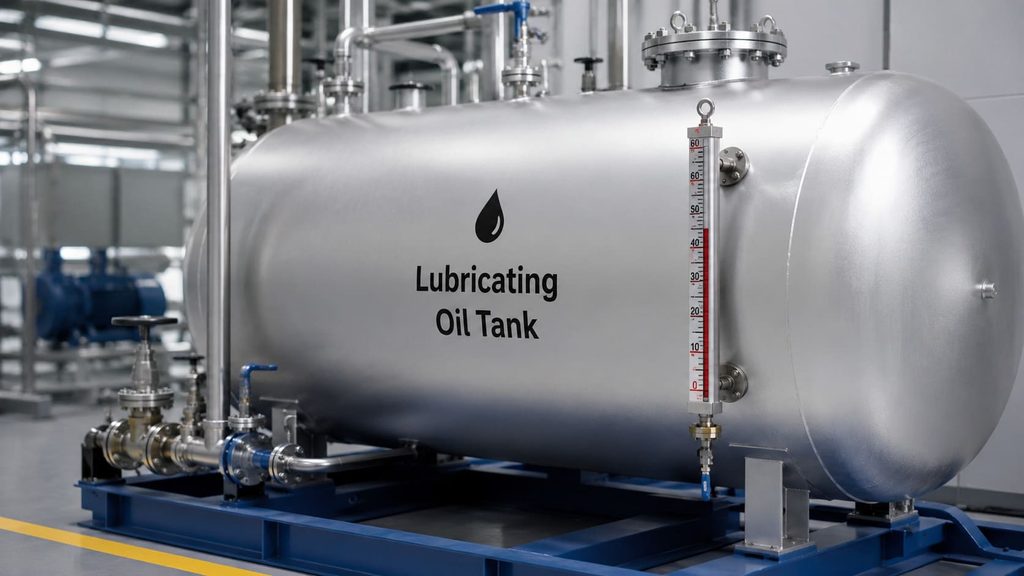
The instrument is typically installed on the side of the lubricating oil storage tank through upper and lower process connections.
Because the measuring chamber is connected to the tank, the liquid level inside the chamber rises and falls with the liquid level inside the storage tank.
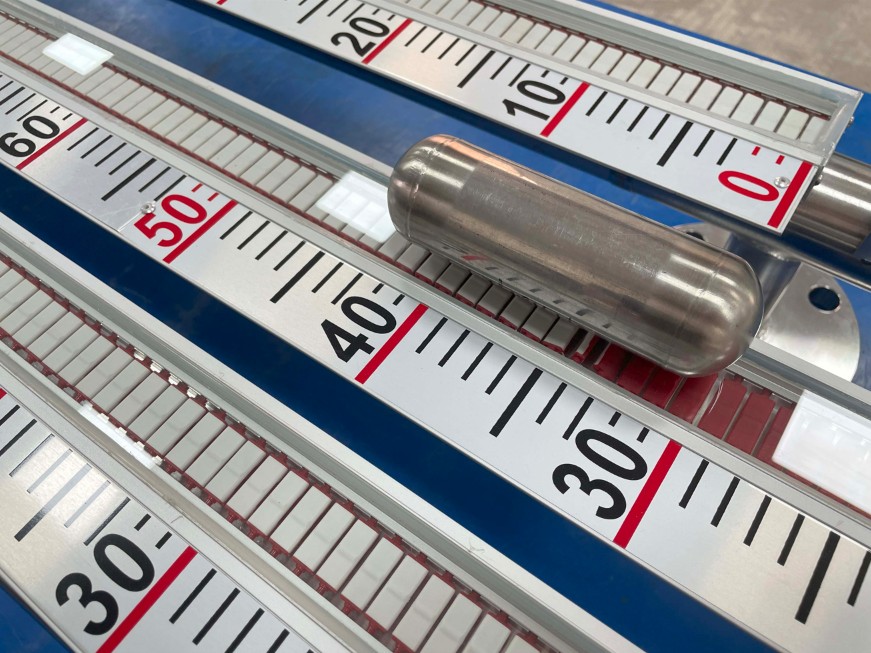
A magnetic float is installed inside the chamber. As the lubricating oil level changes, the float moves vertically.
Permanent magnets are installed inside the float. When the float moves, its magnetic field acts through the chamber wall and rotates the magnetic flaps or rollers installed in the external indicator.
The flaps normally have two contrasting colors.
As the float rises or falls, the flaps rotate and create a clear color boundary. The position of this boundary represents the actual liquid level in the tank.
One important advantage of this design is that the lubricating oil remains completely separated from the external visual indicator.
The liquid is contained inside the tank and measuring chamber, while the external indication is activated magnetically. As a result, operators can observe the tank level without direct contact with the process liquid.
Another important advantage is that the local indication does not require electrical power.
For applications requiring remote level monitoring, a magnetic level indicator can also be equipped with a level transmitter. The transmitter converts the float position into a standard industrial signal such as 4–20 mA, which can be transmitted to a PLC, DCS, SCADA system, or other process control system.
Magnetic switches can also be installed to provide high-level, low-level, high-high-level, or low-low-level alarms.
3. Why Are Magnetic Level Indicators Suitable for Lubricating Oil Storage Tanks?
3.1 Clear and Easy-to-Read Local Level Indication
Lubrication stations, mechanical rooms, oil storage areas, and industrial utility systems often require routine visual inspection.
A magnetic level indicator provides a highly visible liquid level display through a series of color-changing magnetic flaps.
Operators do not need to open the tank, use portable instruments, or rely completely on the control system to determine the current oil level.
This makes daily inspection faster and more convenient.
3.2 Local Indication Without External Power
The local display of a magnetic level indicator is mechanically driven by the magnetic float.
No external power source is required for basic liquid level indication.
Even during a power failure, control system shutdown, or transmitter malfunction, operators can still visually confirm the oil level directly at the tank.
This provides an additional layer of operational reliability.
3.3 Enclosed Measurement Helps Reduce Leakage Risk
Lubricating oil is generally more difficult to clean than water and may create safety and housekeeping problems if leakage occurs.
In a magnetic level indicator, the process liquid remains inside a closed chamber.
The external indicator is magnetically coupled to the float and does not need to be directly exposed to the oil.
When properly manufactured, installed, and sealed, this design helps reduce the leakage risks associated with some traditional direct-reading liquid level devices.
3.4 Local Display and Remote Monitoring Can Be Combined
In modern industrial plants, local indication alone is often insufficient.
By adding a remote transmitter, the magnetic level indicator can provide a continuous 4–20 mA liquid level signal to a PLC or DCS.
The control room can then monitor the lubricating oil level in real time.
This allows the instrument to support functions such as:
- continuous level monitoring;
- automatic oil replenishment;
- high-level alarm;
- low-level alarm;
- trend recording;
- interlock control;
- remote equipment protection.
The combination of local visual indication and remote electrical output is one of the main reasons magnetic level indicators are widely used on lubricating oil tanks.
3.5 High-Level and Low-Level Alarm Functions
Lubricating oil tanks usually have several defined operating levels.
These may include:
- normal operating level;
- refill level;
- high-level alarm point;
- low-level alarm point;
- high-high-level trip point;
- low-low-level trip point.
Magnetic switches can be installed at selected positions along the magnetic level indicator.
For example, when the oil reaches the upper alarm point, the switch can send a signal to stop the filling pump or generate a high-level alarm.
When the oil drops below the low-level setpoint, another switch can generate an alarm or start an oil replenishment sequence.
This allows a single magnetic level indicator assembly to provide local indication, continuous level transmission, and point-level alarm functions.
4. How to Select a Magnetic Level Indicator for a Lubricating Oil Storage Tank
Correct instrument selection is essential for reliable long-term operation.
The height of the storage tank is only one of the parameters that should be considered.
The following process conditions should also be evaluated carefully.
4.1 Lubricating Oil Density
A magnetic float operates according to buoyancy.
Therefore, liquid density is one of the most important parameters when selecting the float.
Different lubricating oils may have different densities, and the density may also vary with operating temperature.
For this reason, it is better to provide the actual operating density instead of simply specifying the medium as “lubricating oil.”
Some industrial stainless steel magnetic level indicators are suitable for liquids with densities in a broad range, approximately from 0.45 to 2 g/cm³, depending on the float design.
The actual float configuration should always be selected according to the real process density.
4.2 Lubricating Oil Viscosity
Viscosity is especially important in lubricating oil applications.
As oil temperature decreases, viscosity generally increases.
If the lubricating oil becomes too viscous, the resistance acting on the magnetic float may increase. This can slow the response of the float or, in extreme cases, affect its free movement inside the chamber.
Some magnetic level indicators are designed for process liquids with viscosity up to approximately 200 cP, depending on the model and operating conditions.
For low-temperature applications, engineers should evaluate the oil viscosity at the minimum operating temperature, rather than using only room-temperature viscosity data.
If the lubricating oil becomes excessively viscous in cold conditions, insulation or heat tracing may need to be considered.
4.3 Operating Temperature
Temperature affects several important aspects of the measuring system.
It can influence:
- lubricating oil viscosity;
- liquid density;
- float buoyancy;
- sealing material performance;
- transmitter performance;
- chamber material requirements.
Indoor lubricating oil tanks may operate under relatively stable temperature conditions.
However, return-oil tanks, turbine lubrication systems, compressor lubrication systems, or outdoor oil storage tanks may experience significantly higher or lower temperatures.
When selecting a magnetic level indicator, it is advisable to define:
- normal operating temperature;
- maximum process temperature;
- minimum process temperature;
- maximum ambient temperature;
- minimum ambient temperature.
Where necessary, insulation, heat tracing, or high-temperature accessories can be used.
4.4 Tank Operating Pressure
Many lubricating oil storage tanks operate close to atmospheric pressure.
However, some lubrication systems use pressurized vessels.
The pressure rating of the magnetic level indicator must therefore match the design pressure and operating pressure of the tank.
The chamber, process flanges, welding structure, gaskets, and seals must all be suitable for the specified pressure.
Industrial magnetic level indicators can be designed for a wide range of pressure conditions, but the final selection must always be based on the actual pressure rating of the chosen instrument.
4.5 Wetted Material
For many mineral-based lubricating oils, stainless steel such as 304 or 316L is commonly used for wetted components.
However, material compatibility should be checked carefully when the tank contains:
- synthetic lubricants;
- lubricants with aggressive additives;
- special heat-transfer oils;
- chemically modified oils;
- other specialty fluids.
Material selection should consider not only corrosion resistance but also temperature, pressure, sealing compatibility, and expected service life.
4.6 Measuring Range
The measuring range should not automatically be assumed to be equal to the total height of the tank.
The correct measuring range depends on factors such as:
- center-to-center distance between the upper and lower process connections;
- normal operating level range;
- alarm setpoints;
- chamber design;
- upper and lower dead zones;
- installation space.
For tall storage tanks, transportation and installation limitations should also be considered.
Long magnetic level indicators may require additional support or a sectional construction.
5. Key Installation Requirements for Lubricating Oil Tank Magnetic Level Indicators
Correct installation is just as important as correct instrument selection.
A magnetic level indicator that is properly selected but incorrectly installed may still produce unstable or inaccurate indication.
5.1 Install the Chamber Vertically
A side-mounted magnetic level indicator should be installed in a vertical position.
The magnetic float must be able to move freely up and down inside the chamber.
If the chamber is tilted, the float may rub against the chamber wall or fail to respond smoothly to changes in liquid level.
5.2 Align the Process Connections Properly
The upper and lower process connections should be properly aligned with the tank nozzles.
The chamber should not be forced into position by tightening the flanges.
Excessive piping stress may deform the chamber or process connections and affect instrument performance.
5.3 Install Isolation Valves
Isolation valves are strongly recommended between the tank and the magnetic level indicator.
These valves allow the instrument to be isolated from the tank during:
- inspection;
- cleaning;
- float replacement;
- transmitter maintenance;
- drainage;
- repair.
Without isolation valves, servicing the level indicator may require partial or complete draining of the lubricating oil tank.
5.4 Avoid Magnetic Interference
The external indicator operates through magnetic coupling.
Strong magnetic fields or large ferromagnetic objects installed too close to the instrument may interfere with the magnetic system.
The instrument should therefore be installed away from strong magnets, large electromagnetic equipment, or ferromagnetic components that could affect flap operation.
5.5 Check the Float Orientation
Magnetic floats usually have a specified installation direction.
If the float is installed upside down, the magnetic field may not correctly activate the external flaps.
The correct orientation should therefore be confirmed before commissioning.
5.6 Commission the Instrument Slowly
During initial startup, the chamber should be filled gradually.
Rapid opening of the lower isolation valve can cause the float to rise suddenly.
A rapid float movement may lead to irregular flap indication or temporary display disorder.
A common commissioning approach is to open the upper isolation valve first and then slowly open the lower valve so that the lubricating oil enters the chamber in a controlled manner.
After filling, the external flap indicator should be checked and reset if necessary.
6. How to Achieve Remote Level Monitoring and Control
Modern lubrication systems increasingly rely on centralized control.
A magnetic level indicator can be upgraded from a simple local visual indicator to a complete level monitoring device by adding a remote transmitter.
The transmitter detects the position of the internal magnetic float and converts it into a standard analog signal.
The most common output is 4–20 mA.
This signal can be connected to:
- PLC systems;
- DCS systems;
- SCADA systems;
- remote I/O modules;
- data acquisition systems;
- tank monitoring systems.
The control system can then use the liquid level signal to execute different operating strategies.
For example, when the liquid level falls below the normal refill point, the system can generate a warning or start an oil transfer pump.
When the required operating level is reached, the pump can be stopped automatically.
If the liquid level continues to fall to a low-low-level threshold, the system can activate a higher-priority alarm or equipment protection interlock.
For applications that only require fixed switching points, magnetic switches can be used instead of a continuous transmitter.
This makes magnetic level indicators highly flexible for both simple and advanced lubricating oil storage systems.
7. Maintenance Recommendations for Lubricating Oil Applications
Compared with water, lubricating oil normally has a higher viscosity and may contain small amounts of sludge, suspended particles, oxidation products, or mechanical wear debris.
Over time, these materials may accumulate inside the measuring chamber.
The main maintenance objective is therefore to ensure that the magnetic float can move freely.
7.1 Periodically Drain Deposits
If the chamber has a drain connection, accumulated impurities should be discharged periodically.
The maintenance interval should be determined according to oil cleanliness, operating conditions, and plant maintenance procedures.
7.2 Clean the Measuring Chamber When Necessary
If sludge or contamination accumulates inside the chamber, the float may become restricted.
The isolation valves can be closed so the magnetic level indicator can be cleaned without draining the entire storage tank.
7.3 Check for Float Sticking
If the actual tank level changes but the external indication does not move, possible causes include:
- the float is blocked by sludge;
- the float is installed incorrectly;
- the chamber contains deposits;
- the flap indicator has become disordered;
- magnetic interference is present nearby.
The float movement and chamber condition should be inspected before replacing the instrument.
7.4 Separate Mechanical and Electrical Troubleshooting
For magnetic level indicators equipped with a remote transmitter, the local visual indication can help identify whether a problem is mechanical or electrical.
If the local magnetic flap display is correct but the control room signal is incorrect, the fault may be related to the transmitter, wiring, power supply, or control system input.
If both the local indication and remote signal are incorrect, the float or measuring chamber should be inspected first.
This separation can significantly simplify troubleshooting.
7.5 Check Grounding for Electrical Accessories
If the magnetic level indicator includes electrical accessories such as:
- remote transmitters;
- magnetic switches;
- heat tracing;
- explosion-proof junction boxes,
all electrical components should be installed and grounded according to applicable electrical and hazardous-area requirements.
8. Magnetic Level Indicator vs. Other Lubricating Oil Tank Level Instruments
Several technologies can be used to measure the liquid level in lubricating oil storage tanks.
Common alternatives include:
- radar level transmitters;
- float level switches;
- hydrostatic level transmitters;
- differential pressure transmitters;
- ultrasonic level instruments;
- magnetic level indicators.
Each technology has advantages and limitations.
Radar level transmitters provide non-contact measurement and are suitable where minimizing wetted moving parts is important.
Float level switches are relatively simple and are commonly used for point-level detection.
Hydrostatic level transmitters provide continuous measurement but may require compensation when liquid density changes significantly.
Magnetic level indicators are particularly useful when the application requires a combination of:
- direct local visual indication;
- enclosed liquid containment;
- operation without power for local indication;
- continuous remote level transmission;
- high and low level switches.
For lubricating oil tanks where operators need to inspect the level locally while the control room also requires a continuous signal, a magnetic level indicator provides a practical and integrated solution.
9. Common Questions About Magnetic Level Indicators for Lubricating Oil Tanks
Can a magnetic level indicator be used for lubricating oil?
Yes.
A magnetic level indicator can be used for many lubricating oil applications as long as the oil density, viscosity, temperature, pressure, and chemical compatibility are within the instrument’s operating limits.
Viscosity at the lowest operating temperature should receive particular attention.
What happens if the lubricating oil is too viscous?
High viscosity can increase resistance to float movement.
If the oil becomes significantly more viscous at low temperatures, the level indicator may respond more slowly.
Insulation or heat tracing may be considered if necessary.
If the process viscosity exceeds the allowable range of the magnetic level indicator, another measurement technology should be evaluated.
Can a magnetic level indicator provide a 4–20 mA output?
Yes.
A compatible remote transmitter can be installed along the chamber to convert the float position into a 4–20 mA analog output.
The signal can then be sent to a PLC, DCS, SCADA, or other control system.
Why does the magnetic flap display not change when the tank level changes?
Possible causes include:
- the float is stuck;
- the float is installed upside down;
- sludge or debris has accumulated in the chamber;
- the flap indicator needs to be reset;
- external magnetic interference is affecting the display.
The chamber and float should be inspected systematically.
How often should a lubricating oil tank magnetic level indicator be maintained?
There is no universal maintenance interval.
The appropriate frequency depends on:
- lubricating oil cleanliness;
- amount of suspended contamination;
- operating temperature;
- continuous operating time;
- maintenance practices;
- criticality of the lubrication system.
Applications with more sludge or particulate contamination may require more frequent chamber inspection and draining.
10. Conclusion
Liquid level measurement in lubricating oil storage tanks may appear straightforward, but reliable measurement depends on several process variables, including density, viscosity, temperature, pressure, tank design, and control requirements.
A magnetic level indicator uses a magnetic float and external flap display to provide direct visual level indication.
Its main advantages include clear local visibility, no power requirement for basic indication, enclosed measurement, and the ability to integrate remote transmitters and magnetic level switches.
These characteristics make it well suited to many lubricating oil storage and lubrication system applications.
However, reliable performance depends on correct selection and installation.
During the design stage, users should provide accurate process information including liquid density, operating viscosity, temperature, pressure, measuring range, process connection, and required control functions.
During installation, attention should be paid to chamber verticality, float orientation, valve arrangement, piping alignment, magnetic interference, and controlled commissioning.
During operation, periodic draining, cleaning, and inspection can help prevent float sticking and indication problems.
For lubricating oil storage tanks that require a higher level of automation, a magnetic level indicator can also be combined with a 4–20 mA remote transmitter, PLC or DCS monitoring, and high/low level switches.
In this configuration, the instrument does more than simply show the oil level. It becomes part of an integrated monitoring and control system capable of supporting continuous measurement, alarm management, automatic refilling, and equipment protection.
For industrial plants seeking a reliable balance between local visibility, mechanical simplicity, remote monitoring, and operational safety, magnetic level indicators remain a practical solution for lubricating oil storage tank level measurement.