In industrial sites, many people know me because I measure liquid level, material level, interface level, or storage height. Some call me a level meter, while others refer to me by my working principle, such as radar level meter, ultrasonic level meter, magnetic level gauge, submersible level transmitter, or guided wave radar level meter. My job may seem simple: I accurately tell you the height of materials inside tanks, silos, pools, or vessels. But people who truly understand me know that whether I can operate stably for a long time depends not only on my measuring principle and accuracy, but also on one very important indicator: my protection rating.
When selecting a level meter, many users focus on measuring range, accuracy, output signal, power supply, and installation method, but they often overlook the protection rating. In fact, the protection rating is like my external armor. It determines whether I can protect my internal electronic components when facing dust, moisture, rain, washing, humidity, and corrosive environments. If the selected protection rating is too low, I may work normally at first, but after a period of time, problems may appear, such as abnormal display, signal drift, communication interruption, or even complete failure. Therefore, understanding the protection rating of a level meter is an important step in correct selection, reducing maintenance costs, and extending service life.
1. Why Do I Need a Protection Rating?
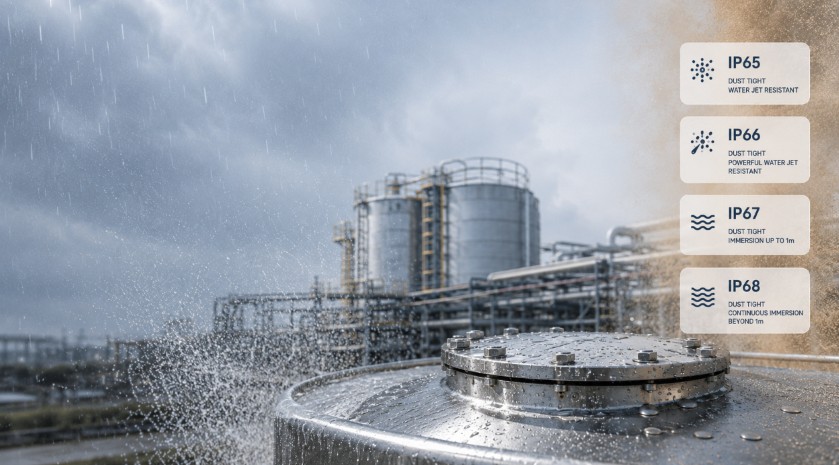
I am often installed in complex industrial environments, such as the top of chemical storage tanks, beside wastewater treatment pools, above food fermentation tanks, on cement silos, in grain warehouses, on mining hoppers, in outdoor tank farms, and even in sites with high humidity, heavy dust, and large temperature differences. What you see may only be my display head, probe, and cable entry, but inside me there are circuit boards, sensors, signal processing modules, sealing structures, and terminals.
If dust enters my housing, it may accumulate on the circuit board, affect heat dissipation, and in serious cases cause a short circuit. If moisture enters my interior, it may cause component corrosion, reduced insulation, fogging on the display, and unstable output signals. For level meters installed outdoors, rainwater, condensation, and wash water can all become hidden risks. For radar level meters or ultrasonic level meters installed on powder silos, dust entering the housing can also affect reliability.
Therefore, the protection rating is not an optional parameter. It is a basic guarantee that allows me to adapt to the working environment.
2. What Does the Protection Rating of a Level Meter Mean?
In level meter selection materials, you will often see labels such as IP65, IP66, IP67, and IP68. Here, IP usually refers to the enclosure protection rating, which indicates the ability of the equipment enclosure to prevent solid foreign objects and water from entering. Simply put, the two digits after IP usually have different meanings: the first digit represents dust protection, and the second digit represents water protection.
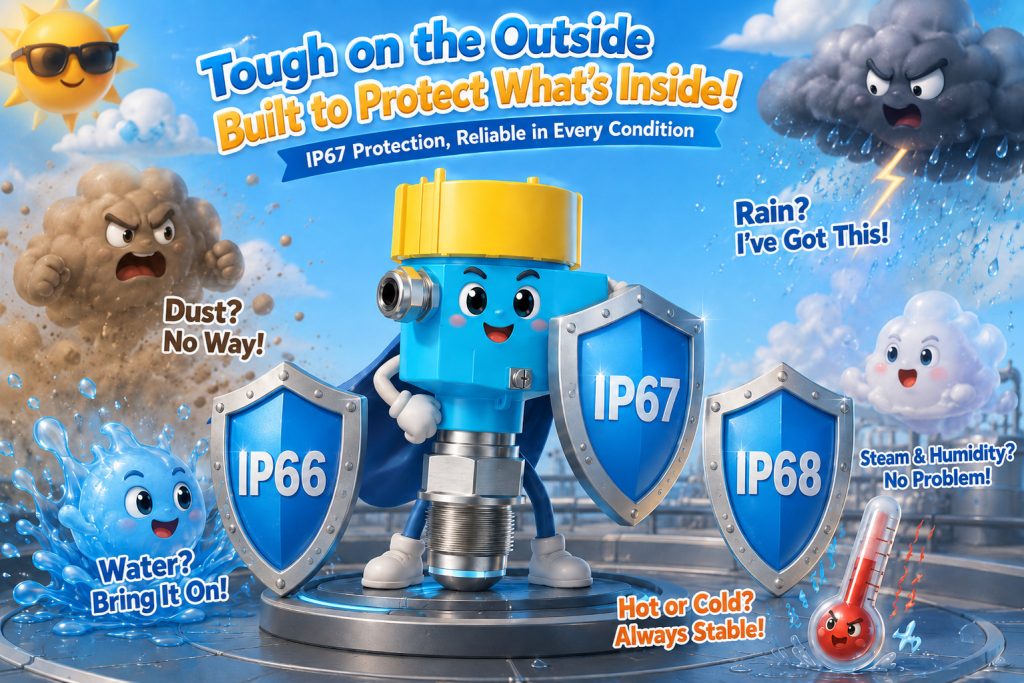
Take IP67 as an example. The first digit, “6,” means that dust is completely prevented from entering, which indicates a high dustproof level. The second digit, “7,” means that short-term immersion in water under specified conditions will not cause harmful effects. Another example is IP65, which means I have good dustproof ability and can withstand low-pressure water jets from all directions. IP68 usually represents a higher waterproof capability and is suitable for continuous immersion or more demanding underwater applications. However, the specific conditions, such as immersion depth and duration, should be checked according to the manufacturer’s instructions.
This is also a common misunderstanding among users: a higher IP rating does not mean absolute safety in every situation. For example, IP67 can handle short-term immersion, but it does not mean I can be soaked in water for a long time. IP68 looks very high, but different manufacturers may define different test conditions. Therefore, when choosing a level meter, you should not only look at the IP numbers, but also evaluate them together with the actual installation environment and product specifications.
3. What Is the Difference Between IP65, IP66, IP67, and IP68?
If you use me in an ordinary indoor environment, such as a dry water tank, a storage tank inside a closed workshop, or a site without obvious spraying or dust, IP65 is usually enough for basic needs. It is dustproof and can resist general water spraying, making it suitable for many conventional industrial applications.
If I am installed outdoors and may face heavy rain, strong wind, equipment washing, or a humid environment, IP66 is more suitable. Compared with IP65, IP66 offers stronger protection against powerful water jets. It is suitable for outdoor storage tank areas, wastewater treatment plants, chemical process units, and similar locations.
If there is a risk of short-term water accumulation, temporary flooding, low installation position, or severe condensation, IP67 provides more security. For example, in some water treatment scenarios, underground pumping stations, or tank areas where water may accumulate, I need better sealing capability.
If I am a submersible level transmitter and need to stay in a pool, well, water tank, or liquid for a long time, IP68 is usually more appropriate. This is because the sensing part of this type of level meter is often immersed directly in the medium, so waterproof performance must be more reliable. However, even with IP68, you still need to pay attention to cable sealing, junction box protection, medium corrosion, and installation method. Otherwise, water may still enter the system through the cable end, connector, or terminal.
4. Different Types of Level Meters Have Different Protection Requirements
I belong to the large family of level meters, but different types of level meters have different working environments and protection priorities.
If I am a radar level meter, I am often installed on the top of a storage tank or silo. For outdoor storage tanks, I need high protection against rain, dust, and moisture. Generally, it is recommended to choose IP66 or IP67 and above. If the site is a powder silo, such as cement, fly ash, lime powder, grain, or mineral powder, special attention should also be paid to the influence of dust on the housing and cable entry.
If I am an ultrasonic level meter, I am usually installed above the liquid surface and measure distance through sound waves. Wastewater pools, open channels, and rainwater wells are often humid and may even produce corrosive gases. Therefore, a higher protection rating and a good sealing structure are very important. For outdoor installation, I also need a rain cover, proper wiring, and waterproof cable glands.
If I am a submersible level transmitter, my sensor is often directly immersed in water or liquid. In this case, the protection rating is not only a housing parameter, but also closely related to long-term immersion reliability. IP68, waterproof cable, sealing and potting technology, and corrosion-resistant materials all need to be considered together.
If I am a magnetic level gauge, although my main body is mostly mechanical, the electrical components such as the remote transmitter, alarm switch, and junction box still need proper protection ratings. Especially in chemical, petroleum, and pharmaceutical industries, there may be moisture, corrosive gases, or cleaning requirements on site, so the protection of electrical parts must not be ignored.
5. Is a Higher Protection Rating Always Better?
At first glance, the higher my protection rating is, the safer I seem to be. But selection is not simply about pursuing the highest rating. It should match the actual working conditions. A higher protection rating usually means a more complex sealing structure, possibly higher cost, and stricter installation and maintenance requirements.
For example, if I am only installed on a dry indoor water tank, and the site has no dust, no washing, and no rain, then choosing IP65 is already reasonable. Blindly pursuing IP68 may not bring obvious benefits, but may increase the budget. On the other hand, if I am an outdoor radar level meter exposed to rain, sunlight, temperature differences, and condensation for a long time, selecting a low protection rating may create hidden risks.
Therefore, the right question is not “Which protection rating is the best?” but “Which protection rating does my installation environment require?” This is a more professional and cost-effective approach to level meter selection.
6. Why Are Some Level Meters More Durable Even with the Same IP67 Rating?
Many users find that level meters from different brands and models may have very different service lives, even when they are all marked IP67. This is because the IP rating is only one indicator of enclosure protection and does not fully represent the overall reliability of the entire instrument.
Many other factors affect my durability, such as housing material, sealing ring quality, waterproof cable gland workmanship, terminal chamber design, cable entry direction, ventilation structure, sealing stability under temperature changes, and whether the on-site installation is standardized. For example, if the cable entry is not tightened, the waterproof gland does not compress the cable properly, or the cable is routed directly from top to bottom without a drip loop, water may enter the device even if I have a high protection rating.
Another common issue is condensation. Many outdoor level meters are not damaged by rainwater directly, but by condensation formed inside the housing due to large temperature differences between day and night. Over time, this affects the circuit. In this situation, besides choosing a suitable protection rating, you should also pay attention to housing ventilation, moisture-proof design, and cable sealing.
7. What Installation Mistakes Do I Fear Most on Site?
As a level meter, what I fear most is not complex working conditions, but improper installation.
The first mistake is installing the cable entry upward. In this case, rainwater and condensation can more easily flow along the cable into the terminal chamber. The correct practice is usually to route the cable downward and leave a drip loop to prevent water from flowing into the instrument along the cable.
The second mistake is failing to tighten the waterproof gland. Many field failures seem to be product quality problems, but they are actually caused by the cable gland not being tightened again after wiring, allowing moisture to slowly enter the housing.
The third mistake is opening the cover casually without checking the sealing ring afterward. If the sealing ring is dusty, deformed, damaged, or if the cover is not tightened properly, the protection rating will be greatly reduced.
The fourth mistake is using an ordinary protection rating in a strong washing environment. In industries such as food, pharmaceuticals, and environmental protection, equipment may need regular cleaning. If the washing water pressure is high, a more suitable protection rating and structure should be selected.
The fifth mistake is ignoring corrosive gases. The protection rating mainly indicates dustproof and waterproof capability, but it is not the same as corrosion resistance. If there are corrosive gases such as acid-base vapor, chlorine, or hydrogen sulfide on site, materials, anti-corrosion coatings, and sealing materials also need to be considered.
8. How Should You Choose the Protection Rating of a Level Meter According to Working Conditions?
If you ask me how to choose the protection rating of a level meter, I would suggest looking at the site environment first, not the price.
For ordinary indoor storage tanks, water tanks, and hoppers in relatively dry environments, IP65 and above can usually be selected. For outdoor storage tanks, open-air silos, wastewater treatment plants, and rain-exposed environments, IP66 or IP67 is recommended. For areas with short-term immersion risk, low-lying locations, or underground spaces, IP67 is recommended, and cable waterproofing should be strengthened. For submersible level transmitters that remain immersed in liquid for a long time, attention should be paid to IP68 as well as the overall sealing reliability of the cable, probe, and junction box.
For dusty environments, such as cement plants, grain processing plants, mineral powder silos, and coal powder silos, I recommend choosing products with strong dustproof capability and paying attention to the sealing of the terminal chamber. For corrosive environments, besides the protection rating, suitable materials should be selected, such as stainless steel, PTFE, PVDF, or anti-corrosion coatings. For high-temperature, high-pressure, or flammable and explosive environments, explosion-proof rating, process connection, sealing structure, and certification requirements should also be considered.
9. Daily Maintenance Also Affects My Protection Ability
Many people think that after buying a level meter with a high protection rating, they can leave me alone completely. In fact, the protection rating is not a one-time guarantee. As service time increases, sealing rings may age, connectors may loosen, the housing may corrode, and cables may wear. Therefore, regular inspection is necessary.
I recommend that on-site personnel regularly check whether the housing is damaged, whether the cover is tightened, whether the cable entry is loose, whether the cable sheath is cracked, whether the display window is fogged, and whether there are signs of moisture inside the junction box. If the site is frequently washed or exposed to rain, inspections should be strengthened. For level meters used outdoors for a long time, rain covers, sun shields, proper wiring, and lightning protection measures can help me work more stably.
10. Conclusion: The Protection Rating Is the Foundation of Reliable Level Meter Operation
As a level meter, my value lies not only in accurate measurement, but also in long-term stable measurement. Although the protection rating is only one of the selection parameters, it directly affects my service life, maintenance frequency, and on-site safety. Behind numbers such as IP65, IP66, IP67, and IP68 are my protection capabilities against dust, moisture, rain, washing, and immersion.
When choosing a level meter, please do not focus only on price and measuring range, and do not blindly pursue the highest protection rating. A more reasonable method is to evaluate the installation environment, medium characteristics, outdoor exposure, washing conditions, immersion risk, dust, and corrosive gases. A suitable protection rating, together with standardized installation and regular maintenance, allows me to operate reliably in complex industrial sites.
If you are selecting a radar level meter, ultrasonic level meter, submersible level transmitter, or other liquid and material level measuring instrument, remember to treat the protection rating as one of the key parameters. For me, accurate measurement is my duty, but reliable protection is what gives me the confidence to stand guard on site for a long time.