Sand and gravel aggregates are essential raw materials for concrete production, building construction, and infrastructure projects. During aggregate production, storage, and transportation, accurate silo level measurement is critical to the continuous operation of crushing, screening, conveying, loading, and batching processes. It also plays an important role in inventory management and production planning.
However, sand and gravel silos commonly have challenging conditions such as heavy dust, uneven material surfaces, varying particle sizes, and strong impact during filling. Conventional level measurement instruments may experience unstable signals, false readings, or even complete loss of measurement.
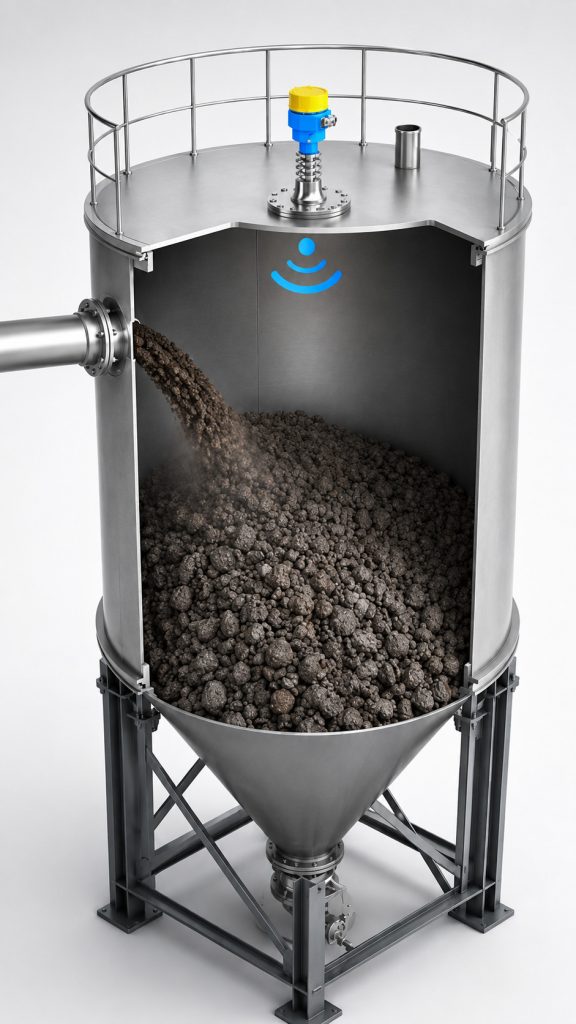
To overcome these challenges, a sand and gravel aggregate producer installed the JWRada-34 radar level meter in its finished-product silos. The solution enabled continuous and reliable online monitoring of sand and gravel levels.
1. Project Background
The company produces manufactured sand and crushed stone aggregates in several particle sizes. After crushing and screening, the materials are transported by belt conveyors into finished-product silos. They are then discharged for batching, truck loading, and delivery according to production orders.
Previously, the silo inventory was mainly estimated through visual inspection and occasional manual measurement. Because the silos were relatively tall, manual inspection was inefficient and exposed workers to potential safety risks.
The filling process also generated large amounts of airborne dust, resulting in poor visibility inside the silos. Operators therefore found it difficult to determine the actual material level accurately.
To improve production automation, the company required a sand and gravel level measurement system capable of operating reliably under heavy dust, strong interference, and irregular material surface conditions. The real-time level signal also needed to be transmitted to the central control system.
2. Main Challenges in Sand and Gravel Level Measurement
2.1 Heavy Dust During Filling
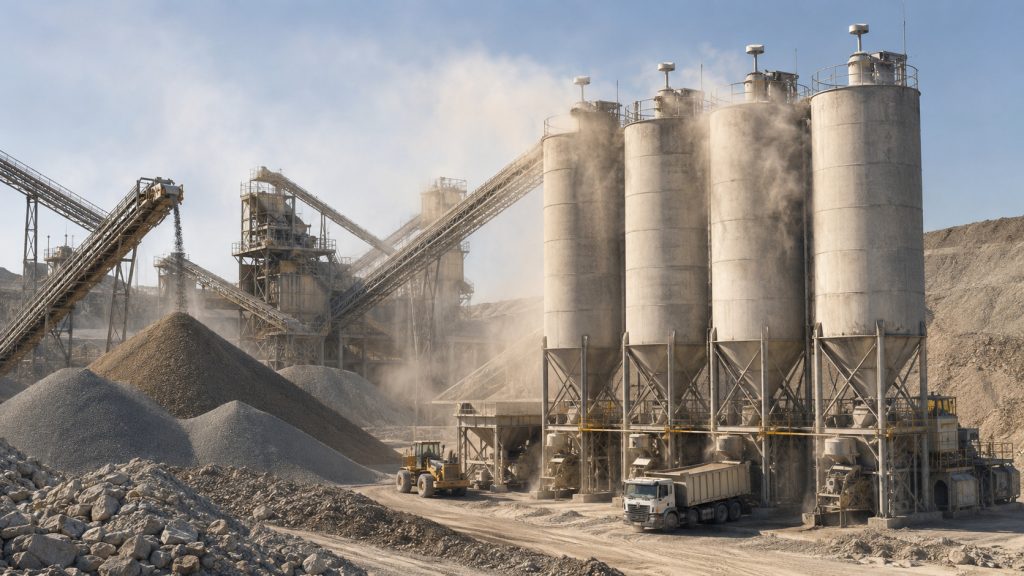
When sand and gravel fall from a belt conveyor into a silo, large quantities of dust are generated. The dust may accumulate near the top of the silo and adhere to the antenna of the measuring instrument.
Some conventional level measurement technologies are easily affected by dust, which can cause signal attenuation, unstable readings, or measurement failure.
2.2 Uneven and Sloping Material Surfaces
Sand and gravel naturally form piles after entering a silo. A cone-shaped surface is often created below the filling point, and its angle changes continuously according to the filling position, discharge location, and movement of the material.
When the measuring instrument is not aimed at a representative area of the material surface, it may detect the top of the pile, the falling material stream, or a lower area close to the silo wall instead of the actual average level.
2.3 Variations in Particle Size and Material Properties
A silo may contain manufactured sand, fine gravel, coarse aggregate, or larger stone particles. These materials can differ in particle size, moisture content, bulk density, and reflection characteristics.
The selected level instrument must therefore be capable of adapting to changing material properties and operating conditions.
2.4 Complex False-Echo Interference
Filling chutes, reinforcement structures, silo walls, mounting nozzles, and falling material streams can all generate interfering echoes.
During filling, the instrument must distinguish the actual material surface echo from multiple false echoes. Otherwise, incorrect or unstable level readings may occur.
3. JWRada-34 Radar Level Meter Solution
After evaluating the silo height, filling method, installation position, material characteristics, and dust conditions, the JWRada-34 radar level meter was selected for continuous sand and gravel level measurement.
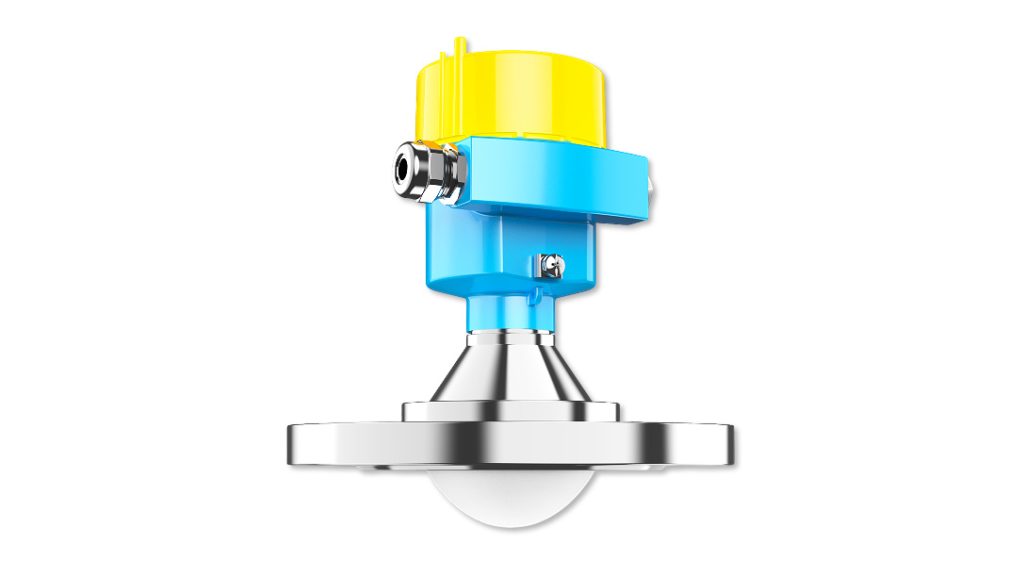
The JWRada-34 uses 80 GHz FMCW millimeter-wave radar technology and is equipped with a 76 mm lens antenna. Its maximum measuring range can reach 150 meters.
With its narrow beam angle and concentrated radar energy, the instrument is suitable for measuring low-dielectric powders, solid granules, bulk solids, and materials in dusty environments.
The radar level meter transmits high-frequency electromagnetic waves toward the sand or gravel surface. When the waves reach the material, they are reflected back to the antenna.
The instrument analyzes the transmitted and reflected signals to calculate the distance between the antenna and the material surface. It then converts this distance into the actual material level according to the silo height.
Because the JWRada-34 uses non-contact measurement, it does not come into direct contact with the sand or gravel. This prevents mechanical stress, abrasion, and damage caused by falling or moving materials, making the instrument suitable for long-term installation at the top of aggregate silos.
4. Instrument Installation and Commissioning
4.1 Avoiding the Filling Stream
The radar level meter was not installed directly above the filling inlet. Instead, the mounting position was selected away from the falling material stream to prevent the instrument from detecting the incoming material as the actual surface.
For a cylindrical silo with a conical outlet, the recommended installation point is generally between one-third and one-half of the silo radius. Adequate clearance should also be maintained between the radar level meter and the silo wall.
For bulk-solid level measurement, a minimum distance of approximately 200 mm between the instrument and the vessel wall is recommended.
4.2 Adjusting the Measuring Direction
Sand and gravel often form a sloping surface after entering the silo. When the radar beam points vertically downward, it may not receive a sufficiently strong or representative echo from the inclined material surface.
The adjustable mounting structure of the JWRada-34 was therefore used to optimize the antenna angle. This allowed the radar beam to be directed toward a stable and representative area of the sand and gravel surface.
The adjustable structure also helped the radar beam avoid the silo wall, filling chute, support structures, and other internal obstructions.
4.3 Using an Antenna Purging System
Because the silo contained a high concentration of dust, an installation configuration with an antenna purging function was adopted.
Clean compressed air was periodically introduced around the antenna to reduce long-term dust accumulation on the lens surface. This helped maintain stable radar transmission and echo reception.
The JWRada-34 can be equipped with a purging system and an adjustable flange, making it suitable for bulk-solid level measurement in demanding, dusty applications.
4.4 Optimizing Echo Parameters
After installation, technicians configured the measuring range according to the empty-silo distance, full-silo level, filling speed, and material surface characteristics.
False-echo suppression was then carried out to identify and filter fixed interference signals generated by the silo wall, mounting nozzle, filling equipment, and internal structures.
Appropriate echo-tracking and damping parameters were also configured to reduce temporary fluctuations caused by dust clouds and falling material during filling.
These settings allowed the instrument to track the actual material surface continuously while minimizing the influence of false echoes.
4.5 Connection to the Process Control System
The JWRada-34 supports signal outputs and communication protocols such as 4–20 mA/HART and RS485/Modbus.
The sand and gravel level data can therefore be transmitted to a PLC or DCS for remote display, trend recording, inventory monitoring, and high- or low-level alarms.
Operators can view the real-time level of each silo from the control room, providing valuable information for material conveying, production batching, inventory management, and truck loading.
5. Application Results
After commissioning, the JWRada-34 radar level meter continuously monitored changes in the sand and gravel levels.
During filling, storage, and discharge, the measured values followed the actual changes in the material inventory. Even when large quantities of dust were generated by falling aggregates, the instrument continued to identify the effective material surface echo.
Adjusting the antenna direction also reduced the influence of sloping surfaces and cone-shaped material piles on the measurement results.
The application delivered several important benefits:
- Continuous online level monitoringThe system provided real-time sand and gravel level data, reducing the need for manual inspections and measurements at the top of the silo.
- Improved operational safetyOperators no longer needed to climb the silo frequently to estimate the material level, reducing the risks associated with working at height and exposure to dust.
- Reliable high- and low-level alarmsThe system could identify high- and low-level conditions in a timely manner, helping prevent silo overfilling, material overflow, empty-silo operation, and production interruptions.
- Better production and inventory managementReal-time level information provided a reliable reference for production planning, inventory estimation, conveyor operation, and vehicle dispatching.
- Reduced wear and maintenanceSince the instrument uses non-contact radar measurement, it is not exposed to abrasion, pulling forces, or impact from the sand and gravel.
- Stable performance in dusty conditionsThe antenna purging system helped keep the lens surface clean and supported reliable long-term operation in the high-dust environment.
6. Selection and Installation Recommendations
When selecting a radar level meter for sand and gravel measurement, users should carefully evaluate the silo height, silo diameter, filling position, discharge method, particle size, moisture content, and internal structures.
For heavily dusty sand and gravel silos, an 80 GHz radar level meter with a narrow beam angle, strong echo-processing capability, and an optional antenna purging system is recommended.
The instrument should not be installed directly above the filling inlet. It should also be positioned away from silo walls, reinforcement structures, filling chutes, and other objects that may generate false echoes.
For silos with significantly inclined material surfaces, an adjustable flange or mounting bracket can be used to direct the radar beam toward a representative measuring area.
For large silos, silos with multiple filling points, or applications with highly irregular material surfaces, installing more than one measuring point may provide a more complete understanding of the actual inventory.
7. Conclusion
Sand and gravel silos present several challenges for level measurement, including heavy dust, inclined material surfaces, varying particle sizes, falling-material interference, and complex false echoes.
With its 80 GHz FMCW radar technology, narrow beam angle, adjustable installation structure, and optional antenna purging system, the JWRada-34 radar level meter is well suited to the continuous measurement of manufactured sand, crushed stone, granular solids, and bulk materials.
By selecting an appropriate installation position and optimizing the echo parameters, the instrument can provide stable and reliable level data. This helps sand and gravel producers improve production continuity, inventory management efficiency, process automation, and workplace safety.