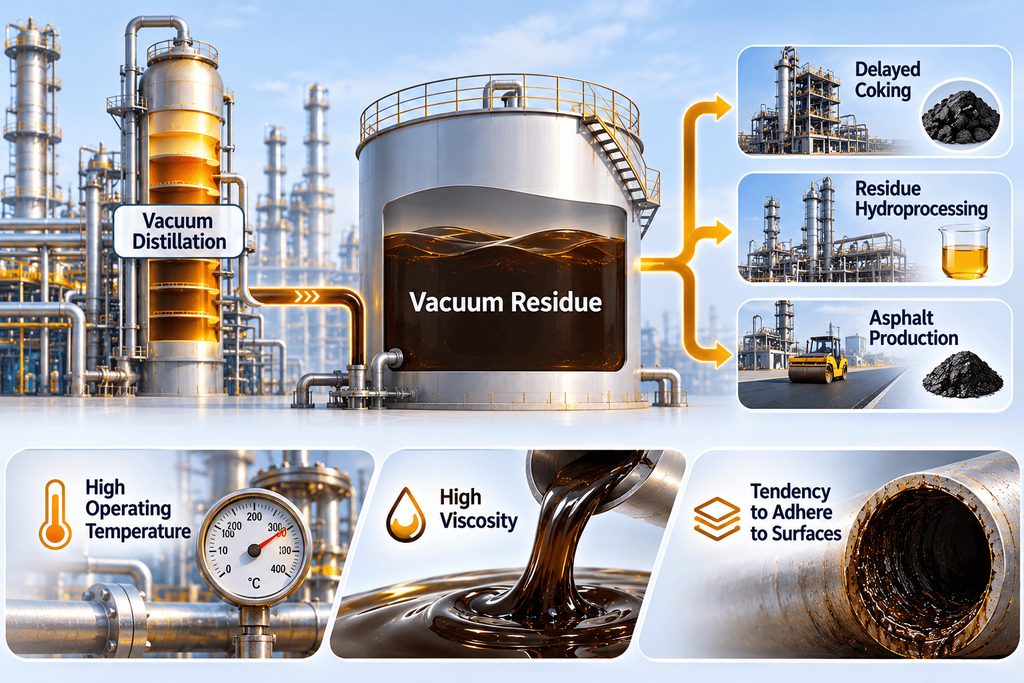
In petroleum refining, vacuum residue is an important product of vacuum distillation and a key feedstock for downstream processes such as delayed coking, residue hydroprocessing, and asphalt production. However, its high operating temperature, high viscosity, tendency to adhere to surfaces, and potential for coke formation make reliable level detection particularly challenging.
In high-temperature vacuum residue tanks, buffer vessels, and transfer systems, accurate point-level detection is essential for preventing overfilling, protecting pumps, and maintaining stable refinery operations.
Conventional level switches may struggle in these demanding conditions, especially when process temperatures exceed their allowable operating limits. High temperatures can damage sensitive electronic components, while viscous deposits and coke formation may interfere with mechanical or vibrating sensing elements.
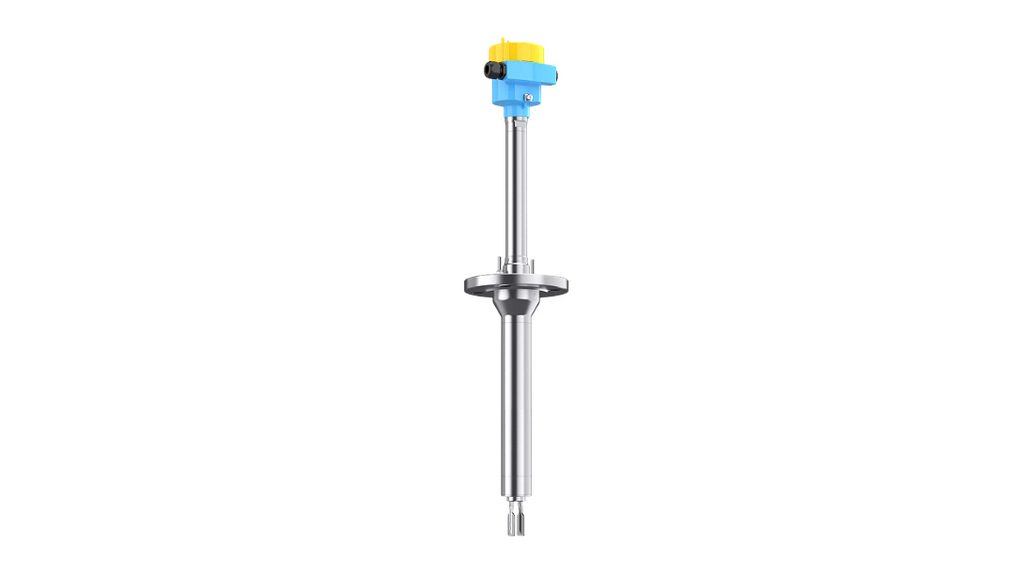
To address these challenges, Jiwei’s Ring-11 Ultra-High-Temperature Tuning Fork Level Switch combines vibration-based level detection with a specially designed water cooling system. This configuration extends the maximum process temperature capability to 400°C (752°F), providing a practical solution for point-level detection in high-temperature vacuum residue applications.
This article explores the challenges of vacuum residue level detection, explains how the Ring-11 tuning fork level switch works, and examines the importance of its water cooling system, installation considerations, and potential applications in refinery operations.
1. Why Is Vacuum Residue Level Detection So Challenging?
Vacuum residue (VR) is the heavy fraction remaining after atmospheric residue undergoes vacuum distillation. It contains high-boiling hydrocarbons, resins, asphaltenes, and other complex components.
Compared with lighter petroleum products, vacuum residue presents several challenges for industrial level measurement instruments.
1.1 Extreme Process Temperatures
Vacuum residue is typically handled at elevated temperatures to maintain sufficient fluidity for pumping, storage, and further processing.
Depending on the refinery process and measurement location, operating temperatures may exceed 300°C (572°F), with certain high-temperature applications approaching 400°C (752°F).
At these temperatures, heat can travel through the wetted sensor and process connection toward the internal sensing components.
If the temperature exceeds the allowable limits of the piezoelectric elements, internal wiring, or electronic assemblies, measurement performance may deteriorate, potentially resulting in premature instrument failure.
Therefore, selecting a level switch for vacuum residue requires more than choosing a sensor made from heat-resistant materials. Effective thermal management is equally important.
1.2 High Viscosity and Material Adhesion
Vacuum residue exhibits strong temperature-dependent viscosity.
As its temperature decreases, viscosity generally increases, reducing fluidity and increasing the likelihood of material adhering to equipment surfaces.
This can become particularly problematic during process shutdowns, temperature fluctuations, or operation in poorly insulated areas.
For mechanical level switches, viscous materials may restrict the movement of sensing components.
For vibrating fork level switches, excessive buildup on the fork can alter its vibration characteristics and potentially affect switching performance.
Consequently, the actual operating viscosity, adhesion tendency, and temperature conditions must be evaluated before selecting a level detection instrument.
1.3 Coke Formation and Deposits
Vacuum residue contains significant quantities of heavy hydrocarbon components, including asphaltenes and resins.
Under unfavorable operating conditions, such as localized overheating or prolonged residence time, thermal degradation and coke formation may occur.
Deposits can accumulate on level switch probes, vessel connections, and installation nozzles.
Over time, this buildup may interfere with sensing performance or make maintenance more difficult.
For this reason, sensor geometry, installation location, and accessibility for inspection are important considerations when selecting a vacuum residue level switch.
1.4 Reliable High- and Low-Level Alarms
In refinery operations, vacuum residue levels may fluctuate due to variations in feed rates, downstream flow demand, and pump operating conditions.
Excessively high liquid levels can create overfill risks or disrupt upstream processes.
Conversely, excessively low levels may lead to insufficient pump suction, cavitation, or interruption of downstream operations.
Reliable high- and low-level detection is therefore essential.
A suitable point-level switch should provide clear switching signals that can be integrated into a programmable logic controller (PLC), distributed control system (DCS), or an appropriately designed safety system.
2. How Does the Ring-11 Tuning Fork Level Switch Work?
The Ring-11 Ultra-High-Temperature Tuning Fork Level Switch operates using the vibrating fork principle.
Instead of relying on mechanical float movement or the electrical conductivity of the liquid, the instrument detects changes in the vibration characteristics of a tuning fork when it comes into contact with the process medium.
Its main components include a vibrating fork sensor, piezoelectric drive and detection elements, signal-processing electronics, a process connection, and a dedicated cooling assembly.
2.1 Piezoelectric Excitation
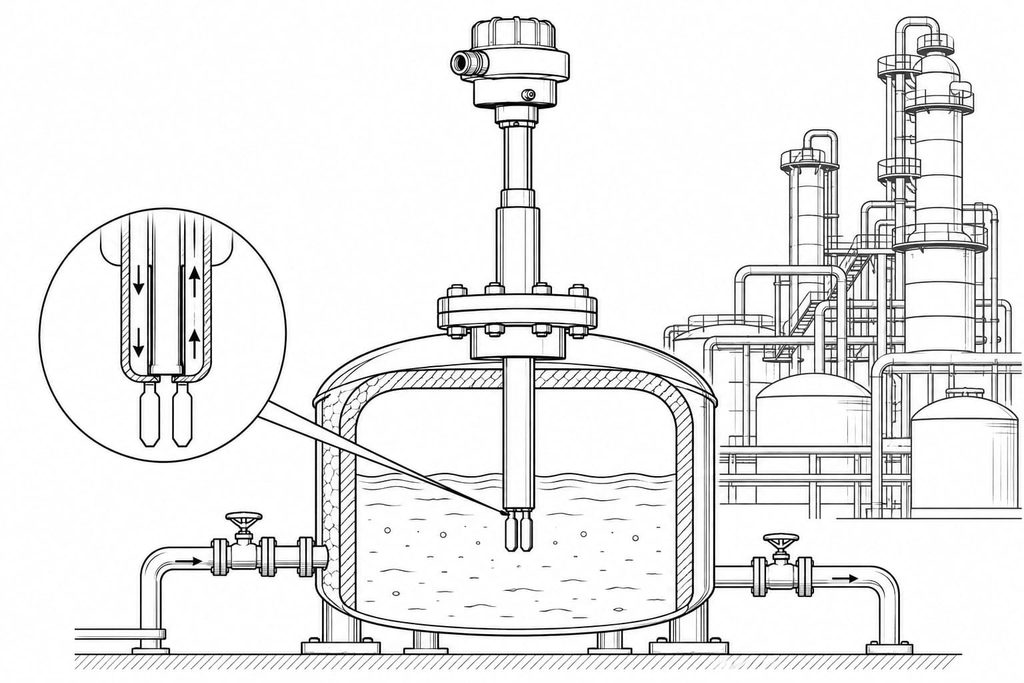
A piezoelectric element inside the instrument converts an electrical signal into mechanical vibration, causing the tuning fork to oscillate at its characteristic resonant frequency.
When the fork is surrounded by air or process vapor, it vibrates at a frequency corresponding to the uncovered condition.
The electronic module continuously monitors this vibration state.
The Ring-11 series features a compact 40 mm fork design with a vibration frequency of approximately 1,200 Hz.
2.2 Frequency Changes When the Fork Contacts Liquid
When the vacuum residue level rises and covers the tuning fork, the surrounding liquid introduces additional mass loading and viscous damping.
These effects change the fork’s resonance characteristics, typically causing its resonant frequency to decrease.
The piezoelectric sensing element converts this mechanical change into an electrical signal.
The electronic module analyzes the signal and determines whether the fork is covered by liquid.
2.3 Switching Signal for Level Alarms
When the detected vibration condition reaches the configured switching threshold, the instrument changes its output state.
This signal can be used for:
- High-level alarms to help prevent vessel overfilling.
- Low-level alarms to indicate insufficient liquid inventory.
- Pump protection against low-level operating conditions.
- Process monitoring and automated control.
Unlike continuous level transmitters, tuning fork level switches are designed for point-level detection.
They indicate whether liquid has reached a particular position rather than continuously measuring the total liquid level in a vessel.
Because the measurement principle does not depend on liquid color, transparency, or electrical conductivity, vibrating fork technology can be suitable for various industrial liquids.
However, for highly viscous or coke-forming media such as vacuum residue, operating conditions and material buildup must still be carefully evaluated.
3. Why Does the Ring-11 Require a Water Cooling System?
One of the greatest challenges in ultra-high-temperature level detection is protecting the instrument’s internal temperature-sensitive components.
Conventional high-temperature tuning fork level switches often use extended process connections or passive heat-dissipation structures to reduce heat transfer toward the sensing electronics.
However, when process temperatures rise beyond the limits of these designs, passive cooling alone may not provide sufficient thermal protection.
The Ring-11 Ultra-High-Temperature Tuning Fork Level Switch incorporates a specially designed water cooling system, allowing it to operate at process temperatures up to 400°C (752°F) when the specified cooling and installation conditions are satisfied.
3.1 Dedicated Water-Cooled Structure
The Ring-11 features a cooling jacket integrated with its process connection and sensing assembly.
The cooling structure includes dedicated cooling-water inlet and outlet connections.
Cooling water enters through the inlet and is directed through an internal flow path toward the area requiring thermal protection.
A capillary copper tube guides the cooling medium toward the vibrating fork assembly, helping remove heat conducted from the high-temperature process.
After absorbing heat, the cooling water exits through the outlet and returns to the designated cooling-water system.
This circulation provides active thermal management for the instrument.
3.2 Protecting Piezoelectric Components
Although the metallic tuning fork is designed to contact the hot process medium, the internal piezoelectric elements, wiring, and associated components have specific temperature limitations.
Without sufficient cooling, heat conducted through the sensor assembly may raise the temperature of these components beyond their allowable operating range.
The Ring-11 water cooling system helps dissipate this heat, maintaining the temperature-sensitive components within their specified limits.
This thermal protection is a key factor in extending the instrument’s process temperature capability.
3.3 Continuous Cooling Is Essential
For ultra-high-temperature applications that require active cooling, the water cooling system is an integral part of the level detection solution.
Insufficient cooling-water flow, blocked passages, or an unexpected interruption in water supply may cause the internal temperature to rise.
If the allowable component temperature is exceeded, measurement stability and instrument service life may be affected.
Therefore, the cooling-water supply must meet the manufacturer’s specified requirements.
For critical level detection points, cooling-water flow, pressure, or temperature monitoring may also be considered as part of the overall instrumentation design.
3.4 Balancing Cooling Performance and Process Conditions
Vacuum residue requires special attention because its viscosity can increase significantly as temperature decreases.
Excessive localized cooling near the sensing fork may increase the likelihood of residue adhesion or deposition.
Consequently, cooling-system design should achieve two objectives simultaneously: protecting the instrument’s internal components and minimizing undesirable cooling effects on the process medium.
Appropriate cooling-water conditions, proper installation geometry, and careful consideration of heat transfer are essential for reliable operation.
4. Application Case: Vacuum Residue Level Detection in a High-Temperature Buffer Vessel
Consider a typical refinery application involving a high-temperature vacuum residue buffer vessel.
The vessel receives heavy residue from an upstream process and supplies material to downstream processing equipment.
Because the residue must remain sufficiently fluid for transfer, the vessel is operated at elevated temperatures and may be equipped with thermal insulation or heating systems.
Liquid levels fluctuate as incoming and outgoing flow rates change.
To support stable operation, the vessel requires reliable high- and low-level alarms.
The following application illustrates a typical engineering configuration rather than a documented customer installation.
4.1 Application Requirements
The level detection system must meet several requirements.
First, the sensing instrument must withstand the high process temperature.
Second, the measurement principle must be compatible with the residue’s density, viscosity, and adhesion characteristics.
Third, the instrument must provide a clear switching signal when the liquid reaches a predetermined level.
Finally, the installation must meet the vessel’s pressure, temperature, sealing, and maintenance requirements.
4.2 High-Level Detection
A Ring-11 Ultra-High-Temperature Tuning Fork Level Switch can be installed at the vessel’s designated high-level position.
When the vacuum residue rises and covers the fork, the vibration frequency changes.
The electronic module detects this change and switches the instrument output.
The signal is transmitted to the control system, which can activate a high-level alarm or initiate the appropriate control response.
This arrangement helps operators identify abnormal level increases before they develop into more serious process problems.
4.3 Low-Level Detection and Pump Protection
A second Ring-11 level switch can be installed at the designated low-level position.
Under normal operating conditions, the fork may remain covered by the process liquid.
As the liquid level decreases and exposes the fork, the vibration characteristics return toward the uncovered state.
The instrument then changes its output signal.
Depending on the control philosophy, this signal can trigger a low-level alarm or contribute to a pump protection function.
For safety-related applications, the complete instrument and control arrangement must be evaluated against the applicable safety requirements.
4.4 Integration With the Water Cooling System
For high-temperature measurement points requiring active cooling, each Ring-11 is connected to a suitable cooling-water supply and return system.
Cooling water enters the instrument’s cooling jacket, circulates through the designated flow path, and exits through the outlet.
During operation, this circulation removes heat from the sensing assembly and helps protect internal components.
The engineering design should confirm the required cooling-water inlet temperature, flow rate, supply pressure, return conditions, and piping arrangement.
Cooling-water connections must also be secured against leakage, blockage, and accidental interruption.
4.5 Integration With Refinery Control Systems
Depending on the selected configuration, the Ring-11 series offers switching output options such as relay, two-wire, NAMUR, and transistor outputs.
These interfaces allow the instrument to be integrated into PLC or DCS architectures.
The resulting system can provide point-level alarms, operating status monitoring, and appropriate process control functions.
In applications involving safety instrumented functions, device suitability and the complete safety architecture must be verified separately.
5. Key Advantages of the Ring-11 for Vacuum Residue Applications
5.1 Process Temperature Capability Up to 400°C
With its dedicated water cooling structure, the Ring-11 Ultra-High-Temperature Tuning Fork Level Switch supports process temperatures up to 400°C (752°F).
This extends its application range beyond many conventional high-temperature point-level switches.
The stated temperature capability depends on compliance with the specified cooling and installation requirements.
5.2 Compact Tuning Fork Design
The Ring-11 series features a compact 40 mm tuning fork.
Its short fork geometry can simplify installation where space is limited and reduce unnecessary probe extension into the process.
However, nozzle design and installation geometry must still be evaluated to minimize stagnant areas and potential deposits.
5.3 Vibration-Based Detection
The Ring-11 detects liquid presence through changes in vibration frequency rather than relying on liquid conductivity or optical properties.
This makes it a potential solution for various challenging industrial liquids.
For vacuum residue, actual viscosity, density, adhesion behavior, and coke formation remain important selection factors.
5.4 Multiple Switching Output Options
The Ring-11 series offers different output configurations to accommodate industrial automation systems.
This flexibility supports integration with level alarms, process monitoring systems, and suitable equipment protection arrangements.
5.5 Suitable for Demanding High-Temperature Processes
Beyond vacuum residue, the Ring-11 Ultra-High-Temperature Tuning Fork Level Switch may also be considered for other high-temperature liquid applications in petroleum refining, petrochemical processing, and industrial thermal systems, subject to process compatibility.
6. Installation and Maintenance Best Practices
Correct installation and regular maintenance are essential for dependable vacuum residue level detection.
6.1 Select an Appropriate Installation Location
Avoid locations where residue is likely to stagnate, accumulate, or form coke deposits.
Installation nozzles should be designed to minimize dead zones, particularly in applications involving highly viscous liquids.
6.2 Ensure Unrestricted Fork Vibration
The tuning fork must have sufficient clearance from vessel walls, nozzles, and internal equipment.
Any mechanical contact may interfere with its vibration characteristics.
Fork orientation should follow the manufacturer’s installation instructions, particularly where material buildup is possible.
6.3 Maintain the Cooling-Water Supply
For ultra-high-temperature applications, cooling-water conditions should be inspected regularly.
Important checks include water flow, pressure, inlet and outlet temperatures, and piping condition.
Any cooling-system abnormality should be addressed according to established plant operating procedures.
6.4 Coordinate Insulation and Cooling Requirements
Vacuum residue vessels and associated piping often require insulation to prevent excessive heat loss.
However, insulation must not be applied indiscriminately to the instrument housing, cooling connections, or other components that require heat dissipation.
The installation should follow the specified thermal and mechanical requirements.
6.5 Inspect for Residue Buildup
Because vacuum residue may adhere to the sensing fork, periodic inspection should be included in the maintenance plan.
Where necessary and permitted by plant procedures, deposits should be removed to restore the required sensing conditions.
Functional testing should also confirm that the switch changes state correctly and transmits the expected signal to the control system.
7. Frequently Asked Questions
Can the Ring-11 tuning fork level switch operate in vacuum residue at 400°C?
The Ring-11 Ultra-High-Temperature Tuning Fork Level Switch is designed for process temperatures up to 400°C (752°F) when the specified water cooling and installation requirements are met.
Actual suitability must also be confirmed against process pressure, viscosity, density, and residue buildup characteristics.
Why is water cooling necessary for an ultra-high-temperature tuning fork level switch?
Water cooling removes heat conducted from the high-temperature process toward the instrument’s internal components.
It helps protect the piezoelectric sensing elements, wiring, and associated assemblies from excessive temperatures.
Can a tuning fork level switch detect highly viscous vacuum residue?
A tuning fork level switch may be suitable for certain high-viscosity liquids, but its performance depends on the actual operating conditions.
Excessive viscosity, heavy adhesion, or coke deposits can influence vibration characteristics and switching behavior.
Application-specific evaluation is therefore recommended.
What happens if the cooling-water supply stops?
If the process temperature exceeds the instrument’s allowable operating temperature without cooling, loss of cooling water may cause internal overheating.
The cooling system should therefore remain operational, and appropriate responses to cooling failure should be established.
Can the Ring-11 be used for both high- and low-level alarms?
Yes. When the application conditions are suitable, separate Ring-11 level switches can be installed at high- and low-level positions.
Each instrument detects whether the liquid covers its sensing fork and provides a corresponding switching signal.
8. Conclusion
Vacuum residue presents significant challenges for industrial level detection because of its high operating temperature, elevated viscosity, tendency to adhere to surfaces, and potential for coke formation.
Selecting a suitable level switch requires careful consideration of process temperature, medium properties, installation conditions, and long-term maintenance requirements.
The Jiwei Ring-11 Ultra-High-Temperature Tuning Fork Level Switch combines vibration-based point-level detection with a dedicated water cooling system, extending its maximum process temperature capability to 400°C (752°F).
By actively removing heat from the sensing assembly, the cooling system helps protect temperature-sensitive components and supports operation in demanding high-temperature environments.
When properly selected, installed, and maintained, the Ring-11 provides a practical solution for high- and low-level detection in vacuum residue vessels and other challenging refinery applications.
Jiwei specializes in industrial level measurement and control technologies, providing instrumentation solutions for petroleum refining, petrochemical processing, energy, metallurgy, and other industrial sectors.
For vacuum residue applications, providing detailed process information—including temperature, pressure, density, viscosity, installation configuration, and cooling-water conditions—helps ensure that the selected Ring-11 configuration meets the specific measurement requirements.