1. What Is a Level Meter? It Does Not Watch the Show—It Watches the Height
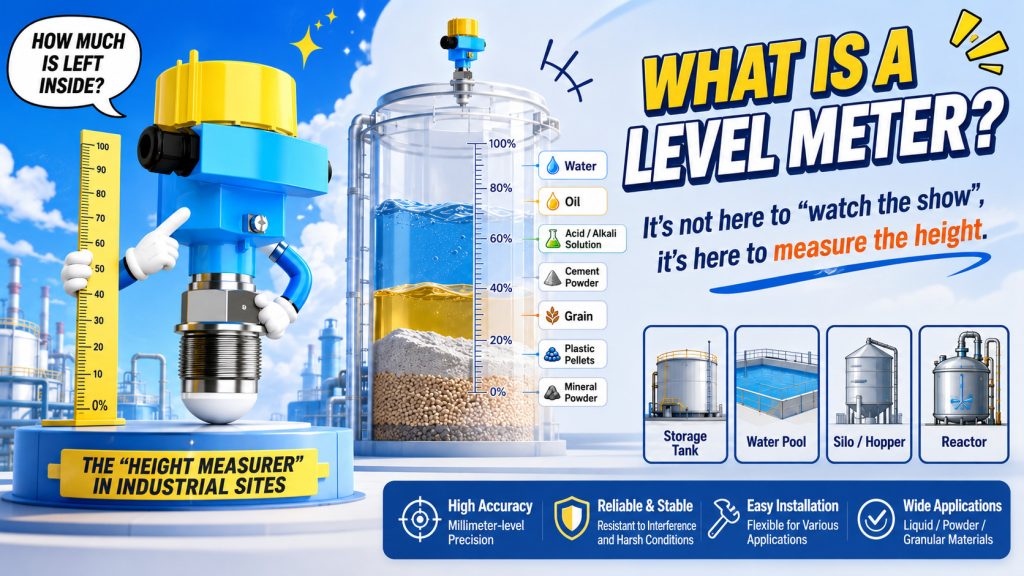
A level meter, as the name suggests, is an instrument used to measure the “level” or position of materials. These materials can be water, oil, acid or alkaline solutions, coal powder, cement, grain, plastic pellets, mineral powder, and many others.
As long as these materials are stored in tanks, pools, silos, reactors, or vessels, the level meter is responsible for answering one very practical question:
How much is left inside?
Sounds simple, right? But in an industrial plant, this question cannot be solved by just taking a casual glance. You cannot ask a worker to climb to the top of a ten-meter-high tank every day, open the lid, peek inside, and shout, “Boss, there’s still half a tank left!”
That is neither scientific nor safe. It may also give the safety manager a sudden rise in blood pressure.
This is where the level meter comes in. It acts like the “height inspector” of an industrial site, keeping an eye on the height of liquids, powders, or granular materials inside containers. It does not complain about dirt, fatigue, height, heat, pressure, or corrosion. Some models can even survive harsh environments that would make ordinary devices cry quietly in a corner.
In simple terms, a level meter is an industrial instrument used to continuously measure or provide alarm signals for the level or position of liquids, solid particles, powders, and other materials inside containers.
2. What Is the Difference Between a Level Meter, a Liquid Level Meter, and a Material Level Meter?
Many people hear the term “level meter” for the first time and immediately ask, “Isn’t that just a liquid level meter?”
The answer is: they are related, but not exactly the same.
A liquid level meter mainly measures the height of liquids, such as water in a tank, oil in a storage tank, or acid and alkali solutions in chemical vessels. Its service target is relatively specific: liquid materials.
A material level meter mainly measures the height of solid materials, such as cement powder in silos, corn in grain bins, coal powder in coal bunkers, or plastic pellets in material hoppers. It is more like a warehouse manager for solids.
A level meter is a broader concept. It can measure liquids, solids, and even interface levels, such as the boundary between oil and water.
In one sentence:
“Level meter” is the general term; “liquid level meter” focuses on liquids; “material level meter” focuses on solids.
So when you see names like radar level meter, ultrasonic level meter, magnetic level gauge, or rotary paddle level switch, do not panic. These are not stage names invented at an industrial instrument talent show. They are simply different categories based on measuring objects and working principles.
3. Why Are Level Meters Indispensable in Industrial Sites?
A level meter may look like it only measures height, but it plays a very important role in industrial production. Without it, many factories would be like drivers without a fuel gauge: the vehicle may still run, but everything depends on guessing.
1. Preventing Overflow: Do Not Let Liquids “Run Away from Home”
When filling a storage tank, if you do not know the actual liquid level and continue adding material, overflow may occur. If water spills out, it may only be embarrassing. But if oil, chemicals, or wastewater overflow, that becomes a serious accident.
A level meter can monitor the liquid level in real time. When the level approaches the upper limit, it can trigger an alarm or even work with valves and pumps to stop the process automatically. In other words, it prevents the tank from being “overfed.”
2. Preventing Empty Silos: Do Not Let Equipment “Go Hungry”
Some equipment requires continuous feeding. Boilers need coal powder, production lines need plastic pellets, and mixing systems need raw materials. If the silo runs empty while the equipment continues operating, the result may be production shutdown or even equipment damage.
A level meter can monitor low material levels and remind operators to refill in time. It works like a refrigerator stock reminder: the milk is almost gone, buy more soon, or tomorrow morning you will be staring sadly at dry cereal.
3. Improving Automation: Let the System Know How Much Is Inside
Modern factories increasingly rely on automation and intelligent control. A level meter can send measurement signals to PLC, DCS, or upper-level control systems, allowing the system to automatically adjust feeding, discharging, mixing, conveying, and other processes.
In the past, people relied heavily on manual observation. Now, data speaks. Previously, it was “the experienced technician’s judgment”; now, it is “the instrument’s evidence.” This does not mean experienced workers are no longer valuable. It simply means production has become too complex to rely only on human experience.
4. Reducing Costs: More Inventory Is Not Always Better
Too little raw material may interrupt production. Too much raw material ties up money, takes up storage space, and may even expire, cake, or deteriorate.
A level meter helps companies accurately understand inventory levels, reducing blind purchasing and excessive stockpiling.
Do not underestimate this. In a large storage tank, dozens of extra tons of raw material may represent a significant amount of money. A small level meter can sometimes help a company “see” money hidden inside a tank.
4. How Does a Level Meter Work?
There are many types of level meters, and different types use different measuring principles. Let us look at several common types to understand how they work.
5. Common Type 1: Radar Level Meter
The radar level meter is one of the most common level measurement instruments in modern industrial sites. Its working principle is a bit like how bats navigate, except bats use sound waves while radar level meters use electromagnetic waves.
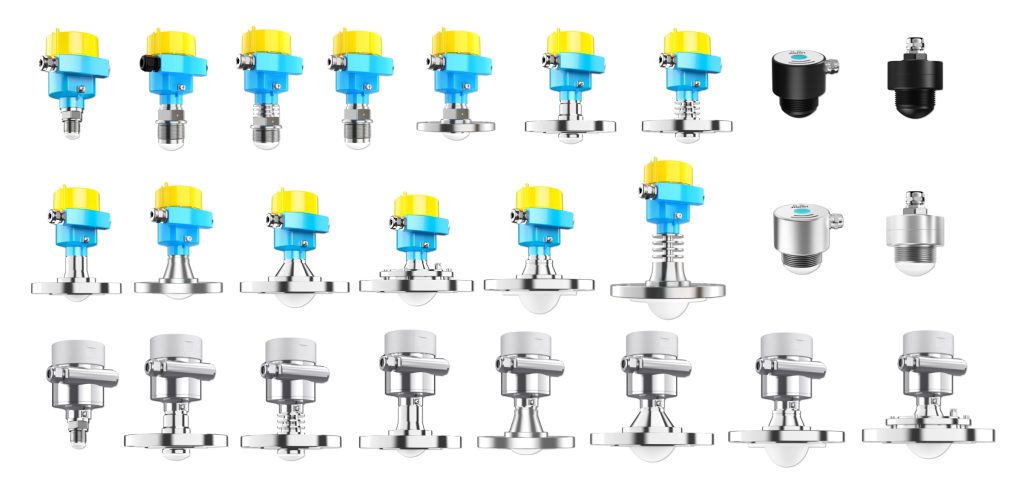
A radar level meter sends radar waves from the top of a tank toward the material surface. When the waves hit the liquid or material surface, they are reflected back. The instrument calculates the distance based on the time difference between sending and receiving the signal, then converts that distance into the level height.
Simply put:
Send signal → signal hits material surface → signal reflects back → calculate time → get level height.
Radar level meters are highly adaptable. They are less affected by temperature, pressure, steam, and dust, making them suitable for industries such as chemicals, petroleum, cement, metallurgy, and environmental protection.
Especially in high-temperature, high-pressure, corrosive, or dusty environments, radar level meters often behave like seasoned professionals who have seen it all.
Of course, they are not magic. Frequency, antenna structure, installation method, and site conditions all affect measurement performance. If there are agitators, foam, heavy dust, or internal obstacles inside the tank, proper selection and commissioning are necessary.
A radar level meter is smart, but you cannot simply screw it onto the tank top and expect it to behave like a fortune teller.
6. Common Type 2: Ultrasonic Level Meter
An ultrasonic level meter uses sound waves. It emits ultrasonic waves downward. When the waves hit the material surface, they bounce back. The instrument then calculates the distance based on the time difference.
The principle is easy to understand. Imagine shouting “hello” in a valley and judging the distance from the echo. Of course, an industrial ultrasonic level meter does not literally shout “hello.” It emits ultrasonic waves that humans cannot hear.
Ultrasonic level meters are non-contact, easy to install, and relatively cost-friendly. They are commonly used in water tanks, wastewater treatment, open channels, ordinary storage tanks, and pools.
However, ultrasonic level meters can be affected by temperature, steam, foam, dust, and airflow. For example, if there is a lot of steam inside a tank, sound wave propagation may become unstable. If the liquid surface has thick foam, the echo may become unclear.
Therefore, ultrasonic level meters are more suitable for relatively mild working conditions. They are practical, but do not ask them to fight in extremely harsh environments without proper consideration.
7. Common Type 3: Magnetic Level Gauge
The magnetic level gauge is a very visual and almost theatrical type of level instrument. It is usually installed on the side of a container. Based on the principle of communicating vessels, the liquid enters the measuring chamber. Inside the chamber, a magnetic float rises and falls with the liquid level. This float drives the external flaps or rollers to change color, displaying the liquid level.
Its biggest advantage is visibility. The red and white flaps flip one by one, almost as if the liquid level is performing a little “face-changing show.”
Operators can see the tank level without directly contacting the liquid.
Magnetic level gauges are widely used in petroleum, chemical, power, pharmaceutical, and food industries. They have a relatively simple structure, clear display, and can be equipped with remote transmitters and alarm switches for remote monitoring.
However, they are mainly suitable for liquid measurement, not powders. If the liquid contains many impurities, crystals, or sticky substances, the float may be affected. Once the float gets stuck, the level gauge may begin to “pretend everything is fine.”
8. Common Type 4: Pressure Level Meter
A pressure level meter calculates liquid level by measuring the hydrostatic pressure generated by the liquid. The deeper the liquid, the greater the pressure at the bottom.
This is easy to understand. The deeper you dive underwater, the more pressure your ears feel. Similarly, the higher the liquid level, the greater the pressure sensed by the sensor.
Pressure level meters are commonly used in water tanks, pools, wastewater treatment systems, and underground tanks. Submersible level transmitters are a common example; they are placed directly into the liquid to measure pressure.
Their advantages include simple structure, convenient use, and relatively controllable cost. However, because they must contact the medium directly, corrosion, clogging, sediment, and temperature variation must be considered. If the liquid density changes greatly, the measurement result may also be affected.
In other words, a pressure level meter is hardworking, but it is the type that has to “go into the water,” so you must consider whether the medium is dirty, corrosive, or likely to clog the sensor.
9. Common Type 5: Float Level Meter
The principle of a float level meter is extremely down-to-earth: when the liquid rises, the float rises; when the liquid falls, the float falls.
It can be used for level display, high and low level alarms, or pump control.
A household toilet tank actually uses a similar idea. When the water reaches a certain level, the float rises and closes the valve. Industrial versions are, of course, stronger, more durable, and more demanding in terms of materials and sealing.
Float level meters are relatively economical, simple in structure, and suitable for many common liquid applications. However, if the medium is viscous, prone to scaling, or full of impurities, the float may get stuck.
Once the float is trapped, it is like an elevator stuck between floors—the system may still think everything is normal, which can be a problem.
10. Common Type 6: Rotary Paddle Level Switch
The rotary paddle level switch is mainly used for detecting the level of powders and granular materials.
It has a small paddle driven by a motor. When material accumulates to the paddle position, the paddle is blocked, and the instrument outputs a signal indicating that the material has reached that height.
Its logic is very straightforward:
If it can rotate, there is no material. If it cannot rotate, the material has arrived.
Rotary paddle level switches are commonly used in cement silos, grain bins, feed silos, and plastic pellet hoppers. They are suitable for high-level and low-level alarms. With a simple structure and friendly price, they are long-time companions of many powder silos.
However, they are contact-type instruments. The paddle directly contacts the material. If the material has strong impact force, high stickiness, or is prone to caking, careful selection is required.
11. Common Type 7: Tuning Fork Level Switch
A tuning fork level switch looks like a small fork. During operation, the fork vibrates. When liquid, powder, or granular material touches the fork, its vibration frequency changes, allowing the instrument to determine whether the material has reached the set position.
It is very suitable for point-level detection, such as high-level alarms, low-level alarms, overflow prevention, and dry-run protection.
You can think of it as a gatekeeper. Once the material touches it, it says, “It has reached here.”
Tuning fork level switches respond quickly and are generally reliable. They are widely used for liquids, powders, and granular materials. However, material density, viscosity, and adhesion characteristics affect model selection. One model cannot simply be used everywhere.
12. What Is the Difference Between Continuous Measurement and Point-Level Detection?
Level instruments commonly work in two ways: continuous measurement and point-level detection.
Continuous measurement is like the battery indicator on an electric vehicle. It tells you whether there is 30%, 50%, or 80% left. Radar level meters, ultrasonic level meters, and pressure level meters can usually perform continuous measurement.
Point-level detection is like a doorbell. When the material reaches a certain position, it rings or outputs a switch signal. Rotary paddle switches, tuning fork switches, and float switches are commonly used for point-level alarms.
If you need to know the exact level in real time, choose continuous measurement. If you only need to know whether the tank is full or empty, a point-level switch may be enough.
It is like asking someone how much money is left in their bank account. Continuous measurement gives you the exact balance. Point-level detection only tells you whether it is “enough” or “not enough.” Both are useful, but for different purposes.
13. Where Are Level Meters Used?
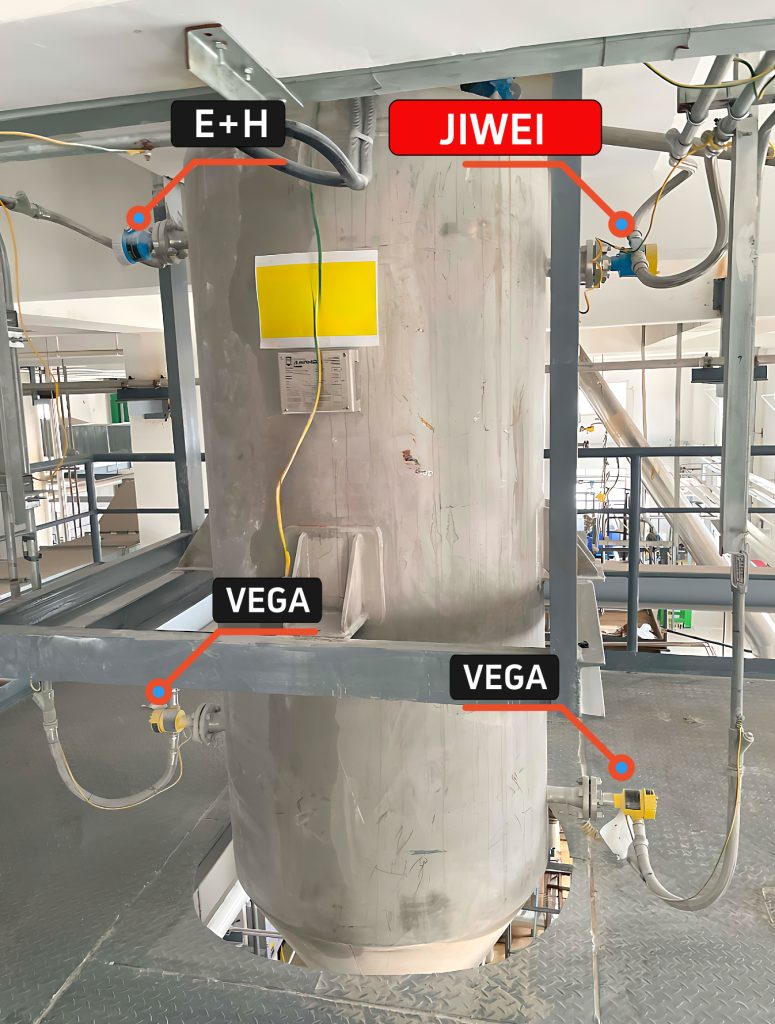
Level meters are used in a very wide range of industries. Basically, wherever there are tanks, silos, pools, or vessels, there may be level meters.
In the petrochemical industry, level meters are used in crude oil tanks, finished oil tanks, reactors, acid and alkali tanks, and solvent tanks to monitor liquid levels, prevent overflow, and ensure production safety.
In the water treatment industry, they are used in clean water tanks, wastewater tanks, sedimentation tanks, chemical dosing tanks, and pumping stations to help control water intake, drainage, chemical dosing, and alarms.
In the food and beverage industry, level meters are used in milk tanks, syrup tanks, wine tanks, flour silos, and grain bins. They must measure accurately and often meet sanitary requirements. After all, nobody wants a beverage tank to look like an auto repair shop.
In the cement and building materials industry, cement powder, lime powder, fly ash, and similar materials in silos all require level measurement. These environments are dusty and harsh, so radar level meters and rotary paddle level switches are often used.
In the power and metallurgy industries, level meters are used in coal bunkers, ash silos, mineral powder silos, water tanks, acid tanks, and alkali tanks to help equipment operate smoothly.
In agriculture and grain storage, level meters can monitor grain bins, feed silos, and seed silos, reducing manual inspection and improving storage management efficiency.
Level meters may look quiet and humble, but they are actually the “inventory eyes” and “safety guards” of industrial plants.
14. How to Choose the Right Level Meter
Choosing a level meter is not just about price, nor should it be based only on someone saying, “This one works well.”
Different working conditions vary greatly. A “miracle device” in someone else’s plant may become an expensive decoration in yours.
When selecting a level meter, consider the following questions.
1. What Are You Measuring?
Is it liquid, powder, granular material, or slurry? Is the liquid corrosive? Is the powder dusty? Do the particles create strong impact? The material properties determine the general direction of selection.
Measuring water and measuring sulfuric acid are not the same thing. Measuring grain and measuring cement powder are also very different. Do not force one instrument to suffer through a job it was never designed for.
2. What Is the Container Like?
Is it an open pool, sealed tank, horizontal tank, vertical tank, or cone-bottom silo? What is the height? Are there agitators, heating coils, baffles, foam, steam, or dust inside?
The more complex the internal structure, the more careful the installation and commissioning must be. This is especially true for radar and ultrasonic level meters. Installation position is very important.
If installed poorly, the instrument may measure an agitator blade, tank wall, or incoming material stream, then confidently give you a wrong answer.
3. Are the Working Conditions Harsh?
Is the temperature high? Is the pressure high? Is there strong corrosion? Is explosion-proof certification required? Is a sanitary design needed? Is there crystallization, material buildup, foam, or condensation?
Under harsh conditions, materials, protection rating, explosion-proof rating, process connection, and sealing structure must all be confirmed carefully.
A level meter is not just a random piece of metal you bolt on and forget. It must match the site environment.
4. Do You Need Continuous Measurement or Alarm Switching?
If you want to see level changes in the control room in real time, you need a continuous measurement instrument. If you only need overflow prevention or empty-level protection, a point-level switch may be enough.
Many sites use both: a continuous level meter for real-time monitoring and a point-level switch for high-high or low-low protection.
It is like driving a car. You need both a speedometer and a seat belt. They serve different purposes, but both help prevent trouble.
5. Does the Output Signal Match Your Control System?
Common outputs include 4–20 mA, HART, RS485, Modbus, and switching signals. During selection, check what signal your PLC, DCS, or control system requires.
Do not wait until the instrument arrives to discover that your system does not recognize it. That feeling is like buying the latest smartphone and realizing your house only has a charger from ten years ago.
15. What Should Be Noted During Installation?
Choosing the right level meter is only half the job. It must also be installed correctly. Many measurement problems are not caused by bad instruments, but by poor installation positions.
For example, radar and ultrasonic level meters are generally not recommended to be installed directly above the inlet because incoming material flow can interfere with measurement. They should also not be installed too close to the tank wall, as this may create false echoes. In tanks with agitators, the sensor should avoid agitator blades and internal obstacles.
For magnetic level gauges, make sure the connecting pipes are unobstructed, the float direction is correct, and the medium is not likely to clog the chamber.
For pressure level meters, pay attention to installation depth, sealing, anti-clogging measures, and cable protection.
For rotary paddle level switches, consider the material impact direction. Protective shields may be needed in some cases.
In short: installing a level meter is not a “bolt it on and forget it” job. Installation position and site details determine whether it can work properly.
16. Common Problems: Why Does a Level Meter Sometimes Give Wrong Alarms?
When a level meter behaves abnormally, it usually does not mean the device suddenly developed emotions. More often, site conditions have changed.
For example, radar level meters may be affected by internal obstacles, heavy foam, material buildup, or antenna contamination.
Ultrasonic level meters may be affected by steam, temperature gradients, dust, and airflow.
Float level meters may get stuck due to impurities.
Rotary paddle switches may be blocked by caked material.
Pressure level meters may be clogged by sediment.
Therefore, level meters also need regular inspection and maintenance. Do not wait until an alarm appears before asking, “Have we ignored this thing for too long?”
Even a tough instrument cannot be expected to self-heal forever in a dirty, harsh environment.
17. Will Level Meters Become Smarter in the Future?
Yes, and this is already happening.
Many modern level meters do more than measure. They can perform self-diagnosis, echo analysis, remote commissioning, digital communication, and data upload.
With the development of the Industrial Internet of Things and smart factories, level meters are no longer isolated sensors. They are becoming part of production data systems.
Future level meters may become even smarter. They may know when their signal quality is poor, when the antenna is dirty, when material behavior is abnormal, or when maintenance should be scheduled in advance.
In the past, a level meter only told you, “How much is inside the tank.”
In the future, it may also say, “Buddy, I think something has been strange with this tank recently.”
18. Conclusion: A Small Instrument That Manages Big Safety and Efficiency
So, what is a level meter?
It is an industrial instrument used to measure the height or position of liquids, powders, granular materials, and other materials. It helps companies understand inventory, prevent overflow, avoid empty silos, improve automation, and ensure production safety.
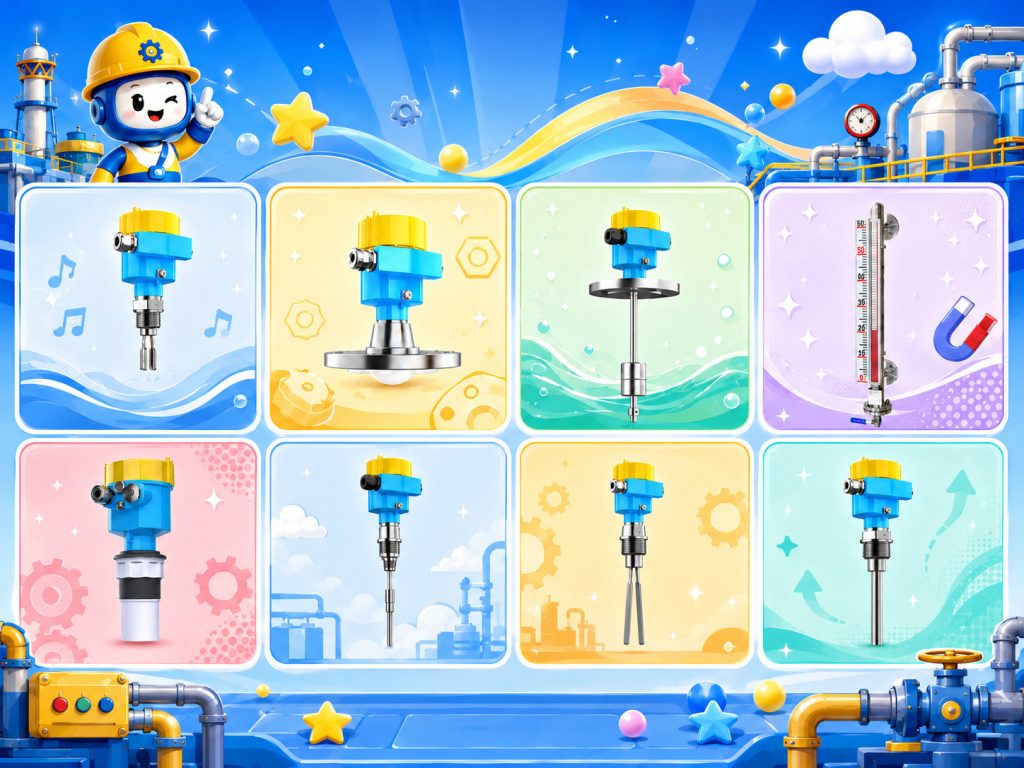
From radar level meters and ultrasonic level meters to magnetic level gauges, pressure level meters, float level meters, rotary paddle level switches, and tuning fork level switches, different instruments have different features and suit different working conditions.
When choosing a level meter, do not only ask, “How much does it cost?” More importantly, ask: What material are we measuring? Where will it be installed? What are the working conditions? What signal output is required? Do we need continuous measurement or alarm detection?
Choose correctly, and it becomes a reliable assistant.
Choose poorly, and it may accompany you every day in an industrial mystery drama starring inaccurate data.
So next time you pass by a large storage tank, silo, or pool, do not just see cold steel. Somewhere inside, a level meter may be quietly doing its job, like a reliable colleague who does not talk much but keeps watching the material level carefully, preventing the factory from being either “too full” or “too hungry.”
It may not be flashy, but it matters.
Because in industrial production, knowing “how much is left inside” is far more valuable than many people imagine.