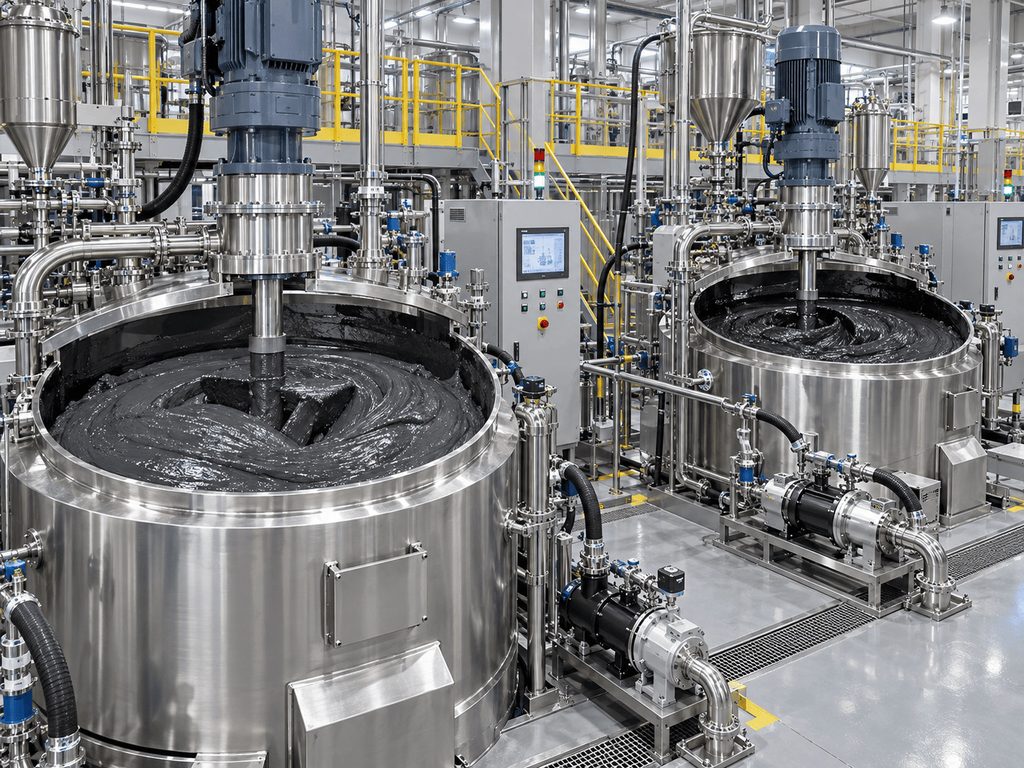
Cathode and anode slurry preparation is one of the most demanding liquid-level applications in lithium-ion battery manufacturing.
The material is not a simple liquid. It may contain active-material powder, conductive additive, binder, solvent, and other formulation components. During mixing, the material properties change as each component is added. The finished slurry can be viscous, coating, and strongly affected by agitation.
At the same time, the mixing tank may contain a large agitator, dispersing elements, internal pipes, and multiple feed points.
For these reasons, a level instrument for a battery slurry tank should be selected as part of the mixing system rather than as a generic tank accessory.
Why Measure Slurry Level?
Continuous level data can support several process functions.
During charging, it helps operators confirm that material additions are progressing as expected.
During mixing, it gives visibility into vessel working volume.
During transfer, it helps determine when sufficient material remains for downstream pumping.
It can also support high-level alarms, low-level alarms, batch records, and process trending.
The level signal is not a substitute for mass measurement where recipe accuracy depends on weighing. Instead, it provides an additional process variable that helps verify vessel condition and material movement.
Why Contact Measurement Can Be Difficult
A long probe inside a slurry mixer is exposed to product coating and strong mechanical conditions.
Sticky material can accumulate on the sensing element. Agitation can create forces on extended probes. Cleaning can become more difficult, and the probe may occupy valuable space inside the mixing zone.
A non-contact radar measures from the tank top and does not require a long immersed measuring element.
This reduces direct mechanical interaction with the slurry and can simplify the internal vessel design.
However, the radar antenna and process connection are still exposed to vapor, splash, and possible condensation, so installation design remains important.
Agitation and the Liquid Surface
A mixing tank surface may be far from flat.
The agitator can create waves, a central vortex, splashing, and local differences in level.
A radar measures the surface within its beam. The displayed value therefore depends on where that beam sees the slurry.
If the sensor is mounted directly over a deep vortex, the reading may not represent the average vessel level.
The mounting location should be selected with knowledge of the mixing pattern.
A vessel drawing is useful, but observation of an operating mixer can provide additional information about where the surface is most representative.
Internal Structures and False Echoes
Metal agitator shafts, support arms, baffles, feed pipes, and cleaning devices can reflect radar energy.
A narrow high-frequency radar beam helps reduce the number of internal components in the measurement path.
Even so, the radar should be mounted where it has a clear line of sight to the material surface.
During commissioning, fixed echoes can be identified and, where supported, false-echo suppression can be configured.
This feature should be used after good mechanical placement, not instead of it.
Viscosity and Coating
Slurry viscosity may change throughout the batch.
The surface can become smoother or more irregular, and splashing may change as the mixer speed or formulation changes.
A non-contact radar is less affected by bulk viscosity than an immersed mechanical sensing device because it is measuring the surface remotely.
The bigger concern is coating near the antenna.
If slurry is sprayed or splashed onto a deeply recessed nozzle, deposits may accumulate.
The process connection should therefore be as clean and open as practical. Long, narrow nozzles should be avoided unless they are specifically compatible with the radar antenna design.
Foam and Entrained Air
Some formulations may create foam or entrained air.
Foam can change the radar reflection.
The correct engineering question is not simply, “Can radar see through foam?” It is, “Which surface should the process measure, and what type of foam exists?”
If the process needs the top occupied height for overfill protection, the foam surface may matter. If the process needs liquid volume, the true slurry surface is more important.
Representative testing is valuable when foam is persistent or highly variable.
Changing Density
Radar level measurement does not calculate level from hydrostatic pressure, so changes in slurry density do not directly change the distance measurement in the same way they can affect a pressure-based level calculation.
This is useful in a mixing process where the composition changes during charging.
However, density still matters elsewhere in the process. If the control system converts level into mass, the conversion requires valid density data.
Do not confuse stable level measurement with direct mass measurement.
Selecting a Jiwei Radar
A compact 80 GHz radar can be useful for small and medium mixing tanks because the narrow beam can fit around internal structures.
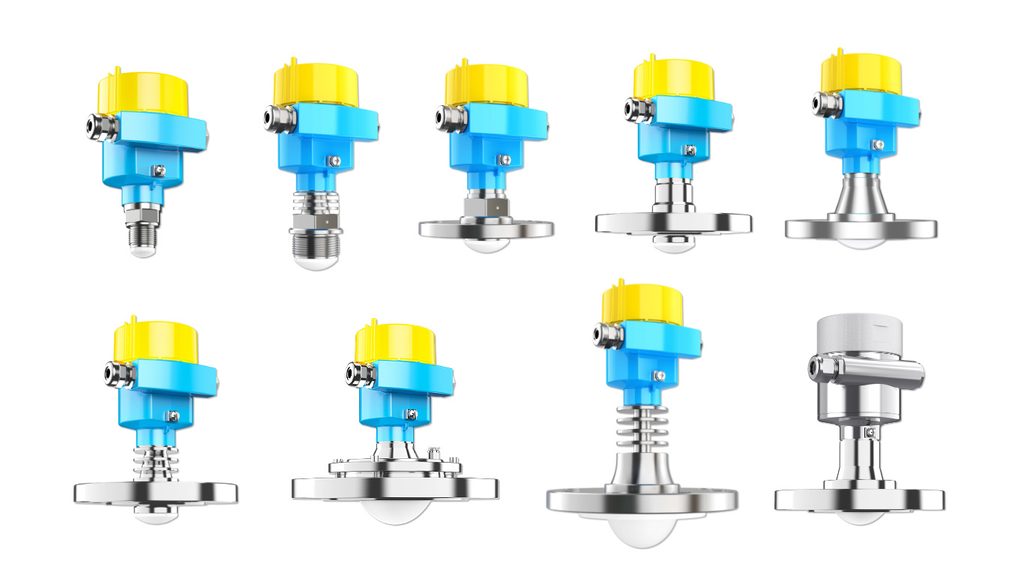
Jiwei JWrada-31 is intended for conventional liquid applications with compact process connections. Depending on tank size, temperature, pressure, chemical exposure, and process complexity, another JWrada model may be more appropriate.
Selection should consider total tank height, normal and maximum slurry level, nozzle diameter and length, agitator position, process temperature, pressure or vacuum, solvent vapor, hazardous-area classification, required process-facing materials, communication output, and cleaning method.
Add Independent High-Level Detection Where Required
A radar transmitter can generate high-level alarms in the control system.
For some tanks, the plant may also install a separate liquid tuning fork switch above the normal working range.
This device provides a discrete signal if the slurry reaches the switch.
A separate switch can be useful when the process team wants an independent high-level alarm or filling interlock.
The suitability of a tuning fork in slurry depends on viscosity, coating, solids content, and whether the fork can cleanly become uncovered after the level falls.
If the product forms a hard deposit, the point level technology should be reviewed carefully.
Low-Level Protection
Low-level detection can help protect transfer pumps.
A low switch should be located based on the pump suction arrangement and minimum usable volume, not simply at the geometric bottom of the tank.
The process team should consider vortexing, outlet position, heel volume, and whether the mixer remains operating during discharge.
In some systems, the continuous radar signal may be sufficient for low-level control. In others, a dedicated switch may be preferred.
Commissioning Procedure
A practical commissioning procedure should include several process states.
Empty or clean vessel
Record the initial echo profile and confirm the mechanical distance to the vessel bottom.
Partially filled vessel
Compare the radar reading with a known added volume or another trusted reference.
Mixer running
Observe how agitation changes the signal and level trend.
High-speed charging
Confirm that the instrument responds quickly enough and does not track the inlet stream.
Normal finished slurry
Verify behavior with the highest expected viscosity and solids content.
Cleaning cycle
Check whether wash liquid, spray, or condensation creates temporary false signals and whether the antenna area remains clean.
Signal Damping
Damping should be selected to match the process.
If the value is too heavily damped, the display may lag during fast charging.
If the damping is too low, normal surface turbulence may create a noisy trend.
The correct setting is the minimum filtering needed to provide a useful process signal while still following real changes.
Maintenance and Process Cleanliness
Battery material production may place strict limits on contamination.
The radar process connection should be selected so that it can be inspected and cleaned according to the plant’s procedures.
Housing and cable entry should be protected from dust, solvent vapor, and washdown conditions as required.
For any instrument installed on a high-purity process, confirm that materials, seals, surface finish, and cleaning methods meet the plant’s own specifications.
Typical System Architecture
A battery slurry mixing tank may use load cells or weighing for precise ingredient mass, radar for continuous level and vessel visibility, a high-level tuning fork for independent alarm, process pressure and temperature instruments, agitator speed feedback, and PLC or DCS logic for charging and transfer.
Each measurement answers a different process question.
A good control system does not ask the level transmitter to perform the job of a weighing system, nor does it ask a high-level switch to provide continuous inventory.
Conclusion
Battery slurry mixing tanks combine agitation, viscosity, changing composition, coating, internal metal structures, and sometimes foam or solvent vapor.
Non-contact radar is a strong candidate because it can provide continuous level without placing a long measuring probe in the slurry.
Reliable performance still depends on mounting position, vessel geometry, process connection, signal configuration, material compatibility, and verification under real mixing conditions.
Where the process requires additional protection, a separate point level switch can complement the radar transmitter.
FAQ
Does changing slurry density affect radar level measurement?
Radar measures distance to the surface rather than hydrostatic pressure, so density change does not directly change the distance calculation. Density still matters if level is converted into mass.
Can radar measure a vortexed slurry surface?
It can, but the mounting position should avoid looking directly into an extreme vortex. The sensor should view a representative part of the surface.
Will slurry coating affect the measurement?
Non-contact radar avoids an immersed probe, but buildup on the antenna or nozzle can still influence the signal. The connection should minimize splash and accumulation.
Is radar enough for overfill protection?
It can provide high-level alarms through the control system, but some applications use a separate point level switch for an independent alarm or interlock.