
1. What Is a Flow Meter? It Is Not Exactly a “Step Counter” for Pipes, But Close Enough
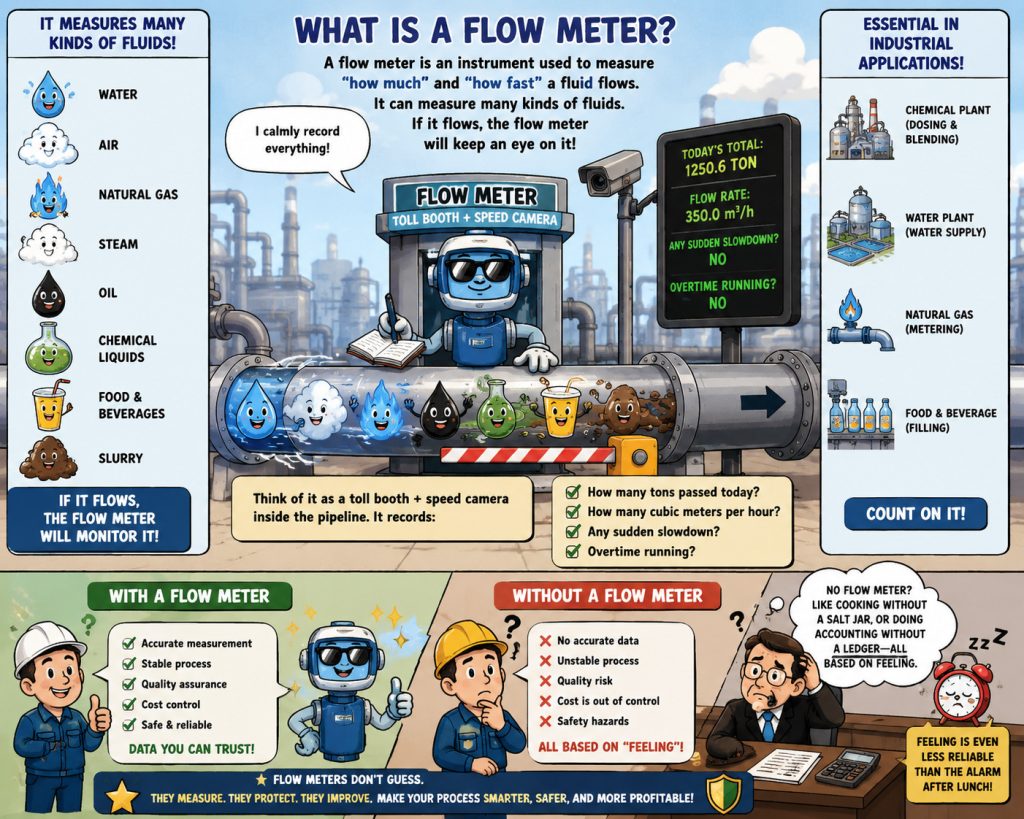
A flow meter, as the name suggests, is an instrument used to measure how much fluid flows and how fast it flows. The word “fluid” here does not only refer to water. It can also mean air, natural gas, steam, petroleum, chemical liquids, food and beverages, or even slurry. As long as something can flow, a flow meter may be interested in keeping an eye on it.
You can think of a flow meter as a “toll station plus speed camera” installed inside a pipeline. When water, gas, or oil passes through the pipe, the flow meter calmly records: How many tons passed today? How many cubic meters per hour? Is the flow suddenly slowing down? Is it secretly working overtime?
In industrial production, flow meters are extremely important. Chemical plants need them for ingredient dosing, water treatment plants rely on them for water supply, natural gas measurement depends on them, and beverage filling lines cannot live without them. Without flow meters, an industrial site would be like a chef cooking without checking the salt, or a business owner doing accounting without looking at the books. Everything would depend on “gut feeling.” Unfortunately, in industrial production, gut feeling is often less reliable than an alarm clock after lunch break.
2. Why Do We Need Flow Meters? Because Fluids Do Not Write Daily Reports
Many people may wonder: if something flows through a pipe, why bother measuring it? The reason is simple. In industrial systems, flow is directly related to cost, quality, safety, and efficiency.
For example, a water company needs to know how much water it has supplied. It cannot simply send an employee to stand next to a pipe and make a wish. A natural gas company needs to charge customers based on consumption. It cannot say, “This household looks pretty cold, so they probably used a lot.” In chemical production, if the ratio of two raw materials is slightly off, the final product may go from “qualified product” to “mysterious liquid.”
The main functions of a flow meter include:
First, measurement and billing. In trade settlement for water, gas, oil, and other fluids, flow meters are directly connected to money.
Second, process control. Many production processes require stable flow, and flow meters provide real-time data to the control system.
Third, safety monitoring. A sudden abnormal flow may indicate blockage, leakage, pump failure, or valve problems.
Fourth, energy saving and cost reduction. Only when you know where consumption is high can you know where to save. Otherwise, energy saving is like losing weight without weighing yourself, relying entirely on your waistband for emotional support.
3. How Does a Flow Meter Work? How Does It Know How Much Has Passed?
Different types of flow sensors work in different ways, but their goal is the same: to turn invisible and hard-to-judge flow conditions into clear numerical data.
There are several common measurement ideas.
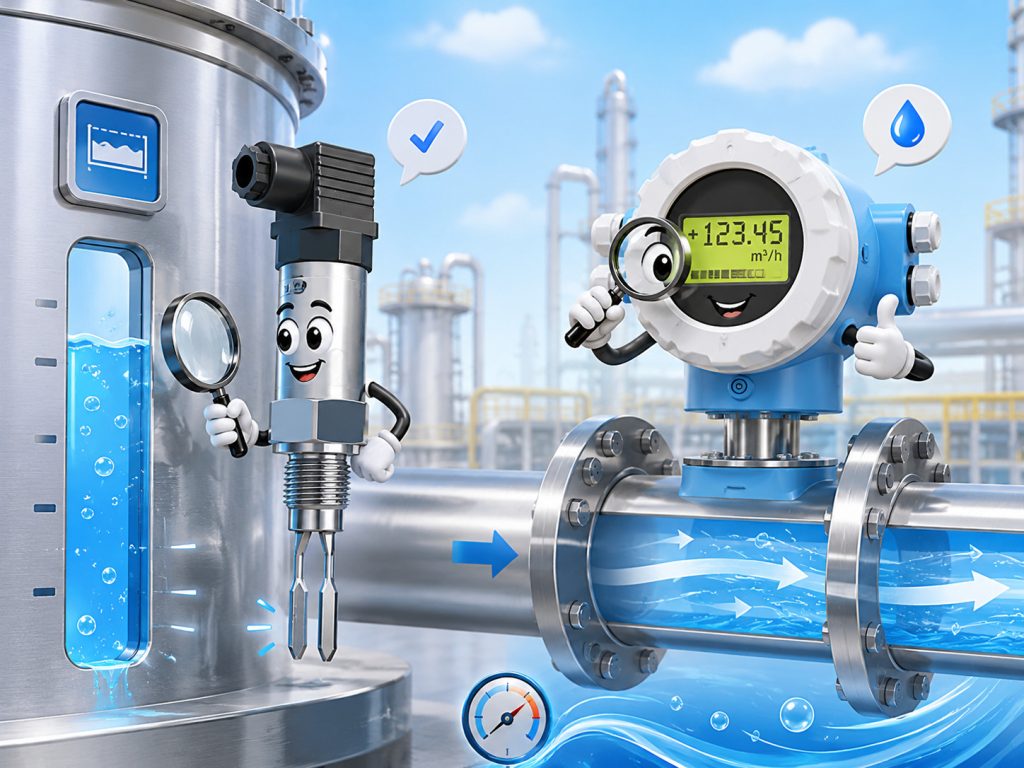
One method is to measure differential pressure. When fluid passes through a throttling device, the pressure before and after the device changes. Generally speaking, the greater the pressure difference, the higher the flow rate. Orifice plate flow meters and Venturi flow meters belong to this category. They act like checkpoints inside the pipeline, judging flow by observing how the fluid behaves when passing through.
Another method is to measure velocity. Once the flow velocity is known, multiplying it by the cross-sectional area of the pipe gives the volume flow rate. Electromagnetic flow meters, ultrasonic flow meters, turbine flow meters, and many others are related to velocity measurement.
Another approach is to measure mass directly. Coriolis mass flow sensors can directly measure mass flow. They are advanced, accurate, and, let us be honest, usually not cheap. They do not care much about whether the fluid is “fat or thin,” hot or cold. What they care about is exactly how much mass has passed through. In the world of flow meters, they are like the honor student who also happens to be an electronic scale.
For gases, there are also thermal mass flow sensors. They determine gas flow by measuring heat loss. It is a little like judging wind strength by feeling how cool the breeze is on your face, except that the instrument is much more reliable than your face.
4. Common Types of Flow Meters: Different Schools in the Pipeline World
1. Electromagnetic Flow Meter: The Best Friend of Conductive Liquids
Electromagnetic flow meters are suitable for conductive liquids, such as tap water, wastewater, acid and alkali solutions, and saltwater. Their principle is based on Faraday’s law of electromagnetic induction: when a conductive liquid flows through a magnetic field, it generates an induced voltage, and the magnitude of that voltage is related to flow velocity.
Its advantages are clear. It has no obvious obstruction inside the pipe, causes little pressure loss, and is suitable for wastewater, corrosive liquids, and liquids containing particles. Its limitation is also clear: it cannot measure non-conductive media, such as oil, pure water, or gas. Its friendship standard is very direct: not conductive? Sorry, we do not know each other.
2. Turbine Flow Meter: Let the Little Wheel Spin
A turbine flow sensor has a rotor inside. When fluid passes through, it pushes the rotor to spin. The faster it spins, the higher the flow rate. This type is often used for clean liquids or gases, offering relatively high accuracy and fast response.
However, it also has a temper. The medium should not be too dirty, otherwise the rotor may wear out or get stuck. It is like a hardworking but sensitive colleague: very capable, but please do not pour sand on their desk.
3. Vortex Flow Meter: Counting Swirls Like a Professional
A vortex flow sensor uses the Kármán vortex street principle. When fluid flows past a bluff body, vortices are generated alternately. The higher the flow velocity, the higher the vortex frequency. The instrument calculates flow by detecting this vortex frequency.
Vortex flow meters are commonly used for steam, gases, and liquids. They have a relatively simple structure, no moving parts, and low maintenance requirements. However, they are not very friendly to low flow rates and are sensitive to vibration. If the site vibrates like a speaker at a public square dance, the meter may become a little confused.
4. Ultrasonic Flow Meter: Measuring Flow by Listening to Sound
An ultrasonic flow sensor measures flow by analyzing changes in ultrasonic wave transmission through the fluid. Common methods include transit-time and Doppler measurement. One major advantage is that it can be designed as a clamp-on device, meaning no pipe cutting, no shutdown, and convenient installation.
A clamp-on ultrasonic flow sensor is like giving a pipe an ultrasound scan. There is no need for surgery, but you can still know what is happening inside. It is suitable for large pipe diameters, temporary testing, and situations where drilling or cutting the pipe is inconvenient. However, the installation position, pipe material, and medium condition can affect measurement performance.
5. Coriolis Mass Flow Meter: Highly Accurate, But Your Wallet May Go Silent
A Coriolis mass flow meter can directly measure mass flow and can often measure density, temperature, and other parameters at the same time. It offers high accuracy and is widely used in petroleum, chemical, food, and pharmaceutical industries.
Its advantage is that it is powerful. Its disadvantage is that the price is often powerful too. When buying one, the boss may take three deep breaths and ask, “Besides measuring flow, can it also make PowerPoint slides?”
6. Rotameter: A Simple and Straightforward Old Friend
A rotameter, also known as a variable area flow meter or float flow sensor, is often used in laboratories and small-flow applications. There is a float inside a transparent tube. The greater the flow, the higher the float rises, making the reading very intuitive.
It has a simple structure and friendly price, but its accuracy and automation capability are limited. It is suitable for simple working conditions, limited budgets, and situations where on-site visual reading is needed. It is like the thermometer of the flow meter world: not necessarily the smartest, but easy to understand at a glance.
5. How to Select a Flow Meter? Do Not Ask Only About Price; Ask About the Working Conditions First
Many people begin flow sensor selection by asking, “How much does it cost?” That is like buying shoes by asking only the price and not the size. In the end, the shoes either squeeze your feet or fly off when you walk.
Flow meter selection should consider several key factors.
First, consider what the medium is. Is it water, oil, gas, steam, or corrosive liquid? Is it conductive? Does it contain particles? Is it prone to crystallization? These factors determine which types of flow meters are suitable.
Second, consider the flow range. You need to know the minimum flow, normal operating flow, and maximum flow. A flow meter should not operate for long periods at extremely low or extremely high ranges, otherwise measurement performance may suffer.
Third, consider temperature and pressure. High-temperature steam, high-pressure gas, and low-temperature liquid all require suitable materials and structures. Do not ask an ordinary instrument to survive extreme working conditions. That is not dedication; that is bullying.
Fourth, consider the accuracy requirement. Trade settlement and dosing control usually require high accuracy. General monitoring may allow a lower accuracy level. Higher accuracy usually means higher cost. Not every application needs a “PhD-level” instrument. Sometimes an “undergraduate-level” one is perfectly enough.
Fifth, consider the installation conditions. Is there enough straight pipe length? Is the pipe full? Is there strong vibration? Is shutdown possible for installation? These conditions all affect the stability of the flow meter.
Sixth, consider the maintenance cost. Some instruments are cheap to buy but troublesome to maintain. Others require higher initial investment but are easier to manage later. When selecting a flow sensor, do not look only at the purchase price. Consider the total lifecycle cost. A cheap instrument that needs repairs every week may end up being more expensive than a premium one, and it may also give maintenance staff a free pair of dark circles under their eyes.
6. Flow Meter Installation Tips: Poor Installation Can Ruin Even an Expensive Meter
A flow sensor is not something you simply buy, slap onto a pipe, and call it a day. If installation is not done properly, even a high-end meter may turn into a random number generator.
Many flow sensors require straight pipe sections before and after the meter to ensure stable flow. If there is an elbow, valve, or pump outlet right upstream, the flow profile may be turbulent, and the readings may fluctuate. It is like asking someone to measure their resting heart rate immediately after running 800 meters. Of course the number will be excited.
Electromagnetic flow sensors require proper grounding, especially when measuring conductive liquids. Poor grounding may cause signal interference. Ultrasonic flow meters require attention to sensor position and coupling quality. Vortex flow sensors should be kept away from strong vibration. When measuring steam, pressure and temperature compensation should also be considered, otherwise volume flow and mass flow may start telling two different stories.
In addition, the pipe should be kept full as much as possible. This is especially important for electromagnetic flow sensors. If the pipe is half filled with water and half filled with air, the meter may have an existential crisis: are you asking me to measure water, or to measure loneliness?
7. Common Flow Meter Problems: It May Not Be Broken; You May Just Not Understand It Yet
There are many common flow sensor issues in the field, and many of them are not caused by instrument failure. Instead, they may result from working conditions, installation problems, or incorrect parameter settings.
For example, unstable readings may be caused by unstable flow itself, pump pulsation, bubbles, vibration, or electromagnetic interference.
No flow display may be caused by sensor wiring issues, power supply problems, unsuitable medium conditions, or simply because the valve is not open.
Large measurement deviation may be caused by incorrect meter size, unreasonable range settings, insufficient straight pipe length, or wrong medium parameters.
If the meter fails shortly after installation, the reason may be corrosion, severe wear, or underestimated site conditions during selection.
So, when a problem occurs, do not immediately blame the flow sensor. It is only an instrument. It does not slack off on purpose, and it certainly does not take revenge. Most of the time, it is simply using numbers to tell you: “The actual site condition is not what you imagined.”
8. Development Trends of Flow Meters: Smarter and More Connected
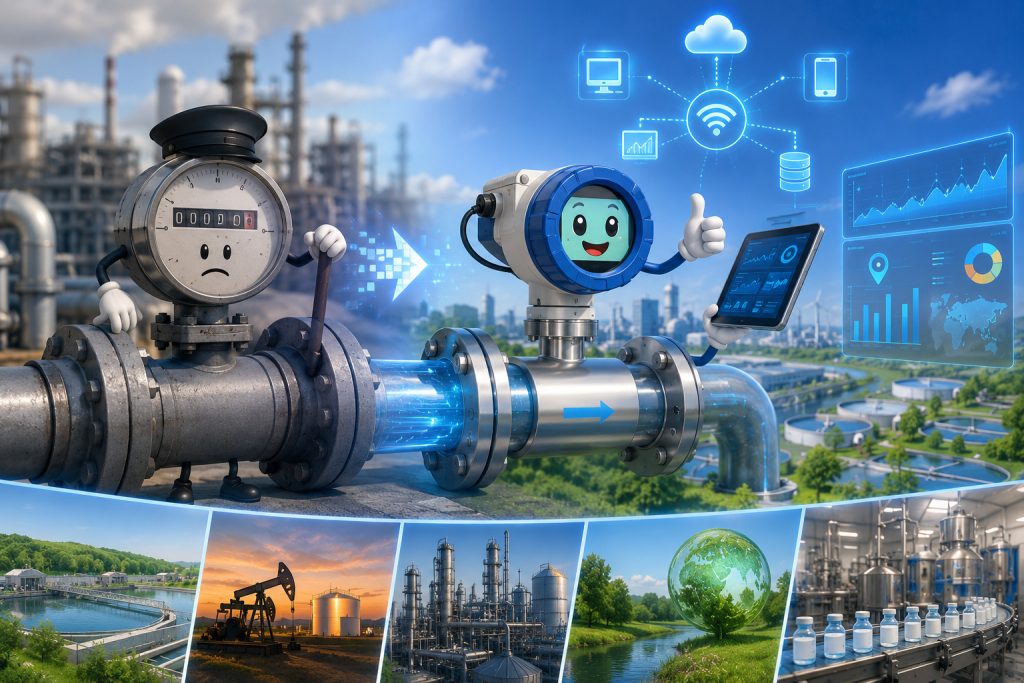
With the development of industrial automation and smart manufacturing, flow meters are no longer just lonely indicators mounted on pipelines. Many modern smart flow meters support digital communication, remote monitoring, fault diagnosis, data logging, and system integration.
In the past, a flow sensor was like a gatekeeper who could only report numbers: “I know how much has passed.”
Today, a smart flow meter is more like a data-savvy administrator: “I know how much has passed, when the abnormality happened, where the problem may be, and whether an alarm is needed.”
In water treatment, energy, chemical, environmental protection, food, and pharmaceutical industries, smart flow sensors are helping companies improve measurement accuracy, reduce manual inspection costs, and optimize production processes. Especially under the trends of energy saving, emission reduction, and refined management, flow data is becoming increasingly valuable.
9. Conclusion: Choose the Right Flow Meter, and Your Pipeline Will Tell the Truth
Although a flow sensor may look like just another instrument on a pipeline, it is closely connected to production efficiency, product quality, energy cost, and operational safety. Whether it is a liquid flow meter, gas flow meter, or steam flow sensor, there is no single “universal model.” A reliable flow meter selection must consider the medium, flow range, temperature and pressure, accuracy requirements, installation environment, and maintenance cost.
In one sentence: the best flow meter is not necessarily the most expensive one, nor is it the cheapest one. The best flow meter is the one that fits the application.
If industrial pipelines are like blood vessels, then flow meters are like health-check instruments. They may not receive attention every day, but at critical moments, they can tell you whether the system is healthy. Do not wait until flow becomes abnormal, costs rise, and product quality collapses before remembering this quiet “digital detective” standing beside the pipe.
Choose the right flow meter, and let every drop of water, every cubic meter of gas, and every ton of oil give an honest account of itself. After all, in industrial production, fluids may flow freely, but data should never be vague.1. What Is a Flow Meter? It Is Not Exactly a “Step Counter” for Pipes, But Close Enough
A flow meter, as the name suggests, is an instrument used to measure how much fluid flows and how fast it flows. The word “fluid” here does not only refer to water. It can also mean air, natural gas, steam, petroleum, chemical liquids, food and beverages, or even slurry. As long as something can flow, a flow meter may be interested in keeping an eye on it.
You can think of a flow meter as a “toll station plus speed camera” installed inside a pipeline. When water, gas, or oil passes through the pipe, the flow meter calmly records: How many tons passed today? How many cubic meters per hour? Is the flow suddenly slowing down? Is it secretly working overtime?
In industrial production, flow meters are extremely important. Chemical plants need them for ingredient dosing, water treatment plants rely on them for water supply, natural gas measurement depends on them, and beverage filling lines cannot live without them. Without flow meters, an industrial site would be like a chef cooking without checking the salt, or a business owner doing accounting without looking at the books. Everything would depend on “gut feeling.” Unfortunately, in industrial production, gut feeling is often less reliable than an alarm clock after lunch break.
2. Why Do We Need Flow Meters? Because Fluids Do Not Write Daily Reports
Many people may wonder: if something flows through a pipe, why bother measuring it? The reason is simple. In industrial systems, flow is directly related to cost, quality, safety, and efficiency.
For example, a water company needs to know how much water it has supplied. It cannot simply send an employee to stand next to a pipe and make a wish. A natural gas company needs to charge customers based on consumption. It cannot say, “This household looks pretty cold, so they probably used a lot.” In chemical production, if the ratio of two raw materials is slightly off, the final product may go from “qualified product” to “mysterious liquid.”
The main functions of a flow meter include:
First, measurement and billing. In trade settlement for water, gas, oil, and other fluids, flow meters are directly connected to money.
Second, process control. Many production processes require stable flow, and flow meters provide real-time data to the control system.
Third, safety monitoring. A sudden abnormal flow may indicate blockage, leakage, pump failure, or valve problems.
Fourth, energy saving and cost reduction. Only when you know where consumption is high can you know where to save. Otherwise, energy saving is like losing weight without weighing yourself, relying entirely on your waistband for emotional support.
3. How Does a Flow Meter Work? How Does It Know How Much Has Passed?
Different types of flow meters work in different ways, but their goal is the same: to turn invisible and hard-to-judge flow conditions into clear numerical data.
There are several common measurement ideas.
One method is to measure differential pressure. When fluid passes through a throttling device, the pressure before and after the device changes. Generally speaking, the greater the pressure difference, the higher the flow rate. Orifice plate flow meters and Venturi flow meters belong to this category. They act like checkpoints inside the pipeline, judging flow by observing how the fluid behaves when passing through.
Another method is to measure velocity. Once the flow velocity is known, multiplying it by the cross-sectional area of the pipe gives the volume flow rate. Electromagnetic flow meters, ultrasonic flow meters, turbine flow meters, and many others are related to velocity measurement.
Another approach is to measure mass directly. Coriolis mass flow meters can directly measure mass flow. They are advanced, accurate, and, let us be honest, usually not cheap. They do not care much about whether the fluid is “fat or thin,” hot or cold. What they care about is exactly how much mass has passed through. In the world of flow meters, they are like the honor student who also happens to be an electronic scale.
For gases, there are also thermal mass flow meters. They determine gas flow by measuring heat loss. It is a little like judging wind strength by feeling how cool the breeze is on your face, except that the instrument is much more reliable than your face.
4. Common Types of Flow Meters: Different Schools in the Pipeline World
1. Electromagnetic Flow Meter: The Best Friend of Conductive Liquids
Electromagnetic flow meters are suitable for conductive liquids, such as tap water, wastewater, acid and alkali solutions, and saltwater. Their principle is based on Faraday’s law of electromagnetic induction: when a conductive liquid flows through a magnetic field, it generates an induced voltage, and the magnitude of that voltage is related to flow velocity.
Its advantages are clear. It has no obvious obstruction inside the pipe, causes little pressure loss, and is suitable for wastewater, corrosive liquids, and liquids containing particles. Its limitation is also clear: it cannot measure non-conductive media, such as oil, pure water, or gas. Its friendship standard is very direct: not conductive? Sorry, we do not know each other.
2. Turbine Flow Meter: Let the Little Wheel Spin
A turbine flow meter has a rotor inside. When fluid passes through, it pushes the rotor to spin. The faster it spins, the higher the flow rate. This type is often used for clean liquids or gases, offering relatively high accuracy and fast response.
However, it also has a temper. The medium should not be too dirty, otherwise the rotor may wear out or get stuck. It is like a hardworking but sensitive colleague: very capable, but please do not pour sand on their desk.
3. Vortex Flow Meter: Counting Swirls Like a Professional
A vortex flow meter uses the Kármán vortex street principle. When fluid flows past a bluff body, vortices are generated alternately. The higher the flow velocity, the higher the vortex frequency. The instrument calculates flow by detecting this vortex frequency.
Vortex flow meters are commonly used for steam, gases, and liquids. They have a relatively simple structure, no moving parts, and low maintenance requirements. However, they are not very friendly to low flow rates and are sensitive to vibration. If the site vibrates like a speaker at a public square dance, the meter may become a little confused.
4. Ultrasonic Flow Meter: Measuring Flow by Listening to Sound
An ultrasonic flow meter measures flow by analyzing changes in ultrasonic wave transmission through the fluid. Common methods include transit-time and Doppler measurement. One major advantage is that it can be designed as a clamp-on device, meaning no pipe cutting, no shutdown, and convenient installation.
A clamp-on ultrasonic flow meter is like giving a pipe an ultrasound scan. There is no need for surgery, but you can still know what is happening inside. It is suitable for large pipe diameters, temporary testing, and situations where drilling or cutting the pipe is inconvenient. However, the installation position, pipe material, and medium condition can affect measurement performance.
5. Coriolis Mass Flow Meter: Highly Accurate, But Your Wallet May Go Silent
A Coriolis mass flow meter can directly measure mass flow and can often measure density, temperature, and other parameters at the same time. It offers high accuracy and is widely used in petroleum, chemical, food, and pharmaceutical industries.
Its advantage is that it is powerful. Its disadvantage is that the price is often powerful too. When buying one, the boss may take three deep breaths and ask, “Besides measuring flow, can it also make PowerPoint slides?”
6. Rotameter: A Simple and Straightforward Old Friend
A rotameter, also known as a variable area flow meter or float flow meter, is often used in laboratories and small-flow applications. There is a float inside a transparent tube. The greater the flow, the higher the float rises, making the reading very intuitive.
It has a simple structure and friendly price, but its accuracy and automation capability are limited. It is suitable for simple working conditions, limited budgets, and situations where on-site visual reading is needed. It is like the thermometer of the flow meter world: not necessarily the smartest, but easy to understand at a glance.
5. How to Select a Flow Meter? Do Not Ask Only About Price; Ask About the Working Conditions First
Many people begin flow meter selection by asking, “How much does it cost?” That is like buying shoes by asking only the price and not the size. In the end, the shoes either squeeze your feet or fly off when you walk.
Flow meter selection should consider several key factors.
First, consider what the medium is. Is it water, oil, gas, steam, or corrosive liquid? Is it conductive? Does it contain particles? Is it prone to crystallization? These factors determine which types of flow meters are suitable.
Second, consider the flow range. You need to know the minimum flow, normal operating flow, and maximum flow. A flow meter should not operate for long periods at extremely low or extremely high ranges, otherwise measurement performance may suffer.
Third, consider temperature and pressure. High-temperature steam, high-pressure gas, and low-temperature liquid all require suitable materials and structures. Do not ask an ordinary instrument to survive extreme working conditions. That is not dedication; that is bullying.
Fourth, consider the accuracy requirement. Trade settlement and dosing control usually require high accuracy. General monitoring may allow a lower accuracy level. Higher accuracy usually means higher cost. Not every application needs a “PhD-level” instrument. Sometimes an “undergraduate-level” one is perfectly enough.
Fifth, consider the installation conditions. Is there enough straight pipe length? Is the pipe full? Is there strong vibration? Is shutdown possible for installation? These conditions all affect the stability of the flow meter.
Sixth, consider the maintenance cost. Some instruments are cheap to buy but troublesome to maintain. Others require higher initial investment but are easier to manage later. When selecting a flow meter, do not look only at the purchase price. Consider the total lifecycle cost. A cheap instrument that needs repairs every week may end up being more expensive than a premium one, and it may also give maintenance staff a free pair of dark circles under their eyes.
6. Flow Meter Installation Tips: Poor Installation Can Ruin Even an Expensive Meter
A flow meter is not something you simply buy, slap onto a pipe, and call it a day. If installation is not done properly, even a high-end meter may turn into a random number generator.
Many flow meters require straight pipe sections before and after the meter to ensure stable flow. If there is an elbow, valve, or pump outlet right upstream, the flow profile may be turbulent, and the readings may fluctuate. It is like asking someone to measure their resting heart rate immediately after running 800 meters. Of course the number will be excited.
Electromagnetic flow meters require proper grounding, especially when measuring conductive liquids. Poor grounding may cause signal interference. Ultrasonic flow meters require attention to sensor position and coupling quality. Vortex flow meters should be kept away from strong vibration. When measuring steam, pressure and temperature compensation should also be considered, otherwise volume flow and mass flow may start telling two different stories.
In addition, the pipe should be kept full as much as possible. This is especially important for electromagnetic flow meters. If the pipe is half filled with water and half filled with air, the meter may have an existential crisis: are you asking me to measure water, or to measure loneliness?
7. Common Flow Meter Problems: It May Not Be Broken; You May Just Not Understand It Yet
There are many common flow meter issues in the field, and many of them are not caused by instrument failure. Instead, they may result from working conditions, installation problems, or incorrect parameter settings.
For example, unstable readings may be caused by unstable flow itself, pump pulsation, bubbles, vibration, or electromagnetic interference.
No flow display may be caused by sensor wiring issues, power supply problems, unsuitable medium conditions, or simply because the valve is not open.
Large measurement deviation may be caused by incorrect meter size, unreasonable range settings, insufficient straight pipe length, or wrong medium parameters.
If the meter fails shortly after installation, the reason may be corrosion, severe wear, or underestimated site conditions during selection.
So, when a problem occurs, do not immediately blame the flow meter. It is only an instrument. It does not slack off on purpose, and it certainly does not take revenge. Most of the time, it is simply using numbers to tell you: “The actual site condition is not what you imagined.”
8. Development Trends of Flow Meters: Smarter and More Connected
With the development of industrial automation and smart manufacturing, flow meters are no longer just lonely indicators mounted on pipelines. Many modern smart flow meters support digital communication, remote monitoring, fault diagnosis, data logging, and system integration.
In the past, a flow meter was like a gatekeeper who could only report numbers: “I know how much has passed.”
Today, a smart flow meter is more like a data-savvy administrator: “I know how much has passed, when the abnormality happened, where the problem may be, and whether an alarm is needed.”
In water treatment, energy, chemical, environmental protection, food, and pharmaceutical industries, smart flow meters are helping companies improve measurement accuracy, reduce manual inspection costs, and optimize production processes. Especially under the trends of energy saving, emission reduction, and refined management, flow data is becoming increasingly valuable.
9. Conclusion: Choose the Right Flow Meter, and Your Pipeline Will Tell the Truth
Although a flow meter may look like just another instrument on a pipeline, it is closely connected to production efficiency, product quality, energy cost, and operational safety. Whether it is a liquid flow meter, gas flow meter, or steam flow meter, there is no single “universal model.” A reliable flow meter selection must consider the medium, flow range, temperature and pressure, accuracy requirements, installation environment, and maintenance cost.
In one sentence: the best flow meter is not necessarily the most expensive one, nor is it the cheapest one. The best flow meter is the one that fits the application.
If industrial pipelines are like blood vessels, then flow meters are like health-check instruments. They may not receive attention every day, but at critical moments, they can tell you whether the system is healthy. Do not wait until flow becomes abnormal, costs rise, and product quality collapses before remembering this quiet “digital detective” standing beside the pipe.
Choose the right flow meter, and let every drop of water, every cubic meter of gas, and every ton of oil give an honest account of itself. After all, in industrial production, fluids may flow freely, but data should never be vague.